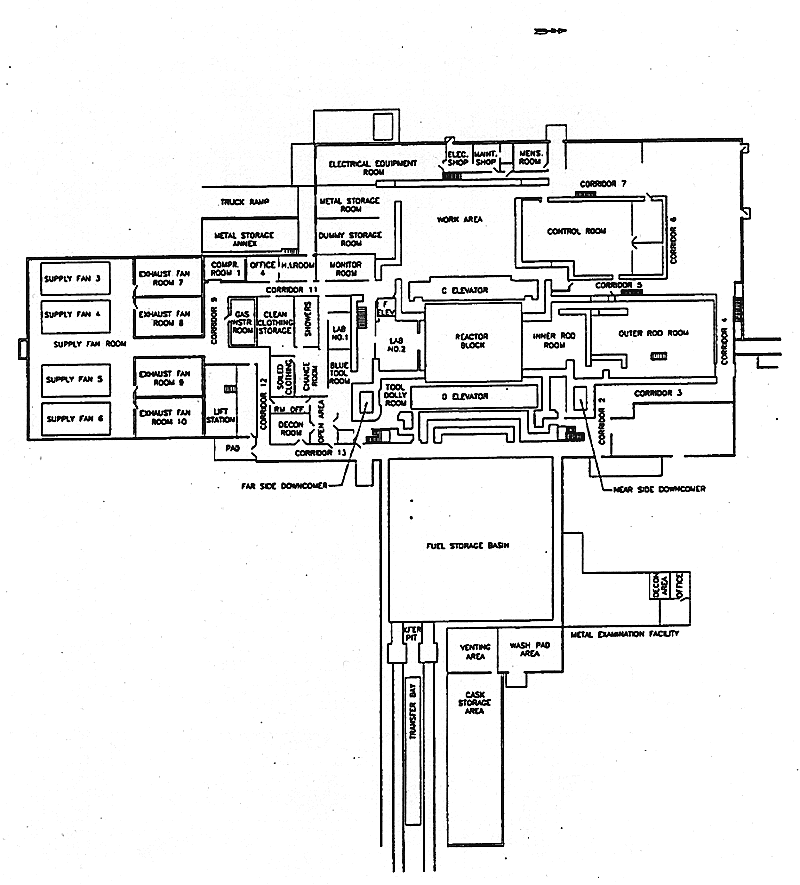
Fig. 1. Floor plan layout of the 105
facility at ground level.
Tomas J. Rodovsky
Bechtel
ABSTRACT
The 105-C production reactor at the Hanford Site in Washington State will be placed into interim safe storage for up to 75 years. The 105-C reactor will be one of the first plutonium producing reactors, used in the cold war, to be decommissioned in the entire (DOE) Department of Energy complex. Extraneous structures outside the reactor shield walls will be decontaminated; waste will be removed; and the external structures will be demolished, leaving the shield walls as final containment for the reactor block for the safe storage period. After all contamination is removed or stabilized in underlying areas, a new stainless steel roof will be built. The design criteria reflects the construction, demolition, and decontamination and decommissioning (D&D) effort overall. The existing reactor shield walls will act as containment and will provide structural stability during the D&D and safe storage period.
The 105-C Reactor project will also include a large scale decommissioning technology demonstration for the U.S. Department of Energy (EM-50) and will demonstrate a variety of new, innovative, and previously overlooked technologies. The incorporation of innovative technologies into safety assessments, scheduling and work procedures has also created new challenges from the standpoint of design criteria.
The original design and construction of 105-C was undertaken on a "no-delay" basis in response to the international tension of the Cold War. Design started in March 1951 and construction began on June 6, 1951. Initial startup of 105-C was achieved on November 18, 1952, only 17months after groundbreaking activities. The overall building requirements, for the most part, are more stringent now for the interim safe storage than during the time of actual operations, which poses several challenges in developing the design criteria for the interim safe storage. The facility will undergo continuous configuration changes during both the D&D operations and technology demonstrations and the sequence of these activities will need to ensure that the integrity of the structure will be maintained at all times in accordance with the design criteria.
The paper will provide insight into the process and the decisions needed to generate the new design criteria for the interim safe storage to comply with all requirements.
INTRODUCTION
In 1942, the Hanford Site, located in the southeastern portion of Washington State, was commissioned by the U. S. Government for the production of plutonium for weapons use. Between 1942 and 1955, eight water-cooled, graphite moderated production reactors were constructed along the Columbia River in the 100 Area of the Hanford Site. Design of the 105-C Reactor was started in March 1951 and construction was initiated on June 6, 1951. Initial startup was achieved on November 18, 1952, 17 months after ground breaking. The design of the facility was based on the earlier Hanford reactors, and drawings of the older facilities were modified to form the design drawings for the 105-C facility.
The 105-C Reactor was shut down on April 25, 1969, approximately 28 years ago, and since then has been in a condition of minimum surveillance and maintenance. Several areas of the facility are in an advanced state of deterioration, particularly the roof sections over the fan room and work area. Safe storage activities for the reactor building have consisted of short-term actions adequate to protect the workers and the environment, and are not considered adequate to ensure stabilized, long-term storage.
Viable, permanent decommissioning alternatives for the Hanford production reactors were assessed in the Draft Environmental Impact Statement, Decommissioning of the Eight Surplus Production Reactors at the Hanford Site (1). The alternatives considered were no action, immediate one-piece removal, safe storage followed by deferred one-piece removal, safe storage followed by deferred dismantlement, in situ decommissioning, and immediate dismantlement. The alternative selected as the preferred alternative in the Record of Decision (ROD) (2) is the safe storage followed by deferred one-piece removal.
To facilitate the engineering and planning tasks for the Interim Safe Storage (ISS) Project, the facility has been divided into two modules. Module I includes all portions of the facility outside the shield walls. Module 2 includes the shield walls and all portions inside of the walls. Figure 1 shows a ground level floor plan of the facility.
Fig. 1. Floor plan layout of the 105
facility at ground level.
PROJECT SCOPE
Hazard Classification
The majority of the radiological inventory was found in the fuel storage basin and reactor block. The fuel storage basin was cleaned out during deactivation activities and most surface contamination was stabilized. Sediment from the floor and walls of the basin was placed in the cask transfer pits. About 50 metric tons of sediment remains in the transfer pits. Some transuranics are present in these pits, but the waste inventory is not considered transuranic as defined in DOE Order 5820.2A (3) for transuranic waste. Most of the reactor block radiological inventory exists in the graphite stack and thermal shield. Isotopes such as 3H, 14C, 60Co and 63Ni are incorporated into the massive reactor block matrix. Release of material is unlikely, taking into consideration various accident scenarios, such as a load drop due to thickness of the biological shield (84 in.), thermal shield (10 in.) and graphite structure. The rest of the facility has various locations where surface decontamination will be conducted, waste will be disposed of, and equipment will be removed.
The Preliminary Hazards Classification (PHC) did not consider the material form, location, dispersability and interaction with available energy sources The Final Hazards Classification (FHC) would take these things into consideration. The PHC listed and compared the radioactive and hazardous constituents with reportable quantities and threshold values. The PHC for the 105-C facility resulted in a Nuclear Category 3 classification.
A classification of Radiological was approved by the DOE for the FHC as per DOE-EM-STD-5502-94 (4) and Ref. 5 and 6. The FHC takes into consideration material form, location, dispersability, and interaction with available energy sources. Along with the FHC, an Auditable Safety Analysis (ASA) was performed that analyzed possible accident scenarios. Various external and internal accidental events were taken into consideration. Internal events included: fire or explosion, heavy load drop into the transfer pits and reactor block, nuclear criticality, loss of ventilation, loss of electrical power, and decontamination and demolition activities. External events included: events from adjacent facilities, wind/tornado, flood, and volcanic activity and earthquakes. Many of these natural events were evaluated by the Draft Environmental Impact Statement (11). The FHC analyzed three accident scenarios and assessed unmitigated releases resulting from these actions. The events analyzed were a seismic event, a heavy load drop into the fuel storage basin transfer pit, and a fire in the fuel storage basin area.
The most consequential hazard event scenario was an unmitigated release from a fire during the D&D phase. The release would be equivalent to a dosage of 4.2 rem at 30 meters from the facility. Since the calculated dose is less than 10 rem, the 105-C is classified as a Radiological facility.
Decontamination and Equipment Removal
The decontamination of contaminated systems, equipment, and structures is required to prepare the reactor building for interim safe storage. The reactor block will be encapsulated to prevent spread of contamination and to facilitate future one-piece removal of the reactor block. To ensure activities are performed safely and efficiently, D&D activities must follow a prescribed sequence that conforms to established standards followed by Bechtel Hanford, Incorporated (BHI). A release survey shall necessitate a thorough and verifiable radiological survey of all areas before releasing areas outside the SSE (Safe Storage Enclosure) for unrestricted use.
Table I Decontamination Methods/Types.
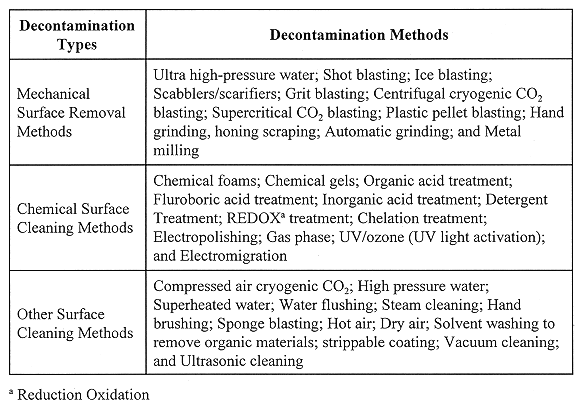
Due to the large variety of equipment, structures, and tools to decontaminate, various methods will be used as deemed necessary. All decontamination efforts for the 105-C Reactor facility will be limited to surface or near-surface decontamination. Decontamination methods (Table I) will be dependent on the extent that item needs to be decontaminated, accessibility safety, and other logical factors. Choice of the proper cleaning method(s) for particular areas and items are explained in more detail in the definitive design report (7).
An EE/CA (Engineering Evaluation/Cost Analysis) was prepared in accordance with the requirements of CERCLA and 40 CFR 300.415 (8) and is intended to aid in selecting a preferred removal action. Only the waste generated from the 105-C ISS Project will be conducted under the CERCLA process. The control and management of the radiological, hazardous, and mixed-waste contaminants shall be managed and controlled as per DOE Order 5820.2A (3) and shall be disposed of in accordance with BM-00139 (9) or other waste site acceptance criteria. Efforts shall be made to minimize the amount of waste generated. Characterization and sampling for radioactive, hazardous, and mixed wastes in solids, liquids, or gases shall be performed in accordance with EPA requirements. It shall also include the waste acceptance criteria, waste packaging and manifest requirements, and those designated by the ERDF (Environmental Restoration Disposal Facility) for waste disposal.
Asbestos and lead will be abated prior to decontamination and dismantlement of the facility. Asbestos abatement will be handled differently depending on its form, radiological versus nonradiological, and will follow BHI and Department of Energy Richland Operations (DOE-RL) procedures. A procedure for removal of lead paint, PCBs (Polychlorinated Biphenyls) and Mercury will be disposed of as appropriate hazardous waste as discussed in BHI-00948 (7) and appropriate Bechtel-Hanford procedures.
Innovative Technology Integration
The 105-C Project has been designated to conduct a national technology demonstration directed by the Department of Energy, EM-50. The technologies available to assist the 105-C Reactor D&D project vary considerably, from lasers and robotics to saws and shape memory alloys. Proposals for new, emerging and innovative technologies were solicited by the DOE. The areas of technology associated with the demonstration effort include characterization, decontamination, health and safety, segmentation (demolition), waste minimization and stabilization. The results of the technology demonstration effort will demonstrate that the improved technologies will have significant benefits over the use of current (baseline) technologies. The integration of new and emerging technologies into the l05-C Reactor D&D effort maintains the potential of reducing overall project expenditure in addition to lessening overall environmental liabilities.
Demolition
All of the reactor support structures outside the shield walls (Module 1) will be demolished. Process piping, specific below-grade tunnels, nonstructural equipment and material, and unfixed hazardous materials will be removed from the whole structure. All safe storage enclosure penetrations will be sealed. Demolition of the existing roof is planned in coordination with the construction of the now roof that will be constructed for the SSE. Decontamination and demolition activities will reduce the footprint of the facility to approximately 1/3 of its initial area and will leave only fixed hazardous constituents within the SSE. In separating Module I from Module 2, the primary demolition tools that will be used are diamond wire saws, floor saws, and wall saws. Other tools may be used when deemed necessary or more efficient. Work conducted prior to the start of separation of the Module I and Module 2 will decontaminate structural steel members and structural concrete to contamination levels at or below the free release criteria. The demolition operations shall be sequenced such that the integrity of the structure is maintained at all times. The integrity of the structure during the decontamination and demolition process, as well as the remaining SSE, will be maintained as analyzed in BHI-00948 (7).
Construction
A new roof will be constructed and will consist of prefabricated steel joists and steel joist girders with a stainless steel sheet metal roofing deck. Open areas between the roof and the top of the shield wall will be closed with the same roofing material. The roof structure will be anchored to the top of the shield wall. Structural evaluation/design for the final safe storage enclosure shall include: analysis and design of the new 50-year roof and framing, evaluation of the remaining concrete structure, and evaluation of the resulting soil loadings. Loads shall be in accordance with the Uniform Building Code (UBC).
Interim Safe Storage Period
Surveillance of the SSE during the site storage period may include video cameras; pressure differential inside versus outside the facility; temperature measuring devices; radiation detectors; and continuous air monitoring (CAM) system. Surveillance data will be transmitted to the U-Plant in the 200 Area. Initially, a routine entry into the safe storage enclosure will be conducted every five years. Figure 2 shows the facility before and after placing the building into interim safe storage.
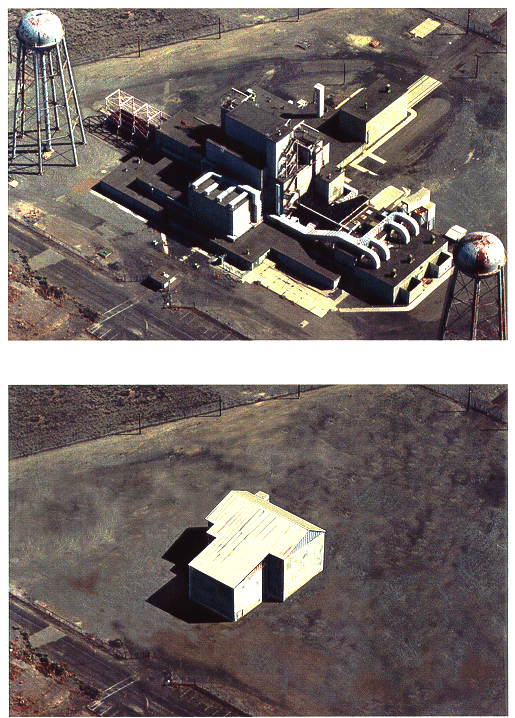
Fig. 2. Structure before project and
structure remaining after project completion.
DEVELOPMENT OF THE DESIGN CRITERIA
Due to funding issues, the Conceptual Design Report (10) and the Definitive Design Report (7) were completed in approximately one year, and decontamination, demolition, and construction activities to place the facility in safe storage are to be completed in the span of only 18 months.
The development of the design criteria for the 105-C Interim Safe Storage Project started when a first version was developed concurrently with the development of the CDR. Due to the rapid pace of such a large-scale project, many tasks were conducted concurrently with the design of the project.
To capture many of the developments created in definitive design phase, the design criteria was revised to incorporate changes, used only applicable regulatory requirements, and omitted unnecessary codes and regulations that existed in the first draft of the design criteria. Industry codes and standards and company procedures were emphasized. During the incorporation of requirements in the definitive design phase, project-specific individuals reviewed and commented on the design criteria within their disciplines.
Technology Demonstration
Taking into account the performance of various technologies for the technology demonstrations posed various challenges during the course of the project and also in the design criteria. Technologies such as the Temporary Power and Lighting (TP&L) system need to be designed around specific requirements; but on the other hand, it eliminated the need for many other restrictive regulations, if permanent power was left in the building. Various innovative decontamination, demolition and characterization technologies, with their unique and specific requirements, had to be taken into consideration when design was being analyzed.
SSE Access
Initially, it was thought there would need to be more than one means of access/egress in the facility for the SSE. During the safe storage period, the facility will have a single access door, which will be welded shut and opened for routine maintenance, initially, on a five-year basis. Comments arose pertaining to the single access/egress in and out of the facility during the safe storage period. DOE Order RLID 5480.7, "Fire Protection," (11) states qualifications for facilities like the SSE. The document states that a single means of access/egress for the SSE is acceptable in its deactivated state based on the following:
As defined in NFPA IO 1 (12), "occupancy" is the habitation by IO or more persons; therefore, the safe storage enclosure will only need one means of access for periodic maintenance and surveillance.
Ventilation
There will be no HVAC (Heating, Ventilation and Air Conditioning) requirements for the 105-C project. Only ventilation requirements will be needed, and these will follow applicable ASHRAE (American Society of Heating, Refrigeration and Air Conditioning Engineers) standards (13). Initially, HVAC was one element that was included as an item in the design criteria document. As the definite design developed, it was determined that only ventilation would be needed during the decontamination, demolition, construction, and interim safe storage period. The Notice of Construction (14) was prepared and submitted to the Washington Department of Health and was responsible for controlling radionuclide emissions and monitoring requirements during decontamination activities. The document was issued in June 1996 and established that continuous monitoring for the SSE would not be required during the ISS period, since radon air emissions are not regulated.
Electrical Loads
Due to the high profile of the 105-C project and innovative technologies, electrical loadings were a continuously changing design parameter. The 105-C project has had numerous diplomatic tours since the project started and will continue to have numerous tours. A separate trailer was procured, with additional electrical loadings, to facilitate diplomatic tours and other large meetings. A total of 12 trailers were mobilized at the facility site, more than was first estimated.
Specific innovative and baseline technologies were selected during the definitive design period of the project. Some equipment and tools demanded larger electrical loads than were initially anticipated, such as a portable exhauster, temporary power and lighting system, and others. As mentioned earlier, many project items were done concurrently due to the pace of the project. In this case, criteria for the electrical design changed as the project design proceeded.
Preliminary and Final Hazards Classification
As discussed in Section 2.1, the preliminary and final hazards classification analysis for the 105-C facility was conducted during the definitive design phase of the project. An Auditable Safety Analysis (ASA) was conducted as part of the final hazards analysis. Due to changing direction in various upper management organizations on how to classify facilities that have a preliminary classification of Nuclear, many design documents, field work instruction, and general work procedures made the assumption that the facility was radiological before final approval was made. Without the approval and finalization of the FHC document, no intrusive work could be performed in the facility. Intrusive work is define by BHI as an activity that has the potential to transport, accumulate, or change the form of any radioactive or hazardous material inventory.
CONCLUSION
The development of the design criteria was a challenging task. The design criteria is never fixed due to the ongoing changes that occur in the design of the project, and the standards, codes, and documents are frequently updated or in a state of revision. Most of all, the understanding of the entire project and all of its contributing disciplines is essential to developing a thorough, yet efficient, design criteria document.
REFERENCES