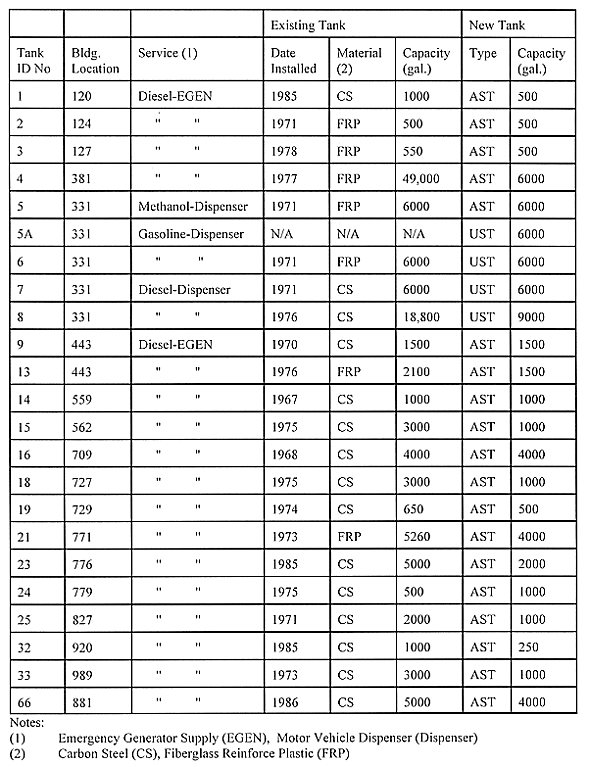
Table I Tank Descriptions
Robert P. Campbell
Rocky Mountain Remediation Services,
LLC
Michael R. Ferrari
Kaiser-Hill Company, LLC
ABSTRACT
Twenty-two underground petroleum storage tanks (USTs) at the Rocky Flats Environmental Technology Site (RFETS) were replaced with eighteen aboveground storage tanks (ASTs) and five USTs. The old USTs were closed-in-place by filling with an inert polyurethane closed-cell foam. ASTs were selected in most cases to avoid interferences with existing structures and utilities, and minimize excavation in areas with potential hazardous and radioactive contamination. The tanks were closed-in-place with significant cost savings due to avoidance of excavation and generation of soils requiring management. Geoprobe sampling was used to verify subsurface soils were not contaminated from tank leakage. The closed-in-place tanks were filled with foam rather than concrete to facilitate future removal if required.
INTRODUCTION
Originally there were 22 USTs used for fuel storage that served emergency power generators or vehicle refueling at RFETS. In order to meet Federal and State regulatory requirements for leak detection and spill prevention, a project is underway to replace these USTs. A pilot project was completed in 1995 to replace three of the tanks. The project to replace the remaining tanks is in progress and will be completed in 1997. The regulatory deadline for replacement or upgrade is December 1998. The existing tanks range from 500 to 49,000 gallons, and are constructed of carbon steel or fiberglass reinforced plastic (FRP). All of the existing tanks have been tightness tested and are not known to leak. A summary description of the tanks is provided in Table I.
Table I Tank Descriptions
Factors having an impact on the replacement are site contamination from past waste management practices, and the future cleanup and use of RFETS. Most of the USTs are in areas that are potentially or actually contaminated with radiological or hazardous constituents, which impacts the closure of the existing tanks and installation of new tanks. The closure and replacement must be consistent with the future cleanup of RFETS stated in the Rocky Flats Cleanup Agreement (RFCA) and the RFETS 10-Year Plan.
This paper describes the decision process and a description of the UST replacement project. The site assessment and closure requirements presented the greatest unknowns or risks for the project. The sampling and closure requirements determined whether excavation and remediation of the individual tank sites would be necessary. If the site must be remediated, the existing UST must be removed, and there is no cost benefit with closure-in-place. The decision of whether to close-in-place versus removal influenced whether to replace the existing tanks with USTs or ASTs. Without removal of the existing UST, there is limited space for installation of a new AST. However, if the existing UST must be removed, excavation is required anyways, and a new UST can be easily be installed in the excavation. Therefore, the type of replacement tank was one of the last decisions made, even though it might seem to logically be the first step in the process.
SITE ASSESSMENT AND CLOSURE ACTION
Cleanup Agreement
The closure of the existing 22 USTs was integrated into the future site plans for RFETS through an agreement made between the Department of Energy (DOE); the Colorado Department of Labor and Employment, Oil Inspection Section (OIS); the Colorado Department of Public Health and Environment (CDPHE); and the United States Environmental Protection Agency (EPA) Region VIII. This agreement, which significantly modifies the standard site assessment and closure methodologies proposed by the subcontractor, is included as an attachment to the RFCA (1). The agreement incorporates the intent of the EPA's Risk-Based Corrective Action (RBCA) Policy for Underground Petroleum Storage Tanks by taking plans for future site usage into consideration. Key points considered in formulating the agreement associated with site assessment, closure, and corrective action are described below:
Assessment Methodology
The agreement stipulated the following site assessment methodology:
Application of the RBCA policy and sound technical justifications for deviating from standard practices resulted in substantial project cost savings while maintaining protection of human health and the environment.
Assessment Results
Seven sites have been assessed so far, the three pilot sites by conventional drilling and four sites by Geoprobe sampling. To date no levels of contamination requiring remediation have been detected.
UST CLOSURE
The two closure options allowed by the regulations are to remove the tank or close-in-place. The objective of tank closure is to remove any existing contamination and sources of potential future contamination, along with meeting regulatory requirements. The cleanup agreement states the tanks will be closed-in-place, although removal could be done.
Removal
Removal involves removal of product from the tank and piping, cleaning the interior, inerting the tank to eliminate potential explosive conditions, and removal of the tank from the excavation. The site assessment is conducted by collecting soil samples from the bottom of the excavation. Removal is the most common closure method used in Colorado. In most cases local fire authorities have not allowed in-place closures unless necessary due to risk to structures or site conditions. Soil excavated during the removal operation is generally returned to the excavation, if clean. At RFETS, because of its designation as a National Priority List Clean-up Site soils will have to be analyzed prior to replacement. Most of the tanks are located in sites with actual or potential contamination with hazardous or radioactive constituents. Contaminated soils require special handling and management, at considerable cost. Monitoring and sampling will also be required during excavation to protect personnel, and the use of personnel protective equipment may be required.
Additional concerns with removal are interferences such as underground utilities, and proximity to structures where excavation and removal could adversely affect foundation support. There are numerous underground utilities at RFETS, some that are not shown on drawings.
Closure-in-Place
Closure-in-place involves removal of any product from the tanks and piping, cleaning the interior to remove any residuals and sludges, collecting samples for the site assessment, and filling the tank with an inert material. The site assessment is normally conducted by drilling boreholes adjacent to the tank. Concrete is typically used to fill the tank due to its wide availability, low cost, and structural integrity. Inert polyurethane closed-cell foam is an alternate fill material. The cost of foam is significantly higher ($1.00 to $1.13 per gallon) than concrete ( $0.59 per gallon for material and $0.13 per gallon for equipment and labor) at RFETS. However, foam with a density of 2 pounds per cubic foot verses 145 pounds per cubic foot for concrete, facilitates tank excavation if future removal is required.
Evaluation
An Alternative Analysis Report (3) was completed as part of the design. The decision was to close all USTs in place, unless site assessment sampling detects contamination levels that require removal of the tank. The primary driver for closure-in-place was the potential unknown expense of managing contaminated soils. As future removal may be required as part of the final RFETS closure, foam was selected as the inert fill. Seven tanks have been cleaned and foamed to date. The major disadvantage of closure-in-place is the additional costs related to the foaming. The cost of closure-in-place was approximately 10 percent higher than removal, not including potentially higher costs for contaminated soil handling or disposal had the tanks been removed.
ABOVEGROUND VERSES UNDERGROUND TANKS
The Alternative Analysis Report also evaluated the tank replacement alternatives. Colorado has promulgated regulations for both underground and aboveground petroleum tanks (4). The regulations for USTs follow the federal regulations (5). The AST regulations are based on NFPA 30 (6) and NFPA 30A (7).
Underground Tanks
The design evaluated for the USTs was a double wall FRP tank to provide interstitial leak detection and avoid cathodic protection. The primary fuel piping for both the ASTs and USTs was steel with a PVC outer containment pipe for underground piping and aboveground piping outside of buildings. USTs require excavation and the associated concerns addressed with closure. In addition, with closure-in-place, a different site must be located for the new UST, as the existing UST will not be removed. Normally the existing UST is removed, and the new UST is placed in the same excavation.
Aboveground Tanks
ASTs are becoming more common for the storage of petroleum products due to the regulations for USTs and the potential liability for releases from USTs. The primary concern with an AST is fire safety. The design evaluated for the AST was a UL Listed (8). "Protected Type" tank with a 2-hour fire rating. The AST is constructed with a double steel wall, membrane liner, and concrete insulation. The two designs used at RFETS are shown in Fig. 1. An AST requires adequate space to meet the regulatory spacing requirements from buildings and structures. The future removal of an AST is easier than that for a UST, and a removed AST has greater resale value. By closing the existing tanks in place, only minimal excavation for the AST foundation is required for the project.
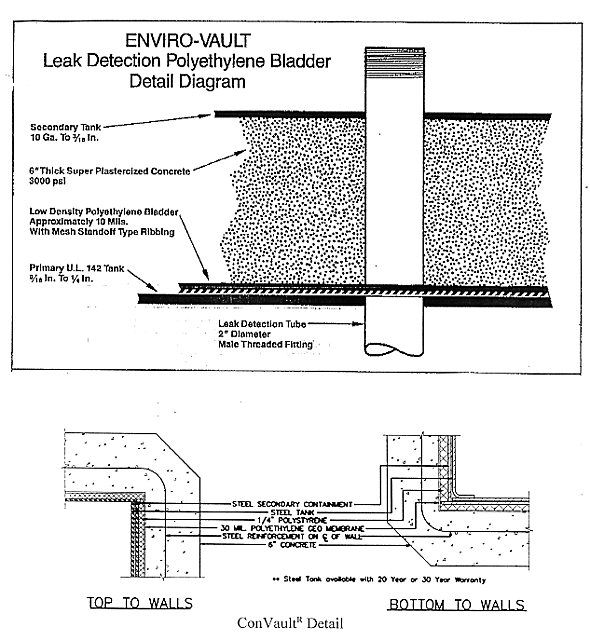
Fig. 1. Cross section of protected
type ASTs installed at RFETS.
Evaluation
The decision was to use ASTs for all 18 of the diesel fuel emergency generator tanks. There was adequate space at all sites to accommodate the AST and avoid the concerns with excavation for a UST. A typical AST installation is shown in Fig. 2. Five new USTs were installed at the RFETS vehicle fueling facility. There was not adequate space for ASTs; however, space was available for USTs, and there were additional regulatory requirements for ASTs used for vehicle dispensers.
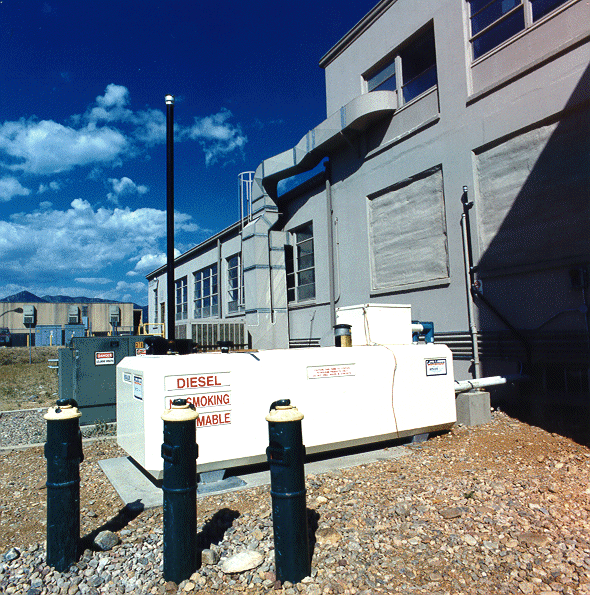
Fig. 2. Typical AST installation at
RFETS.
OTHER TANK CLOSURE AND REMOVAL PROJECTS AT RFETS
Two aboveground storage tanks (800,000 and 1.9 million gallon) used for fuel oil were emptied and demolished. After removal of 540,000 gallons of #6 fuel oil, the tank interiors were cleaned with remotely operated spray heads, avoiding the need for confined space entry. A track-mounted mechanical shear was used to demolish the tanks.
Two aboveground 8000 gallon stainless steel nitric acid supply tanks were removed. The piping and structures were removed, and the tanks were verified as empty. The tanks were removed without size reduction on trailers. The concrete containment berm was backfilled and the site was reseeded.
CONCLUSION
USTs can cost effectively be closed-in-place by filling with foam. Closure-in-place eliminated the need for excavation, avoiding potential hazardous or radioactive soil generation, and worker exposure. Remediation could have been required even if the petroleum UST has not leaked. The use of foam instead of concrete fill will facilitate tank removal, if necessary during final Site closure. ASTs were used to replace the majority of the USTs to minimize excavation. UL listed protected type tanks were used to minimize potential fire risk with an AST.
REFERENCES