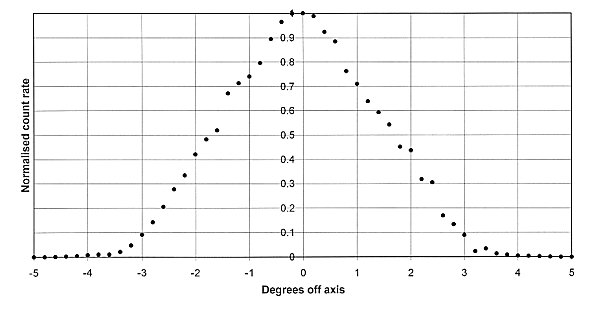
Fig. 1. Response of the RadScan 600
to 662 keV radiation.
K.A. Hughes and J.A. Lightfoot
BNFL Instruments Ltd
B14.1, Sellafield, Seascale, Cumbria, CA20 1PG
United Kingdom
ABSTRACT
BNFL Instruments' RadScan 600 has been developed to survey gamma radiation remotely in a wide variety of environments. The device is based on a CsI spectrometer located in a highly collimating tungsten shield. This spectrometer can detect gamma rays with energies between 100 keV and 10 MeV. A color CCD camera produces a visual image of the of the area being surveyed. This device has been used to monitor the location of contamination contained within a cell at a nuclear site in England. The cell, which during its operational life had been used for post irradiation examination of spent nuclear fuel, had already undergone a level of decommissioning. The clean-up operations performed had failed to reduce dose rates in the cell to a level which would allow man entry. In an effort to resolve this problem the RadScan 600 was used to perform a full survey of the cell. This was accomplished, confirming that the dose rates in the cell were originating from Cs-137. The survey established the location of a number of hotspots. The information provided by the RadScan 600, which would not have been available with existing health physics instrumentation, has been key to allowing the Decommissioning Team to develop their plans for further decontamination of the cell.
INTRODUCTION
Development of the RadScan 600 began in 1993. The objective of this development program was to produce a device that could identify and characterize 'hot spots' of gamma radiation in an active environment. The instrument developed is a general purpose aid to decommissioning teams, and provides information about the location, intensity and identity of gamma ray sources within a plant or cell. The information can be used for a number of purposes. These include :
- Assessing the contribution of any one 'hotspot' to an overall dose rate,
- Monitoring the success of clean-up operations,
- Aiding in the design of shielding,
- Locating radiation sources in high dose rate environments and
- Identifying the radioisotopes present within an environment
DESCRIPTION OF THE RADSCAN 600
The RadScan 600 is a real-time, directional count rate meter with the capability for low resolution gamma ray spectrometry. Gamma radiation is detected by a caesium iodide scintillator, CsI(Tl), coupled to a silicon photodiode and preamplifier, all housed in an aluminium can. This is placed within a tungsten collimator which attenuates gamma radiation from all angles of incidence apart from the forward. The response of the system to 662 keVradiation from a point source of Cs-137 is shown in Fig. 1. This figure shows that the response is symmetrical about its center point and has a nominal field-of-view of 4 degrees. The field-of-view can be changed mechanically to 2 or 9 degrees depending upon the resolution required for a particular investigation.
Fig. 1. Response of the RadScan 600
to 662 keV radiation.
A range finder and CCD camera attached to the detection head, a photograph of which is shown in Fig. 2, provide the range and a color video image of the field-of-view. The whole assembly is mounted on a pan and tilt unit and is operated from a remote workstation which is connected to the detector head by up to 100 m (330 feet) of cable.

Fig. 2. A photograph of the RadScanTM
600 detector head.
The field-of-view can be scanned using the pan and tilt unit to produce two-dimensional images which indicate the location and quantity of gamma emitting isotopes. The system software provides a facility for the automatic production of 2D gamma images and the identification of the co-ordinates of any hot spots identified. An integral, multi-channel analyzer (MCA) allows radionuclides to be identified, and radionuclide-specific images to be produced. A video recorder in the remote workstation can make a permanent record of all the measurements.
APPLICATION OF THE RADSCAN 600 TO THE MONITORING OF A HIGHLY ACTIVE CELL
Description of the Active Cell
At the request of the UKAEA, RadScan 600 was made available for the survey of a suite of cells within building A59 at the Winfrith Technology Center which had been used for the Post Irradiation Examination (PIE) of spent nuclear fuel. The PIE facility at Winfrith consists of a succession of cells, each of which has dimensions of roughly 4 x 4 x 4 m. Personnel working outside the suite of cells are shielded by several feet of concrete. Lead glass windows allow operators to view the interior of the cells. Each cell is equipped with master-slave manipulators (MSMs) and a crane runs the full length of the suite of cells. Sliding shield doors between the individual cells allow the movement of items from cell to cell within the suite. There is an access bay at each end of the suite of cells where items may be loaded onto and removed from the crane.
A Demonstration of RadScan Outside the Suite of Cells
Before loading RadScan into the suite of cells the system was demonstrated to the plant operators. The RadScan was set up outside the cell to scan a collection of radioactive waste packages which included drums, crates and bagged items. An automatic scan was set-up to monitor the area containing the items and an attempt was made to determine which, if any, were emitting gamma radiation.
The scan was set up to monitor the selected area with a scan that had 144 measurement points. The spectrometer was set to record all gamma radiation which deposited between 150 and 1500 keV in the CsI detector. Using the set-up procedure incorporated in the software, RadScan indicated that the scan would take 20 minutes to perform so the option to record the automatic scan on a video cassette was selected.
The output scan file, produced as a result of the automatic scan, showed that the majority of the measurements within the scan contained only background counts, i.e. that at these locations there was no detectable contamination in the field of view. The background count rate was around 1 cps. A level of 10 cps was selected as the threshold count rate, any values detected above this being a 'hot spot'. Alternatively, a user determined value or a value derived from a radioactive standard could have been used for this threshold. The software on the RadScan was used to filter the results using this 10 cps threshold, this identified that there were two hotspots present.
The RadScan 600 has the facility to automatically cue the video cassette to the points where the hotspots are recorded. The first hotspot related to a bag of waste wrapped in PVC and the second to a section of a waste drum. The bag of waste yielded 30 cps on the RadScan, and was situated 4 metres (13 feet) from the scanner, whilst the drum gave 100 cps at a distance of 5 m (16 feet). The dose rates coming from each of the two items was measured using a standard health physics probe. The bag was recorded as yielding a dose rate of 50 µSv/hr at 0.5 m from its surface and the drum a dose rate of 120 µSv/hr at the same distance. The spectroscopic capability of the RadScan indicated that Cs-137 was the isotope giving rise to the measured dose rates. The spectrum from the drum indicated a larger proportion of scattered radiation than that from the bag. This is as expected as the drum and its contents act as scattering media.
This demonstration outside the cell clearly indicated the ability of the RadScan to locate, remotely and rapidly, the sources of gamma radiation present within an area of plant.
Loading the RadScan into the Active Cell
For operation in the active cell the RadScan was bagged in PVC to prevent it becoming contaminated. Clear plastic was used in the vicinity of the video camera and the bag was sufficiently loose to allow the pan and tilt unit to move through its full operational range. Once these requirements were met the RadScan was loaded into the cells.
A metal stand was developed for this application that allowed the RadScan to be carried in to and out of the cells using the cell crane. This item was free standing and had a hoop located at its top by which the RadScan could be picked up.
The RadScan was loaded into the suite and carried to the active cell by the crane. It was located at the center of the cell in order to maximize the coverage of its interior. Two cables, one providing power for the detection head and the other communication to and from the operator's console, were fed through a shield plug in the wall of the cell. MSMs were used to connect the cables to the RadScan. The operators console was located adjacent to the lead glass window, immediately outside the cell.
Operation of the RadScan 600 within the Active Cell
The RadScan was configured to record gamma radiation with energies between 190 and 1500 keV. Within this energy window the RadScan recorded a background count rate of 80 cps, arising from radiation which has penetrated the shielding of the collimator. The difference between a spectrum originating from radiation which has penetrated the shielding and a spectrum from radiation present within the field of view of the RadScan is shown in Fig. 3. Both of these measured spectra originate from Cs-137. The spectrum originating from radiation within the field of view shows the characteristic broad photopeak, Compton edge and backscatter components. The majority of counts in the background spectrum are at low energies, with a small unscattered component at 662 keV. The discrimination between signal and background can obviously be improved by setting the energy window such that only the 662 keV photopeak is counted.
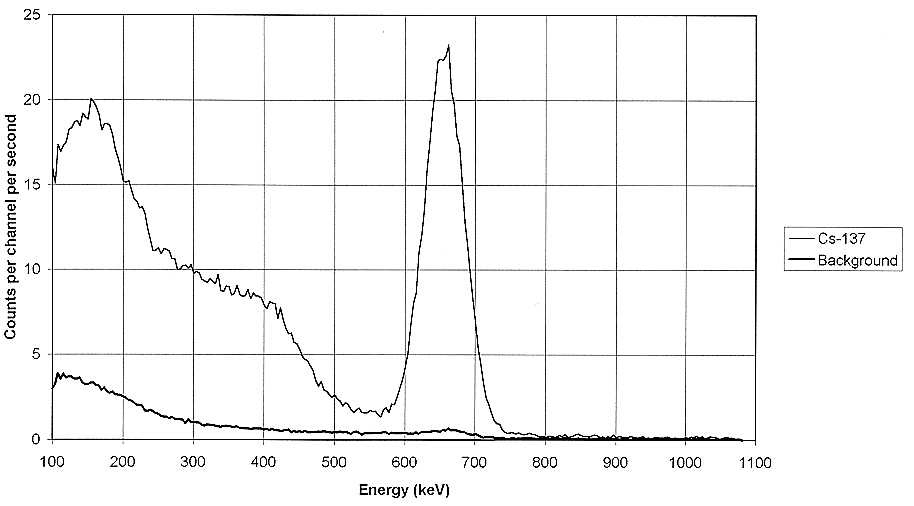
Fig. 3. Spectra from signal (Cs-137)
and background.
The dose rates within the cell were measured using a calibrated Geiger-Muller tube sensitive to radiation from all angles of incidence. This probe was manipulated within the cell using the MSMs. The dose rate at the scanner head was measured to be around 3 mSv/hr.
A complete scan of the cell was made using the RadScan which was moved towards one corner so as to include a feature in the center of the cell at ground level. The complete survey was made overnight. Figure 4 shows a contour plot of the contamination levels measured within the cell. It can be seen from this figure that there are a number of areas within the cell that contain relatively high levels of contamination.
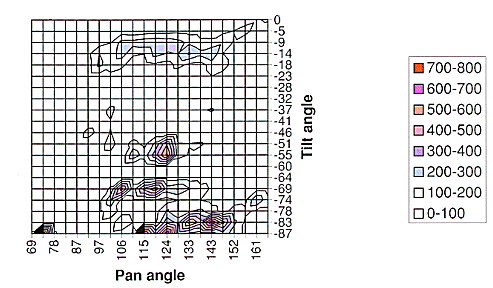
Fig. 4. Contour plot of contamination
present in the active cell.
A number of hotspots were identified within the cell. As well as identifying areas of cell that had, or were suspected of having, levels of increased contamination, the scan identified a significant unknown hotspot. An area of cell wall beneath one of the lead glass windows gave rise to several 1000s of counts per second on the RadScan. Manual scanning of the area with the RadScan showed that the increased count rates followed a physical feature within the cell. This feature ran below and parallel to the bottom edge of the lead glass window, which was a metre or so wide. This area was monitored using the in-cell dose probe. Surface dose rates at this feature were measured to be up to 100 mSv/hr.
In a similar fashion other areas of contamination were found, though not all could be readily monitored using the in-cell dose probe. The spectroscopic capability of the RadScan showed all of the contamination to be Cs-137, as would be expected in a cell which had been used for the handling of irradiated fuel.
The RadScan was able to identify the presence of hotspots of widely varying intensity, in an environment where there was significant background radiation encroaching upon the device.
Withdrawal of the RadScan from the Active Cell
The power and communication cables were unplugged from the RadScan, which was subsequently moved by the crane to an accessible area. The PVC bags, which had become contaminated while in the cell, were removed and discarded. Standard procedures were employed and subsequent monitoring of the RadScan by health physicists showed that the device had not been contaminated.
SUMMARY
The operation performed in the Winfrith active cell clearly demonstrated the RadScan's ability to be deployed in an environment of high radiation and loose contamination. In this deployment it has been shown that the RadScan 600 can be :
The RadScan has produced information that has confirmed the presence of suspected hotspots, and identified the location of new ones. The design of the RadScan is such that hotspots of widely differing intensity can be located. Within a single scan its dynamic range can be in excess of 1,000, thus enabling the device to locate small quantities of contamination in the vicinity of much larger quantities. The collimated design also allows the device to be operated in environments where each individual hotspot contributes only a small fraction to the overall dose rate
The results of the work performed at Winfrith gave the decommissioning team information on the quantity and location of contamination within their cell. This information allows the team to develop their strategy for the further decommissioning of the cell.