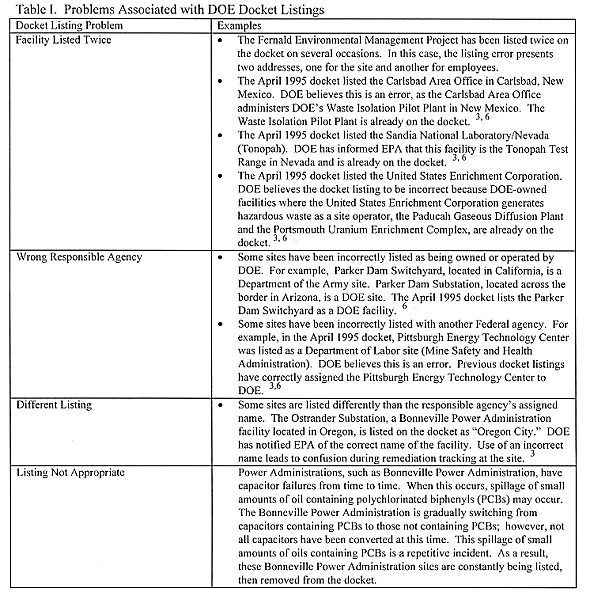
Table I Problems Associated with DOE Docket Listings.
Kate Landkrohn
Environmental Scientist
Environmental Programs Center
Brown & Root Environmental
Robert C. Fleming
Oakland Operations Team Leader
Office of Environmental Restoration
U.S. Department of Energy
Juliet M. Berling
DOE Docket Coordinator
Office of
Environmental Compliance
U.S. Department of Energy
ABSTRACT
The purpose of the Comprehensive Environmental Response, Compensation, and Liability Act (CERCLA) is to encourage the identification and remediation of sites contaminated with hazardous substances. Federal facilities managing hazardous waste must comply with CERCLA and are listed on the Federal Agency Hazardous Waste Compliance Docket (the docket) maintained by the U.S. Environmental Protection Agency (EPA). The docket, among other things, provides a mechanism to identify those facilities which should be evaluated for placement on the National Priorities List (NPL).
Once listed on the docket, facilities must perform a preliminary assessment of the environmental conditions at the site within 18 months of the listing. If necessary, a site investigation may also be performed. EPA uses this information to make a determination regarding the status of a site, such as no further remedial action is planned, or further investigation is required to determine if inclusion on the NPL is warranted. If a facility becomes listed on the NPL, then it must perform a remedial investigation and feasibility study within six months and submit it for review by the EPA. The facility must enter into an interagency agreement within 180 days after EPA's review of the study. However, there have been problems associated with docket listings, ranging from a facility's being listed twice to an inappropriate listing.
For fiscal year 1996, the U.S. Department of Energy (DOE) has 90 facilities listed on the docket and 21 facilities on the NPL. DOE is required by CERCLA 120(e) to inform Congress and the public of its progress in cleaning up contaminated facilities. At the present time, DOE provides this information in an Annual Report to Congress and Governors of affected states. Several other reports present similar information, however, and the information provided by the CERCLA Annual Report to Congress does not quantify the cleanup activities at the reporting sites. This paper suggests it is time to consider whether the intent of the original reporting requirements is appropriate for the current level of environmental knowledge held today by Congress and the public.
INTRODUCTION
In 1980, Congress passed the Comprehensive Environmental Response, Compensation, and Liability Act (CERCLA) (Public Law 96-510), more commonly known as Superfund. The purpose of this Act is to encourage the identification and remediation of sites contaminated with hazardous substances.
As the first few years passed, Congress and the public lost confidence that the Federal government was cleaning up sites owned or operated by Federal agencies. Congress expressed concern that Executive Orders effectively nullified Department of Defense compliance with CERCLA. (1,2) To this end, the Superfund Amendments and Reauthorization Act (SARA) (Public Law 99-499) amended CERCLA in 1986. SARA added certain provisions applicable to the identification and cleanup of contaminated sites owned by Federal agencies, departments, and instrumentalities, such as DOE. Located in Section 120 of CERCLA, these provisions require Federal facilities to comply with CERCLA. (3,4)
WHAT IS REQUIRED BY CERCLA?
Under Section 120 (a)(1), CERCLA specifies that Federal departments, agencies, and instrumentalities must comply with CERCLA in the same manner and to the same extent as nongovernmental entities. Except for requirements applicable to bonding, insurance, or financial responsibility, all guidelines, rules, regulations and criteria applicable to preliminary assessments (PAs), National Contingency Plan (NCP) evaluations, inclusion on the National Priorities List (NPL), and the conduct of remedial action are applicable to contaminated sites at Federal facilities (Sections120(a)(2), (3), (4)). (3)
Even before the passage of SARA, Federal agencies were required to identify sites where hazardous waste was treated, stored, or disposed of at any time. SARA added Section 120(b), which requires Federal agencies to also identify contamination affecting contiguous or adjacent property and any monitoring data associated with this contamination. (3)
Section 120(c) of CERCLA requires the U.S. Environmental Protection Agency (EPA) to compile information about Federal facilities managing hazardous waste or having potential waste contamination. This information is entered into the Federal Agency Hazardous Waste Compliance Docket (the docket). The purpose of the docket is threefold:
HOW DO FEDERAL FACILITIES BECOME LISTED ON THE DOCKET?
To compile the docket, each Federal agency, including DOE, notifies EPA of hazardous waste activity under:
Certain Federal facilities conducting hazardous waste activities under these sections of CERCLA and RCRA are, however, exempt from docket listing. These facilities include small-quantity generators of hazardous waste (generators of less than 1,000 kg/month of hazardous waste) and facilities that notify EPA of hazardous waste activity under Section 3010 of RCRA only because they are transporters of hazardous waste. (3)
The docket is extracted from information contained in four databases: 1) the Emergency Response Notification System (ERNS); 2) the Biennial Inventory of Federal Agency Hazardous Waste Activities; 3) the Resource Conservation and Recovery Information System (RCRIS); and 4) the Comprehensive Environmental Response, Compensation, and Liability Information System (CERCLIS). (4)
The docket is updated on a regular basis by EPA. Updating involves extracting information regarding Federal facilities from the four databases, creating a Proposed Docket Listing. This proposed list is sent to the EPA Federal Agencies Docket Coordinator, who forwards the appropriate sections to each Federal agency's Docket Coordinator. At DOE, the Docket Coordinator contacts personnel at the sites on the Proposed Docket Listing for input to confirm or contest the listing. EPA, however, has the final decision of the site's docket status and ultimate listing. If DOE sites do not respond to the DOE Docket Coordinator, the site is listed as presented on the Proposed Docket Listing.
Each site listed on the docket is assigned an EPA Regional Docket Coordinator to track the site's activities in response to docket listing. To remove a site from the docket, either DOE notifies the EPA Regional Docket Coordinator of the reason for removal, or the EPA Regional Docket coordinator notifies the site of a change in its status using information reported in one of the databases. In either case, a meeting is held in which the parties discuss the site to determine its correct docket status. The EPA Regional Docket Coordinator tracks the site docket status and submits the information (via the appropriate database) for publication in the next docket update.
A facility is listed on the docket with a code relating to its NPL status. The NPL is the EPA's list of the most serious or abandoned hazardous waste sites identified for long-term remedial action under CERCLA. Sites are placed on the NPL if they receive a threshold score of 28.5 or less on EPA's Hazardous Ranking System. Sites listed on the NPL may be owned by the Federal government or be privately owned. Privately owned facilities do not appear on the docket. Docket status codes and their meanings are:
U__Undetermined
N__No Further Remediation Action Planned (NFRAP)
P__Currently Proposed for the NPL
F__Currently Final on the NPL
R__Removed from the Proposed NPL and No longer considered for the Final NPL
D__Deleted from the Final NPL
EPA assigns the N code, denoting No Further Remedial Action Planned, to facilities that are not likely to be placed on the NPL and where no further involvement by EPA in site assessment or cleanup is anticipated at the time of the evaluation. DOE may, however, perform additional response actions at facilities with No Further Remedial Action Planned status. (3,4)
WHAT ARE THE IMPLICATIONS OF DOCKET LISTING?
Section 120(d) of CERCLA requires Federal agencies to conduct a PA of facilities listed on the docket within 18 months of docket listing. If the PA indicates a need for further investigation, the responsible agency must conduct a site investigation (SI). Based on information developed in the PA or the Preliminary Assessment/Site Investigation (PA/SI), EPA must determine if 1) no further remedial action is necessary at this time or 2) further evaluation and possible inclusion in the NPL are warranted. (3)
Section 120(e) requires Federal agencies that own or operate facilities on the NPL to begin a remedial investigation and feasibility study (RI/FS) for these facilities not later than 6 months after being placed on the NPL. EPA must review the results of each Federal facility RI/FS. Within 180 days after completion of EPA's review, Federal agencies must enter into interagency agreements (IAGs) with EPA (and the state, if deemed appropriate) for expeditious completion of remedial action at the facility. The contents of the IAGs must include:
Remedial action must begin not later than 15 months after completion of an RI/FS and must be completed "as expeditiously as practicable." To ensure that adequate funds will be appropriated to perform cleanup, Federal agencies must include a statement of the hazards posed to human health, welfare, and the environment by each facility on the NPL. Also, specific consequences of failure to begin and complete remedial action must be identified and included in annual budget submissions to Congress. 3
Under Section 120(e)(5) of CERCLA, each department, agency, or instrumentality of the Federal government responsible for compliance with Section 120 must submit an annual report to Congress concerning its progress in implementing the requirements of Section 120. The report must include information on at least the following items:
ARE THERE PROBLEMS ASSOCIATED WITH DOE DOCKET LISTINGS?
The April 1995 docket contains 2,070 listings of facilities owned/managed by Federal agencies where hazardous waste exists or from which hazardous substances have been or may be released. Several problems have occurred with docket listings of DOE facilities. Table I presents these problems.
The most troublesome problems to DOE are when DOE is incorrectly identified as the responsible agency and when there is an inappropriate listing. DOE is sensitive to incorrect and inappropriate listings because of the economic implications (preparing the required preliminary assessments and site investigations requires funding; additionally, removal of a site is a time consuming process). Table I presents an example of an inappropriate listing caused by are recurring incident and its impact upon the Bonneville Power Administration. At the present time, the Bonneville Power Administration is working with EPA Region X on an agreement to reduce the impact of preliminary assessments for recurring incidents. Additionally, the Bonneville Power Administration and the Region are working together to confirm a site's status prior to docket listing.
Table I Problems Associated with DOE Docket Listings.
For DOE, some of these problems can be avoided during the review of the Proposed Docket Listing. The DOE Docket Coordinator and the site have the opportunity at this time to correct the site listing if an error is identified. However, identification of problems and proposals to correct them have not always led to changes.
DOE has expressed concern over the number of the sites listed on the docket. The sites listed (from all agencies) submit reports (such as preliminary assessment or site investigation reports) as required by CERCLA and the EPA, but there is little, if any, response by EPA regarding a change in the facility's docket status. As a result of the slow response, DOE has expressed concern that it appears to the public that DOE is not responding as required by CERCLA. EPA, on the other hand, is trying to respond to all of the reports submitted by all Federal agencies listed on the docket so that the docket status will accurately reflect identification and remediation efforts by the Federal agencies.
WHAT IS THE STATUS OF DOE'S DOCKET LISTINGS?
DOE's Ninth Annual CERCLA Report provides information on DOE's progress in implementing CERCLA Section 120 for fiscal year (FY) 95, i.e., from October 1, 1994 to September 30,1995. During FY 95, there were 90 DOE facilities subject to CERCLA Section 120. (3)
EPA did not update the docket during FY 96, so the number of DOE facilities subject to CERCLA Section 120 remains unchanged for the FY 96 Annual CERCLA Report, which is under development. Although two DOE sites were deleted from the NPL during FY 96, these sites are still subject to CERCLA Section 120. The deleted sites, located in Washington state, are Hanford Site - 1100 Area and Bonneville Power Administration's Ross Complex.
For FY 96, 21 DOE facilities are listed on the NPL. DOE's Hanford Site is listed once on the docket, but accounts for three listings on the NPL. Each NPL entry covers a discrete contaminated area, i.e., Hanford Site - Areas 100, 200, and 300.
Early in the docket and NPL listing process, Privately Owned, Government Operated (POGO) sites were excluded from the docket. During docket update #6 (57 FR 3178, July 17, 1992), the EPA decided to include POGOs on the docket. On the other hand, sites which are privately owned, but where a Federal agency is responsible for cleanup, are not identified on the docket. For example, two of the facilities subject to CERCLA Section 120, the St. Louis Site in Missouri and the Monticello Vicinity Properties in Utah, are privately owned and operated; these sites are not included on the docket. Both of these sites are listed on the NPL, however, and DOE is responsible for their cleanup as established by Congressional mandate. The application of listing either POGOs or privately owned facilities on the docket is not consistent. (3)
HOW CAN DOE IMPROVE THE WAY IN WHICH IT INFORMS CONGRESS AND THE PUBLIC OF PROGRESS IN CLEANING UP CONTAMINATED FACILITIES?
Cleanup activities at most of the Federal facilities is very complex. Large DOE facilities such as Hanford Site or the Savannah River Site cover hundreds to thousands of acres. Remediation activities at the sites may involve radioactive materials and wastes, hazardous materials and wastes, or a combination of radioactive or hazardous wastes, known as mixed wastes. Remediation activities may occur over long periods of time. This paper suggests two methods of improving the avenue for presenting information to Congress and the public on DOE's remediation activities: providing some quantification of cleanup activities in the CERCLA 120 Report, and consolidating DOE's remediation reporting efforts.
Quantify the Cleanup Activity
Results presented in the Annual Report to Congress on CERCLA Section 120 can be misleading. The report provides information about hundreds of cleanup activities ongoing throughout the DOE complex; however, there is no mechanism in the report to quantify these reporting activities or to identify how close a given site is to final cleanup. For example, in a recent report, one facility states that remedial actions have occurred at 375 out of 411 individual sites. Upon further reading, there is no indication in the report how large or how complex the cleanup activities will be at the 36 remaining individual sites. It is possible these remaining individual sites may be larger or more complex than the 375 already completed or, on the other hand, that the majority of the facility's sites have completed cleanup activities.
The Baseline Environmental Management Report, published in 1995 and 1996, attempted to quantify the cleanup occurring at DOE sites. The report showed that the cost and time required for cleanup are dependent upon the land use after site cleanup. In other words, if the land is expected to be used for residential activities, the cleanup level required is substantially greater than if it is expected to be used for industrial purposes. For land planned for residential use, cleanup levels are greater because of the planting of vegetable gardens, children playing in the soil and water, and people living on the land and breathing the air 24 hours every day. Cleanup for industrial purposes is far less stringent because exposure to humans is for a limited amount of time on a daily basis.
Originally the Baseline Environmental Management Report was to be published annually. The time and effort required to gather the necessary information and produce this report were greater than originally planned. At this time, there are some concerns about the cleanup plan and the 30-year schedule identified in the Baseline Environmental Management Report. It does not coincide with that identified in DOE's Ten-Year Plan. However, the quantification information presented in the Baseline Environmental Management Report is important to help Congress and the public understand how much closer DOE's cleanup efforts are in reaching a site's final end use.
Another DOE report, Charting the Course, The Future Use Report, published in April 1996, discusses DOE's plans for future land use as a result of cleanup or remediation activities.7 If DOE determines quantification of cleanup is the proper approach, this will involve identifying the definition of "clean" for each site, the approach to be taken, implemented, and status reported to Congress and the public.
Perhaps the annual CERCLA Report to Congress could be modified to incorporate more quantitative information presented in a qualitative manner. Discussion of both land use and cleanup activities is appropriate in this report. For example, the CERCLA 120 Report could provide estimates of the percentage of the site that is cleaned up in preparation for a particular end use. Additionally, the report could incorporate land use discussions at the reporting sites as part of the discussion of the level of cleanup effort.
Consolidate Reporting Efforts
In the years since CERCLA's passage, the Federal government, its agencies, and the public have become, to a certain extent, more environmentally knowledgeable. Perhaps it is time to revisit the intent of CERCLA and other environmental regulations and determine if the intent is being accomplished. In particular, some consolidation of the regulatory and reporting requirements may be in order to reduce the burden on the various agencies.
For example, a report entitled Environmental Management is produced annually as a result of the National Defense Authorization Act. This report summarizes the environmental management activities occurring throughout the DOE complex for the past year, as well as the future plans for environmental management throughout the complex. This environmental management report is Congressionally mandated, as is the annual CERCLA Report to Congress. Both reports respond to separate laws requiring similar information. The National Defense Authorization Act is reauthorized each year by Congress, while the Superfund Act is reauthorized on a less frequent basis. Perhaps the language in the National Defense Authorization Act could be modified to combine these reports so that the reporting requirements, both frequency and content, for each law are fulfilled. This would allow DOE to come much closer to achieving the current goal of encouraging efficiency, streamlining work, and reducing costs throughout the Federal sector.
CONCLUSIONS
The original intent of CERCLA Section 120 was to provide Congress and the public with information about the status of Federal hazardous waste sites throughout the country. Since 1986, both Congress and the public have become more environmentally knowledgeable about hazardous waste activities occurring at Federal facilities. Numerous reports, many providing similar information, are generated to provide information about environmental cleanup activities, schedules and budgets, and land use. It is time to consider consolidating the required reports and presenting information in a more quantitative manner to inform Congress and the public of the outcome once cleanup is complete. Consolidation of the reports on environmental cleanup activities throughout the DOE complex will help reduce costs and streamline work. Of course, the process of making responsible, informed decisions is in the hands of Congress, the public and DOE.
REFERENCES