Fig. 1. Two phases of establishing
deactivation end points.
C. Negin
Oak Technologies
A. Szilagyi
USDOE-EM-62
J. Hayfield, L. Stefanski, L. Zinsli
B&WHC
R. Schmidt
SSOC
ABSTRACT
Deactivation is the conduct of a surplus facility's termination of operations within the scope of DOE's Office of Nuclear Material and Facility Stabilization (EM-60). This occurs prior to making a facility available for decommissioning and environmental restoration. EM-60 has stipulated that an end points approach be used for deactivation projects.
End point specifications define the facility conditions to be achieved prior to transferring a facility to those responsible for post-deactivation management, whether it be for surveillance, decommissioning, or conversion to non-defense use. Thus, all individuals and contractor organizations involved in either deactivation or decommissioning of surplus facilities necessarily have a need to understand the use of end points specifications. This paper is one vehicle to further such understanding.
INTRODUCTION
Deactivation is an essential phase of the DOE's strategy for surplus facilities. It precedes a facility's decommissioning and environmental restoration activity when there is a need to reduce the annual operating budget. The concept of end points specification as a key method to plan and execute surplus facility deactivation was presented at Spectrum '96 in Seattle (1). This WM '97 paper advances the concept with examples of successful application of end points methods at several facilities.
While the types of tasks for deactivation are standard, technical planning and engineering for deactivation projects is a new discipline for which few people have been directly involved. As such, it has become necessary to find ways to carry out such projects. One major approach that has evolved addresses how to specify deactivation end points.
Specifying end points has now progressed from a general concept, through development of a systematic methodology, to practice in the field. Importantly, this evolution has been conducted by on-the-job field personnel who have continuously improved the approach over a two year period in proceeding through facilities. This paper reports some of that experience.
DEACTIVATION PROJECT MANAGEMENT
A fundamental premise of project management for facility deactivation is answering the question:
How do you know when the project is complete?
Just as the design specifications are essential to a construction project, specifying end points is the key to answering this question for a deactivation project. Compiling end point specifications for the entire facility has the following uses during and/or after implementation:
- As input for scheduling and estimating the project cost.
- To create detailed work plans for each space and system in the facility.
- To document bases for performance based contracting or out-sourcing of work, where practical to do so. In effect, to become part of the performance specifications.
- To demonstrate conformance to agreements negotiated with third parties who have a legitimate stake in the condition of the facility after deactivation.
- To show compliance with regulations, both local and federal.
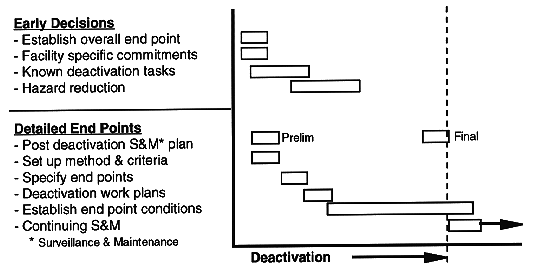
In general, for complex facilities with a multitude of structures, systems, and components, deactivation implementation occurs in at least two phases. Fig. 1 illustrates this point. The first phase deals with strategic issues and can be referred to as "early decisions." The second phase addresses details of the final condition and can be referred to as "detailed end points." The importance of this two phase view is that most major decisions should be made early while decisions on final conditions for individual areas of the facility can be made somewhat later. Indeed, early decisions will often be necessary before the latter can be specified.
Fig. 1. Two phases of establishing
deactivation end points.
A policy requirement for facility deactivation is that the management approach must be transformed to a project management structure from a production (level-of-effort) facility operation. Fig. 2 illustrates the relation of end points specification to other deactivation project management tasks. Specifying end points are an integral part of deriving the project work breakdown structure, schedule, and budget. While preliminary projections can be created, sufficient data for budgeting will only be available when work planning is conducted with an explicit set of area, equipment, and documentation goals.
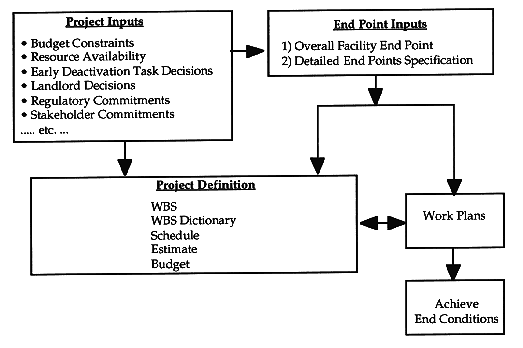
Fig. 2. Relationship of End point
specifications within project management.
END POINTS SPECIFICATION METHODS
Two methods have been developed and used for specifying end points for deactivation projects. They are called the "hierarchical" and the "checklist" methods. They both are fundamentally standard engineering and are only unique in the adaptation to these types of projects. Each project should decide which is appropriate to apply deactivation of their facility.
Hierarchical Method
A set of guiding principles was used at the PUREX facility at Hanford to evolve a method for end points specification. It has been revised several times, moving toward simplification and is now being applied at other Hanford facilities and at Rocky Flats. End points are developed in a hierarchical way, in successively more detailed levels, to the point of quantitative or otherwise explicit item-by-item end point specifications suitable for developing engineering work plans and performing field work packages.
The steps in applying this method are shown in Fig. 3. It is a top-down, logical process of determining final conditions for each of the facility's systems and spaces based on stated objectives, likely task types, and expected future uses for each system or space.Of the steps shown in this figure, Steps 1 through 5 are conducted for establishing and setting up the method as it would apply to the facility. This setup process assesses the entire deactivation project by examining its three dimensions - objectives, tasks, and end functions for the physical plant - in a logical, top down manner. It is important to realize that this setup is only done once in the beginning. The bulk of the end points specification effort is in the subsequent steps indicated as 6, 7, and 8.
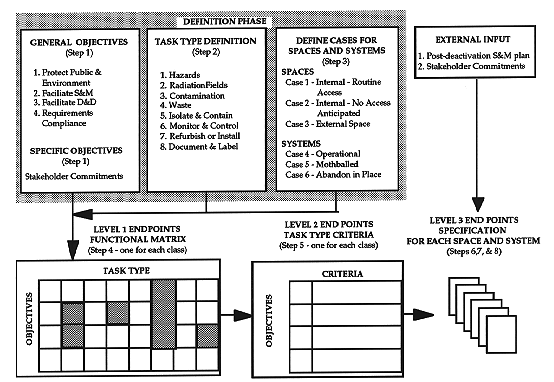
Fig. 3. End points specification
steps - hierarchical method.
The hierarchical method has proven to be straightforward to use and, with minimal training, readily understood by users, and by those not directly involved in specifying end points. It has been accepted in principle by the Defense Nuclear Facilities Safety Board (DNFSB) as a reasonable way to establish deactivation end points.
Check List Method
Managers of some facility deactivation projects can consider use of a checklist method for endpoints. The checklist method is consistent with a graded approach to planning, in which the level of detail is appropriate to the complexity and risks of the project. This approach is suitable for facilities which are basically industrial buildings, or for small facilities without substantial contamination, or for facilities without substantive process systems, or other similar situations. Other considerations may also favor use of a checklist method, such as the lack of engineering resources or budget for planning.
Fig. 4 illustrates the steps in applying a checklist method. As with the hierarchical method, a systematic process is used to set up the checklists that are to be used. The result is a comprehensive checklist for each logical physical work area in the facility.
The checklist method has been used at a few facilities at Hanford. While it does not have the same level of endorsement from the DNFSB as the hierarchical method, it can nevertheless be applied in appropriate situations. Future use will serve to further refine the method.
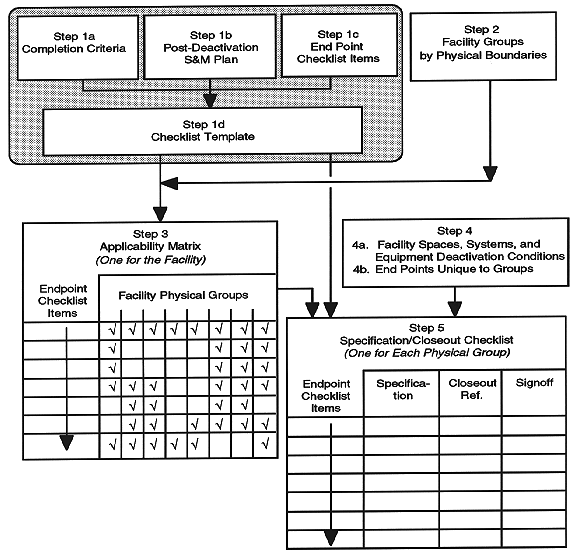
Fig. 4. End points specification
steps - checklist method.
Source of Details for Using the Methods
This paper has served to introduce the experience to date with end point specification for deactivation. Sources for details for applying either of the methods described can be found in EM-60's handbook (2) and software developed at Hanford for creating an end points specification document (3). If not already available, access to these sources can be gained via the authors.
EXPERIENCE TO DATE
Experience with the Hierarchical Method
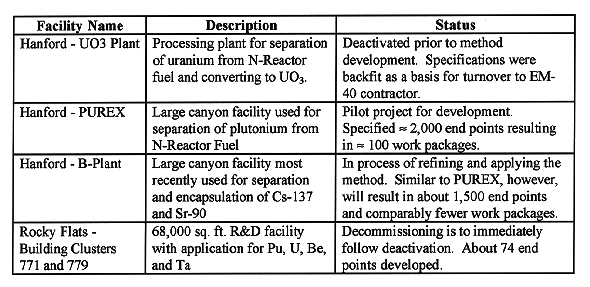
Table I lists some facilities that have used the hierarchical method and their status.
TABLE I - Experience with the Hierarchical Method
Experience with the Checklist Method
The checklist method was first applied to a set of at the Hanford Plutonium Recycle Test Reactor where managers decided that the simpler method would be suitable. A generic checklist was first developed, and then about half a dozen checklists were specifically derived for individual buildings and facilities, each consisting of about 40 items. In addition an administrative turnover checklist was developed and used.
The checklist method is now being applied to Rocky Flats Building Cluster 886, a 10,000 sq. ft. critical facility that was used for experiments with highly enriched Uranium Nitrate. End points will be specified for 15 systems and 37 spaces.
PUREX AVOIDED COST EXPERIENCE
Figure 5 shows the cost history and projection for PUREX, a deactivation project where much of the methods reported here were pioneered. It is seen in this figure that between 1993 and 1996, the spending rate was greater than had operation of the facility continued without change. However, substantial cost avoidance will be realized by the time deactivation is complete by the elimination of substantial annual costs and a low S&M budget. In this case, payback for the 1993-1996 incremental investment will be realized before the completion of deactivation in 1997.
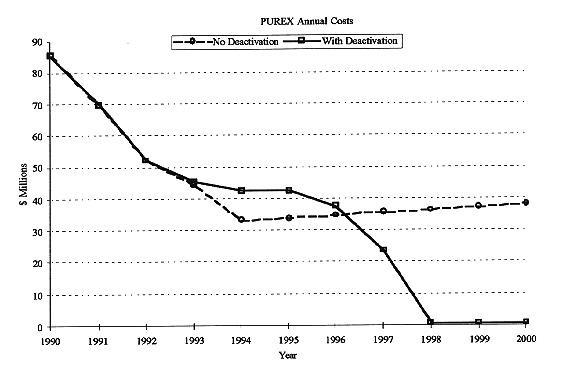
Fig. 5 - PUREX deactivation cost
profile.
CONCLUSIONS
Planning and execution of the deactivation of surplus defense nuclear facilities is being carried out using formally established, field-developed, logical and defensible methods for specifying project end points. These methods have now been applied at several facilities and have proven to be useful for managers, workers, and third parties with interest in the conduct of deactivation.
The lessons and examples from these successes can be applied to many other facilities that are to be deactivated. DOE contractors who are responsible for carrying out deactivation should acquire and adapt these methods to their projects. A handbook, software, and individuals are available to show others how to use the methods.
REFERENCES