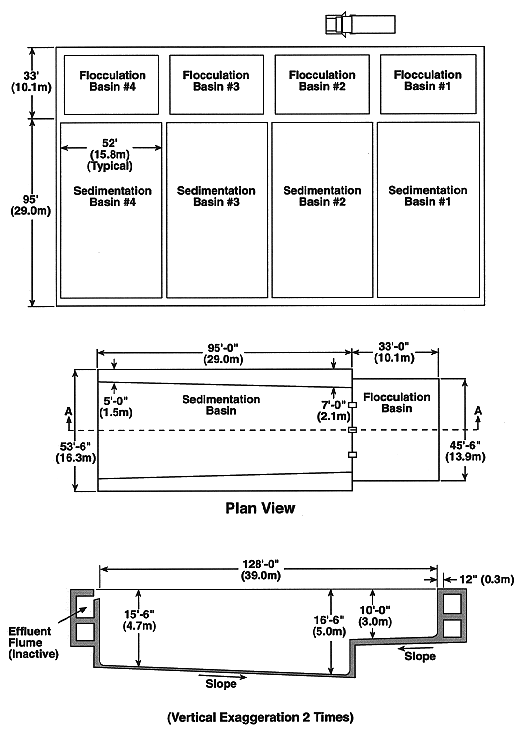
Fig. 1. Details of the 183-H solar
evaporation basins.
Janet W. Badden and Rex Miller
CH2M HILL Hanford, Inc.
Richland, WA
Michael A. Mihalic
Bechtel Hanford, Inc.
Richland,
WA
ABSTRACT
Cooperative teaming between the State of Washington Department of Ecology (Ecology), the U.S. Department of Energy, Richland Operations Office (RL), and its Environmental Restoration Contractor (ERC) resulted in the successful closure of a mixed waste unit and associated contaminated soil at the Hanford Site. Success was measured by the achievement of large cost savings, waste minimization, and timely closure of the unit. Regulatory obstacles were significant. The 183-H Solar Evaporation Basins (183-H) were used for storage and evaporation of large volumes of radiological process waste waters. The basins also received small quantities of RCRA listed wastes which defined the entire volume of process wastewaters as listed waste. Leakage from 183-H caused large areas of underlying soils and groundwater to be contaminated by these listed chemical and radiological constituents.
After removal and storage of the remaining mixed waste liquid and sludge from 183-H , decisions were needed on the disposition of the large volumes of listed soil and structural concrete. To avoid high disposal costs associated with permitted mixed waste landfills, a regulatory strategy was developed to remove the listed waste designation from the concrete and soil. Disposal costs were further reduced by regulatory approval of concrete and soil disposal in a landfill permitted to accept only CERCLA waste. During soil removal it was discovered that contamination went deeper than earlier characterization information indicated. A decision was made between RL, the ERC, and Ecology to integrate remaining RCRA postclosure actions on deep soil and groundwater contamination to remedial actions associated with the Comprehensive Environmental Response, Compensation, and Liability Act (CERCLA) operable unit. This decision avoided unnecessary and costly landfill closure options. This project provided evidence that the RCRA regulations can allow closure of a complex unit in a protective manner while avoiding unnecessary and costly actions.
BACKGROUND
183-H History
The 183-H is part of the 100-H Area, located in the northern part of the Hanford Site along the Columbia River. The 100-H Area contained a nuclear-defense, production-reactor facility that operated from October 1949 to April 1965. The 183-H structure consisted of four basins (aboveground concrete structures). Each of the basins consisted of a flocculation and a sedimentation reservoir. Basin dimensions are illustrated in Fig. 1. The width of the concrete basin walls was uniformly 15 centimeters (6 inches) and the basin floor was 13 centimeters (5 inches) in minimum thickness.
Fig. 1. Details of the 183-H solar
evaporation basins.
Beginning in 1973, 183-H was used for disposal of neutralized acid-etching solutions from NReactor fuel fabrication facilities in the 300 Area of the Hanford Site, as well as for miscellaneous used and unused chemicals. Waste deposited in the basins underwent volume reduction through evaporation. A total of 9,462 kiloliters (2.5 million gallons) of caustic solution was discharged to the basins during the period of waste operations. The solution consisted primarily of sodium nitrate with trace amounts of uranium, technetium-99, and miscellaneous chemicals. The waste stream included small amounts of listed waste constituents, as defined by Title 40 Code of Federal Regulations (CFR) Part 261, including formic acid (U123), vanadium pentoxide (P120), and cyanide salts (P029, P030, P098, P106). The solution was designated mixed waste (waste containing both hazardous waste and low-level radioactive waste as defined by the Atomic Energy Act of 1954). The last shipment of waste to the basins occurred in November, 1985.
Regulatory Background
The U.S. Environmental Protection Agency, Region 10 (EPA) and Ecology jointly administer the RCRA regulations in Washington State. The EPA retains oversight authority while delegating to Ecology the administration of a state program that is consistent with, or more stringent than, the corresponding federal program. EPA retains authority over the Land Disposal Restrictions Program (40 CFR 268) under the Hazardous and Solid Waste Amendments of 1984 (HSWA). Ecology's authorization includes administering the closure of RCRA treatment, storage, and/or disposal (TSD) units.
183-H is a final status TSD unit under RCRA. It is also within the CERCLA 100-HR-1 operable unit, an area designated under the National Priorities List. A RCRA closure plan for this unit was included in the Hanford Facility RCRA Permit (1) in 1994. Conditions of the Permit required final closure of the unit (physical activities needed to close the unit's structure and remediate the soil) in 1996. Removal and decontamination activities commenced in early 1996 and were completed in June of that year.
Ecology regulations allow three closure options under RCRA. The first two coincide with federal regulations: clean closure and landfill closure. If hazardous waste constituents can be removed and decontaminated to levels considered protective of human health and the environment, then a RCRA unit can be clean closed and postclosure care will not be required. If it cannot, the unit must close as a landfill. Closing as a landfill is a costly process. A RCRA cover system must be designed and constructed over the system and generally 30 years of postclosure maintenance and monitoring of the cover and groundwater monitoring system must be provided. In the State of Washington, another closure option is allowed. This closure option is defined as a modified closure. A modified closure option takes advantage of the continuum of health-based levels that are considered protective within a particular land-use scenario. Modified closure would allow levels of constituents to remain at a unit that are protective in an industrial setting without the imposition of a RCRA cover system. Institutional controls, such as access controls, and groundwater monitoring would continue to be provided until a reassessment of the site is made. Reassessment of the closure option is required every 5 years under a modified closure.
Extent of Contamination
In 1989 and 1991, 183-H concrete and soils were sampled. Laboratory chemical and radiological analyses of the 183-H concrete, shallow soils beneath and adjacent to the basins, and the deeper soils of the vadose zone beneath and surrounding the basins, were conducted using standard methods. Chemical analyses were conducted in accordance with Test Methods for Evaluating Solid Waste: Physical/Chemical Methods (2) at offsite laboratories.
Results indicated that concrete, shallow soils, and vadose zone soils above 11 feet contained contamination above Ecology health-based levels for unrestricted use (as prescribed under Ecology's Model Toxics Control Act [MTCA]). A shallow soil zone of contamination that extended throughout the entire footprint of the basins included arsenic, copper, nickel, nitrate, fluoride, and chromium. Deeper soil contamination was evident where more mobile constituents (hexavalent chromium, nitrate and fluoride) had migrated to the vadose zone. Radiological contaminants included uranium-234, uranium-235, uranium-238, technetium-99, and total uranium in the shallow soils.
The closure plan for 183-H defined the potential for closure of the unit under any of these options. Until structures and soils were removed, sampled, and analyzed, the levels of contaminants left in place could not be ascertained. However, groundwater contamination attributable to the operation of 183-H was first evident in 1978 and continues at the site for the constituents chromium, fluoride, nitrate, and technetium-99. Therefore, a clean closure option was not achievable for the unit. Either a modified or landfill closure option was required
CONCRETE DECONTAMINATION
Obtaining a Debris Contained-in Determination
In order to reduce disposal costs, the decision was made to pursue a contained-in determination for this waste. This could be accomplished in two ways in accordance with the EPA Debris Rule promulgation contained in 40 CFR 261.3[f]: use of a specified technology or case-by-case determination from EPA. The first and most common approach is through the use of a specified technology identified in 40 CFR 268.45 (in this closure action such a technology was a physical extraction technology). This approach would have resulted in clean structural concrete but the extraction residual would have remained listed waste.
In order to maximize disposal cost savings, the decision was made to pursue the second approach by requesting a site-specific determination from EPA Region 10 (40 CFR 261.3[f][2]). This would allow both the decontaminated concrete and the extraction residual would not be listed waste. Because the planned radiological decontamination technology for the basins would comply with a Debris Rule specified technology for contained-in and because decontamination occurred prior to receipt of the determination, the performance standards within 40 CFR 268.45 were adhered to. In this manner, a contingency to receipt of a contained-in determination was built into the closure planning in the event approval for "delisting" the entire concrete matrix could not be obtained. This contingency would at least have ensured that decontaminated structural concrete would not be defined as listed waste.
Earlier sampling of concrete cores through the basin indicated that listed constituents were contained in the concrete at levels below health-based concerns. Calculations proved that even if all the contaminants were contained in the top 6 mm (the standard extraction depth specified in the Debris Rule), health-based levels would not be exceeded. This formed the basis for the contained-in determination submitted by RL.
Ecology concurred with the information submitted by RL in the contained-in request (approval of the contained-in determination was deferred by EPA Region 10 to Ecology and RL) allowing both the extraction residual and the decontaminated structural concrete to be redesignated as nonlisted waste. Disposal of the residual as nonlisted waste saved the project $200,000.
Conditions of the contained-in determination required verification sampling for listed and characteristic constituents in the residual and disposal of the extraction residue in the 200 Area Plateau of the Hanford Site. The 200 Area Plateau is an area within the Hanford Site that is highly industrialized, contains many operational and closed radioactive and mixed waste units, and has a groundwater depth that is over 200 feet deep.
Decontamination Technology
Both chemical and radiological contamination was removed from the basins' surface with a vacuum blaster using steel grit beginning in May of 1995. The goal of this effort was to remove contamination to the extent that a large portion of the concrete could be disposed of as clean fill thus avoiding a disposal cost. High-efficiency particulate air (HEAP) filtered containment equipment and structures were provided to ensure Air Emissions permit requirements were met. Efforts were made where possible to minimize the amount of waste generated for disposal.
Demolition of the basins began in September of 1995 and was accomplished by dismantling the basins' vertical structure with heavy equipment. A concrete pulverizer and steel shear were used for removing concrete walls and structural reinforcing steel. The rubble was removed and reduced in size, as necessary. A backhoe and crawler were used to carefully dismantle the basins' floor slabs (using a slab rotating technique) to minimize disturbance of the underlying soil surface. The backhoe and crawler was also used to remove the foundation/footings to at least three feet below grade. The dismantled floor material was removed to a laydown area with steel scrap, concrete, and reinforced concrete rubble segregated into separate piles to aid in the final processing task.
Scabbled residue was containerized. Containers were then analyzed to ensure that the scabbled residue did not exhibit a hazardous waste characteristic and radiologically surveyed. Release of the basins' structural material as non-radiological and non-hazardous was achieved by the following: 1) decontamination verification for Debris Rule criteria of 6 mm surface removal, 2) successful visual inspection in accordance with the Debris Rule, 3) performance of analysis confirming that the material does not exhibit the characteristic of dangerous waste in accordance with a sampling and analysis plan developed in consultation with Ecology, EPA, RL, and ERC (3,4) radiological survey and sample analyses indicating that the material did not exceed radiological standards. The majority of the concrete was able to be free released and used as clean fill. This allowed for an estimated cost savings of up to $23,000,000.
SOIL REMOVAL
Obtaining an Environmental Media Contained-in Determination
In contrast to a debris contained-in determination, environmental media contained-in determinations are made through a policy decision at the Ecology level. Similar to the site-specific debris determination, the environmental media determination is based on proof that hazardous constituents are contained in the media below a health-based concern. Utilizing the 1989 and 1991 soil analyses as a basis, it was determined that the soil did not contain constituents above levels considered protective of an industrial setting. However, levels of nitrate, fluoride, chromium, arsenic, nickel, and copper were found above an unrestricted or residential setting. Of these constituents, nitrate and fluoride contamination was found to be the most vertically spread. Nitrate and arsenic were the most laterally spread contaminants. State policy on contained-in determinations allow removal of the listed waste designation when the waste is above residential levels, as was the case at 183-H, through a "contingent contained-in" determination. This contingent determination was granted by Ecology and allowed the listed waste designation to be removed from the soil under two conditions: that the waste be disposed in a protective manner within the 200 Area Plateau of the Hanford Site, and; that confirmatory sampling and analysis be performed to ascertain that levels of contaminants in waste soils were below the prescribed health-based levels.
Removal of Soil and Verification of Closure Option
The Sampling and Analysis Plan for the 183-H Solar Evaporation Basins - Phase II - Soil (4) contained sampling and analysis methodologies that were used to verify the conditions of the appropriate level of closure of 183-H under RCRA. This plan was a coordinated effort between RL, ERC, and Ecology and utilized the procedures of a Data Quality Objectives process. Also, another document, Field Screening Sampling and Analysis Strategy and Methodology for the 183-H Solar Evaporation Basins - Phase II - Soils (5) provided a strategy for cost effective field verification contamination concentrations remaining in the soil.
Soil removal began in February of 1996. Initially, a 0.6 m lift was taken off the entire footprint of the basins. An overlying grid was constructed and eleven sample locations were chosen at random, with one exception. One specific location of interest was sampled beneath Basin #1 where high arsenic concentrations had been found through previous sampling and this area was targeted for more information gathering. Of the eleven field samples taken, two were taken for confirmation analysis at an offsite laboratory. The results of this sampling effort concluded that all constituents were removed from shallow soils to levels below residential health-based levels with the exception of arsenic and the mobile constituents (hexavalent chromium, nitrate and fluoride) that were known to be found in deeper vadose soils. Deep contamination was indicated only under Basin #1. Upon completion of shallow soils removal, the remaining soil footprint was surveyed and released from its designation as a radiological area.
Deep vadose zone soils were sampled like the shallow soils with the majority of the sampling and analysis being achieved through field screening techniques. A total of five confirmation samples were sent for offsite independent validation. Hexavalent chromium was not identified in deep soils. Arsenic met cleanup standards at 2.7 m. Nitrate and fluoride contamination was found much deeper than earlier characterization information indicated. Soil lifts continued under Basin #1 to 4.6 m below the engineered structure. At this point, a test pit was dug to 7.6 m. Both nitrate and fluoride contamination above industrial standards were still indicated at this depth. Depth to groundwater is about 12.2 m.
Groundwater monitoring results indicated that these constituents were chronically above groundwater protection standards but that concentrations were particularly high during seasons of high precipitation, as was the case in the early spring of 1996. After removal of the source of contamination (the basin liquids), contaminant concentrations in the groundwater generally declined.
The source of the contamination appeared to be in the groundwater/vadose zone soil interface and under the direct influence of the water table. No downward driving force contributed to increased groundwater contamination due to the very low precipitation at the Hanford Site.
RCRA/CERCLA INTEGRATION ISSUES
Corrective Action Requirements
The conclusion was reached that deep vadose zone contamination from nitrate and fluoride could not meet modified closure standards (industrial health-based levels) without excavation to groundwater. Therefore, a landfill closure was indicated. Neither RL nor Ecology desired the use of funding for placement of a RCRA cover (estimated to cost over $500,000) over 183-H because of the lack of a downward driving force contributing to groundwater contamination. Therefore, Ecology allowed RL to demonstrate through a groundwater movement modeling effort that levels remaining in the soil were protective of groundwater after covering the site with clean fill. This demonstration was approved by Ecology in May of 1996 and allowed RCRA closure of the unit under a modified closure option even though levels of contaminants exceededindustrial groundwater protection standards. The demonstration was granted on an interim basis until a complete analysis of corrective action requirements could be made in association with CERCLA remedial actions. Final remedial action for the contamination in the vadose zone soil and the groundwater under 183-H will be analyzed in a feasibility study and defined in a Record of Decision (ROD) for the 100-HR-3 Operable Unit. The results of the ROD will be incorporated into the RCRA Permit through a modification and placed in the Postclosure Permit portion of the 183-H Closure Plan.
Waste Disposal
Final designation of most of the decontaminated concrete was nonhazardous and nonradiological material. This concrete was used as clean fill in an adjacent clear well. The scabbling residue, contaminated concrete, and soil were designated as nonhazardous low-level waste and required disposal in an appropriate low-level radioactive landfill.
The Hanford Site contains two disposal units capable of receiving low-level waste. These include the Low-Level Burial Grounds (LLBG) and the Environmental Restoration Disposal Facility (ERDF). In an analysis of onsite disposal costs, it was determined that the ERDF could accept these low-level wastes at a significantly reduced cost. However, the ERDF was the subject of a ROD that allows only CERCLA remedial action wastes for acceptance. The 183-H waste originated from a RCRA closure action, therefore, it was not eligible for acceptance at ERDF.
As a cost-savings measure, Ecology and EPA Region 10 concurred with RL's use of a non-time critical removal action Engineering Evaluation/Cost Analysis (EECA) pursuant to CERCLA. The EECA evaluated the LLBG and ERDF alternatives as well as a no action alternative against CERCLA remedial alternative criteria (e.g., long-term protectiveness, short-term protectiveness, implementability, and cost). The EECA resulted in an Action Memorandum signed by RL, Ecology, and EPA Region 10 in November of 1996 (6) that cited as the recommended alternative disposal of concrete and soil in ERDF. In this manner, the RCRA disposal action was redefined as a CERCLA action, thus complying with the ERDF ROD and achieving significant disposal cost savings.
CONCLUSION
Cost savings achieved through the use of contained-in determinations, efficient decontamination technologies, and RCRA/CERCLA integration actions totaled $3,000,000. The success of this project was directly attributable to open communication and cooperation between RL, ERC, Ecology, and the EPA. All parties were committed to expedient closure of 183-H and were willing to use all existing regulatory avenues for its completion. There was also recognition that RCRA and CERCLA actions must be integrated. Integration of these actions can be easily accomplished and will result in a consistent, cost-effective cleanup action at the Hanford Site.
REFERENCES