Table I Typical Radionuclide Composition of Soil from the Clean-up
of Federal Facilities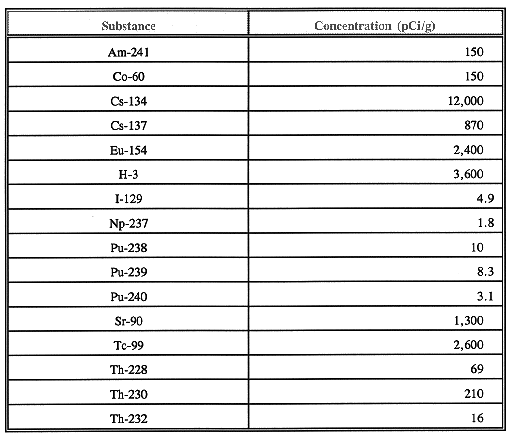
Table II Typical Radionuclide Composition of Soil from the Clean-up
of Federal Facilities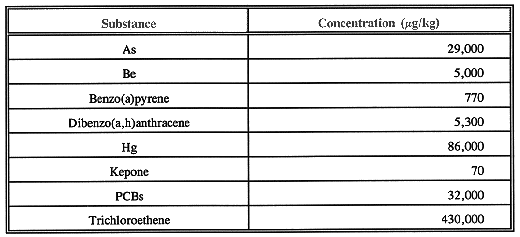
Steven A. Schaffer, Thomas McLaughlin and Neil Numark
SC&A,
Inc.
Michael Boyd
U.S. EPA
ABSTRACT
Contaminated soil from the clean-up of U.S. federal facilities represents a unique waste disposal problem because of its very large volume and relatively low concentrations of hazardous contaminants when compared to other waste streams. Disposal of this soil in a typical low-level waste facility could be extremely expensive and wasteful because of the large volume and low contamination characteristics of the soil. In addition, low-level waste disposal may not protect against the hazards of the non-radioactive hazardous substances.
A study was conducted to determine the safety of disposing contaminated soil in the following four different types of land disposal systems:
- Municipal Landfill (RCRA Subtitle D),
- Hazardous Waste Landfill (RCRA Subtitle C),
- Uranium Mill Tailings Facility,
- Low-level Waste Facility.
The radionuclide and non-radioactive hazardous components of typical contaminated soil waste from federal facilities were characterized. By assuming that this waste was the source of contamination, the risks from each waste disposal option was quantified using appropriate exposure pathway and risk models. The risks from each disposal facility was then compared.
The results of the soil characterization showed that typical soil waste from federal facilities would contain several fission and activation products, tritium, isotopes of thorium, several toxic elements, two polycyclic aromatic hydrocarbons, PCBs and chlorinated solvents. The results of the risk assessment showed that the more water soluble radionuclides (I-129 and Tc-99) represented the far greater risk. The overall risk from each disposal option was below 3E-04 suggesting that any of the four land disposal systems could provide an acceptable level of protection.
INTRODUCTION
Contaminated soil from the clean-up of U.S. federal facilities represents a unique waste disposal problem because of its very large volume and relatively low concentrations of hazardous contaminants when compared to other waste streams. Disposal of this soil in a typical low-level waste facility could be extremely expensive and wasteful because of the large volume and low radioactive contamination characteristics of the soil. In addition, low-level waste disposal may not protect against the hazards of the non-radioactive hazardous substances which may also be present in this soil.
This study was conducted to determine the safety of disposing contaminated soil from U.S. DOE facilities in the following four different types of land disposal systems:
- Municipal Landfill (RCRA Subtitle D),
- Hazardous Waste Landfill (RCRA Subtitle C),
- Uranium Mill Tailings Facility,
- Low-level Waste Facility.
The radionuclide and non-radioactive hazardous components of typical contaminated soil waste from federal facilities were characterized. By assuming that this waste was disposed in each disposal option and the source of risk, the risks from each waste disposal option was quantified using appropriate exposure pathway and risk models. The risks from each disposal facility was then compared.
METHODS
Soil Characterization
A preliminary characterization of the soil waste expected to arise from the environmental restoration of federal facilities was performed. This characterization includes the typical radionuclides and hazardous organic and inorganic substances contained in the soil and the relative amounts of each. The results of the soil characterization was aimed at identifying those substances which are both present in the largest volumes of soil and represent the greatest level of hazard thereby having the greatest likelihood of requiring cleanup.
The draft Programmatic Environmental Impact Statement (1) contains detailed contamination information in spreadsheet form for all U.S. Department of Energy (DOE) facilities. The information contained in this document was used to develop our soil characteristics. This information includes the radionuclide and hazardous substance composition and volume quantities for six different environmental media. Much of the information is incomplete, but the authors of this document state that the compiled data is representative of the total environmental contamination facing the DOE.
Radionuclide and hazardous substance composition and soil volumes were obtained from eleven facilities listed in Ref. 1. These facilities were chosen because they represented a good cross section of federal activities and provided a reasonable amount of contamination information. Soil volumes and concentrations for each contaminant within a facility were combined with the other facilities' soil volumes and concentrations to obtain an overall average contaminant concentration weighted by volume.
These volume weighted average contaminant concentrations were then assessed for a measure of hazard to determine the likelihood of requiring remediation. The weighted average radionuclide concentration in soil was then compared to the screening concentration in NRC, NUREG-1500 (2), which yields 3 E-05 Sv/yr (3 mrem/yr) total effective equivalent dose for the resident living on contaminated soil. The weighted average hazardous organic and inorganic substance concentrations were compared to the risk based screening levels in Ref. 3. Those weighted average contaminant concentration above the screening levels were then used to represent the typical DOE soil characteristic concentrations likely disposed in the various land disposal options.
Risk Assessment
The maximum individual lifetime risks from disposing contaminated soil for each land disposal option was quantified by modeling five exposure scenarios appropriate for surface land disposal. These include the external radiation exposure during waste transport and handling, and the post-closure exposure to radionuclides and non-radioactive hazardous substances via contaminated groundwater. The five exposure scenarios are the following:
The risk for external radiation exposure was the product of the radionuclide soil concentration, the EPA HEAST external slope factor (4), and a modifying factor. This modifying factor accounted for the difference between a semi-infinite volume source and a 30 cubic yard roll-off waste container (0.1), and the difference between exposures during a work year (2000 hours) and a full year exposure (8760 hours).
The post-closure risk from groundwater exposure was calculated for each disposal option using the MEPAS computer code. Standardized input to MEPAS for all four disposal facility included a 40 acre facility 24 feet deep with the receptor well located 1850 feet away from the site, and the receptor surface water body located 5000 feet from the facility. These values were obtained from NUREG/CR-6147 (5). In order to maximize individual risk, the waste was assumed to be disposed in an unsaturated zone with the saturated soil zone directly below the facility.
Each facility was modeled under three climatic conditions: 1) arid, 2) temperate, and 3) humid. Rainfall was assumed to be the following for each condition:
- arid = 6 inches/year,
- temperate = 24 inches/year,
- humid = 40 inches/year.
The RCRA Subtitle D landfill design used in the MEPAS code included a loam top soil cover with vegetation covering 50% of the area. This top soil cover was over a 24 feet deep loam unsaturated zone where the contaminated soil was placed. Below the buried waste soil was a three foot clay liner with a saturated conductivity of 1.0 E-07 cm/s. Directly below the clay liner was a sand saturated zone. Sand was chosen to increase contaminant transport to maximize post-closure exposure. All other parameters were default values taken from the MEPAS user's manual (6).
For the RCRA Subtitle C landfill the top soil and partially saturated soil waste zones were kept the same as the design of the Subtitle D facility. The RCRA criteria for Subtitle C disposal design call for a layer of clay with a membrane liner, a leachate collection system, and another clay liner. For the long-term nature of this study, the membrane liner and the leachate collection system were assumed not to be functional and are not included in the design. What is included following the 24 foot loam waste layer is a partially saturated 3 foot clay layer, then a one foot layer of sand, and then another 3 feet of clay. All other MEPAS parameters were kept the same as the Subtitle D design.
The uranium mill tailings disposal cell design has loam top soil followed by a three foot clay layer to simulate a radon barrier. The partially saturated waste zone was followed by a three foot clay liner. All other MEPAS parameters were kept the same as the previous discussed facilities.
The low-level waste disposal facility contained the same top soil cover, but this layer was then followed by 16.4 feet of clay as an intruder barrier. Below this barrier was the 24 foot loam unsaturated waste layer, and the saturated sand layer was immediately below the waste. All other MEPAS input parameters were the same as the other facilities.
RESULTS AND DISCUSSION
Soil Characterization
Table I and II contain the resulting radionuclide and hazardous substance concentrations in typical federal facilities soil requiring cleanup. Table I shows that the radionuclides include several fission and activation products, in addition to tritium and several isotopes of thorium. Table II shows that the typical non-radioactive hazardous substances include several heavy metals, polycyclic aromatic hydrocarbons and PCBs, in addition to a chlorinated solvent and pesticide.
Table I Typical Radionuclide Composition of Soil from the Clean-up
of Federal Facilities
Table II Typical Radionuclide Composition of Soil from the Clean-up
of Federal Facilities
This soil characterization is uncertain and must be considered preliminary. Actual volumes and contaminant composition of waste arising from contaminated soil are highly dependent on the selected remedy, and most federal facilities are far from selecting remedial actions. In addition many federal sites have little or no information on soil composition. All these issues could subsequently change our estimate of the typical soil characterization.
Risk Assessment
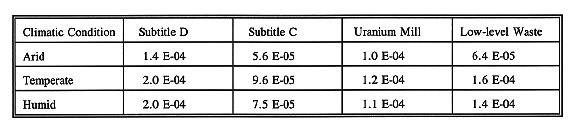
Table III lists the total maximum individual lifetime cancer risk for each disposal option under the three different climatic conditions. MEPAS calculates risks out to 10,000 years, and the tabular results list the maximum lifetime risk in that time frame. The table shows that the most protective facility is the RCRA Subtitle C landfill, and the least protective is the RCRA Subtitle D facility. Arid conditions resulted in the lowest risk, however the temperate sites produced the highest risk. Humid sites, with their added rainfall, diluted the resulting groundwater concentrations at the receptor location to levels lower than at the temperate sites.
Table III Individual Lifetime Cancer Risk for Each Disposal
Facility and Climatic Condition
Virtually all the risk came from the groundwater pathway and from the radionuclides that readily move with water, H-3, I-129, Np-237 and Tc-99. The non-radioactive carcinogens that move with groundwater (As and trichloroethene) yielded positive risks, but the levels were several orders of magnitude below the four significant radionuclides.
Mercury is not considered a carcinogen, and its impact was calculated using the Hazard Index approach in MEPAS. The Hazard Index is the ratio of the calculated exposure to the EPA reference dose (RfD). A Hazard Index value grater than one suggests detrimental health impacts. The results of our analysis showed a Hazard Index for mercury for all facilities and conditions in the 1 E-05 to 1 E-15 range, well below any indication of hazard.
The results in Table III are maximum risks and no facility or condition yield 70 year lifetime risks greater than 2 E-04. This suggests that typical soil from federal facility remedial actions can safely be disposed in any of the four types of land disposal designs. The annual radiation dose equivalent to 2 E-04 70 year life time cancer risk is less than 1 E-04 Sv/year (10 mrem /yr).
REFERENCES