Table I Contamination Dose Rates Distribution in Ploucnice River
Environment.

Sona Konopásková
Nuclear Research
Institute plc
CZ-250 68 Rez, Czech Republic
ABSTRACT
The contamination of the Ploucnice river environment occurred in 1960 as a consequence of long-term leaching process in the site of chemical uranium mining facility. There were accepted no remediation activities until 1990. The river sediments and the riverside have been contaminated to the level of 200 nSv/h to 600 nSv/h, but in some parts of the riverside the dose rate increases even above the value of 2.5 µSv/h.. The site is contaminated mainly by Ra-226 and U(nat) isotopes. In 1995 the Ecology Division of DIAMO company has started the activities dealing with the radiological impact evaluation of the river contamination. The discussion about the final site remediation was opened. It was proved that the radiological impact is not negligible with respect to long-term safety requirements and all the region is followed at present to review the input data and to chose the alternative final solution of the site remediation.
PLOUCNICE RIVER CONTAMINATION
Ploucnice river environment is a part of contaminated area close to uranium mining milling site in Stráz pod Ralskem (Czech Republic). The site is in the vicinity of the uranium waste settling pond. The contamination occurred as a consequence of the leaching process in uranium mining in 1960 but no constraints had been accepted till 1990. Therefore the contamination moved downstream the river and the contamination of soil and sediments can be found along the whole length of river (88.2 km) (1) with exception of individual parts of the riverside. In the beginning the contamination was caused by failures in uranium processing technology. Consequently, the contaminated area spread along the Ploucnice river downstream due to numerous floods form 1960 to 1990 and dependently with the river flow parameters.
At present the uranium mining in the area was finished and remediation of the site shall follow. The data on river water, riverside and sediments contamination has been collected since 1960. The Ecology Division of DIAMO company, who is the owner of the uranium mills in Stráz, continues with these activities. The radiation impact of present state of contamination was evaluated by Nuclear Research Institute Rez. The options of the site redemption had been proposed in 1995 (2).
SOURCE OF CONTAMINATION
The Ploucnice river environment is contaminated with radionuclides Ra-226 and with U(nat) isotopes. It was proved that the contamination is not of natural origin and it varies along the riverside. The source term evaluation would be very complicated in this case because the dose rate magnitude increases from the background value 200-600 nSv/h to more than 2.5 µSv/h in some areas. Natural background in the site does not exceed 200 nSv/h. The dose rate distribution and 226Ra contamination in the soils of Ploucnice riverside is presented in Table I.
The river water contamination is 0.1-3 Bq/l and the river sediments are contaminated with 226Ra and U(nat) to the level of 10000 Bq/kg. The maximum contamination can be found in ponds supplied by Ploucnice water. The contamination of biota was not proved.
Table I Contamination Dose Rates Distribution in Ploucnice River
Environment.
For the purpose of safety evaluations, the source term was divided into particular elements with homogenous contamination.
EVALUATION OF LONG TERM IMPACTS ON POPULATION
There was not detected any increase in activity and dose rates in the Ploucnice environment in twenty years. The Czech Law 59/72 limits the population dose to 5 mSv/y and the concentration of natural radionuclides in solids is limited to 74 Bq/g.
It was not proved that the contamination in the site would significantly decrease during last 30 years - it only moves along the riverside. It was necessary to analyze possible residence scenarios and probable future use scenarios for the Ploucnice river safety evaluations. As there is lack of demographic data connected to the possible future use of the riverside, the principal safety scenarios were evaluated using present real and conservative data. It must be noted that the contaminated riverside is badly accessible by persons and that the contamination of river water and of fish is practically zero.
The maximum dose occurs within the first 50 years. The dose in the period of 2000 years are in orders of units of mSv/y and they decrease to zero in 3000 years. The dose is mostly subject to the presence of 226Ra in the riverside sediments (Fig.1). The effect of presence of U(nat) is two orders of lower magnitude. In the case of water independent pathway external exposure and potential plant consumption are the decisive components of the dose (Fig. 2). Considering water dependent pathway, i.e. possible leaching of sediments and soil contamination to groundwater, the dominant pathway of dose is due to groundwater consumption and plant consumption (Fig. 3).
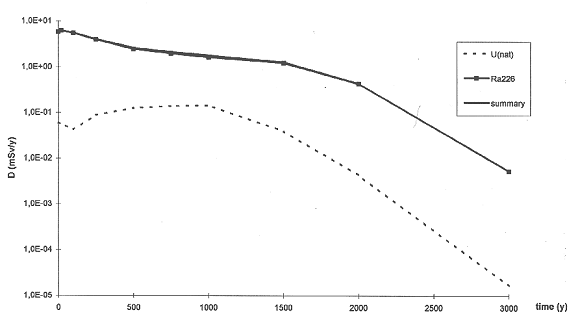
Fig. 1. Dose by unit contamination
from Ra-226 and U (nat).
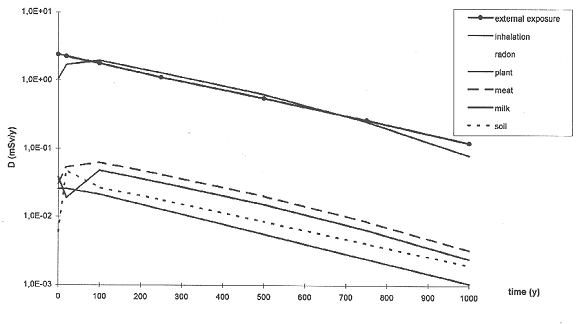
Fig. 2. Water independent pathway -
summary.
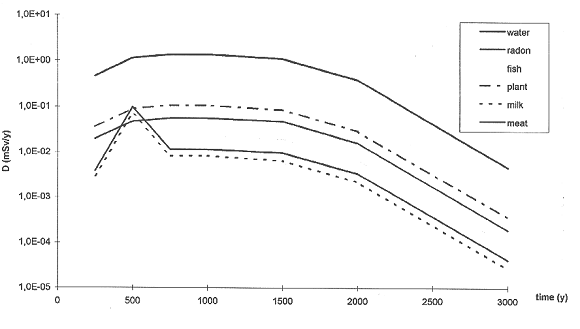
Fig. 3. Water dependent pathway -
summary.
It can be assumed that external exposure is the decisive component of the dose. After the time necessary for radionuclides in biosphere, i.e. in 1000 years, the ingestion would be the most important way of impact. Realistic doses would be much lower in near future than the these doses because of bad reachability of the riverside by man.
CONCLUSIONS
Final solution of the Ploucnice river sediments contamination will be probably included in the final solution of settling pond in Strá. There exist several options to solve the present situation:
REFERENCES