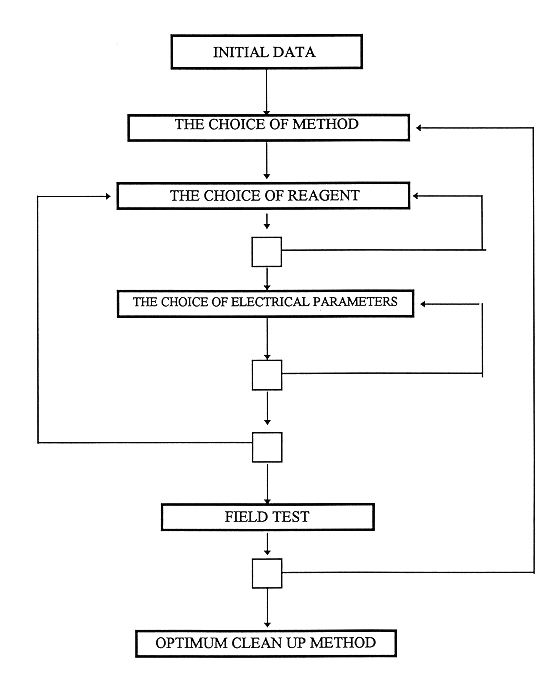
Fig. 1. The choice of electrokinetic
method for soil decontamination.
L.B. Prozorov, V.V.Martyanov, M.Yu.Chtcheglov
Mos SIA "Radon"
ABSTRACT
Electrokinetic methods are applied for soil clearing from radionuclides and heavy metals. It, so-called, IN SITU methods. With the help of these methods the soil clearing is made directly on the place of pollution (without preliminary ground removing and processing).
These methods are based on known processes:
The application of methods is preferable for local sites with the large levels of contamination.
Since 1993 these methods are used for soil cleaning from radionuclides at the Mos SIA "Radon" . Earlier electrokinetic methods were applied to clear surfaces from SO42- and residual uranium at the production enterprises.
INVESTIGATIONS
The choice of the soil decontamination type bases on the realization of both laboratory and field researches. As a result of these researches the optimal procedure or the soil decontamination technology are selected. We use the certain sequence of researches to define an optimum electrokinetic technology for soil cleaning (Fig.1). Based on results of experimentation, we have selected the main parameters of the technological proceeding as follows:
We will not consider all the parameters mentioned above in the present paper. We shall give a special attention to some particularities and regulations, realized during the laboratory and field research.
Fig. 1. The choice of electrokinetic
method for soil decontamination.
LAB TESTS
At present time we have conducted more than 80 tests for chemical reagents choice (static researches) and have defined, that 137Cs deleting from a polluted ground occurs mainly in the acid environment with the presence of first chemical group cathions (Na+, K+, Rb+) and ammonium salts (NH4+). These results are in a full accordance along with results of other authors.
Upon dynamic research we have found very strong influence of iron and aluminium cathions on the process of 137Cs extraction from the ground.
The research has been conducted using of vertical columns (Fig.2).
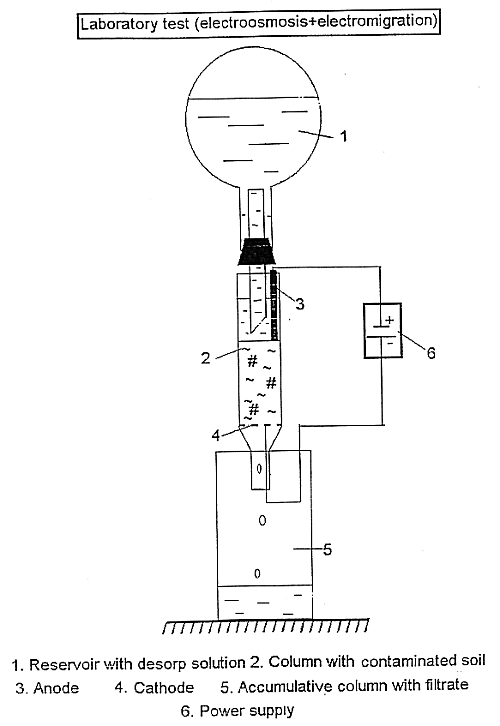
Fig. 2. Laboratory test
(electroosmosis + electromigration.
The clay ground, polluted by 137Cs (specific activity 80 Bq/g ) was selected for tests. It was established as a preliminary result, that the soil had a low filtration (Kf=0.001m/day, n=0.47) and a good sorption properties (137CsKd=6000ml/g).
The mineralogical and spectrometer analysis data show the component structure of a ground, which is characteristic for the clay minerals (Table I).
Table I The contents of Main Components in the Ground, % Weight.

The low permeability of this ground was one of the reasons why the electrokinetic method for its decontamination has been used. The regular selection of filtrate (for determination of specific activity, mineralization and component structure) was carried out during this research. The electrodes voltage drop was constant and equal to 0.8 V/cm.. The force of current varied between 110 and 500mA. The acide solutions, containing K+ and NH4+ were used as the desorbent.
It was established, that 137Cs extraction depends on aluminium and iron ions extraction. The peak value of 137Cs specific activity was found out at the same time with the appearance of iron and aluminium ions in analyzed filtrate (Fig. 3). The decrease of Fe2+3+ and Al3+ concentration in analyzed filtrate has been also resulted in decrease of 137Cs specific activity.
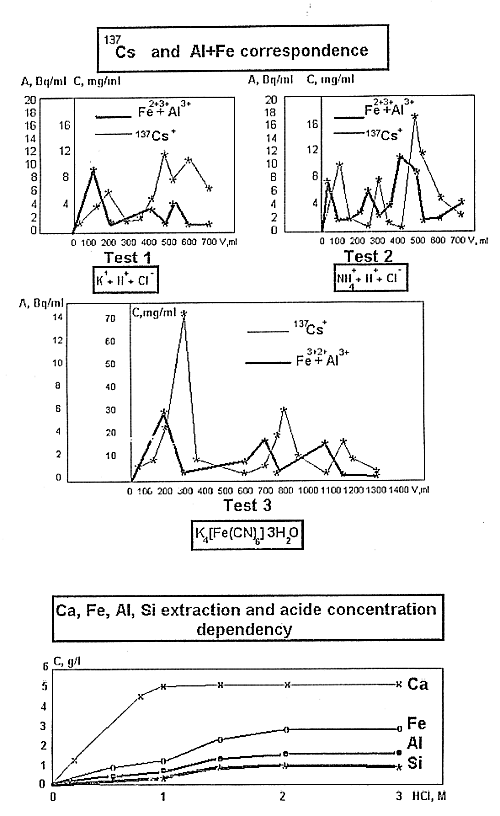
Fig. 3. 137Cs and Al+Fe
correspondence.
After completion of laboratory tests the samples of soil were analyzed for determination of residual specific activity and other parameters. During this research the locations of the secondary 137Cs accumulation, including the locations of iron hydrooxides and other metals (pH > 1.8-2.2) were found.
FIELD TEST
It was recommended for the field tests to use the technological parameters as follows:
An experimental site located on the creek valley was selected for the field tests.
As the results from surface radiometric shooting and data of wells drilling, the main contamination for intervals of depths 10-30 and 15-40cm has been discovered. The results of geological, hydro-geological and radiometric ground testing have shown, that the ground is represented by several clay sediments, having various significances Kd (from 480 up to 16800 mg/ml for Cs137). The basic element-contaminant is the 137Cs (more than 94% from total radionuclides in this ground), the specific activity makes 5-56 Bq/g.
The electrode (cathode) and the monitoring wells were drilled on the depth 0.9-1.0m. The anode electrode was placed on the surface of the site. The site was supplied by the special tank with chemical solution, providing periodic surface raining.
The same legitimacies have been detected both in the field and laboratory tests (Fig. 4).
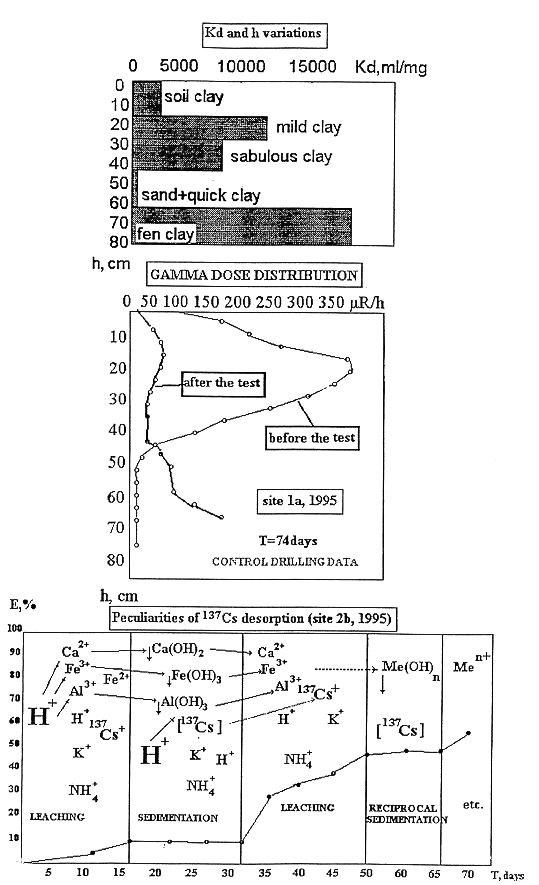
Fig. 4. Kd and h variations.
The change of gamma-activity was ceased in about 2.5 weeks after beginning of tests. The force of electric current decreased in several times (from 1 up to 0.25A for each pair of electrodes ), the osmosis effect disappeared and the filtration of the solution into the ground has been stopped.
The results of wells drilling ( depth 20cm) shown secondary resedimentation of iron and other metals in carbonates and hydrooxides forms. For the these locations the secondary anomalies of scale - activity, exceeding initial values, were dated.
However, during the following two weeks it was marked that the filtration ability has been restored, the electric current increased up to the initial value and the maximum of contamination moved downwards under influence of electrical and chemical effects.
Further these processes was repeated. The control drilling was conducted after completion of the field tests. The results have shown that the surface was cleaned till the level of radioactivity equal to 1-2 natural background. It was also marked, that the loss of radioactivity was 62% in interval of depths 0-40cm. At the same time, the data of profile drilling have shown nonuniformity of the soil cleaning in the whole volume of the ground. The greatest degree of cleaning was fixed at the points, where the shortest distances between cathodes and anodes were established. The secondary 137Cs accumulations have been observed on different peripheral points.
CONCLUSION
Based on research it is possible to mark following:
BIBLIOGRAPHY
REINIERS R.S. and KRENKEL P.A. 1974. Kinetics of Mercury Adsorption in Sediments, J. Water Polut. Control Fed., 46(2): 215
HAMED, J., Y.B. ACAR and R.J. GALE 1991. Pb (II) removal from kaolinite by Electrokinetics, J. Geotech. Eng., ASCE, 117(2): 241-271
I.A. SOBOLEV, L.B. PROZOROV, A.S.BARINOV & V.V. MARTYANOV. 1996. Experiments of Applying Electromigration to Soil Contaminated with 137Cs, J. Environment. Geotechn., 6(2):1089-1094