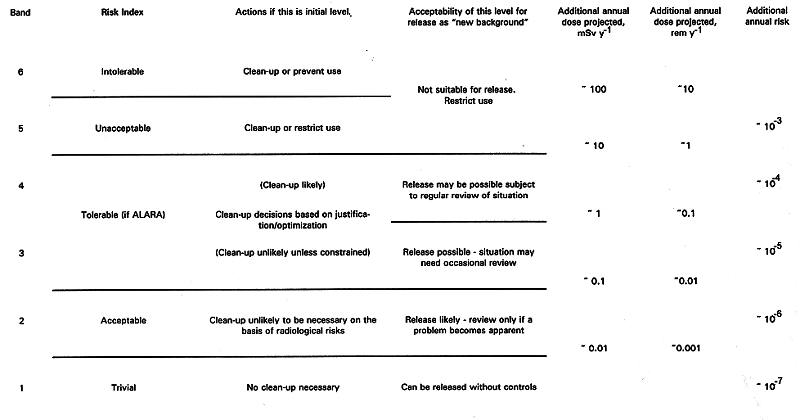
Fig. 1. Scale of proposed actions for
different dose and risk levels.
G. Gnugnoli, G. Linsley, and P. Stegnar
International
Atomic Energy Agency (IAEA)
Vienna, Austria
ABSTRACT
In the past, radiation protection has been concerned primarily with establishing the conditions that should be applied to the introduction of new practices and the management of continuing practices. There are two other types of situations which may need to be considered. These are contamination from past practices, which may be discovered well after a practice is discontinued at a particular site, or when an accident occurs that leads to chronic exposures due to the resulting contamination. Different scales of the operation, source terms, radionuclides and environmental media lead to different contamination situations. They may be confined to the site of the operation or extended to the off-site area. In the latter case, the contamination situation may be caused, for instance, by inadequately controlled discharges, transportation accidents (including satellites and weapons) and major accidents at nuclear installations, causing large scale off-site contamination. Apart from the terrestrial contamination, such releases may also contaminate off-site aquifers and river, lake and estuarine sediments. In order to bring such environmental contamination situations to a state in which they can be safely reoccupied and utilized, some remedial actions may be necessary, such as removal, cover and/or mixing of radioactive materials in soil, treatment of ground and surface waters, and the decontamination of structures.
Over the last three years, an IAEA working group has been developing radiological principles for use in decisions related to the clean-up of contaminated areas. More specifically, it has been attempting to establish an approach to developing radiological criteria for clean-up and to recommend ranges of generically applicable numerical values. The draft guidance produced by this working group is about to be circulated within the international community of experts in this field for comment.
INTRODUCTION
At the present time there is a gap in the guidance offered by the international agencies concerned with radiation protection in the area of chronic exposure to residual radioactivity. This arises from past practices, which may have been discontinued at a particular site, and may have resulted in contamination either routinely from the previous activities or else from an accident, where adequate clean-up had not been undertaken or completed. These are commonly known as "clean-up situations". The term "clean-up" in this context has approximately the same meaning as the words "rehabilitation", "reclamation", and "remediation" used elsewhere. In these situations some remedial actions may be necessary, such as removal, cover and/or mixing of radioactive materials in soil, treatment of ground and surface waters, and the decontamination of structures. Decisions on remedial actions should be guided by appropriate radiological criteria. Considerations for the development of such criteria are summarized in the following sections (1).
TYPES OF CONTAMINATION SITUATIONS
Clean-up may be needed when environmental media have been contaminated as a result of a variety of human activities involving radionuclides. The activities, past and present, that may lead to contaminated areas and eventually to clean-up include amongst others:
a. various phases of the nuclear fuel cycle (mining and milling of uranium ore, enrichment and fuel fabrication, energy production and reprocessing),
b. radioactive waste disposal, either on land or in the marine environment,
c. nuclear weapons production,
d. nuclear tests and other detonations,
e. use of radionuclides in medicine and research,
f. use of sealed and unsealed sources in industry,
g. ore processing, mineral extraction of materials containing natural radionuclides, and other activities with may generate enhanced levels of natural radionuclides (radium, thorium, rare earths, phosphates, oil and gas production),
h. misuse of natural or man-made materials containing natural radionuclides, which have been used in construction (e.g., uranium mill tailings used in landfills or in residential construction), and
i. accidents.
The type and extent of the contamination will depend on the scale of the operation, the source term, the nature of the radionuclides and the contaminated environmental media involved. This will lead to different contamination situations. They may be confined to the site of the operation or may extend to off-site areas. In the latter case, the contamination situation may be caused by inadequately controlled discharges, either by current operations, or by operations in the past, transportation accidents (including satellites and weapons) and major accidents at nuclear installations, causing large scale off-site contamination. Apart from the terrestrial contamination, such releases may also contaminate off-site aquifers and river, lake and estuarine sediments.
DEVELOPMENT OF CLEAN-UP CRITERIA
The following paragraphs are based upon the discussions of the IAEA working group on this subject. It is a preliminary and abbreviated account of their deliberations intended to provide an initial indication of the international trends in this area.
The approach suggested for establishing criteria for clean-up operations involves the justification/optimization principles of radiation protection and also defines a maximum generic annual dose level to constrain the residual dose following clean-up operations. This maximum generic annual dose level is based on a series of international recommendations on intervention and exemption levels and on the perspective supplied by the variation of annual individual doses from natural sources.
Figure 1 displays the range of possible clean-up situations, divided into six sections or "bands", each covering approximately an order of magnitude in dose or risk. For easy reference, these are numbered from 1 (annual doses less than 10 Sv or 1 mrem above background) to 6 (annual doses with the potential to cause serious deterministic effects in less than a year). Each band is categorized into two aspects - the need for clean-up if this level of exposure would result from the initial level of contamination, and the post- clean-up measures that would be implied if the situation were to be used as the end-point, indicating its possible suitability as a release level. The doses are chronic and to be considered additional to the level of doses attributable to the natural environment.
Band 1, represents annual doses less than 10 Sv (1 mrem) above background, and represents risks that would be regarded as trivial in the vast majority of situations. Criteria for triviality of risks have been published in the context of exemption of practices and sources and clearance of materials from practices. The Basic Safety Standards (2) specify criteria for exemption and clearance, when the effective dose -- expected to be incurred by any member of the public -- is on the order of 10 Sv or less in a year, and the collective dose committed by one year of performance of the practice is no more than about 1 man -Sv.
Band 2 represents annual doses (typically tens of Sv above background) in the range that would be considered acceptable, as additional exposures imposed on members of the public as a result of a set of planned actions with an overall net benefit to society (i.e., a justified practice, such as the use of smoke detectors).
Band 3 represents risks that might be considered tolerable as additional risks from a justified practice, provided that they were as low as reasonably achievable; the upper bound of Band 3 corresponds approximately to the ICRP (3) dose limit for members of the public (1 mSv y-1 or 100 mrem y-1 above background). Also, many national authorities have adopted dose constraints, typically between a hundred to some hundreds of Sv y-1 to apply to new and/or existing practices, and international recommendations have been made about rationales for choosing constraints (4, 5). However, these levels of risk are low enough that they would be considered acceptable in many other situations.
Examples of situations involving decisions for Bands 1-3 involve the presence of natural radionuclides (e.g., 226Ra) in construction fill material. Depending on the levels of radium, and hence radon, and the resultant radon daughter concentrations, decisions would need to be made based on the cost of repair and on the benefit thereof.
Band 4 represents risks corresponding to doses of the order of 1 mSv y-1 (up to a few times average background). These would not normally be considered acceptable if they were deliberately imposed on the public, but are low enough that they would be acceptable in other situations, such as:
a. If the individuals are exposed voluntarily and receive a direct compensating benefit; e.g., radiation workers or people receiving medical x~rays, then risks of this magnitude would be acceptable if they were as low as reasonably achievable;
b. Radiation risks of this magnitude are routinely accepted from natural sources, and variations of this magnitude in levels of background radiation do not appear to influence people's behaviour.
Band 5 (doses of tens of mSv y-1) represents risks that would generally be regarded as unacceptable from any source (with the exception of necessary medical treatment) as the stochastic risks associated with exposures in this band are too high to be tolerated under normal circumstances.
Band 6 represents risks (whether in terms of serious deterministic effects or a high probability of stochastic risk) that are clearly intolerable in all but the most exceptional circumstances (e.g.; radiation therapy to treat cancer). Both the risk of serious deterministic effects and stochastic risks would always be so high as not to be tolerated under any circumstances.
It is clear that the annual doses dividing the bands can only be approximations in view of the uncertainties involved. Nevertheless it is convenient to have single numbers to represent criteria, and considerable presentational problems may be expected if slightly different numbers are quoted in different situations.
In this case, the most significant criterion that cannot readily be linked to existing criteria is probably that dividing Bands 4 and 5. This represents a point above which cleanup would normally be expected to be undertaken in unconstrained situations, and therefore also represents the maximum level of residual risk that (apart from exceptional circumstances) might be considered acceptable as a "new background" level. Therefore, situations with annual individual doses above this level would never be considered as normal, whereas situations with annual doses below this level would in most cases - but not always - be considered as normal.
An example is nuclear weapons testing area in the Republic of the Marshall Islands in the Pacific Ocean. The annual background (excluding the effects of the nuclear weapons testing) is 2.4 mSv (0.2 rem). Without any intervention, the total effective dose is approximately 17.4 mSv (1.7 rem). Following an optimized remediation strategy, the effective dose is reduced to 2.8 mSv (0.3 rem). This effective dose rate (which includes the contribution from the natural environment) becomes the "new background" level (6).
Fig. 1. Scale of proposed actions for
different dose and risk levels.
PROPOSED GENERIC LEVEL FOR CLEAN-UP
The analysis of the IAEA working group indicates that when annual individual doses from residual activity (excluding background) are in excess of 10 mSv y-1 (1 rem y-1), cleanup should be undertaken. For situations in which the annual doses are already 10 mSv y-1 (1 rem y-1), the objective should be to avert as much of the dose by clean-up as reasonably achievable. The selection of 10 mSv y-1 (1 rem y-1) as a generic criterion above which some form of clean-up would normally be expected is also supported by consideration of the following:
i. Worldwide variation in natural background dose;
ii. Action levels recommended by ICRP and IAEA for radon in dwellings and workplaces;
iii. Doses implied by interdiction levels of activity in foodstuffs; and
iv. IAEA recommendations on criteria for resettlement of populations.
REFERENCES