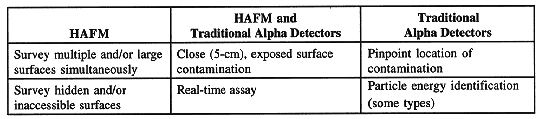
Table I Comparison of HAFM and Traditional Alpha Detector
Applications
P. L. Kerr, J. E. Koster, Kevin Macy and Jay Cook
Los
Alamos National Laboratory
Los Alamos, NM 87545
ABSTRACT
Detection of contamination within large volumes or pipes is important for the processes of decontamination and decommissioning and for the transportation and disposal of hazardous waste. Alpha-emitter contamination (actinides) has been particularly difficult to assay because of the short range of alpha particles in air -- about 5 cm. In addition, real-time sensitive monitoring of long or small enclosures, or of large volumes with complicated internal geometries, is very difficult or impossible with traditional alpha detectors.
However, the ionization detection method (long-range alpha detection, or LRAD) in development at Los Alamos National Laboratory detects the air molecules ionized by alpha particles (rather than the alpha particles themselves), and these ions can travel long distances through enclosed volumes (several meters). In addition, a single 5-MeV alpha particle produces approximately 140,000 ions, and so even an incomplete collection of the ions will produce a significant signal as opposed to a traditional alpha detector which either detects or fails to detect a single alpha event. The LRAD method therefore offers significant advantages over other detector schemes.
Ionized air molecules are produced in an enclosed volume by alpha-emitting contamination. The LRAD detector collects these ions on a grid or on parallel plates held at 100-300 V. Ions of a given charge move onto the detector plates via the electric field. A fan is often used to help move the ions if they originate far from the electric field. The current produced is then measured by a very sensitive electrometer. For larger volumes, higher airflows and detector voltages are required to maintain the same sensitivity to alpha contamination. In addition, the parallel plates are the preferred method for high airflows because of reduced turbulence. However, the technique can be complicated by other sources of ions in the volume such as ventilation systems or background ion concentrations from the atmosphere and cosmic rays.
We will present the results of tests of a High Airflow Monitor alpha detector and draw conclusions about the optimum configuration for specific assay applications. Detector parameters examined include varying voltages, grid and plate geometries, airflow rates, and whether the signal originates from the neutral plates or the plates at high voltage.
INTRODUCTION
Aswill be shown in this paper, the advantages of an LRAD-based volume monitor are its inexpensive simplicity, ruggedness, and its ability to detect contamination that is hidden from traditional alpha detection methods such as Geiger-Muller, gas cell, or solid-state detectors. In addition, LRAD designs have been miniaturized to the size of portable hand-held devices for use as swipe monitors, surface contamination monitors, and ion "sniffer" devices for alpha emitter radioactive leaks.
Traditional alpha detectors are designed to detect individual alpha particles and must not only be in direct line of sight of the contamination, but also in the immediate area of the contamination. This is because alpha particles travel directly out from their source and have a very short range. Within just a few centimeters of their source, the alpha particles lose all of their energy to collisions with air particles, creating many ions. This makes it difficult or impossible to see contamination in small spaces such as cracks or on other surfaces inaccessible to the detector.
However, the ions created by the alphas can escape from small cracks or from behind enclosures and travel several meters. The LRAD is designed to collect these ions and therefore can detect contamination that is inaccessible to traditional alpha detectors. In addition, a single alpha particle creates 140,000 ion pairs, and so, even if only a fraction of these ions make it to the LRAD, they will produce a large signal. In contrast, a traditional alpha detector produces a signal only if struck by individual alpha particles. Adding high airflow to the LRAD technology greatly extends its capability.
In this paper we discuss the design and behavior of a High Airflow Monitor (HAFM) based on Long-Range Alpha Detector (LRAD) technology (1). The low air resistance construction of the HAFM enables the high airflow crucial for assay of rooms, vaults, or cargo vehicles. This is accomplished by orienting plates parallel to the airflow rather than perpendicular, as are the grids in other LRAD designs.
APPLICATION
With the increase of nuclear waste, there is an increase in the need for its safe transport, storage, and disposal. In order to maintain a safe working environment for personnel and to comply with federal regulations, an accurate set of radiation monitoring tools is required. The set may include devices for detecting beta, alpha, and gamma emitting material. Cost considerations demand devices which are simple to build and operate, reliable, and rugged enough to withstand potentially harsh environments. For example, a truck installed with a detector system for continuous monitoring must withstand and operate in environments with large temperature fluctuations and with high vibration and motion shock. A detector continuously monitoring an underground vault may have to endure very dusty or damp conditions.
The design of the HAFM is extremely rugged and simple to build, operate, and maintain. For these reasons, the HAFM could be one of the valuable monitor and assay tools used in the transportation, storage, and disposal of nuclear waste. The HAFM is well suited for the monitoring of large volumes such as cargo vehicles, storage vaults, and rooms, which may be exposed to radioactive waste.
Surface contamination can result from storage containers that are poorly prepared or that have small leaks. These leaks can be very small and difficult to reach with traditional alpha detectors. In addition, checking every square foot of container and vault surface can be impractical. However, with the HAFM, this kind of contamination can be assayed very easily. All surfaces can be monitored simultaneously because the fan on the stationary detector pulls ions into the detector from throughout in the room. There is a limit to the detector capability, dependent upon the size of the room and number of barriers between the contamination and the detector. However, as will be shown below, preliminary tests of the HAFM in a medium sized van indicate it has good sensitivity to alpha emitters.
For comparison, Table I shows potential applications for LRAD-based and traditional type alpha detectors, including overlap.
Table I Comparison of HAFM and Traditional Alpha Detector
Applications
HIGH AIRFLOW MONITOR OPERATION
The high airflow LRAD design is shown in Fig. 1a. It consists of two to seven parallel plates aligned along the direction of airflow. A fan pulls air at high speed (50-400 cm/s) from the volume to be monitored, such as a room, storage vault, or cargo volume, into the detector. Voltage of up to 600 V is applied to alternate plates, while the remaining plates are at ground potential. The ions of oxygen and nitrogen moving through the detector collect on the high-voltage (HV) plates and create a current proportional to the number of ions in the air. This current is extremely small (10-12-10-15 A), but very sensitive electrometers are available to measure these small currents. In addition, Los Alamos has developed electrometers that are small enough (wrist-watch size) to be carried on portable devices.
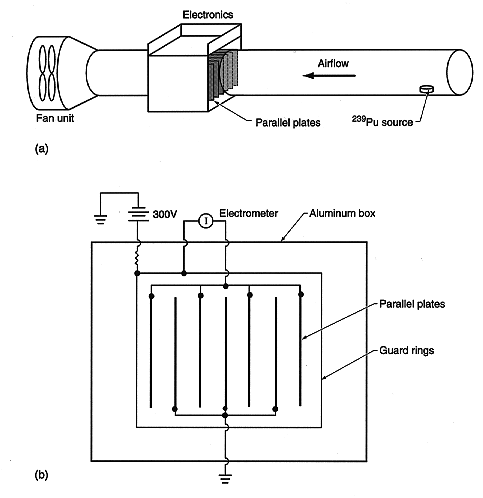
Fig. 1. Schematic diagrams of High
Airflow Monitor. Figure 1a shows the mechanical layout and Fig. 1b shows the
electrical layout. The 239Pu source shown in Fig. 1a was used to
test the system.
The high airflow through the detector enables more of the ions in the monitored volume to arrive at the detector before they recombine with other ions and become neutral again (2). The finite lifetime of the ions is determined largely by their interaction with the surfaces and objects in the volume. Turbulent airflow can increase collisions with detector walls, reducing the signal, and is therefore undesirable. In low airflow LRAD designs, the plates are perpendicular to the airflow, and this geometry would introduce great turbulence and reduce the airflow rate if used in a high airflow application. The smooth (laminar) airflow made possible using the parallel plate design, increases the airflow and maintains low ion loss due to turbulence, thus increasing detector sensitivity.
Since the detector monitors such small currents, effort must also be made to reduce false signals from currents leaking through insulators. These so called leakage currents can be comparable to and even larger than the signal from alpha emitters. Leakage currents can be reduced greatly by using a guard plate or ring between the signal plate and other paths to ground potential. The guard ring is at the same HV as the signal plates, and so the signal current will not take a path through the guard ring to ground. Figure 1b illustrates the electrical layout of the HAFM, including the guard ring. The resistor is in place mainly for electrical safety to reduce the shock if a researcher accidentally contacts the HV plates during testing.
Figure 2 shows a two-plate detector to illustrate the dependence of the
detector signal on each of the parameters which characterize the detector. Here,
L is the detector plate length, Vp is the plate voltage, S is the
plate separation, and F is the airflow rate. The quantity c is a constant
representing the drift rate or diffusion of ions in an electric field, and has
units of  .
.
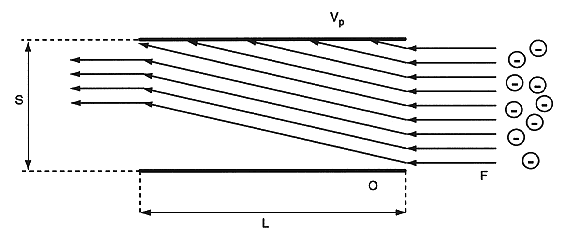
Fig. 2. Diagram of High Airflow
Monitor parameters for a two-plate configuration. S is the plate separation, Vp
is the applied positive voltage, L is the plate length, and F is the airflow
rate. Shown are the negative ions being attracted to the top plate at potential
Vp. The bottom plate is at ground potential and attracts positive ions.
An incoming ion at the bottom plate will pass through the detector in a time
L/F. In order to be detected, the ion must drift in the electric field up to the
second plate in an equal or lesser time. The time for this drift is
 . Therefore, 100% efficiency
is ideally given by
. Therefore, 100% efficiency
is ideally given by
 (1)
(1)
where Vm is the voltage at which the signal saturates. If, for
example, the quantity L/F is half of the drift time
 , the efficiency is 50%. The
efficiency can therefore be written
, the efficiency is 50%. The
efficiency can therefore be written
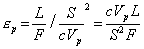 (2)
(2)
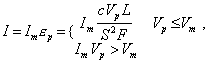
The ideal response of the detector is then
 (3)
(3)
which for Vp<Vm is linear in the applied voltage Vp with slope
 (4)
(4)
Here, I is the detector current, and Im is the saturation, or maximum, current.
Although the detector response does not follow Eq. (3) exactly, it is linear at low voltages and enables a determination of the diffusion constant c. These results are given in the data section below.
EXPERIMENTAL DATA
The HAFM shown in Fig. 1 is a seven-plate LRAD design. This represents one of several plate configurations tested for the combination of optimum detection efficiency and simplicity of construction. Several other parameters were also varied, including airflow rate, voltage applied to the plates, plate separation, and collection of the signal from the plates at either HV or at ground potential.
The detector opening is a 9cm inner diameter aluminum pipe, followed by a 15cm x 15cm x 16cm aluminum box containing the parallel plates. This is followed by a 9-cm inner diameter aluminum pipe exit, and then a fan. The measurements were performed using a 192,000-disintegrations-per-minute (192kdpm) 239Pu source 65cm from the front of the detector plates. Voltage to the plates was provided by combinations of batteries between 1.5 and 300V, and the current was measured using a miniature electrometer constructed in-house. The electrometer has a 0-1V output signal for convenience, and this is the output signal used in plotting the results.
Source-In-Pipe Study
Figure 3 shows the data taken for several plate configurations ranging from two plates spaced 7.6cm to seven plates spaced 1.3cm. All error bars are smaller than the data symbols. Figure 3a shows the detector response at F=400cm/s with the signal taken from the positive HV plates. The ions collected are therefore negative. Figure 3b shows the same for F=50cm/s. The curves are fits to the data, and are described below.
For the 50cm/s data, notice that the signal levels off at ~225mV independent of the number of plates. This is the saturation signal, and indicates that essentially all of the ions making it to the detector are collected, i.e., none pass through the detector. The same is true for the 400cm/s data, but the saturation signal is higher at 350mV. The higher airflow results in a higher signal because a shorter transit time to the detector results in more ions making it to the detector. In other words, because of the ion recombination half-life, a shorter transit time to the detector means more ions make it to the detector before they recombine. For example, in the case of ion transport in pipes, studies have found an ion half-life of 8. ± 2.s. (3).
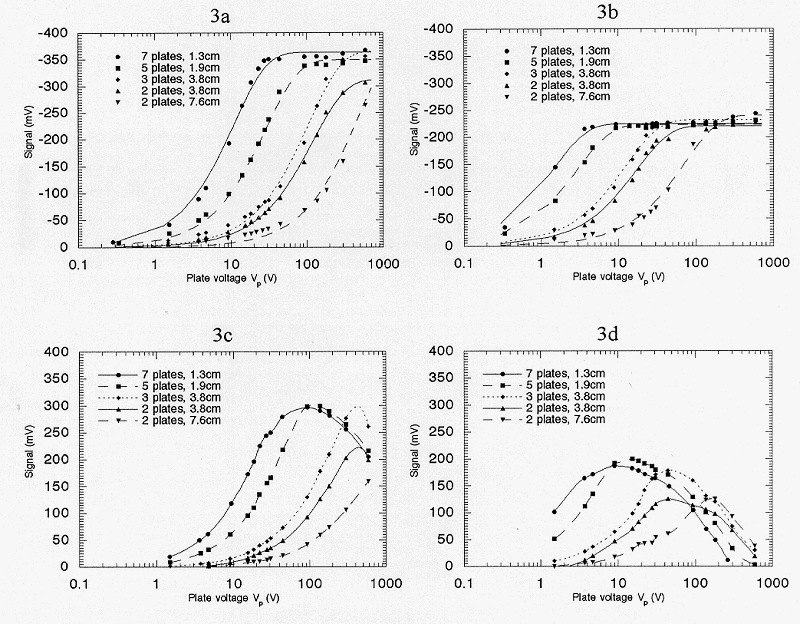
Fig. 3. Response of the HAFM to
various plate separations, airflow rates, and signal origins. Figure 3a shows
the detector response for the signal taken from the high-voltage plates for an
airflow of 400 cm/s. Figure 3b shows the same for an airflow of 50 cm/s. Figures
3c and 3d show the signal from the ground plates at 400 cm/s and 50 cm/s,
respectively.
Figures 3c and 3d show data for an airflow of 400cm/s and 50cm/s with the signal taken from the plates at ground potential which collect positive ions. The curves shown simply connect the data points. Again the 400cm/s data produces the larger of the two signals. However, they are smaller than the corresponding signals from the HV plates. In addition, the signals fall off at high voltages. Both of these effects are due to fringe electric fields from the HV plates. The fringe fields create a collection plate for positive ions out of the pipe walls, and this competes with the ground collection plates for a signal. This effect is not present in the case of the signal taken from the positive HV plates. This is because the stronger the fringe fields in the pipe, the more the negative ions are attracted toward the HV plates and away from the grounded pipe walls.
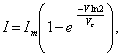
For the cases in Figs. 3a and 3b, the signal is linear at low voltage and levels out at high voltage, as described by Eq. 3. However, the signal deviates from Eq. 3 at intermediate voltages. An attempt was made to find an equation which better describes the data of Figs. 3a and 3b. The desired equation should have a slope given by Eq. 4 at Vp=0V, and approach zero slope at high voltage. The curves shown in Figs.3a and 3b were obtained by fitting the data to
 (5)
(5)
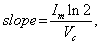
where Vc is the voltage which produces I = ½ Im. At Vp = 0, Eq. 5 has a slope of
 (6)
(6)
which can be set equal to Eq. 4 to give
 (7)
(7)
Equation 7 can be solved for c to obtain experimental values of the diffusion constant. These results are shown in Table II, and are within a factor of 2 to 3 of much more precise measurements of ion mobility (4).
Table II Experimentally Determined Values of c, Vc/F, and Vc/S2 for Plate Geometry vs. Flow F. Least Square Fitting Errors for c and Vc are in parentheses below the values.
The value of Vc obtained from the fitted curves can also be compared to the functional dependence of Eq. 7. Table II shows experimentally determined values of Vc, Vc/F, and Vc/S2. The dependence on F is in good agreement with Eq. 7 as seen by the consistency of values in the rows of Vc/F. The dependence upon S2 is not as good as for F, but the values of Vc/S2 down the columns are also fairly consistent.
Van Study
The above analysis shows the results of a very controlled geometry. The detector must also be tested in more realistic situations before its value as a vehicle or facility monitor can be established. Some preliminary data has been obtained for the detection of contamination in a van using the HAFM. The source of ions in these tests was several commercially available static control strips. These "Static Master" devices are composed of alpha-emitting 210Po with a half life of 138 days, nominally 500mCi when manufactured.
The van study included measurements for the source at different locations, measurements after the source was in the van for several minutes and immediately following addition of the source, and measurements for different airflow rates. In addition, the effect of opening a door, and the effect of the van being in direct sunlight or not, was monitored. Figure 4 shows the detector response in these situations. The signal varies significantly for these different tests, but the signal was always clearly visible above the background, indicating the HAFM is a viable technique for monitoring large volumes.
Fig. 4. Realtime response of the HAFM placed within a passenger van with different airspeeds and radioactive source locations. The following regions are evident: a) background signal inside van, b) source location is second row of seats, c) source location is third row of seats, d) background outside of van, e) source located on third row seats for several minutes before signal taken; also effect of van entering shadow of sunlight, f, g) signal for several airflow rates with source on third rows of seats, (h) source location is forth row of seats.
SIMULATION WORK
In an effort to refine the HAFM, we are beginning a study to simulate the airflow characteristics of rooms and vehicles. This effort will identify general requirements for detector size, placement, and airflow rate for maximum detector sensitivity. There are several codes available which do computational fluid dynamics and/or ion interaction, and others that can numerically map the geometry of rooms and objects within them. However, a code which integrates all of these, as required by the current problem, is not available.
The current effort in this area involves a) determining which codes to use and integrating their input and output requirements and b) constructing a HAFM which has an axially symmetric and laminar airflow and providing for the detector an axially symmetric source of ions. Data from b) is necessary for comparison to initial calculations because of the large computation times required for true three-dimensional simulations. An axially symmetric detector and ion source has been constructed and are currently under test.
Simulations of this type have been used successfully in other applications. A code developed by the US Army High Performance Computing Research Center at the University of Minnesota, and under consideration for this work, was used successfully to simulate the dispersion of a chemical contaminant through the Tokyo subway. The present application concerns a much smaller geometry, but is complicated by the need to draw conclusions about volumes of arbitrary size and contents, and the need to describe not only flow patterns of the ions but also the recombination of ions within the volume and at the walls.
CONCLUSIONS
The LRAD-technology-based High Air Flow Monitor has been examined for sensitivity as a function of number of plates, plate voltage, plate separation, airflow rate, and the electrical potential of the signal plate. The results indicate a preference for a collection voltage of 300V, the use of at least five plates, and an airflow of at least 400cm/s. In addition, the signal should be taken from the plates at high voltage to avoid competing with the pipe walls for signal due to fringe fields.
The HAFM shows promise as a detector for the assay of radioactive waste transport vehicles and storage vaults, and as a facility monitor. Multiple HAFMs could be incorporated to monitor larger volumes. The proof of principle has been shown for the case of a source placed within a van, which has complicated internal surfaces.
Work to simulate the airflow and ion recombination in rooms is underway. Data from an axially symmetric detector will be compared to calculations in simple shaped rooms initially, followed by calculations for more complicated volumes. These calculations may reveal a problem with detector size, placement within a volume, or airflow rate, which has eluded current experimental tests. The calculations may also provide answers to questions more quickly than is possible by detector redesign and testing. The conclusions from these simulations will then be used to optimize the HAFM for vehicle and room size volumes.
REFERENCES