FERNALD'S APPROVED TEN YEAR PLAN LESSONS LEARNED AND
FUTURE CHALLENGES*
Dennis Carr and Terry Hagen
Fluor Daniel Fernald
Johnny Reising
USDOE-FEMP
ABSTRACT
The Fernald Environmental Management Project (FEMP) is unique among DOE
sites by virtue of successful efforts by Fluor Daniel Fernald and DOE-Fernald in
developing and implementing the first approved, stakeholder-assisted final site
closure vision, and initiating field activities supporting the EPA-approved
Record of Decisions for final site remediation. DOE and Fluor Daniel Fernald
have agreed in principle on a Ten Year Plan which accelerates all activities to
remediate the site in approximately half of the target schedule, saving
taxpayers more than $3 billion in the process. Key elements of the current Ten
Year Plan are discussed; lessons learned from the development and initial
implementation of the plan are presented, and expectations about future
challenges DOE and Fluor Daniel Fernald face are detailed. This information is
directly applicable to other DOE sites and can be used to better achieve DOE's
complex-wide vision for accelerated environmental restoration.
KEY ELEMENTS OF FERNALD'S TEN YEAR PLAN
Detailed planning by DOE and Fluor Daniel Fernald has resulted in the
development of a comprehensive plan that projects all of the major remedial
activities that need to be accomplished in a time-phased, dollar-driven model.
These activities encompass five "operable units" targeted for cleanup
at the FEMP, including the Waste Pit Area (Operable Unit 1); Other Waste Units
including flyash piles, lime sludge ponds, and excavation and disposal in an
on-site disposal facility (Operable Unit 2); the Former Production Area
(Operable Unit 3); Silos 1-4 (Operable Unit 4, which includes radium-bearing
wastes stored in concrete silos); and Environmental Media including aquifer
restoration (Operable Unit 5).
The overall cleanup strategy for the FEMP represents a balanced approach to
waste management whereby slightly-contaminated soil and debris will be stored
permanently in an engineered On-SiteDisposal Facility, while more highly
contaminated wastes - such as those in the waste pits and silos - will be
treated and shipped off site for safe and permanent disposal.
At the time the Ten Year Plan was completed, Fernald was projecting a
25-year remediation schedule and a cost of $5.8 billion from FY 96 to
completion, in accordance with the targeted budgets at that time. The cost
estimate for the Ten Year Plan is approximately $2.8 billion. Its shortened
schedule and substantial cost savings made the plan an attractive proposal.
Fernald is leading the DOE Complex as the first site of major consequence to
complete the study phase and clear the way for final remediation. Successful
implementation of the Ten Year Plan has set benchmarks and will pave the way for
similar successes at other major DOE facilities.
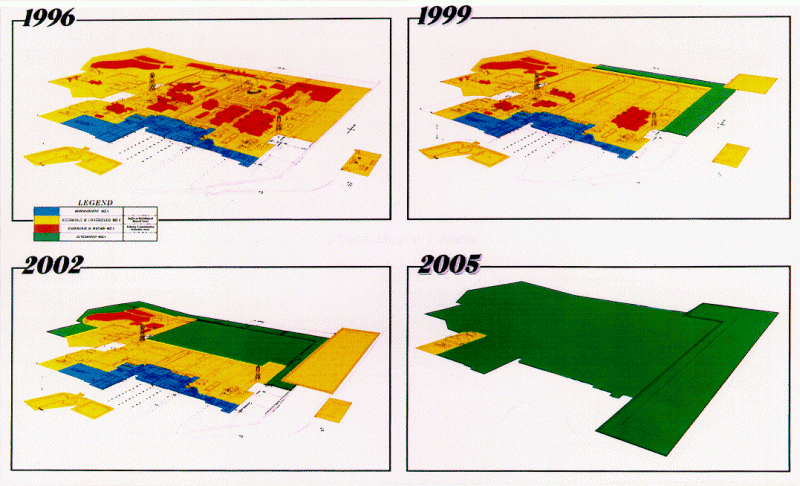
Fig. 1. Illustrates the FEMP as it
will look during the next ten (now nine) years. The progress of the D&D of
site facilities and the construction of the on-site disposal facility can be
clearly seen. The final land use has not been determined, except that
residential or farming use will not be permitted. The final land use will later
be determined by DOE and the FEMP stakeholders.
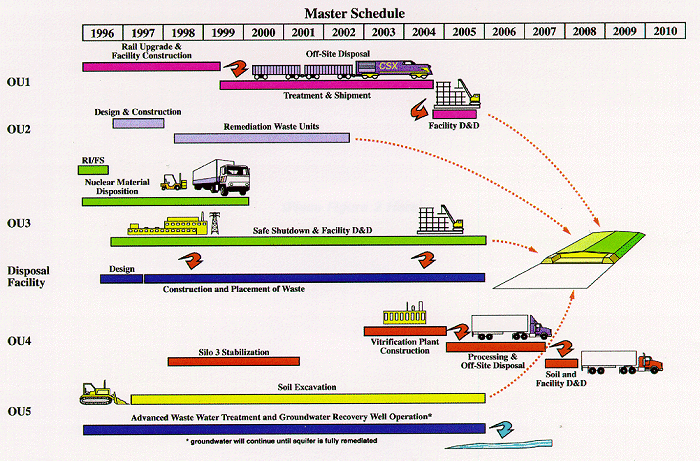
Fig. 2. Depicts the overall schedule
and indicates the critical path activities. The critical path consists of D&D
of the buildings, excavating the soil and underground foundations, piping and
utilities and building the on-site disposal facility.
The key indicators or performance measures for the remediation of the FEMP
revolve around the Operable Units. The selected cleanup remedy for Operable Unit
1 calls for excavation, drying, and shipment of material from Fernald's Waste
Pits to a permitted off-site disposal facility. Site preparation is currently
underway. The first rail car of waste pit material is expected to be shipped in
March of 1999 and shipments will continue through 2005. The selected remedy for
Operable Unit 2 calls for building of an on-site disposal facility, which will
contain about 2.5 million cubic yards of FEMP waste, with the first waste
placement scheduled for March 1998. Final waste placement is expected by 2005.
The selected remedy for Operable Unit 3 calls for the decontaminating and
dismantlement (D&D) of 17 site complexes and the two remediation facilities.
All facilities except the water treatment plant will be taken down. Plant 7 and
Plant 4 -- two of the largest structures on site -- already have been imploded.
Plant 1 is expected to be imploded in late February 1997, weather permitting. D&D
activities in the former production area will continue through 2005. The
selected remedy for Operable Unit 4 calls for vitrification of material from
Silos 1-4 at Fernald. Currently this plan is being re-evaluated due to problems
associated with the Vitrification Pilot Plant, a test project at the site.
Vitrification remains the leading option for Operable Unit 4 and, if
vitrification is implemented, it is expected to be completed by 2008. The
selected remedy for Operable Unit 5 calls for restoration of the aquifer by
extracting and treating contaminated groundwater and reinjecting the aquifer
with treated, clean water. Field activities are underway and completion is
expected by 2005.
SUCCESSES AND LESSONS LEARNED DURING TEN YEAR PLAN
DEVELOPMENT
Clearly, difficult decisions and some concessions had to be made due to cost
and time considerations during the Ten Year Plan development stages. The key to
DOE and Fluor Daniel Fernald's success during the development stage was the
constant interaction between all the key players. Together, DOE and Fluor Daniel
Fernald selected remedies and worked on a skeleton of the Ten Year Plan
schedule. A lot of up-front meetings and detailed planning took place between
DOE and Fluor Daniel Fernald and when conceptual consensus had been reached, DOE
presented the plan to key stakeholder groups including the United States
Environmental Protection Agency (U.S. EPA), Ohio EPA, and FEMP stakeholders
including the Fernald Citizens Task Force and the citizens group Fernald
Residents for Environmental Safety and Health (FRESH). The Ohio Congressmen and
Senators also supported the adoption of the Ten Year Plan. Public involvement
was an important component during the development of Fernald's Ten Year Plan and
will be even more critical as the cleanup progresses.
Setting the "blueprint" to move forward with the Ten Year Plan was
extremely complex due to the various projects that overlap at Fernald. Constant
attention went into the development of one, integrated master schedule for the
remediation of numerous different projects located within the 1,050-acre FEMP
site.
SUCCESSES AND LESSONS LEARNED DURING INITIAL
IMPLEMENTATION OF TEN YEAR PLAN
First Year Successes
Significant accomplishments were made at the FEMP during the initial
implementation of the Ten Year Plan. These accomplishments continue to reinforce
the site's reputation as a model for the safe, efficient, and effective cleanup
of DOE sites. Examples of these accomplishments include Fluor Daniel Fernald's
steps to reorganize the company by setting up project organizations that plan
and execute remedial activities simultaneously. Many factors went into the
decision to "projectize" Fluor Daniel Fernald, but the main reason was
to better position the company to implement the Ten Year Plan. The "projectized"
structure gives more responsibility to individual project managers, and allows
multiple cleanup activities to proceed simultaneously and independently. Of
course, oversight mechanisms are in place to ensure regulatory compliance in all
jobs.
"On-the-ground" results were achieved during the initial
implementation of the Ten Year Plan including the initiation of the thorium
overpacking project, which consists of placing deteriorated drums that contain
radioactive waste into new, larger drums. Approximately 5,600 drums of thorium
are being overpacked by a remote control forklift and transported to secure,
secondary containment boxes for safe off-site disposal. Also, Fluor Daniel
Fernald has dramatically accelerated the off-site shipment of "legacy waste"
materials and to date has safely disposed of more than 1.8 million cubic feet of
these wastes --more than any other DOE site undergoing remediation. Over the
past three years, the two largest former production facilities, Plant 7 and
Plant 4 have been imploded at the site. Plant 7 was imploded in September 1994;
Plant 4 came down in the same manner in August 1996. Both of these facilities
were imploded by Controlled Demolition Inc. (CDI) using linear-shaped explosive
charges. Safety and economy were key criteria in selecting implosion as the
final dismantlement method. These are just a few of numerous accomplishments
that were achieved during the initial implementation of the Ten Year Plan.
Innovation and Productivity
DOE and Fluor Daniel Fernald also have jointly developed the Ten Year Plan
to expedite the FEMP cleanup and significantly reduce or eliminate costs
associated with overhead, landlord activities and building maintenance. Fluor
Daniel Fernald's performance-based contract with the DOE has been further
modified to give the company incentives to produce more "on-the-ground"
remediation results. This is an effort to spend as little money as possible
supplying heat, electricity and maintenance support for buildings targeted for
demolition and shift the money to actual remediation work.
Some of the other productivity enhancements, technology innovations and cost
savings that have been implemented at Fernald include: a remote-controlled
forklift truck exclusively for use in handling about 5,000 deteriorated drums of
thorium waste; a remote-controlled lawnmower to control vegetation in
contaminated areas; an in-tank robot for the remote retrieval of radium-bearing
wastes in above-ground silos; new drilling technology; an alternative remedial
action subcontracting approach for the waste pits project to lower capital and
overall project costs; and streamlining documents for Operable Unit 3 to avoid
nearly $1 million in costs. These productivity enhancements and technology
innovations will enable us to achieve cleanup activities more effectively at a
lesser cost, saving time, money and enhancing safe performance. Additional
technology innovations, productivity enhancements and cost saving opportunities
will continue to be aggressively pursued.
Performance-based Fee
The FEMP was among the first sites to adopt the contract reform principles
of performance-based fee contracting. In this concept, the basic objectives are
set for each six-month period in alignment with the Ten Year Plan. They include
hard milestones linked to key deliverables where quality and safe work are
required to maintain the schedule, and soft objectives are set to measure
progress on procurement, safety, stakeholder involvement and other measures. By
aligning both DOE and Fluor Daniel Fernald personnel to the performance-based
fee plan, a win-win situation is produced. The DOE and Fluor Daniel Fernald
agree on project priorities for each six-month performance period, which can be
easily tracked and measured by DOE. Both DOE and Fluor Daniel Fernald benefit if
excellent performance is achieved in accordance with the performance-based fee
plan. The use of performance-based fee measures will keep the Ten Year Plan in
focus as a high priority for all parties.
FUTURE CHALLENGES
Technical Challenges
The mission to remediate the FEMP is unique due to the size and scope of
this project and there are several technical challenges that remain in the
critical path forward. For example, the Vitrification Pilot Plant is a test
project at the FEMP designed to operate at approximately one ton per day, and
was built to provide actual site-specific data for the design, construction and
operation of final remediation facilities. As previously mentioned, this
technical challenge is being re-evaluated to ensure it is the most effective
cleanup remedy for the remediation of the silos at the site. An Independent
Review Team (IRT), a group of technical experts assembled to serve as an
advisory group and technical resource for the Silos Project, has been meeting on
a regular basis. The IRT will be providing recommendations to DOE and Fluor
Daniel Fernald to aid in the decision-making process. Overall, the IRT
recommendations will assist DOE and Fluor Daniel Fernald with the decision of
whether to formally re-evaluate the selected remedy for remediation of the silos
at Fernald. It is not expected that the IRT will provide a sole recommendation
for a single alternative, but instead will deliver evaluation and advice based
on their experiences for each alternative as an aid to our path forward
evaluation. Despite the fact that cleanup remedies have been approved by
regulators for the Fernald cleanup, DOE and Fluor Daniel Fernald are constantly
evaluating areas of improvement.
Uncertain Funding
A potential roadblock to the Ten Year Plan of the FEMP remains the
uncertainty of federal funding. The DOE's annual budget, including the amount
requested for the FEMP cleanup, is subject to Congressional approval each year.
Under these circumstances, it is crucial that DOE and Fluor Daniel Fernald
continue to reevaluate the Ten Year Plan and be flexible in replanning
activities based on the day-to-day realignment of schedules due to the uncertain
funding. Because federal money is appropriated year by year, there's no
guarantee that the required level of funding will be approved every year.
If the FEMP receives less money than anticipated, planned work activities
will be scaled back. However, the DOE and Fluor Daniel Fernald will continue to
work with a broad range of stakeholders to overcome shortfalls and technical
challenges as they occur. Fluor Daniel Fernald is constantly working with DOE to
develop new strategies and replan those strategies that exist in order to
prepare for various anticipated funding scenarios.
Regulator and Stakeholder Involvement
Involving members of the public and FEMP personnel in the decision-making
process is essential to the success of DOE and Fluor Daniel Fernald. Numerous
stakeholders have been involved in helping DOE and Fluor Daniel Fernald develop
and implement the Ten Year Plan. It is DOE and Fluor Daniel Fernald's goal to
work even closer with regulators and stakeholders during the decision-making
process and not lose the day-to-day interface with all interested groups.
Specifically, the Fernald Citizens Task Force represents the public and
serves as an advisory board to DOE. The task force has recommended significant
solutions to critical cleanup issues pertaining to the FEMP cleanup. For
example, the task force established remediation levels that protect the aquifer
and provide consistent and permanent protection of human health. Achieving "background-level"
conditions, that is, restoration to a completely uncontaminated state, would
require surface soil excavation for five miles surrounding the site, which the
task force rejected because of high cost. The task force's recommendation on
cleanup levels reduces the overall cleanup costs by approximately $1.3 billion,
while cleaning up the site so it can be used for industrial or other purposes
excluding residential or farming. The task force also concurred with existing
DOE/EPA decisions to dispose of the most highly-contaminated wastes off site and
recommended construction of an on-site disposal facility to accept
slightly-contaminated materials from the Fernald site only. This strategy
reduces the overall cleanup cost by an additional $850 million for a total cost
savings of $2.15 billion. The task force's recommendations to the DOE provide
the basis for significant cost savings under the Ten Year Plan. The task force's
recommendations have been accepted and embraced by the DOE and both U.S. and
Ohio EPA.
FEMP employees, which DOE and Fluor Daniel Fernald refer to as team members,
are also considered to be key stakeholders. Several successes have been
accomplished at Fernald -- some of which mark first time successes within the
DOE complex -- due to the hard work, dedication, and teamwork of all FEMP team
members. These successes have led to Fernald representing the DOE weapons
complex as an environmental restoration model.
DOE and Fluor Daniel Fernald are committed to continuous improvements in our
efforts to foster an environment of openness and cooperation with regulators and
stakeholders. This level of teamwork is critical in order for DOE and Fluor
Daniel Fernald to be successful in accomplishing the challenges that lie ahead
at the site.
CONCLUSION
The FEMP will continue to proceed at an accelerated pace of remediation
while maintaining schedule and overall project flexibility due to budget
uncertainties. Performance measures have been selected to monitor progress, and
changes in project structure, organization, and requirements have been
implemented as necessary to allow the Ten Year Plan to succeed.
As cleanup proceeds the DOE and Fluor Daniel Fernald will continue to share
the lessons learned from Fernald's Ten Year Plan with other DOE sites. As a
result, all facilities within the DOE's Weapons Complex can be better positioned
to achieve the complex-wide Ten Year Vision.
Copyright Statement
By acceptance of this Technical Paper, the publisher and or recipient
acknowledges the U.S. Government right to retain a non-exclusive, royalty-free
license to any copyright covering this technical information.
Legal Disclaimer
This technical information was prepared as an account of work sponsored by
an agency of the United States Government. Reference herein to any specific
commercial product, process, or service by trade name, trademark, manufacturer,
or otherwise, does not constitute or imply its endorsement, recommendation, or
favoring by the United States Government or any agency thereof. The views and
opinions or authors expressed herein do not necessarily state or reflect those
of the United States Government or any agency thereof, or Fluor Daniel Fernald,
its affiliates or its parent companies.
*FDF with the U.S. Department of Energy, under Contract
No. DE-AC24-920R21972