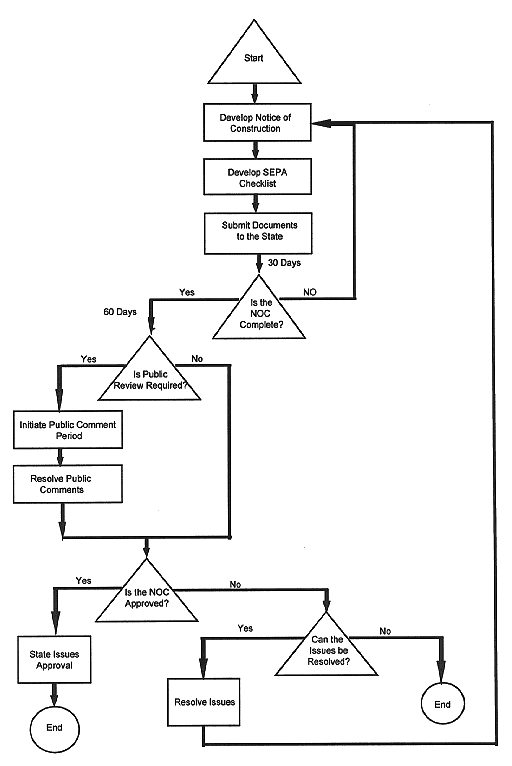
Fig. 1. New Source Review
Hector M. Rodrigueza
DOE-RL and
Jeffrey R. Markillieb
R.E.M.
Dames & Moore
ABSTRACT
Most sources of air emissions in Washington state addressed by the Federal Clean Air Act as amended (42 U.S.C. §7401 et seq.) are regulated by the Washington State Department of Ecology (Ecology). One exception is that the Washington State Department of Health (Health) is responsible for implementing and enforcing the National Emission Standards for Emissions of Radionuclides of 40 CFR Part 61 Subpart H. Rules promulgated in support of the Federal Clean Air Act programs require extensive regulator review for every new source of hazardous, toxic, and radioactive air emissions. At the Hanford Site, the U.S. Department of Energy Richland Operations Office in conjunction with Ecology and Health have implemented a mechanism which completes permitting of new air emissions sources through a streamlined review process. When compared to the traditional mechanism of obtaining regulatory approvals for new sources of air emissions, this approach to air permitting is more sensitive to projects with expedited schedules, and has resulted in considerable savings of time and money.
SUMMARY
Most sources of air emissions in Washington state addressed by the Federal Clean Air Act as amended (42 U.S.C. §7401 et seq.) are regulated by the Washington State Department of Ecology (Ecology). One exception is that the Washington State Department of Health (Health) is responsible for implementing and enforcing the National Emission Standards for Emissions of Radionuclides of 40 CFR Part 61 Subpart H. Rules promulgated in support of Federal Clean Air Act programs require extensive regulator review for every new source of hazardous, toxic, and radioactive air emissions. At the Hanford Site, the U.S. Department of Energy Richland Operations Office (DOE-RL) in conjunction with Ecology and Health have implemented a mechanism which completes permitting of new air emissions sources through a streamlined review process. When compared to the traditional mechanism of obtaining regulatory approvals for new sources of air emissions, this approach to air permitting is more sensitive to projects with expedited schedules, and has resulted in considerable savings of time and money. This paper identifies the primary Health and Ecology requirements pertaining to new sources of radioactive, toxic, and hazardous air emissions; explains the streamlined approach for approval of these new sources; discusses the benefits realized from use of the streamlined approach; and provides recommendations for implementing the streamlined approach at other Department of Energy sites.
HANFORD BACKGROUND
The Hanford site covers approximately 1,450 square kilometers of semiarid land owned by the Federal government and managed by DOE-RL. The Federal government began operating the Hanford Site, near Richland, Washington, in 1943 as part of the Manhattan Project to produce plutonium for national defense. For more than 20 years, activities at the Hanford Site were dedicated to plutonium production and managing the generated waste streams. In later years, new activities such as research and development for advanced reactors and renewable energy technologies were undertaken. The end of the Cold War brought the shutdown of the plutonium production and management facilities. Current activities are focused on the massive environmental restoration project to clean up the Hanford Site.
REGULATORY REQUIREMENTS
Rules promulgated in support of Federal Clean Air Act programs require extensive regulator review for every new source of hazardous, toxic, and radioactive air emissions. Although Ecology and Health have developed separate rules which govern permitting new sources of air emissions, the approach for obtaining regulatory agency approval is essentially the same for each agency.
Notice of Construction
Before any new source of emissions is allowed to operate within the Hanford Site, the operators of the new source must participate in the new source review process. This process is essentially the same for hazardous, toxic, and radionuclide emissions, and is outlined in Fig. 1. The first element in the new source review process is the development of a Notice of Construction (NOC). This document describes the emission unit in sufficient detail for the regulators to understand the chemical or physical process or equipment and how it operates. Important information such as operating parameters and safety set-points, as well as process flow diagrams, is included in the description. The proposed emissions control technology must be identified and described in detail to enable the regulators to determine whether it is protective of human health and the environment. Typically, the emissions control technology must be recognized by the regulatory agency as "Best Available" for the specific application. Information on the proposed monitoring equipment, such as monitoring capability and detection limits, must also be included so that the regulators can assure that the constituents of the air emissions can be properly identified and their quantities calculated. Engineering drawings of the proposed control technology and the monitoring equipment must be submitted to the regulators for approval.
Fig. 1. New Source Review
The length of time required to develop the notice of construction is dependent upon the accuracy of the source term, the quantity of potential emissions, the complexity of the process emitting the pollutants, and the complexity of the proposed emission controls. Typically, a month is necessary to identify the source term, obtain the necessary process documents, calculate the potential to emit, and provide assurance that the proposed emission controls may be considered "best available." For highly complex projects for which a high potential to emit exists, it is not uncommon for six months to be spent developing a single notice of construction.
Following identification of the process equipment and controls, the applicant must identify the regulated constituents of the air emissions, and quantify the release rate of each regulated constituent. Calculations for abated emissions are included to demonstrate to the regulatory agencies the quantity of pollutants that would be discharged to the air when the facility is in operation. Calculations for unabated emissions, identified as the "potential to emit," are provided to bound the emissions with a worse case scenario. When submitting a notice of construction for radionuclide emissions, the application must calculate the number of curies of each radionuclide that would be emitted. Additionally, the total effective dose equivalentc must be determined for the person whose geographic location and eating habits result in the highest possible dose equivalent. At Hanford, this maximally exposed individuald is a hypothetical member of the general public who resides downwind of the Site. The NOC is submitted to either Ecology or Health, depending upon the types of emissions anticipated being released to the environment.
Additional Environmental Documentation
Along with the NOC, the applicant must also submit a State Environmental Policy Act (SEPA) environmental checklist, or demonstrate to the regulator's satisfaction that the action to be undertaken is categorically exempted from the SEPA process. The SEPA process addresses the project's anticipated impacts to the human and built environments, as well as potential impacts to air, water, soil, and wildlife. It is similar in scope to the National Environmental Policy Act process. The SEPA environmental checklist is used by State agencies to determine whether the environmental impacts of a proposal are significant. If the impacts are considered by the regulatory agency to be significant, additional environmental documentation, such as an environmental assessment or environmental impact statement, would have to be developed.
Regulatory Agency Review
After the NOC (and SEPA environmental checklist, if applicable) are submitted, the regulators have 30 days in which a completeness determination is made. The application is reviewed, and its adequacy is assessed. The regulatory agency will notify the applicant in writing that the application is complete, or instruct the applicant to provide all additional information necessary, based on the review of the supplied information, needed to complete the application. Within 60 days after receiving a complete application, the regulatory agency will either issue a final decision on the application or, for those projects subject to public notice, initiate notice and comment procedures. It is common for 90 days or more to elapse before a project receives the necessary final determination on the NOC. The order of approval, any conditions contained in the approval, or the denial of a notice of construction application may be appealed.
Costs
As with any permitting process, there are costs associated with developing a NOC. For non-complex activities, between $10,000 and $12,000 is typically expended over the three months necessary to draft the application for submittal to DOE-RL. These non-complex activities are routine actions characterized by a very low potential to emit radionuclides or hazardous air pollutants to the environment, and a chemical and radiological source term for which a high degree of confidence exists. Projects falling into this category include pumping of slightly radioactive water from radioactive waste tank valve pits.
For more complex processes, $25,000 can be expended to develop a draft application. Additional costs would be incurred if negotiations were required with the regulatory agencies. Complex activities generally have a higher potential to emit air emissions than do non-complex activities. Examples of recent complex activities for which NOCs were developed include: replacement of the two Hanford Site steam powerhouses with 21 standalone steam boilers; and development of the Canister Storage Building that will house some 2270 metric tons of spent nuclear fuel. When applied to the eight to ten applications that are generated at Hanford each month these costs to develop NOCs approach $1 million per year.
STREAMLINED APPROACH
In this day of decreasing budgets, increased public scrutiny, coupled with the drive to clean up Hanford, the cost and time-intensive process to obtain an approved notice of construction was not in the best interest of public stakeholders. It soon became apparent to DOE-RL, Ecology, and Health that an innovative cost-effective approach was necessary to assure protection of human health and the environment, and to assure compliance with the regulatory requirements. The approach stemmed from the relationship of mutual trust that existed among the three agencies. This trust had been nurtured with the full sharing of technical information, objective discussions of concerns, and the belief that doing the right thing is important.
Process
In expanding on theses concepts, permit writers and regulators began to development alternative methods of obtaining permits quicker, smarter, and at less cost. Figure 2 outlines the streamlined process.
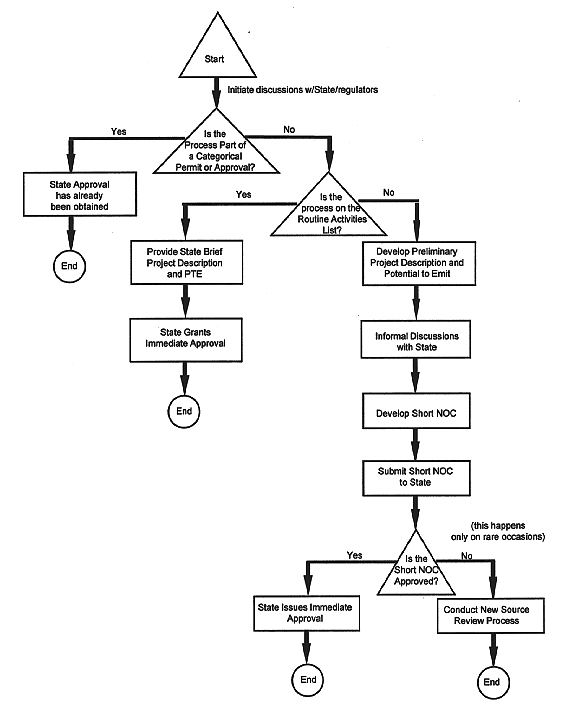
Fig. 2. Stream Lined Approach
Categorical Permits or Approvals
Categorical permits or approvals were worked into the streamlining process. This type of permit enables a specific type of equipment to be used in numerous locations across the site within certain bounds of operation. If the bounds are to be exceeded, another approval must be obtained. Equipment which falls into this category includes a Kelly Vacuum System for use in the decontamination and decommissioning process, the Guzzler Excavation System used during excavations of contaminated and uncontaminated soils, and the CO2 Decontamination Blaster System used in nondestructive decontamination processes. These pieces of equipment are use at various locations and operate under limits agreed to by the operations team, permitting team, and the regulatory agencies. No other permitting is required unless an operation will exceed the agreed to limits or have to potential to breach the in place controls.
Routine Activities List
Another approach to streamlining the process was the development of a "routine activities list." This list comprises numerous activities such as contaminated soil removal, waste transfers, building and facility decontamination activities, and various tank farm activities which occur on a routine basis. Because of the way the regulations are written, any activity which has a potential to emit would require permitting. The routine activities list meets the intent of the regulation by identifying activities which would have a potential to emit and, for the sake of streamlining the permitting process, allows these activities to proceed on a regular and routine bases with regulatory approval.
Routine Technical Assistance Meetings
A third approach to streamlining which has proved to be of extreme value is the development of the Routine Technical Assistance Meeting with Health. These meetings center around short NOCs developed by Hanford Site projects. The on-site monthly meetings are held with representatives from the Health, DOE-RL, and key site contractors. In the meeting, contractor staff provide a written description of the proposed project, including the estimated potential to emit, proposed emissions controls, duration of the project, location of the project, and other pertinent information which will allow Health to grant immediate approval. This written proposal also includes a signature page where the project manager, Health representative, and the DOE-RL permitting program manager acknowledge their concurrence. Most of the presented projects are short in duration, and have very nominal amounts of emissions.
"Short" NOC
Ecology has followed suit in the development and implementation of a "short" NOC. This short NOC provides a significant streamlining mechanism when compared to "full" NOC. The short NOC uses the most pertinent information, including anticipated emissions and proposed emissions controls. It facilitates approval without having to wait for a formal review process, public comment period, and comment resolution period. It should be understood that the regulatory agencies need certain information on which to base their approvals. This information is exchanged during informal conversations, and then documented for inclusion in the short NOC approval.
Criteria
A number of criteria must be met in order to use any of the streamlined approaches. These general criteria were developed during technical interfaces between DOE-RL and State regulators. Initially, the project's source term must be known in sufficient detail so as to allow a complete calculation of potential to emit. Secondly, the potential to emit must be very small. For radionuclide emissions, this is typically below 0.1 mrem per year. Emissions of hazardous air pollutants must fall within the "insignificant" levels identified in the Washington Administrative Code. Lastly, the proposed emissions control technology must have a proven history of abating the project's anticipated emissions. Proven emissions control technology includes high efficiency particulate air filters, ion exchange columns, scrubbers, and activated charcoal.
Benefits
Numerous benefits have been realized since implementing streamlining of air permitting at Hanford. Most significantly, an estimated $770,000 in permitting costs alone has been saved each year since streamlining was implemented. Approximately 220 person-hours are saved per NOC when the short NOC is used. Additionally, Hanford's risk is reduced because regulators have been involved early in each project. Obtaining regulator concurrence and input early in the life of a project -- especially in complex projects -- fosters exchange of information and joint resolution of issues.
RECOMMENDATIONS
Regulators have a responsibility to the public to assure the health and safety of human health and the environment. DOE has a responsibility to the public to assure environmentally sound operations are conducted at a competitive cost. To this end, DOE has to help regulatory agencies form the basis for a permit approval that can be defended if questioned, and is developed at minimal expense to the taxpayer. DOE-RL and its regulators have developed a framework of using regulatory requirements in a manner that not only maintains but enhances environmental integrity, but, at the same time, reduces cost. The following recommendations were implemented in support of regulatory streamlining at Hanford; they may be useful as additional streamlining approaches are developed:
a Mr. Rodriguez is the air permitting program manager at the DOE Hanford Site. He may be reached at PO Box 550, MSIN A5-15, Richland, WA 99352; tel: 509/376-6421; e-mail: h_m_rodriguez@rl.gov.
b Mr. Markillie is an environmental compliance and industrial safety consultant. He may be reached at 1200 Jadwin Ave., Suite 102, Richland, WA 99352; tel: 509-946-4833; e-mail: j_r_jeff_markillie@rl.gov.
c Total effective dose equivalent is the sum of the dose equivalent due to external exposures and the committed effective dose equivalent due to internal exposures of ionizing radiation.
d The maximally exposed individual is any member of the public (real or hypothetical) who abides or resides in an unrestricted area, and may receive the highest total effective dose equivalent from the emission unit under consideration, taking into account all exposure pathways affected by the radioactive air emissions.