Charles Fairhurst
University of Minnesota
Chairman
National Research Council WIPP Committee
ABSTRACT
The National Academy of Sciences/National Research Council (NAS/NRC) has prepared a report on the suitability of WIPP as a geological repository for transuranic (TRU) radioactive waste. TRU waste, although of low activity than high-level waste, contains long-lived emitters that require geological isolation. The NAS/NRC Committee was established in 1978, and last issued a comprehensive report in 1984. The U.S. Department of Energy (DOE) has prepared, for submission in October 1996, an application to the U.S. Environmental Protection Agency (EPA) for permission to begin disposal of TRU waste in November 1997. It was thus considered timely for the NAS/NRC to publish its views, based on a continuing review of DOE investigations at WIPP over the 12 years since the previous NAS/NRC report.
The talk will discuss the use of total system performance assessment at WIPP and the status of the principal issues and concerns which appear to influence the overall isolation capability of the repository. These issues include the significance of human intrusion in assessing repository performance; hydrology and radionuclide transport at WIPP; actinide solubility in WIPP brine; engineered barriers, and the mechanical characteristics of salt that affect its suitability for geological isolation of waste. General insights gained with respect to geological assessment of waste repositories will be reviewed.
WASTE ISOLATION PILOT PLANT (WIPP)
The Waste Isolation Pilot Plant (WIPP) is a network of underground excavations at a depth of approximately 658 m (2,160 ft), in bedded salt formations near Carlsbad, New Mexico, in the southeastern comer of the state (Fig.1). WIPP is intended to serve as a permanent repository for transuranic (TRU) waste, which consists of a wide variety of materials (such as protective clothing, laboratory equipment, and machine parts) that have become contaminated with radioactive transuranic elements (1) during use in defense-related activities. These materials, from U.S. Department of Energy (DOE) facilities, currently are stored at several DOE locations around the country and are classified as either CH (contact handled) or RH (remote handled) waste.
DOE has been investigating the suitability of WIPP as a TRU waste repository since the 1970s and plans to submit an application to the U.S. Environmental Protection Agency (EPA) in the fall of 1996 for a certificate of compliance to open and operate the facility. To obtain the certificate of compliance, DOE must demonstrate that the WIPP facility will comply with relevant U.S. federal regulations---chiefly, the EPA's 40 CFR 191 and 40 CFR 194.
The National Research Council (NRC) Committee on the Waste Isolation Pilot Plant was formed in 1978 at the request of DOE to provide scientific and technical evaluations of DOE investigations at WIPP. The committee's statement of task charges it to report on the current state and progress of the scientific and technical issues that form the core of a submission by DOE to EPA for certification of the WIPP facility.
Because DOE's compliance certification application to the EPA consists largely of conclusions drawn from DOE investigations, it is timely to comment on results of committee evaluations and their implications with regard to the overall suitability of WIPP as a repository for TRU waste (Fig. 1). This report presents these findings.
Several general committee findings regarding TRU waste disposal at WIPP are worth noting. These findings are based on the characteristics of the waste and the salt medium and from scientific and technical studies at WIPP and at potential salt repositories in other countries.
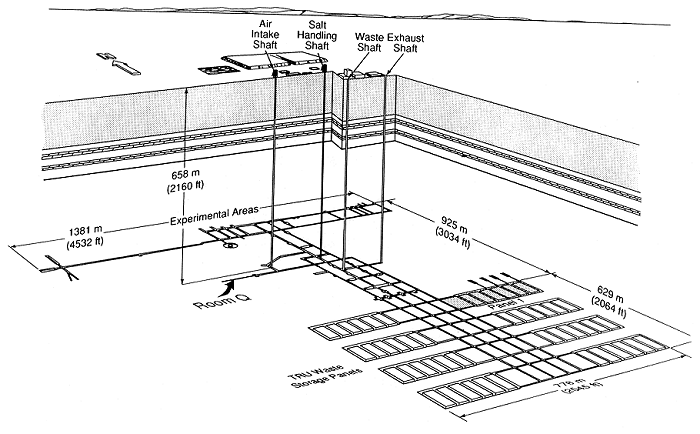
Fig. 1. Three-dimensional view of the
Waste Isolation Pilot Plant. The WIPP facility includes surface support
buildings, a waste-handling building, four shafts, and the mined underground
operations area. The repository is located approximately 658 m (2,160 ft) below
the surface, within the Salado Formation, a Permian sequence of bedded salt with
minor amounts of anhydrite and clay. The excavations are accessible from the
surface by four vertical shafts. Only one of the planned eight panels, labeled
Panel 1 in the diagram, has been excavated to date. Each panel consists of seven
rectangular rooms, 10 m wide and 91 m long, separated by 30.5-m-wide pillars.
Room Q, also labeled, is the site of a series of experiments on brine inflow
into a 2.9-m-diameter, 109-m-long bored cylindrical tunnel. (Note: 1 meter [m]
is approximately 3.28 feet [ft].) Source: Jensen et al. (1993), modified from
their Fig. 3-1.
GENERAL CONCLUSIONS AND RECOMMENDATIONS
The combination of general considerations, such as those outlined above, and detailed studies described later in this report, lead to the following conclusions and recommendations.
Based on available scientific evidence, the only probable threat to satisfactory isolation performance of the repository is the possibility of disturbance by human activity, deliberate or unintentional, that could compromise the integrity of the repository. Engineering methods are available, if needed, to reduce the consequences of human intrusion to acceptable levels.
Conclusion: Human exposure to radionuclide releases from transuranic waste disposed in WIPP is likely to be low compared to U.S. and international standards.
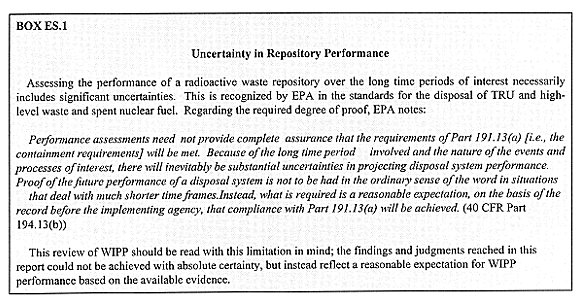
Consideration of the consequences of future activities that could violate the natural, or undisturbed, integrity of the repository is valuable for assessing the relative vulnerability of the repository to such activities and in identifying ways to reduce this vulnerability, but assess in thousands of years hence is highly conjectural and lacks a sound scientific foundation.(3)
Recommendation: Speculative scenarios of human intrusion should not be used as the sole or primary basis on which to judge the acceptability of WIPP (and, by extension, any geological repository).
Findings, Conclusions, and Recommendations on DOE Studies
DOE has concentrated on studies and calculations intended to determine compliance with federal regulations for WIPP in the event of human intrusion. Although the committee has not so restricted its studies, the following comments relate specifically to the DOE compliance activities. Most of the issues discussed below are significant only in the event of human intrusion.
Although PA has made important contributions to the WIPP project, in retrospect, it is clear that the potential of PA is higher, and important opportunities to put PA to good use have been missed. PA is valuable at all stages of the repository evaluation process. It can identify the most critical components of the system, assess the significance of engineered supplements to the natural geological barriers, and serve as an aid to pining and management decisions on the most effective allocation of staff and project resources.
The assumption that the Disturbed Rock Zone (DRZ) bordering the room excavations remains a relatively high-permeability region throughout the first 10,000 years of the repository appears overly conservative. This is in marked contrast to the assumption (see Chapter 4) that the DRZ around the shaft will heal, achieving a permeability of between 10-16 m2 and 10-18 m2 within 50 to 100 years and approaching the essentially impermeable condition of intact salt within a small fraction of 10,000 years. Such a conservative assumption with respect to the DRZ in the PA models may prevent a realistic evaluation of the major benefits of compartmentation of the waste by room and panel seals in reducing the consequences of repository disturbance by intrusion.
The committee recommends that DOE develop, in parallel with the complex PA models, simpler versions that provide a more transparent, traceable path from the model inputs to the predicted releases. The insights gained from the simpler model as to which components of the isolation system are most critical to improved repository performance would serve a very useful role in decision making and in resource allocation for WIPP. It is essential, of course, that the simpler PA models still identify correctly the key features, events, and processes upon which repository performance depends.
To illustrate this recommendation: because plutonium (Pu) is the dominant radioactive element of concern in the WIPP inventory, a simpler model could focus on Pu in the source term to the exclusion of other radioactive elements. However, understanding and predicting the behavior of Pu in the WIPP system is challenging, and experimental work with other actinides is necessary to develop the parameters for Pu required for the PA models, for both the full model and any simpler version. While studies of other actinides are necessary to support the chemical model developed for Pu, a simpler PA of the kind proposed here would consider only Pu isotopes as a source term, and only the dominant pathway(s) for environmental releases, with no more complexity than needed for an adequate representation.
- actinide solubilities in brine,
- formation and transport of colloids containing radionuclides, and
- retardation of radionuclides during transport through the Culebra.
The EPA also has identified these issues as critical to its evaluation of the compliance certification application.
At the time of the writing of this report, the data and models to be used to represent these three issues in the next version of the PA (to support the compliance certification application) were not available for review.
SUMMARY
The committee believes that some combination of the above three considerations will very probably be sufficient to allow DOE to demonstrate that a WIPP repository will keep radionuclide release within acceptable levels for the disturbed case.
1Transuranic elements are those elements with atomic number greater than that of uranium. Most are radioactive because of their emission of alpha particles. TRU waste contains those with half-lives greater than 20 years in concentrations exceeding 100 nanocuries per gram.
2The level of radioactivity per unit volume of WIPP TRU waste is of the order of 0.1 percent of the corresponding level for U.S. spent fuel [see Chapter 1 Table 1.1]
3Federal Regulations (40 CFR 191, 40 CFR 194) require stylized calculations on releases due to human intrusion. The level of proof required is a "reasonable expectation." See Box ES. 1. The weight to be given to human intrusion possibilities is also discussed in Technical Basis for Yucca Mountain Standards (NRC, 1995; see especially, pp. 11, 107-111,115).