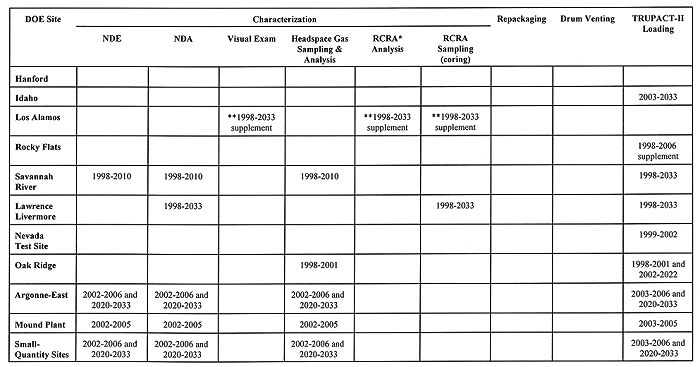
Table I Potential Use of Additional Mobile Systems Based on Site
Needs
John F. Suermann and Michael R. Brown
U.S. Department of
Energy-Carlsbad Area Office
Carlsbad, NM
Ann C. Kercher
NFT, Inc.
Lakewood, CO
Mark Doherty
Advanced Sciences, Inc.
Albuquerque,
NM
ABSTRACT
The Mobile Systems Capability Plan (MSCP) has been prepared by the U.S. Department of Energy (DOE)-Carlsbad Area Office (CAO) to assess how mobile systems can be used to prepare, certify, and package transuranic (TRU) waste for disposal in the Waste Isolation Pilot Plant (WIPP) in support of the DOE National Transuranic Waste Management Plan (NTWMP). The MSCP identifies TRU waste site needs and currently existing commercial capabilities and assesses the areas of capability that remain to be developed. Mobile technology development is briefly discussed. The MSCP concludes that a market exists in the form of the DOE's immediate needs for commercial mobile systems and that the DOE is aggressively pursuing contracts with commercial firms to privatize this market.
OBJECTIVES OF THE MOBILE SYSTEMS CAPABILITY PLAN
The MSCP (1) supports and is consistent with the NTWMP (2). The goal of the NTWMP is to maximize the disposal of legacy TRU waste by 2006 in support of the DOE Office of Environmental Management 10-Year Plan. For many TRU waste sites, the ambitious disposal goals of the NTWMP can only be met by the use of commercial mobile waste characterization and certification services. A goal of the MSCP is that these services will be procured through fixed-price, performance-based, cost per unit contracts with the commercial sector.
SITE NEEDS
The waste characterization, handling, treatment, and transportation needs at TRU waste sites were determined by the NTWMP. These needs were identified through an assessment of the current and future capabilities of the sites, the amount and type of waste processing that are required, and the anticipated work-off schedule for these wastes.
Mobile system needs were identified at most of the large-quantity sites and all of the small-quantity sites; they are reported in Table I. The table shows which waste sites need to accomplish waste characterization and TRUPACT-II loading. Mobile treatment, repackaging, and drum venting have not been quantified as needs by the waste sites at this time. It is anticipated, however, that they will be identified as needs in the future. The needs of the 15 small-quantity sites are combined and are considered as the equivalent of a single facility as presented in Table I.
Table I Potential Use of Additional Mobile Systems Based on Site
Needs
Generally, the large-quantity sites need some form of mobile capability for the following reasons:
Small-quantity sites may rely exclusively on mobile systems for their waste certification needs.
VENDOR CAPABILITIES
The waste characterization activities that can be met using mobile systems are:
Other waste-processing services that can be met by mobile equipment include:
The current DOE-owned mobile assets have been generally designed and engineered for use at specific sites. Private vendors have much more extensive equipment and capabilities; some capabilities currently exist in most areas of need or can be readily assembled using current technology.
The MSCP identifies American and foreign vendors of these systems. Vendors of commercial systems are required to meet certain DOE requirements to assure the services they provide meet quality assurance objectives and operate in a manner that meets DOE health and safety requirements. The MSCP describes these requirements.
PROCUREMENT APPROACH
The CAO plans to issue a draft Request for Proposal (RFP) for up to a 30-day comment period prior to issuing the RFP in final form. CAO will qualify vendors based on demonstrated experience of their mobile system capabilities under field conditions at DOE sites and proposed approach to obtaining certification authority. The DOE anticipates that there will be multiple awards to qualified vendor teams similar to a Basic Ordering Agreement. Mobile services will be performed at sites through competed task orders issued by the sites and awarded under the CAO master contract.
TECHNOLOGY DEVELOPMENT
The CAO is soliciting from waste sites their needs for new technology related to mobile waste management. Areas of particular need include:
The following projects are currently underway to improve radioassay systems:
CONCLUSION
The DOE has immediate needs for mobile waste systems for TRU waste processing activities to support the WIPP mission. Although many needs can be filled by commercial systems, some needs will require development of new technology to be fully met. The DOE is pursuing contracts with the private sector as a means to rapidly and efficiently deploy mobile systems.
REFERENCES