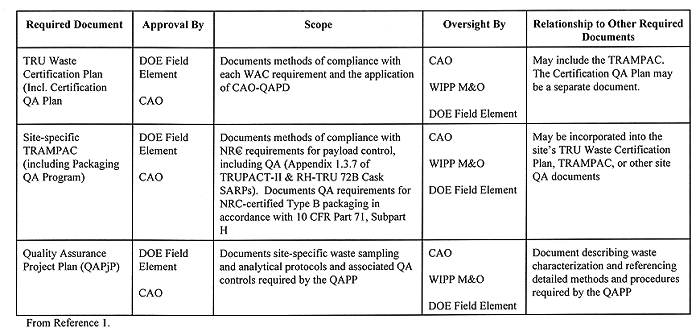
Table I Generator/Storage Site TRU Waste Program Documentation
Amber Clay
DOE-Carlsbad Area Office
Carlsbad, NM
James L. Maupin
Advanced Sciences, Inc.
Albuquerque, NM
Thomas E. Bearden, P.E.
NFT, Inc.
Lakewood, CO
ABSTRACT
The Waste Isolation Pilot Plant (WIPP), a deep geological repository located in southeast New Mexico, has been constructed by the U.S. Department of Energy (DOE) to permanently dispose of all defense-generated radioactive transuranic (TRU) waste. Much of this waste is retrievably stored at several DOE sites across the U.S.; some will be generated from ongoing weapons production and environmental restoration activities.
The DOE-Carlsbad Area Office (CAO) is responsible for granting waste certification and transportation authority to TRU waste sites. This authority allows waste sites to certify their TRU waste to meet the WIPP Waste Acceptance Criteria (WAC) and to transport their waste using the TRUPACT-II shipping container.
A rigorous site certification program has been developed for this purpose which includes extensive document preparation, program reviews, audits, and continuing coordination between CAO and the sites. Each of the major TRU waste sites is in the process of implementing the WAC and other CAO guidance required for waste certification. Some sites are also building or modifying the necessary facilities to characterize or treat TRU waste prior to shipment to and disposal at WIPP.
SUMMARY OF SITE CERTIFICATION REQUIREMENTS
The requirements to characterize, certify, and ship waste for disposal at WIPP are presented in the WAC (1), Quality Assurance Program Plan (QAPP) (2), and the TRUPACT-II Safety Analysis Report for Packaging (SARP) (3). Sites are currently updating their documents and procedures to comply with these requirements. Specifically, sites must prepare the documentation in Table I and pass a series of reviews and audits before waste can be certified and shipped to WIPP.
Table I Generator/Storage Site TRU Waste Program Documentation
One of the first site visits that CAO performs is a National Transuranic Program (NTP) program review. Program reviews are sponsored by the CAO-NTP Waste Certification Manager and are informal in the sense that no official audit findings are generated. Generally, a program review consists of a team of thr-ee to six technical specialists who have expertise in specific areas of waste characterization and transportation. These specialists review the site's TRU waste program and procedures and make recommendations about how the program can be improved.
After a program review, there is generally a series of formal characterization and certification/transportation audits. These audits are sponsored by the CAO Quality Assurance (QA) Manager. The personnel chosen for these audit teams consist of both QA and technical specialists. Formal findings and observations that are generated from these audits require the site to write Corrective Action Reports (CARs). These reports explain in detail what actions the site will take to correct the deficiencies found by the audit. The CAO must review and approve the CARs and then approve the closeout of these CARs when all actions are complete.
When all audits, surveillances, CARs, and other CAO review actions are complete, the Manager of the CAO authorizes the site to certify waste and to transport contact-handled waste via the TRUPACT-II.
The DOE-CAO recently published the National Transuranic Waste Management Plan (NTWMP) (4). This plan integrates the activities of the waste sites and proposes a schedule for site certification and shipment of TRU waste. This schedule is summarized in Table II.
Table II Site Certification, Corridor Opening, and First Waste
Shipment Dates
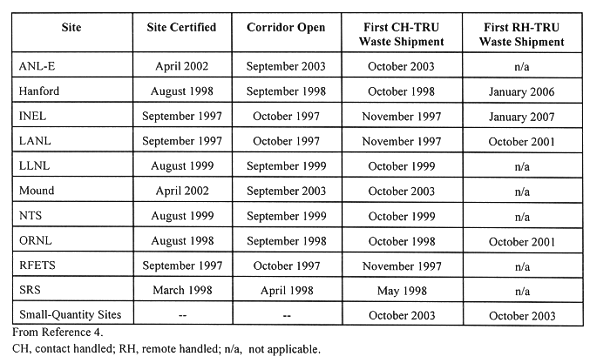
The schedule calls for three sites to be certified in FY97: Idaho National Engineering Laboratory (INEL), Los Alamos National Laboratory (LANL), and Rocky Flats Environmental Technology Site (RFETS). The factors considered in choosing these three sites were the maturity of their TRU programs, their waste inventories, and their geographical location along the northern transportation corridor, as shown in Figure 1.
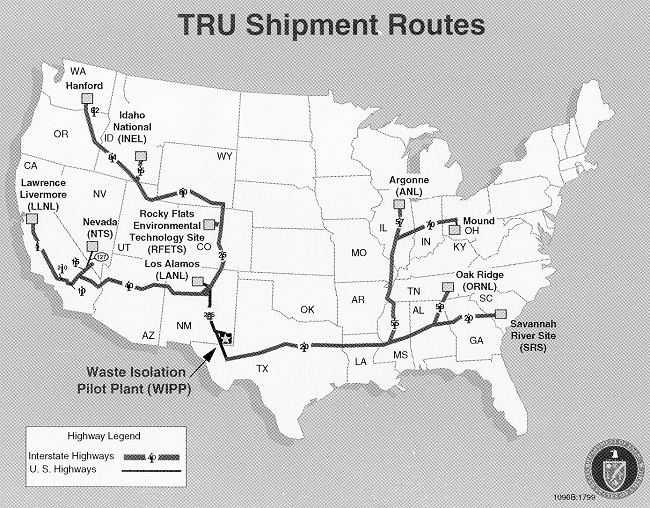
Fig. 1. TRU shipment routes.
In FY98, the eastern transportation corridor will be activated, allowing shipments from Savannah River Site (SRS) and Oak Ridge National Laboratory (ORNL). Also, the northern corridor will be extended to include the Hanford site. In FY99, the western transportation corridor will be opened, allowing shipments from Lawrence Livermore National Laboratory (LLNL) and the Nevada Test Site (NTS). The northeast corridor will be activated in FY2002, allowing shipments from Argonne National Laboratory-East (ANL-E) and the Mound Plant. Many of the small-quantity sites (SQSs) will ship their TRU waste to a larger TRU waste site rather than directly to the WIPP.
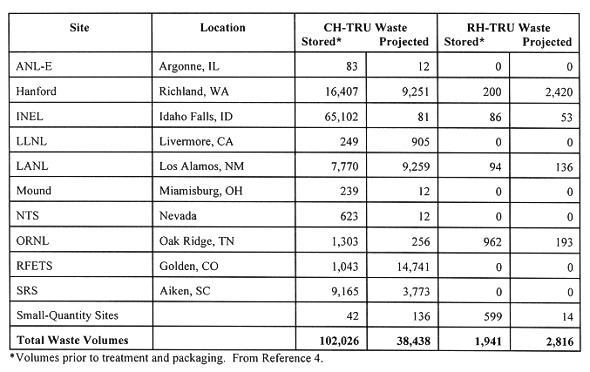
The currently estimated inventories of TRU waste by site are presented in Table III. The INEL has the largest inventory of CH-TRU waste and the ORNL has the largest stored inventory of RH-TRU waste. Hanford is projecting over 2,400 cubic meters of RH-TRU waste; however, this projection is uncertain.
Table III TRU Waste Storage Locations and Volumes (cubic meters)
STATUS OF THE MAJOR SITES
Idaho National Engineering Laboratory (INEL)
The INEL has the largest amount of TRU waste, approximately 65,000 cubic meters (4), destined for WIPP. Also, INEL has been identified as a treatment site for its own waste and for TRU waste stored at other sites (4). Certification activities are ongoing at INEL. A revised waste certification plan (WCP) was submitted to CAO in December 1996, and CAO has commented on it. A six-volume QAPjP has been consolidated into a single volume; it is scheduled to be approved in spring 1997. The INEL has an approved site-specific TRAMPAC and Packaging QA Program. A waste characterization, transportation, and certification audit is scheduled for the spring of 1997. It is planned that INEL will be fully certified to characterize and ship waste to WIPP by September 1997.
Los Alamos National Laboratory (LANL)
The LANL has approximately 8,000 cubic meters of TRU waste currently in storage and is estimated to generate an additional 9,000 cubic meters (4). In addition to characterizing its own waste, LANL plans to provide waste characterization services (visual examination and solids sampling and analysis) to other sites. LANL revised its WCP for contact-handled TRU waste in May 1996 to comply with Revision 5 of the WAC, and has incorporated CAO comments. Their approved WCP was issued in November 1997. The WCP includes LANL's certification QA plan, site-specific TRAMPAC, and Packaging QA Program. The LANL QAPjP has been approved and is being revised to reflect the latest CAO guidance. A waste characterization audit is scheduled for late spring, followed by a transportation audit the summer after.
Rocky Flats Environmental Technology Site (RFETS)
The RFETS has approximately 1,000 cubic meters of waste currently in storage and is estimated to generate an additional 15,000 cubic meters (4). Much of the waste will require repackaging or treatment before it can be certified and shipped to WIPP. The RFETS WCP, site-specific TRAMPAC, and Packaging QA Program have been combined into a single-volume Waste Management Plan. The Waste Management Plan has been submitted to CAO; RFETS is currently incorporating CAO comments. The RFETS also has an approved QAPjP, which is currently being revised to reflect the latest CAO guidance. A characterization, certification, and transportation audit is scheduled for the summer of 1997.
Oak Ridge National Laboratory (ORNL)
The ORNL has generated approximately 2,300 cubic meters of waste currently in storage and plans to generate an additional 500 cubic meters (4). It has the largest current inventory of RH waste--1,000 cubic meters (4). The ORNL has an approved QAPjP; however, it does not have an approved WCP, site-specific TRAMPAC, or Packaging QA Program. According to the NTWMP, ORNL is scheduled to begin shipping waste to WIPP in October 1998. A certification audit of ORNL has been scheduled for spring 1998.
Lawrence Livermore National Laboratory (LLNL)
The LLNL has approximately 200 cubic meters of waste currently in storage and plans to generate an additional 900 cubic meters. The LLNL has an approved QAPjP; however, it does not have an approved WCP, site-specific TRAMPAC, or Packaging QA Program. A certification audit of LLNL has been scheduled for spring 1999.
OTHER MAJOR SITES
The Hanford Site, Savannah River Site, Nevada Test Site, Argonne National Laboratory (both east and west facilities), and Mound Plant have not yet submitted any waste certification documents for approval by CAO. Of these, the Hanford Site and Savannah River Site are scheduled for certification in FY98, so it is expected that their documents will be drafted and reviewed in FY97.
SMALL-QUANTITY SITES
The small-quantity sites (SQSs) have less than one percent of the total inventory of TRU waste; however, closing these sites in the near term is an important CAO priority. In general, these sites have very limited waste characterization and certification capabilities. The NTWMP recommends that mobile systems be used as much as possible to certify waste at the SQSs. In many cases, SQSs will ship their waste to larger sites for repackaging or treatment prior to shipment to WIPP. No certification documentation is expected from SQSs in FY97.
CONCLUSION
The WIPP is currently scheduled to begin receiving waste in November 1997 (4). To meet this schedule, the major sites are aggressively pursuing certification and transportation authority from DOE-CAO so that shipments of waste from their sites are not delayed.
REFERENCES