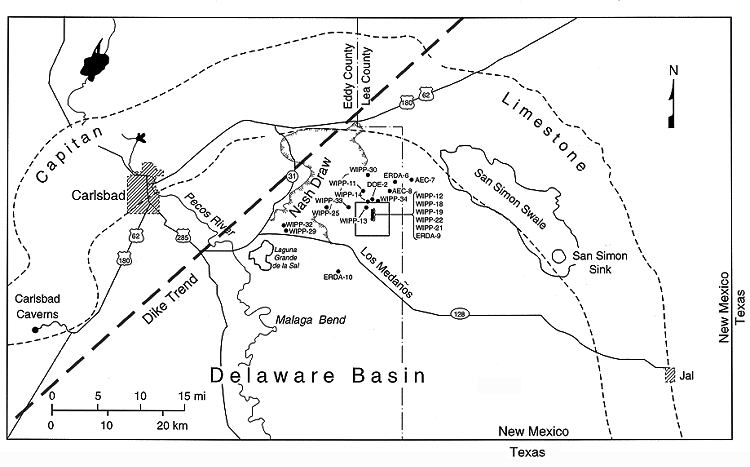
Fig. 1. Location of the WIPP site and
relation to geologic features considered in site selection.
Wendell D. Weart and Margaret S.Y. Chu
Sandia National
Laboratories
P. O. Box 5800
Albuquerque, NM 87185-1337
ABSTRACT
The Department of Energy submitted a Compliance Certification Application for the Waste Isolation Pilot Plant to the Environmental Protection Agency (EPA) in October, 1996. A critical part of this application was a Performance Assessment which predicts the cumulative radioactive release to the accessible environment over a time period of 10,000 years. Comparison of this predicted release to the EPA standard shows a comfortable margin of compliance. The scientific understanding that was critical to developing this assessment spans a broad range of geotechnical disciplines, and required a thorough understanding of the site's geology and hydrology.
Evaluation of the geologic processes which are active in the site region establishes that there will be no natural breach of site integrity for millions of years, far longer than the 10,000 year regulatory period. Inadvertent human intrusion is, therefore, the only credible scenario to lead to potential radioactive release to the accessible environment. To substantiate this conclusion and to quantify these potential releases from human intrusion, it has been necessary to develop an understanding of the following processes:
Other issues which had to be evaluated to allow definition of breach scenarios were brine reservoir occurrences and their associated reservoir parameters, consequences of mining over the repository, and drilling for natural resources in the vicinity of the repository. Results of all these studies will be briefly summarized in this paper.
INTRODUCTION
The Waste Isolation Pilot Plant (WIPP) is a geologic repository for Defense Program-generated transuranic (TRU) waste. The repository is excavated at a depth of 2150 feet in the Salado Formation in southeast New Mexico, about 25 miles east of the town of Carlsbad (Fig. 1). Geotechnical and other scientific studies conducted since 1975 to confirm the suitability of the WIPP site are now essentially complete.
Fig. 1. Location of the WIPP site and
relation to geologic features considered in site selection.
SCIENTIFIC ISSUES
The Department of Energy's (DOE) WIPP project submitted its application for compliance certification to the U.S. Environmental Protection Agency (EPA) on October 29, 1996. The EPA will evaluate this application and is expected to rule on its adequacy in demonstrating compliance within one year of its submittal. During that year EPA will likely ask for additional information and clarification from the DOE. A critical part of the application is the 10,000 year probabilistic assessment of compliance with EPAs numerical standards which are stated in the form of a cumulative complementary distribution function. This assessment shows the WIPP to be a "robust" repository in the sense that failure through natural processes is extremely unlikely and the unavoidable releases of radioactivity due to future inadvertent human intrusion will fall well below the limits allowed by the EPA standards (Fig. 2). This is true even when considering the remaining uncertainties in the physical and chemical processes involved in modeling the radioactive releases to the accessible environment. This robustness of the repository provides confidence that the repository will safely contain the radioactivity even should varied assumptions be applied to the performance modeling in future analyses.
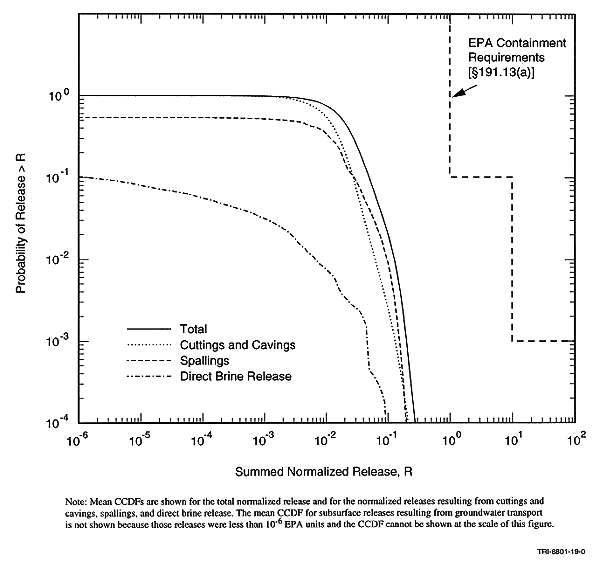
Fig. 2. The median CCDF for WIPP and
the relative contributions to the total from cuttings and cavings, spalling and
prompt brine rlease.
The confidence in the WIPP repository derives from studies conducted over 22 years. Early studies addressed the geotechnical setting of the site and are responsible for the assessment that natural processes will not breach the site for a period much longer than the 10,000-year regulatory time frame. Shaft seal designs have been developed that preclude those features as significant release paths and which will retain the critical sealing properties for as long as the salt itself exists. The repository horizon should remain isolated from the human environment for millions of years if it is not intruded by humans.
The EPA environmental radiation protection standards for geologic repositories require that the consequences of human intrusion be incorporated into long-term (10,000 year) performance. Given the required assumption of human intrusion, the WIPP Project has concentrated its investigations in recent years on those processes which are critical to realistic modeling of release of radioactivity up boreholes which are inadvertently drilled into and through the repository over the next 10,000 years. The WIPP performance assessment (PA) modeling has indicated that a few issues and processes stand out as being the most critical to the compliance of the WIPP. These processes will be addressed in the following paragraphs.
It is convenient to discuss the issues involved in modeling WIPP radionuclide releases by grouping them into the three broad categories of disposal room, seal systems, and fluid flow andtransport. The current understanding on these aspects as presented in the WIPP compliance certification application (CCA) will be briefly discussed.
Disposal Room
The disposal room conditions will ultimately be determined by the interaction of room closure (salt creep), brine seepage into the room, and gas generation resulting from microbial waste decomposition and anoxic iron corrosion. Room closure and resulting compaction of waste and backfill will approach final state within 100 years. Brine seepage will occur on a slower timescale and if the salt in the disturbed rock zone (DRZ) around the underground openings heals and isolates the marker beds from the room, the rooms will not saturate with brine. Gas generation from corrosion and, to a lesser degree microbal degradation of organic wastes, requires brine. Enough gas generation would also act to inhibit brine seepage due to increased pressure in the room. As a result of these coupled interactions, the CCA modeling must perform iterations which assume either brine saturation or mostly dry room conditions.
For a brine saturated room, one of the most important considerations is the concentration of actinides in the room brine since this directly relates to the radioactivity released in the brine flow up a drill hole. Earlier studies showed that the wide range of chemical conditions possible in a waste room gave rise to a large uncertainty in solubility. To reduce this uncertainty and drive the brine chemistry to a pH of 9 to 10, MgO has been added to the backfill design. This significantly reduces the solubility of actinides and the range of uncertainty that would otherwise exist. Colloids have also been considered in developing an actinide source term. The relative contribution of colloids to the calculated releases has been shown to be less than that for dissolved actinides due to a variety of factors such as flocculation in the brines and the large size of many of the anticipated colloidal particles which leads to filtering during fluid movement. The present results show a much reduced range of uncertainty for actinide concentrations disposal room brine although the median value may be two to three orders of magnitude greater than in earlier (1992) PA modeling.
Gases generated in the disposal room are primarily hydrogen (if enough brine is present) and carbon dioxide (CO2). The CO2 is important both for its contribution to gas pressure in the room and because it will affect the chemistry in the room tending to lower the pH of the brine. The addition of MgO to the room backfill will react with the CO2 to form magnesite, thereby reducing its influence on chemistry and pressure.
The recent CCA calculations show that disposal room gas pressure is important mainly in its effect in inducing spalling of the waste into a future borehole as it is being drilled. This modeling shows that spalling contributes much less to direct release that do the direct releases from cuttings and sloughing. The arguments made for spalling depend on tensile strength of the material as well as the gas pressure. By the time the human intrusion occurs the waste will have been degraded and compacted. Since we have no directly comparable material, we assign it a very low strength of one pound per square inch (psi) to conservatively model the spall phenomena.
Shaft Seals
Sealing concepts for the WIPP have always relied upon reconsolidation of salt to form a highly impermeable barrier in the lower portion of the WIPP shafts. Current designs implement two improvements over earlier concepts. The primary seal will consist of tamped, crushed salt which will reach approximately 90 percent of intact salt density upon emplacement, thus greatly reducing the time required for salt creep to complete the compaction of salt required to achieve very low permeability. The second feature added to provide additional assurance is the placement of asphalt water stops and compacted clay columns. These sections are placed to assure that possible entry points for water are isolated from the lower compacted salt column where final compaction and the ultimate sealing occurs. These additions to the shaft seals assure that effective permeabilities less than 10-17 meter square (m2) will be realized upon emplacement, thereby preventing water and brine from saturating the primary salt seal (Fig. 3). This assures an ultimate permeability approaching that of intact salt over the lower salt section in less than 100 years.
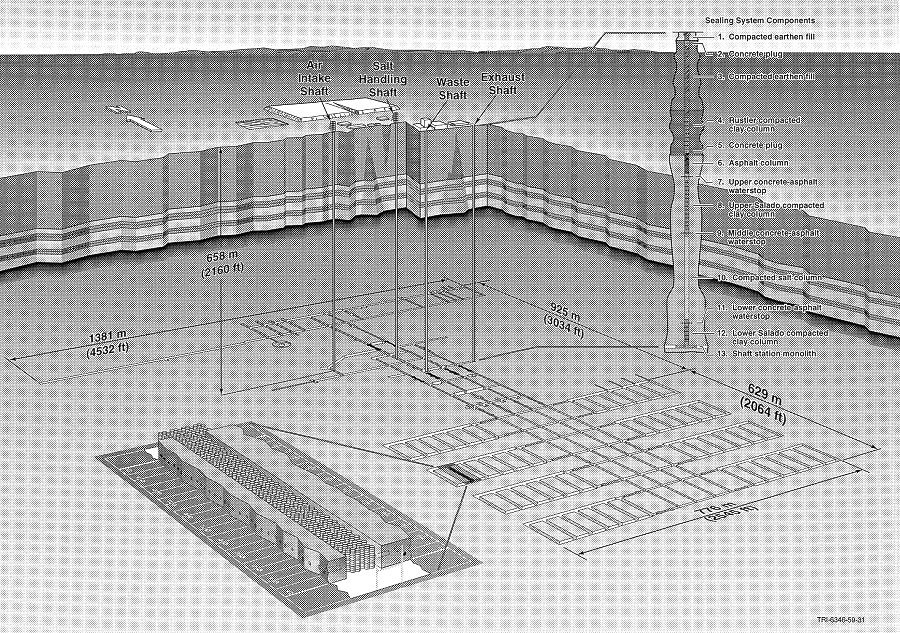
Fig. 3. Artists concept of the WIPP
repository and shaft seals.
Fluid Flow and Radionuclide Transport
A repository disposal room intersected by a drill hole may be initially brine saturated and pressurized or the repository may be connected by the borehole to an underlying pressurized brine reservoir (Fig. 4). In either case the flow of brine up the borehole has the potential of reaching the surface during the drilling operation. The brine flow may carry dissolved actinides or remove solid waste to the surface. CCA modeling indicates prompt flow and direct removal of material due to drilling into an initially saturated room is the major contributor to radioactive release. Once the prompt release is stopped the hole would be cased and eventually plugged. The modeling assumes the plugs will eventually fail and allow brine to once more move up the hole--but now inhibited by material sloughed into the hole. The fluids may reach the Culebra but are not predicted to reach the overlying Dewey Lake formation or the surface. Drilling through a room into a brine reservoir does not contribute to prompt release because the fluid pressure balance is such that waste room brine cannot flow into the drill hole.
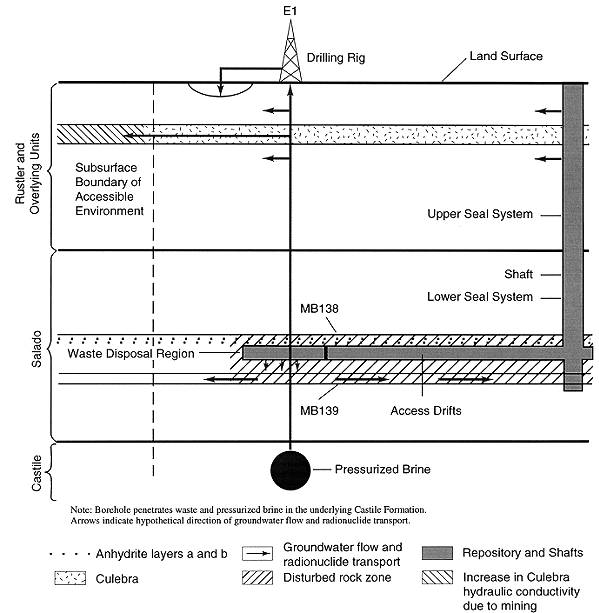
Fig. 4. Human intrusion release
scenario involving a borehole into a waste room and brine reservoir.
Once the radioactive isotopes in the brine rise to the level of the Culebra, the transport through that aquifer must be modeled. Tracer tests over the past couple of years have provided the information to justify the concept of dual porosity and matrix diffusion. The tests have also provided information on effective matrix block size and indicate that the characteristic dimensions vary depending on the scale of the transport modeling. The CCA modeling utilizes relative large-block sizes to assure that the diffusion into blocks is conservatively addressed.
Chemical retardation (Kd) has also been studied extensively in laboratory batch tests and in column flow tests. Although tests were conducted with Salado and Castile brines, as well as two Culebra brines, the CCA modeling used the lower Kd values determined for the deeper brines throughout the Culebra transport. This is a conservative approach if the plume does not mix well with Culebra waters but maintains its chemical identity during the transport to the accessible environment. The uncertainty range in Kd values for most actinide isotopes has been greatly reduced by the experimental program. For those actinide oxidation states not measured directly,conservative correlations or bounding arguments are used in the CCA modeling, i.e., the Kd data for plutonium (V) is extended to plutonium (III) and americium (III), and the Kd for the plutonium (IV) polymer is set equal to zero.
The result of the field and laboratory studies of fluid flow and actinide sorption indicate that the PA scale calculations which use laboratory-determined Kd values in a single-rate double porosity flow model provide a reliable method of modeling the transport of actinides in the Culebra. The CCA modeling indicates the release of actinides into the Culebra does not contribute to the calculated CCDF due to significant retardation. No radioactive isotopes reach the accessible environment through the Culebra aquifer.
The flow system as it presently exists could be altered by future events, such as climatic change or extraction of potash ore from over the repository site. Both eventualities have been incorporated into PA. Hydraulic heads and gradients are increased in the model to account for greater precipitation and recharge that could occur in future pluvial periods. To model the subsidence effects on the Culebra, the present sampled transmissivities are increased up to 1000 times. This has the effect of shifting the main flow over the site toward the west and increases somewhat the flow time of a radionuclide release to the accessible environment. The range of transport times for a non-sorptive tracer ranges from about 5000 years to more than 100,000 years.
Human Intrusion
Since no releases are predicted for undisturbed repository conditions, this focuses attention on the methodology and assumptions used to describe human intrusion. EPA has provided new criteria in 40 CFR 194 which specifies that the rate of future human intrusion should be the same as that which has occurred in the Delaware Basin over the last 100 years. This rate is 4.68 boreholes/km2/1000 years. However, passive institutional controls can provide some measure of deterrence for a period of 600 years after the 100-year active institutional control period. This deterrence is considered by the WIPP Project to be 99 percent effective. This overall guidance on intrusion however, results in many more intercepts of the repository than forecast by earlier EPA guidance in 40 CFR 191. As a consequence, the greatest contribution by far to a calculated CCDF is the waste material directly intercepted by the drilling and released promptly up the borehole to the surface. The longer continuing releases of brine to the Culebra over thousands of years do not affect the magnitude of the CCDF at all. Consequently, for the release scenarios as modeled, the Culebra flow and radionuclide transport properties do not have a significant impact on the calculated CCDFs. Should conditions change and assumptions alter to result in more actinide input to the Culebra, the transport through that aquifer provides an additional robust barrier to prevent radioactivity from reaching the accessible environment.
In summary, the WIPP CCA submitted to EPA shows the WIPP to be a robust repository for which the only potential for radioactive release is through future inadvertent human intrusion. This intrusion will inevitably result in some prompt release which is well below that allowed by the EPA standard. Long-term, continuous release to the Culebra that could occur through failures of future borehole seals never reaches the boundary of the site and does not contribute to the CCDF. WIPP has been demonstrated to be a safe and EPA-compliant repository.