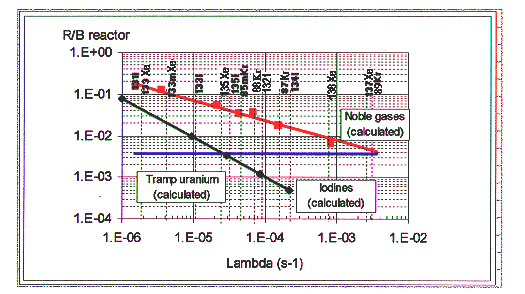
Fig.1. Gases and iodines fractional
release in the primary water
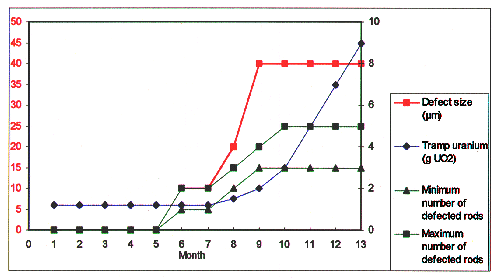
Fig. 2. Evolution of the mass of
tramp uranium and numbers of defects during cycle
C. Leuthrot, K.Chevalier, J.P. Ghysels, P.Ridoux
Commissariat à l'energie atomique Electricité de France
CEA/DRN- CE CADARACHE EDF/SEPTEN
ABSTRACT
The long-lasting nature and toxicity of some of the radionuclides contained in low level process wastes or in dismantled reactor materials have received in France particular attention relative to their final disposal. Typical radionuclides are 90Sr, 129I, 99Tc, and actinides. These nuclides are predominately pure or emitters and can normally not be measured with the laboratory equipment used in nuclear plant facilities.
Most of the utilities use scaling factors for evaluating the difficult-to-measure (DTM) isotopes. The scaling factors (SF) are determined by relating the concentration of the DTM isotope to the concentration of an easy-to-measure «tracer» (principally 60Co or 137Cs). Except for the nuclides which have the same physico-chemical behavior, such as 59Ni/60Co and 63Ni/60Co, the problem of the SF is their inconstancy and dispersion. Generic SF applicable on all PWR plants and for all fuel cycles are in most cases very difficult to obtain specially if small data sets exists.
The acquired knowledge at CEA on the physico-chemical behavior of fission products, actinides and corrosion products in the french PWR's primary circuit and the EDF feedback in this field allowed to work out assessment models for the DTM radionuclides in the primary water as well for these which are deposited on the primary circuit surfaces. These estimates allow to predict the long lived isotopes retained by the filter and the resins of the primary water purification system. These filter and demineralizers constitute normally the major part of EDF's low level waste activity which is periodically shipped to the near surface disposal centers in France.
CALCULATED DTM NUCLIDES
The difficult-to-measure (DTM) nuclides considered for the assessment models are the fission products 90Sr, 99Tc, 107Pd, 129I, 135Cs, the activation products 59Ni, 63Ni, 93Mo, 94Nb or both (93Zr),and actinides 238Pu, 239Pu, 240Pu, 241Pu, 241Am. The french computer codes are called:
These codes allow the source term for a given nuclide (short/medium lived or long lived) to be calculated and to balance its activity in the primary circuit. The source term balance considers reactor water activity, reactor coolant system surface deposited and activity removal by the reactor water purification system (demineralizer with a front cartridge filter). The long lived DTM nuclides are derived from reactor water measurements of medium lived gamma emitters, which are either fission products (Kr, Xe, I, Cs) or activation products (Co, Fe, Mn, Ag, Sb). This is done for each reactor cycle.
At the present time, the assessment models and their verification have been completed for the fission products 90Sr, 129I and for the actinides. The verification is still in progress for the other fission and activation products.
SOURCE TERMS FOR DTM FISSION PRODUCTS
As for short lived fission products, the source terms of DTM fission products in the primary water is induced by the following mechanisms:
The values of source terms for these mechanisms can be obtained from the analysis of the reactor coolant gamma isotope data during the cycle. The nuclides analyzed are the rare gases ( 85mKr, 87Kr, 88Kr, 133Xe, 135Xe, 138Xe) and the iodines (131I, 133I, 134I, 135I). From the measured activities and reactor parameters (power, CVCS flow rate), it is possible to calculate the fractional release of these nuclides in the primary water (Fig. 1) and to deduce:
Fig.1. Gases and iodines fractional
release in the primary water
Fig. 2. Evolution of the mass of
tramp uranium and numbers of defects during cycle
From these information, the PROFIP code will calculate the source term for all the DTM fission products and the activity balance in the primary circuit.
ACTIVITY BALANCE IN THE PRIMARY CIRCUIT
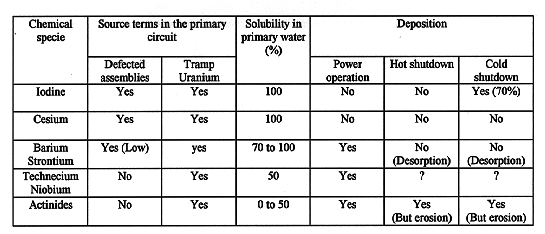
The activity balance for the DTM fission products and actinides is calculated by using the source term modeled above and employs theoretical models or empirical correlations for the behavior of the radionuclides in the primary circuit. The different mechanisms taken into account are:
Variations due to the pH of the reactor water (e.g. cold shutdown) are also taken into account. Table I summarizes the considered behavior of the radionuclides in the primary circuit.
TABLE I Behavior of Fission Products. Chemical
Species in the Primary Circuit
RETENTION ON THE DEMINERALIZER AND FRONT FILTER IN THE CVCS CIRCUIT
From the solubility factors in Table I it seems very easy to deduce the percentage of the activity which is trapped in the CVCS filter and resin. This is true for the actinides which are very insoluble, chemical species. However, for the species which are totally or partially soluble, adsorption of the soluble part may occur on the filter. The adsorbed fraction depends on the chemical form of the radionuclide and is often variable with the filtration time.
Considering the fact that direct measurements on CVCS filter and resin are not easy and are expensive, a small simulator has been built (called «Mini-RCV») which represents the CVCS demineralizer connected with its front filter. It consists of:
The Mini-RCV is inserted in the reactor water sampling system. It may use flow rates between 50 to 200l/h. During operation, on line gamma spectrum measurements are performed at the inlet or at the outlet of the device. The measurements of the DTM nuclides are carried out off-site in specialized CEA laboratories.
The following parameters have been controlled to make sure that the simulator is representative:
The results show:
TABLE II Fractions of CVCS activities trapped in the
filters
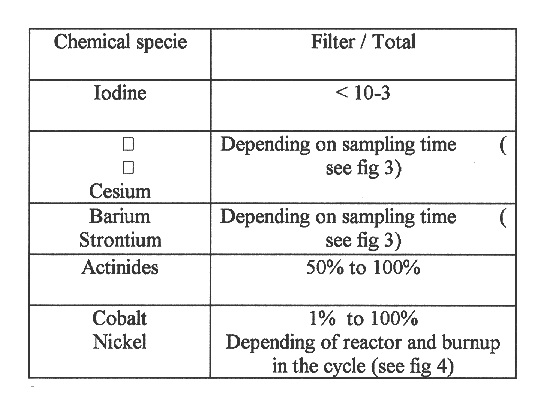
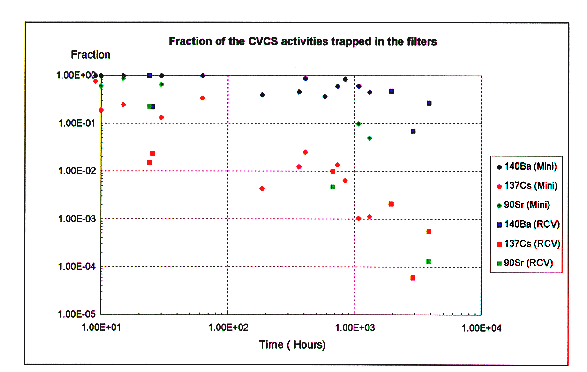
Fig. 3. Fraction of the activities
trapped in the CVCS filters correlated to sampling time
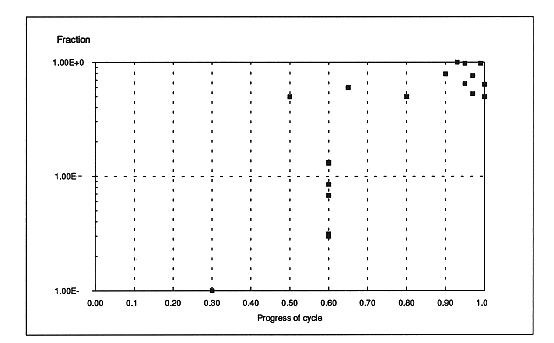
Fig. 4. Fraction of Cobalt trapped in
the CVCS filters during a cycle
VALIDATION OF THE MODELS
The prediction models for the DTM radionuclides in the primary water, CVCS filter, resin and deposits on primary circuit surfaces, have been qualified for 90Sr and for the actinides (partialy for 129I, 59Ni and 63Ni). The validation was performed by a comparison with measurement results from:
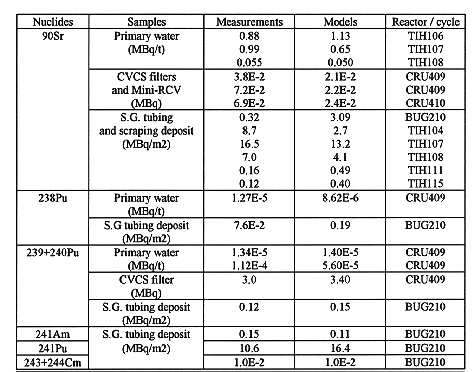
Typical results of the validation measurements are shown at Table III for the 90Sr nuclide and the actinides.
Generally, a perfect agreement is obtained between prediction and measurement except for some values related to the filter activities. This is probably associated with a large variation of the crud content from one reactor to another. This dependency requires further study for the assessment models.
TABLE III Validation of the models for 90Sr
and Actinides activities in the primary circuit
CONCLUSION
The CEA models for the prediction of 90Sr and actinides have been successfully achieved and show good agreement between the calculated and the measured values. The models, based on the PROFIP and PACTOLE codes, will soon be extended to the others DTM nuclides (129I, 99Tc,107Pd, 59Ni and 63Ni). As their use will become more consistent, a reactor site computer will be developed, called SADDAM, which will allow the DTM nuclides to be calculated on the basis of gamma spectrum measurements of primary water samples.
REFERENCES