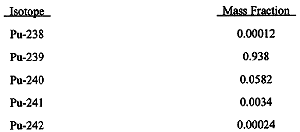
Table I Mass Composition of Pu-52
Lawrence J. Slate
SAIC
545 Shoup Avenue
Idaho
Falls, ID 83402-3575
ABSTRACT
This paper documents the established transportation and final storage regulations that will affect the slag waste form generated by the Plasma Hearth Process (PHP). The established transportation and storage regulations applicable to the PHP slag waste form are the Transuranic Package Transporter-II (TRUPACT-II) and the Waste Isolation Pilot Plant (WIPP) Waste Acceptance Criteria (WAC). The following is a summary of the limitations imposed by these two regulations that impact PHP treated wastes:
This study illustrates how each of the above limitations are applicable, which are likely to be exceeded by the treated PHP slag waste form, and recommends those limitations that should be reevaluated so the Department of Energy (DOE) can most effectively use the waste form stabilization and volume reduction offered by the PHP system.
INTRODUCTION
The Plasma Hearth Process (PHP) being developed by Science Applications International Corporation (SAIC) for the Department of Energy (DOE) is a high temperature waste treatment technology for treating a large variety of wastes. The PHP is initially targeted to process alpha-contaminated wastes, including transuranic (TRU) waste, and TRU mixed waste into a final vitreous waste form. The PHP destroys the organic material in a waste stream and vitrifies the inert fraction to a glass or slag form, thereby reducing the volume of waste, stabilizing the contaminants, and concentrating the associated radionuclides. The slag is contaminated with weapons grade plutonium identified as Pu-52. The isotopic composition of Pu-52 is shown in Table I. Americium-241 is omitted from the table because it is not a major contributor to the criticality of the system.
Table I Mass Composition of Pu-52
Current PHP project planning is to discharge the slag from the process into 55-gallon drums for final disposal. A full drum containing slag has the potential to weigh 1,700 pounds and would be administratively controlled to contain less than 200 grams of fissile material. This study will examine the current transportation and storage regulations that will be applicable for PHP treated waste.
To effectively use the volume reduction offered by the PHP system, transportation and final storage emplacement regulations must be investigated to determine how this volume reduction, and the related concentrating of contaminants, may be impacted by these regulations. Currently, all shipments of DOE TRU waste to the Waste Isolation Pilot Plant (WIPP) must comply with the Transuranic Package Transporter-II (TRUPACT-II) requirements.(1) Waste treated using PHP is presently anticipated to be emplaced at the WIPP and will have to conform to the WIPP Waste Acceptance Criteria (WAC).(2)
TRUPACT-II
The TRUPACT-II Contact Handled Transuranic Waste Shipping Package has been developed as a safe means of transporting contact-handled transuranic (CH-TRU) materials among DOE generating sites and to the WIPP. The TRUPACT-II Shipping Package is designed for tractor trailer transport.(3) Three loaded TRUPACT-II packages can be transported at one time on a single tractor trailer. A single TRUPACT-II Shipping Package can transport fourteen, 55-gallon drums of CH-TRU waste or alternately two Standard Waste Boxes (SWB).
The TRUPACT-II has several package content requirements that will impact PHP treated waste. Waste content, gross weight, fissile content, and decay heat limitations could restrict the cost effective shipment of PHP treated waste.
Waste Content
The TRUPACT-II Shipping Package is designed to transport CH-TRU materials for the U. S. DOE to the WIPP. This section will highlight the restrictions that CH-TRU payload materials transported in the TRUPACT-II Shipping Package must meet.
CH-TRU waste materials in payloads for the TRUPACT-II package are described according to the following Waste Types (I, II, III or IV) or can be divided into Waste Material Types (I.1, I.2, I.3, II.1, II.2, III.1, and IV.I):
I. Solidified aqueous or homogeneous inorganic solids (that contain water)
I.1 Absorbed, adsorbed, or solidified inorganic liquids (nuclides may be in solution and energy transfer may occur between the liquid and the inorganic binder).
I.2 Soils, solidified particles, or sludges formed from precipitates.
I.3 Concreted inorganic particulate waste having a maximum of 30 weight percent unbound water.
II. Solid inorganic materials
II.1 Solid inorganic materials in plastic bags.
II.2 Solid inorganic materials in metal cans.
III. Solid organic materials (including some absorbed liquids and cemented organics)
III.1 Plastics, cellulose, cemented organic solids, and other solid organics.
IV. Solidified organic materials
IV.1 Cemented or immobilized organics liquids and solids.
The physical form of the CH-TRU waste comprising the TRUPACT-II payload shall be restricted to solid or solidified material. Liquid waste is prohibited in the payload containers, except for residual amounts in well-drained containers. The total volume of residual liquid in a payload container shall be less than one volume percent of the payload container.
The chemical properties of the waste are determined by the chemical constituents allowed in a given waste type (e.g., solidified aqueous or homogeneous inorganic solids is Waste Type I). Chemical constituents in a payload shall not be in a form that could be reactive during transport. Specifically, three types of chemical constituents are prohibited from a TRUPACT-II payload: explosive materials, pyrophorics, and corrosives.
An explosive material is defined as: any chemical compound, mixture, or device, the primary or common purpose of which is to function by explosion (i.e., with substantial instantaneous release of gas and heat). Examples of explosives are ammunition, dynamite, black powder, detonators, nitroglycerine, urea nitrate, and picric acid.
A pyrophoric material is defined as a flammable solid which, under transport conditions, might cause fires through friction or retained heat, or which can be ignited readily, and when ignited, burns vigorously and persistently so as to create a serious transportation hazard. Included in the pyrophoric definition are spontaneously combustible materials, water reactive materials, and oxidizers.
Pyrophoric radioactive materials shall be present only in small residual amounts (<1 weight percent) in payload containers. Examples of pyrophoric radionuclides are metallic plutonium and americium.
Corrosive materials are defined as: Aqueous materials which have a pH less than two (2) or more than twelve and a half (12.5).
In addition to the above concerns regarding the content of the waste in a TRUPACT-II payload, another concern is the generation of gas from the reactions of alpha, beta, neutron, or gamma radiation with the waste during transport of a TRUPACT-II payload. Gas concentrations and pressures are restricted to the following limits:
Gross Weight
The weight of each individual payload container and the total weight of the TRUPACT-II payload shall be less than the weight restrictions as outlined in Section 1.2.3.3 of the safety analysis report (SAR).(2) The weight limits are:
The weight of the seven drums on the top row of a fourteen-drum payload assembly shall be less than or equal to the weight on the seven-drums on the bottom of the assembly. The weight of each payload container shall be measured and recorded in the database for individual containers, along with an estimate of the error in the weight.
Fissile Content
In addition to the content and weight requirements set by TRUPACT-II, the amount of fissile material contained in a TRUPACT-II container is regulated. A payload container is acceptable for transport only if Pu-239 fissile gram equivalent (FGE) plus two times the error is below the following values:
Decay Heat
A TRUPACT-II payload container (fourteen 55-gallon drums or two SWB) in a given shipping category is qualified for transport only if two decay limits are met: 1) the total decay heat from the radioactive decay of the radioisotopes within an individual waste container and 2) the total decay heat from all payload confiners in a TRUPACT-II. Also, a payload container in a given shipping category is qualified for transport only if the measured decay heat plus error is less than or equal to the limits for that shipping category. PHP waste is catagorize as waste material type II.2; therefore, from Table 1.2.3.3-1 of section 1.2.3.3 from the SAR illustrates that the maximum wattage is 40 watts per drum and 40 watts per a TRUPACT-II.
WASTE ISOLATION PILOT PLANT
It is currently anticipated that the treated slag waste from the PHP system will be emplaced at the WIPP. The limitations imposed by the WIPP that affect treated PHP slag are very similar to those from TRUPACT-II. The limitations that could affect PHP treated slag waste are waste content, gross weight, fissile content, and decay heat.
Waste Content
The current WIPP WAC precludes free liquids in all waste containers. As a guideline, CH-TRU waste shall contain as little residual (free) liquids as is reasonably achievable. In no case shall the total free liquid volume (i.e., the sum of all internal or payload container volumes) exceed:
Pyrophoric materials, other than radionuclides shall be rendered safe by mixing them with chemically stable materials (e.g., glass or concrete) or shall be processed to remove their hazardous properties. Not more than one percent by weight of the waste in each waste container may be pyrophoric forms of radionuclides, and these shall be generally dispersed in the waste. The waste shall not contain explosives, corrosives, or compressed gases.
Gross Weight
Individual container weights shall be limited to the weight capacities that meet DOT Specification 7A, type A requirements. The requirements are as follows:
Fissile Content
The fissile or fissionable radionuclide content of CH-TRU waste packages shall not exceed the following values, in Pu-239 FGE:
Decay Heat
The WIPP requirements for decay heat are analogous to the TRUPACT-II requirements:
SUMMARY OF TRUPACT-II AND WIPP REQUIREMENTS
The Table II is a summary of the TRUPACT-II and the WIPP WAC requirements that have the potential to impact the packaging, handling and disposal of PHP treated waste.
Table II Summary of TRUPACT-II and WIPP WAC Requirements(1, 2)
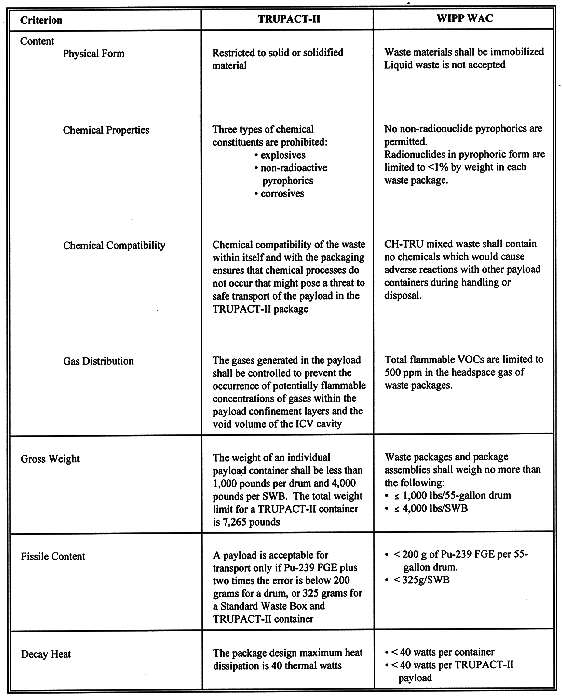
Table II illustrates the limitations that will restrict the capabilities of treating waste using the PHP. The remaining portion of this section will address each item in Table II as the item pertains to PHP.
Waste Content
With regard to the content of the waste, slag generated from the PHP is a homogenous, highly stable vitrified crystalline phase material that consistently tests at least two orders of magnitude below the Resource Conservation Recovery Act (RCRA) limits for the toxicity characteristics leaching procedure (TCLP).(4) Because of these properties the waste form meets both the WIPP and TRUPACT-II requirements regarding the physical form and qualifies as Waste Type II defined in Section 2.1 of this paper. The PHP treated waste will not contain any explosive materials and therefore, meets both sets of requirements considering the chemical form. The organic constituents of the waste will be volatilized or pyrolyzed from the treatment and will not remain in the waste; therefore, no generation of gases will occur from the reactions of alpha and neutron radiation, thus satisfying the gas requirements for both sets of requirements.
Gross Weight
The weight limitations set by the TRUPACT-II and the WIPP will impact the disposition of PHP treated waste. From experimental data, the maximum density of the slag formed from the PHP is 3.8 g/cc.(4) This density will yield a mass of one (1) 55-gallon drum of 1,700 pounds. Consequently, if 14 drums are placed into a TRUPACT-II container with this density, the total weight would be 23,800 pounds which exceeds the total weight limit of 7,265 pounds by 16,535 pounds. The current TRUPACT-II limitation of a maximum weight limit of 7,265 pounds per container would reduce the capacity of each drum or the number of drums by 70% (based on a 1,700 pound drum) to remain below the maximum weight requirement. The project should investigate the feasibility of increasing the weight limit of a TRUPACT-II container to 14,000 pounds. This increase would allow each drum to weigh 1,000 pounds, which would satisfy both the TRUPACT-II and the WIPP requirements of a single drum weight limitation. The additional weight limit would not effect the Department of Transportation (DOT) regulation of 80,000 pounds for motor vehicle weight limit. The weight of an empty tractor trailer is approximately 30,000 pounds.(5) Thus, the weight of three TRUPACT-II containers and the truck would weigh 72,000 pounds. The structural integrity of the TRUPACT-II container would have to be examined to ensure that it could withstand the additional weight for all postulated scenarios.
Fissile Content
A criticality study using the Monte Carlo N-Particle Transport Code System (MCNP) has determined the quantities of fissile material that the PHP can safely treat without a criticality incident.(6) The analyses evaluated four stages in the PHP that could sustain a nuclear reaction. These stages include melting waste feed drums in the crucible, pouring the molten slag into a slag collection drum, moving or relocating the drums within the facility, and storing the drums. Within the processing sequence, fissile material concentrates in the crucible as a result of vitrifying multiple waste feed drums. Once the crucible is full, the molten slag is poured into a 55-gallon drum, which causes the geometry of the slag matrix containing TRU isotopes to change. With the vitrified material contained, the remaining two process stages cause geometric changes by moving and storing the slag collection drums. The results from the study are provided in Table III. The first column indicates the process stage. The second column shows the nominal mass of Pu-52 anticipated in each stage of the PHP, based on an average drum containing 5.81 grams of Pu-52.7 The third column displays the mass of Pu-52 that would accumulate in each process stage based on a 200 gram limitation for each processed drum (these values are based on a combustible waste volume reduction of 11:1, because of this volume reduction the crucible can retain 19 drums). The last column demonstrates the mass of Pu-52 that each stage of the process can contain and remain subcritical. The four drum scenario simulates moving four drums on a pallet via a fork truck and the infinite drum scenario simulates permanent disposal in a closely stacked matrix.
Table III Criticality Mass Limits for PHP(6)
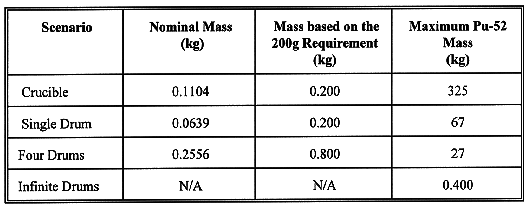
The results in Table III indicate that the PHP could load drums with a fissile material content greater than allowed for TRUPACT-II without a criticality occurrence. The fissile material limitations for TRUPACT-II could restrict the treatment capabilities of the PHP in that all fissile material content must be limited to be transportable under current regulations. The regulations regarding the certified amount of fissile material for a TRUPACT-II should be evaluated to consider larger total quantities of fissile material if it can be proven that more fissile material can be safely transported. A study (8) was conducted (by Sandia National Laboratories) to show that more fissile material could be safely transported in a TRUPACT-II. The study "Rocky Flats Residues (RFR) Criticality Analyses" showed that by placing the fissile material into a pipe overpack and then placing the overpack into a 55-gallon drum, the FGE could be safely increased to 2.8 kg or 200 g in each of the fourteen drums. The WIPP fissile content limit would not need to be changed. Further analysis would be required to show that the stabilized drummed waste configuration is similarly safe to transport.
Decay Heat
The current TRUPACT-II decay heat limitation is restricted to 40 thermal watts for a single drum and 40 thermal watts for a TRUPACT-II payload. The mass of Pu-52 required to obtain 40 thermal watts is 1,970 grams (in a subcritical configuration), which is clearly higher than the allowed limitation. A PHP drum containing 200 grams of Pu-52 treated waste would generate 0.465 watts.
Comparison of the Limits for PHP
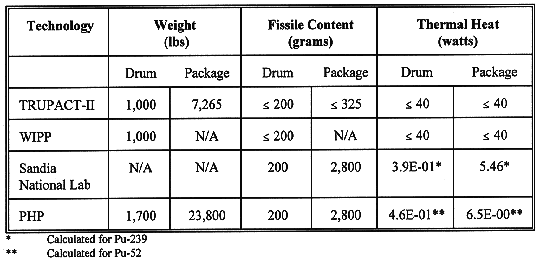
Table IV summarizes the different limits that are currently in place for PHP treated slag waste by the TRUPACT-II and the WIPP. Also, the table indicates the boundary conditions for the pipe overpack study conducted at Sandia National Laboratory and PHP treated slag waste. The table illustrates the differences for one and fourteen 55-gallon drum containers transported to the WIPP.
Table IV Summary of Current Requirements
CONCLUSIONS
To cost effectively transport and dispose of mixed TRU waste using the PHP system, specific requirements regarding transportation and storage need to be updated. The limitations that need to be addressed are gross weight and fissile content. From the waste contents identified in the TRUPACT-II SAR, a PHP slag waste form meets or exceeds all of the limitations set in the Waste Material Type II.2 definition. The decay heat limitations do not pose a problem as described in Section 4.4 of this paper. To effectively use this technology, the gross weight limit needs to be increased to 1,000 pounds for up to fourteen drums in a TRUPACT-II package, increasing the total weight content of a TRUPACT-II package to 14,000 pounds. In addition, the fissile content needs to be increased to at least 200 FGE per drum container. This is supported by the Sandia National Lab study and the study conducted for PHP waste.
If these limitations are not updated then measures will have to be taken to ensure that the PHP treated slag waste remains transportable. These measures will have to include stringent administrative controls on the waste feed so that the treated slag waste will not exceed the transportable weight and fissile content limits. Current TRUPACT-II weight limitations would reduce the volume of slag that could be transported in a single TRUPACT-II container to approximately seven 55-gallon drums that are 60% full (1,000 pound limit) or fourteen drums that are 30% full. An item of interest is that the 1,000 pound limit roughly corresponds to a full 30-gallon drum. Current TRUPACT-II fissile material limitations are similarly, or perhaps more, restrictive. It was calculated that the average drum (1,700 pounds) of treated Idaho National Engineering Laboratory (INEL) stored alpha waste would contain 64 g of Pu-52 (Table 2.0). With drums limited to 1,000 pounds of treated slag waste, 38 g of Pu-52 would be present in the average drum. Based on a current TRUPACT-II limit of 325 g per container, only eight drums of slag can be transported at one time. This number would be reduced to as low as two drums whenever any one or more drums have greater than 38 g of Pu-52 up to the maximum of 200 g per drum. The conclusion is that current transportation limitations will result in more than twice as many TRUPACT-II shipments being required to transport this slag waste form for disposal than the volume capability of the TRUPACT-II would otherwise allow.
REFERENCES