 WASTES
WASTES
WASTES
A. Froment
Transnucleaire
9 , rue Christophe Colomb
75008 Paris
Y. Rouquette
COGEMA
2 Rue Paul Dautier
78141
Velizy Villacoublay
ABSTRACT
Alpha wastes are generated in fuel cycle facilities such as those involved in reprocessing, in manufacture of mixed oxide fuel, and by research laboratories. As concerns transport, a large quantity of these wastes cannot be considered as Low Specific Activity (LSA) material, and some of them are combustible: if a significant amount of material has to be transported, then a Type B packaging is required. The TN GEMINI container has been developed by COGEMA and Transnucléaire to achieve this goal.
The TN GEMINI is a parallelepipedic packaging with a rear door allowing an horizontal loading. It is similar to an ISO 20 ft sea container in terms of total weight, size, handling devices and tie-down capability. It provides a large internal volume (4.5 x 2 x 1.8 m) available for a 5.8 Mt payload with a 30 Mt total gross weight. The TN GEMINI enables the transport of alpha wastes in drums (forty 200 liter drums or sixty 118 liter drums). The maximum fissile contents have been set at 370 g of plutonium.
This container fulfills the requirements for B(U) packages according to the International Atomic Energy Agency (IAEA) regulations. In addition, it also allows full compatibility with standard transport/loading equipments and does not require any stringent protection measures.
Our presentation will 1) give a general description of the TN GEMINI container and its contents; 2) briefly outline the main phases of its design and manufacture; 3) illustrate the operational features of the TN GEMINI container.
GENERAL DESCRIPTION
The TN GEMINI container is a parallelepipedic packaging with a rear door allowing an horizontal loading. It is similar to an ISO 20 ft sea container in terms of total weight, size, handling devices and tie-down. Its main dimensions are summarized in the following table.
| Overall dimensions | 6058 x 2500 x 2650 mm |
| Free volume | 4510 x 1840 x 2000 mm |
| Total gross weight | 30000 kg |
| Maximum payload | 5800 kg |
The packaging includes three main components: the body, the containment door and the shock absorbing cover (Fig. 1).
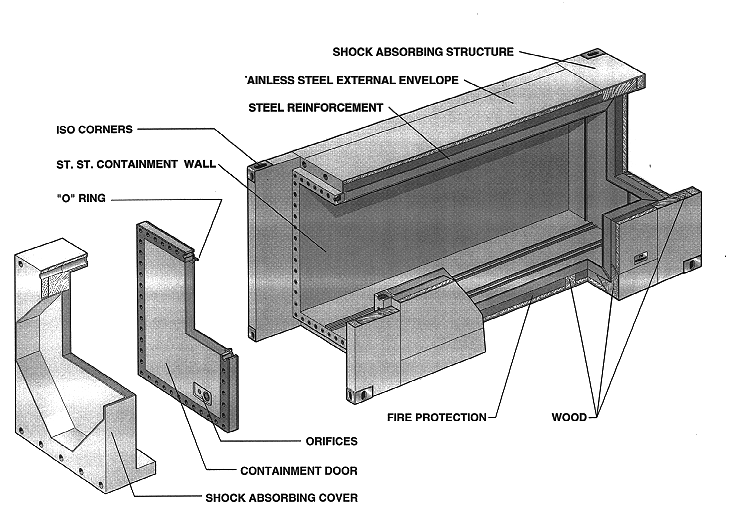
Fig. 1. TN Gemini: "Type
B" container for a waste drums.
Body
Walls are made of multilayered materials such as stainless steel (for structural resistance), balsa wood and phenolic foam (for their low crushing stresses and thermal insulation capabilities). This was found the most efficient for the puncture resistance. The corners are protected by thick layers of redwood and balsa (for shock absorbing).
Containment Door
It is designed similar to the walls. It is bolted to the body. Two concentric "O" rings made of EPDM (Ethylene Propylene Rubber) guarantee a very low leakage rate. This can be measured by means of an orifice provided at the bottom of the door. Another orifice is dedicated to gas sampling or pressurization whenever inert gas is necessary.
Shock Absorbing Cover
The removable shock absorbing cover is bolted to the container body and provides protection for the closure system during transportation. Its central part is made of two stainless steel plates and phenolic foam. Around it are composite materials such as stainless steel plates, redwood, balsa and thermal insulator.
GENERAL DESCRIPTION OF THE CONTENTS
Typical contents are alpha wastes in drums: forty 200 liter drums or sixty 118 liter drums. Special internal arrangements such as pallets are used for loading, unloading and tie-down operations of the drums.
The waste materials are among the following:
These wastes must be dry (less than 1% liquid in each drum), in solid form, chemically stable, non-combustible, non-explosive and non-corrosive (2 < pH < 12,5 in water solution). They can be conditioned in plastic bags.
The maximum quantity of uranium 235 and plutonium is defined by Eq. (1).

where mPu (resp. mU235) is the mass of Pu (resp. U235) in grams.
For each drum, the maximum mass of the content is 40 kg and the maximum residual heat power is 15 mW. The large cavity and the high payload of the TN GEMINI container also offer an answer to a wide range of specific contents such as large size contaminated equipments resulting from dismantling operations (e.g. glove boxes) or damaged transport containers. In such a case, the cavity must be equipped with anchor points for tie down.
DESIGN AND MANUFACTURE
As a B(U) packaging type, the TN GEMINI container fulfills the specific requirements of the IAEA regulations in terms of drop resistance test and fire test resistance. A half scale model of the whole packaging was used to demonstrate the 9-m drop resistance test (Fig. 2) and the 1-m drop puncture resistance test (Fig. 3). Seven drop tests were performed so as to procedure the most severe damages to the container. They proved that the total leakage remains at the same level as before the first drop, and that the consequences of the drop tests cannot prevent the container from withstanding the fire test.
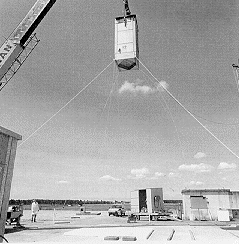
Fig. 2. 9-M drop
resistance test of TN Gemini.
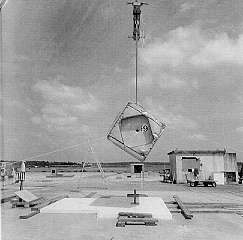
Fig. 3. 1-M drop
puncture resistance test of TN Gemini.
The fire test was simulated by finite element analysis. The simulation results show the temperature of the cavity does not exceed 70°C which is quite compatible with the transport of commonly used organic waste. Particular attention is paid to the hydrogen production due to radiolysis or chemical decomposition of organic materials. In that case, the permeability envelope characterization of the waste guarantees an acceptable H2/air of less then 4 % for a 45 days transport duration assuming the drum storage duration is less than 200 days.
Two units have been manufactured (Fig. 4) for Cogema and are operated by Transnucleaire in France for two purposes:
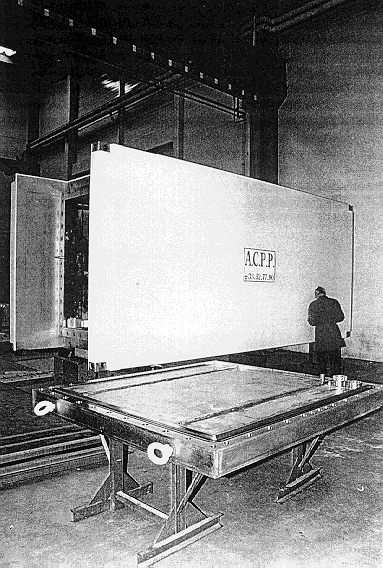
Fig. 4. A TN Gemini
unit ready for final inspection.
OPERATIONS
The design concept of the TN GEMINI container provides an easy operating system. Handling by lift spreader and tie down to trailers are operated by means of the eight standard ISO anchor points located at the corners of the container with the same geometry as for standard ISO 20 ft containers. The maximum transport accelerations are:
All metallic components for structure or containment are in stainless steel for durability and ease of decontamination. Horizontal loading is made possible by the design of the rear door which provides an opening of 2000 mm x 1840 mm. Special internal arrangements (Fig. 5) for drums such as pallets are used for loading, unloading and tie down operations. The drums are loaded/unloaded with a forklift in a manual mode (Fig. 6), or with a special equipment for positioning and handling in an automated mode. A simplified loading procedure in the manual mode is as follows.
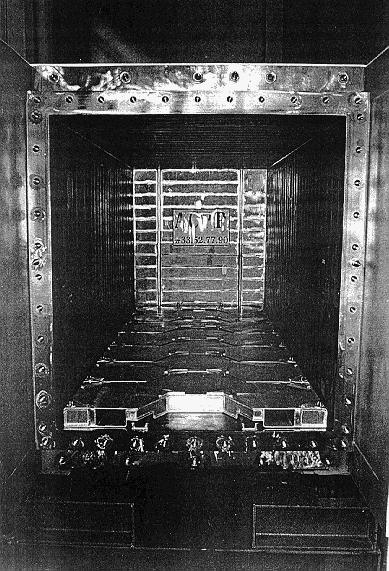
Fig. 5. Internal arrangements of a
TN Gemini Container for loading, and tie-down operations.
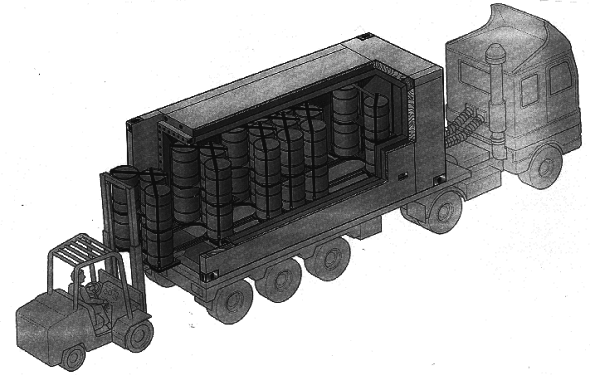
Fig. 6. Loading 200
liter drums with a forklift.
CONCLUSION
The TN GEMINI container is a new type B(U) container which provides
Two units have been manufactured for COGEMA and are operated by Transnucléaire in France for the transport of alpha wastes in drums from CEA research laboratories and between the Mox fuel manufacturing facilities. The large cavity and the high payload of the TN GEMINI container also offer an answer to a wide range of specific contents such as large size contaminated equipments resulting from dismantling operations.