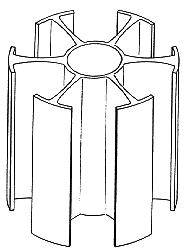
Fig. 1. Basket
design.
A. R. Cory, R. T. Benbow
British Nuclear Fuels plc
Risley, Warrington, Cheshire, UK
ABSTRACT
High-level waste is generated as a product of reprocessing, being a product of the chemical process that is unusable for recycling into new fuel. BNFL has stored such waste at Sellafield in liquid form for about 40 years. While most of the waste generated at Sellafield is a product of the UK nuclear industry, an increasing quantity is generated as a result of reprocessing fuels from Japan and Europe. Since 1976, contracts signed with overseas customers have included the return of the waste product to the country of origin.
The waste, or residue has to be incorporated in a stable form to facilitate safe and convenient re-export. BNFL has constructed a plant at Sellafield to embed the residue in a stable glass matrix. BNFL's vitrification plant came on stream in 1992, and has continued to expand its capacity. Feedstock is drawn from the highly active waste storage tanks and concentrated by evaporation. The concentrated product is mixed with glass powder, or 'frit' at high temperature in a 'calciner' before canning in stainless steel containers. The containers are sealed by a robotic welding process and consigned to a specially constructed store, cooled by natural air circulation.
After a period in storage during which time the activity and heat generated have decayed to acceptable levels, those containers selected for re-export are remotely loaded into a cask designed for either transport, or dual purpose transport & storage, depending on the requirements of the individual customer. In practice, residues destined for Japan are carried in a transport cask, which is re-used after unloading into a shielded store in Japan. Most residues destined for Europe will be stored in the cask in a repository. In both cases this storage is regarded as an interim measure, where 'interim' can mean a 40-50 year period preceding final disposal.
BNFL has designed casks to suit each requirement. The cask servicing the dual-purpose transport & storage requirement is the latest to be designed, and is the subject of this paper. The degree of optimization of the key cask features is very high - in other words the design is very efficient in its use of materials to allow maximum payload at minimum weight.
HISTORICAL CASK DEVELOPMENT
In the early 1980's BNFL recognized the need to begin conceptual development of a transport cask for Vitrified Residues, resulting in a 21-container cask being designed. At that time, competitive designs were non-existent, and considerable latitude was used to develop innovative features in the internal basket construction. Progress with Sellafield's vitrification plant governed the rate of spend on the cask development, with the result that the final stages involving impact testing were not completed until 1992. During this period, much work was done to demonstrate the thermal performance of the cask internals, much of which has been extrapolated to the 28-container design. Production of the 21-container transport cask starts in 1997.
DESIGN OBJECTIVES
Transport vs. Storage Requirements
The requirements for a dual-purpose transport and storage cask are different in a number of details from those of a transport-only cask. Extended periods of storage require more onerous requirements for the cask sealing system. Elastomeric seals are satisfactory for transport applications where they can be replaced during regular maintenance, but prolonged exposure to radioactivity for several years results in degradation of the material. Where maintenance is not possible, as in interim storage, metallic seals must be used where performance can be guaranteed for the duration of the storage period.
Metallic seals can also be tailored to give a much higher sealing integrity, which is demanded by the strict limitations on activity release applicable to the typical repository. This sealing philosophy is extended to all penetrations into the cask containment. As an additional safeguard for storage, a secondary lid is fitted over the main containment closure. This lid must also have the same sealing integrity as the primary lid. The interspace formed between the lids can be tapped into during the storage period to monitor for leakage.
Radiological Criteria
As the cask performs a dual-purpose transport and storage function, the separate requirements of both transport and storage must be met. In the transport case, the requirements laid down in IAEA Safety Series 6-1985 edition (as amended 1990) are applied. This limits the external dose rates at a maximum of 2000 µSv/hr on the surface and 100 µSv/hr at a distance of 2 meters from the surface. The storage requirements are laid down by the operators of the repository; the only repository in service at the time of writing is the facility at Gorleben, in Germany. This site lays down criteria derived from acceptable levels at the site boundary, extrapolated back to the individual package. In the case of the VISTA-28 cask, the limits at the surface are 325 µSv/hr (neutron) and 130 µSv/hr (gamma). Similar criteria are required by the projected Swiss facility.
Thermal Criteria
IAEA transport regulations define the allowable accessible surface temperatures, and the permissible temperature in the repository has a separate limit governed by maximum temperatures sustainable by the building structure. Most importantly, the temperatures of the residues carried have to be maintained below 500 degrees C to ensure that de-vitrification of the product does not occur. Whilst posing no immediate danger, de-vitrified product is less stable for long-term storage and would consequently have to be returned to Sellafield for alternative sentencing.
Physical Criteria (Size, Weight)
The package has to be transportable from the BNFL Vitrified Residue Export facility at Sellafield to Barrow-in-Furness by rail, and by PNTL ship from Barrow to a European port. The package overall size must be such that it can be carried by railwagon on the UK and European rail loading gauges, and weight limited such that permissible wagon axle loadings are not exceeded. Ideally, use should be made of existing transport equipment.
Handling and Carriage
The cask has to be fitted with features to enable eases of handling, and tie down attachment points strong enough to resist accelerations imposed during transport. The latter requirements are obtained from IAEA Safety Series 37. As far as possible, handling features are to be suited for use with existing equipment, or at least by familiar methods. Tie down features shall be designed for ease of use, to minimize turnaround times and dose uptake to operators. Additionally, the requirements of the German nuclear code KTA 3905 must be met concerning lifting regulations.
Damage Criteria
The cask must meet regulatory criteria laid down by the IAEA concerning its ability to sustain damage in prescribed transport accident scenarios without exceeding defined criteria for radiological dose or release of activity. When in the store, various events must be considered, including the collapse of the building and subsequent reduction in the package's ability to dissipate heat, and the impact of a crashing aircraft.
Residue Blends
Residue production has been classified into a number of blends of Magnox, AGR and LWR wastes, ranging from Q1 to Q9. The constitution of each blend also varies according to the timing of reprocessing, and the burnup characteristics of the fuels giving rise to the residues. The VISTA-28 cask is designated to carry blends Q1 to Q9, with blend Q9 being the most severe in terms of its shielding requirements, having the highest gamma and neutron sources.
DESIGN DESCRIPTION
Basket
In many ways the design of the basket is key to the performance and viability of the package. In order to achieve a transportable package containing 28 residue containers the weight of all features has to be optimized according to the duty of that component. The prime purpose of the basket is to transfer heat efficiently from the residue containers to the bore of the cask. In doing so, the residue temperature must be limited, and the temperature of the aluminum itself must not exceed that at which mechanical strength seriously declines.
The resulting optimized design consists in plan of a central cylinder with six radial extensions connecting with the bore of the cask, forming housings for seven stacks of residue containers (Fig. 1). The radial extensions, or 'spokes' are profiled carefully to minimize weight and reduce temperatures at the inner aluminum cylinder. The basket is constructed from five castings, each a one-meter deep section comprising cylinder and spokes. Only the outer diameter of the spokes is machined, to a close tolerance fit with the cask bore. The positive fixing of the basket within the bore is achieved by differential expansion of the aluminum with respect to the steel of the cask due to the thermal load of the contents. The basket is located to prevent rotation before loading of the residue containers.
The basket undergoes an anodizing process to enhance the emissivity value of the surface. This is crucial to achieving the thermal performance, and is carried out prior to machining.
Fig. 1. Basket
design.
Lid / Sealing System
The cask lid is machined from a forged billet of ASTM A350 LF5 steel, the same material as the cask body. Stainless steel is weld overlay clad in the area of the 'O' ring grooves, which are then machined. The mating surface on the cask body is also weld overlay clad with stainless steel. In order to ensure satisfactory performance over the life of the cask (50 years), the sealing system is provided by metallic spring-energized 'C' rings with an aluminum surface coating. These seals are capable of a leak tightness integrity of the order of 1 x 10⁻⁹ mbar.l/s SLR. A pair of similar seals is located concentrically, as opposed to a combination of inner metallic and outer elastomer seal favored by some designs of storage cask. It is argued that provided metal seals could be demonstrated to give acceptable transport impact performance without the backup of elastomer secondary seal, a higher integrity could be assured for storage. Additionally, the products of long-term decay of an elastomer seal would be absent from the monitored interspace between the primary and secondary lid, and so no opportunity to affect the equipment readings would be offered.
As a requirement of the storage facility, a second lid is placed over the first lid and bolted in place (Fig. 2). This secondary lid has a single metallic seal, and is fitted with the necessary connections to allow monitoring equipment to be installed. An interspace test point is fitted between the inner and outer seal of the primary lid to enable testing of the seals on lid closure after loading. On installing the secondary lid at the repository, seal testing is achieved by testing the lid interspace. Testing of the metallic seals has to be carried out using a helium mass spectrometer, no other method having the required sensitivity. The type of seal used is extremely sensitive to surface finish and contamination of the sealing surfaces by debris, however small. To ensure optimum sealing performance requires a high standard of cleanliness to be observed during the lidding operations, and careful application of sequential tightening to the lid retaining bolts to ensure even compression pressures over the seal circumference.
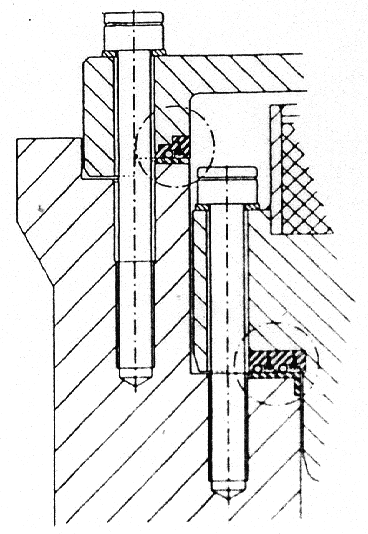
Fig. 2. Lid/sealing
system.
Materials
Material for the construction of the cask body and lid has been selected as ASTM A350 LF5 forged steel, to build on BNFL's extensive experience gained in the manufacture of spent fuel transport casks from this material and to guarantee low temperature performance.
Material for the basket is selected to maximize mechanical strength with respect to thermal conductivity, and is chosen as cast aluminum to BS 3 grade L52. This material is unsurpassed in these properties, with thermal conductivity exceeding 175 W/m2 with high mechanical strength up to 250°C. While the individual castings are relatively large, the patterns and casting process are both straightforward.
Copper Thermal Conductors (Plates)
Heat conduction from the outer diameter of the primary containment shell is effected by copper plates running through the neutron shielding layer. The plates are welded to the inner shell, then, after placing the outer steel shell in position, welded by a remotely controlled boom to the outer shell. 30 plates of 5mm thick high-purity copper are used, welded in an axial direction in such a way that in plan view they make an approximate tangent to the inner bore of the cask. The axial cavities between the copper plates are then filled with neutron shielding material.
Capping / Temperature Distribution
A 25mm thickness of rolled steel forms the outer shell of the cask, providing shielding for secondary gamma radiation generated in the neutron shielding layer. This material is also essential as a means of transferring the flow of heat from the copper plates to the main extended convective surfaces of the cask. The thickness of the secondary shell affects the distribution of temperature at the fins and consequently the amount of heat given off by each fin. Too thin a shell would result in a marked undulation in temperature around the circumference of the cask, such that local fins may exceed the limit of 85 degrees C for accessible surface temperature. The convective surface is composed of carbon steel fins welded to the outer shell. These fins are 5mm thick and 150 in number, disposed axially to give a more effective heat dissipation in vertical storage of the cask. The fins have a depth of 110mm giving a surface area in excess of 180m2.
Temperatures - Transport/Storage
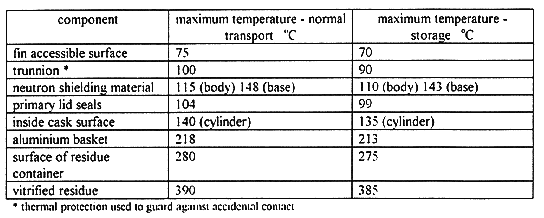
Temperatures arising from use under maximum normal transport conditions have been calculated at various parts of the cask to ensure that limiting temperatures for the residue, and also maximum temperatures for the cask and components are not exceeded. The two temperatures which limit the performance of the cask to its design condition are the accessible surface temperature, and the temperature of the aluminum basket. In both cases a reasonable margin is demonstrated to exist, which is judged prudent to maintain as a contingency pending thermal trials on the first production cask.
In the storage condition, temperature profiles around the cask surface change somewhat to reflect the vertical storage attitude and the consequent change in extended surface orientation. A formula to calculate surface temperatures in relation to prevailing ambient is satisfied under the design heat load of the cask.
Typical temperatures are shown in Table I:
Table I Maximum Temperatures for Normal Transport and Storage
Shielding - Gamma vs. Neutron
An important part of the design optimization has been to obtain the optimum balance of gamma and neutron shielding. The overall limitation on weight combined with the brief to accommodate 28 x 2kW containers has resulted in a certain amount of fine tuning between primary gamma, neutron and secondary gamma shielding. A further complication has been to meet the differing requirements of the transport and storage cases. Gamma shielding has been aided significantly by recessing the containers slightly into the cask bore. This provides more material between the containers to attenuate the contributory dose from containers remote from the cask surface at any particular point. The overall thickness of shielding varies between 395 and 415mm. Additional shielding is provided by the copper plates and the external fins.
Tiedown
In order to simplify the design of lifting features and to minimize the weight of the transport frame(s), the tie down attachment points are provided by four pads placed relatively low on the cask body. Each pad is secured to a transport cradle by tightening four bolts. The tie down attachment points are designed to meet the accelerations defined in IAEA Safety Series 37. The pad fixture is securely attached back to the primary shell by means of steel gussets penetrating the neutron shielding layer and welded to both inner and outer shells. The construction of the transport cradle is from the lightest gauge of plate commensurate with the required strength.
Handling Features
The design of trunnions for lifting the cask represents a departure from normal cask practice. Recognizing a weakness in neutron shielding around the trunnion area in similar designs, the trunnion is designed to minimize discontinuity to the neutron shield layer. This is achieved by taking the compressive loadings through a relatively thin annulus through the secondary shell to the primary shell. The tensile loads are taken by 12 M36 bolts penetrating through to the primary shell just inside the diameter of the compression annulus.
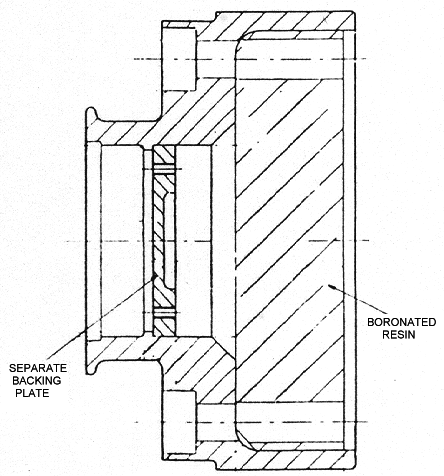
Fig. 3. Design of Trunnion
The trunnion has one journal diameter only, as there is no requirement for transport support. Tilting of the cask is effected by a tilting support plate in which the flange diameter of the base end trunnion rotates in. The material of the trunnion is martensitic stainless steel type BS 2S 143.The high strength allows minimisation of weight by providing a substantially hollow structure.
Secondary Lid and Storage Philosophy
Compliance with storage criteria requires the use of a secondary lid, as previously described. The secondary lid provides a completely independent containment boundary. The cavity of the cask is filled with helium at a pressure reduced below atmospheric. Under all foreseen circumstances, any leakage at the containment boundary will be inwards. Extensive scenarios have been considered and form part of the activity release analysis.
The interspace formed between the two lids is constantly monitored in storage for signs of leakage of cavity gas. Should such a leak be detected, the secondary lid provides a testable containment boundary which would allow the cask to be transported away from the repository to a location where the contents could be unloaded. Alternatively, it may be decided to retain the cask in the storage facility but introduce a third containment boundary to compensate for the failure of the first. This would be carried out by welding a third lid in position over the secondary lid, to a prepared feature on the body of the cask.
Penetrations
Aside from the primary lid, the containment is penetrated by a valve in the lid. The operating part of the valve comprises a quick-release coupling, but for containment consideration this is ignored. The valve is sealed by a cover plate having a double metallic seal of the same type and integrity as the lid itself. The seal interspace is provided with a test point. There are no other penetrations to the cavity.
Weights
Accurate weight calculation has been vital during the development of this design. It is recognized that to achieve the functional specification has demanded a design which pushes weight considerations to the limit. The overall transport weight of the loaded cask is 113 tons, of which 13.6 tons is payload. The support saddles add a further 3 tons. In storage this weight is reduced by six tons with the removal of lid and base shock absorbers, offset by an increase of 1.5 tons due to the installation of the secondary lid.
Criticality
The vitrified residue contains trace fissile material, and although the
fissile content is very small it has been demonstrated that the cask's contents
are critically safe under all circumstances. After analysis of a number of
scenarios, the maximum value of (k-eff+3 ) is less than 0.10.
DEVELOPMENT
Development of the VISTA-28 cask has drawn heavily on the development trials relating to the 21-container transport, and transport & storage variants.
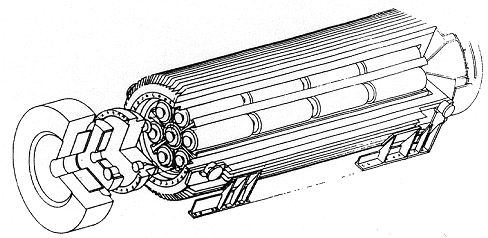
Fig. 4. VISTA-28 Cask
Thermal Testing
Some seven years ago, thermal trials were conducted with a full-scale mock-up of the 21-container transport cask. Although the basket structure and other details vary somewhat on the 28-container cask, the results of the earlier tests, together with analytical data produced from two separate routes, give the necessary level of confidence in predicting thermal performance without resort to further testing. Additionally, a large margin exists between the service temperatures of the vitrified residue and its acceptable limit.
Anodizing
Tests on various anodizing processes for the aluminum basket were carried out for the 21-container transport cask. These tests demonstrated the value of applying a hard anodizing process to the aluminum to enhance the surface emissivity and hence heat transfer. The aluminum basket subjected to the thermal trials mentioned above had been treated by this process, and the results of the trials bore out the anticipated properties of the treated aluminum. The surface emissivity is raised from approximately 0.25 to a value in excess of 0.8 by this process. It has been confirmed that the process is equally easily applied to the different alloy considered for the basket of the VISTA-28, and will give a similar enhancement of emissivity.
Thermal Testing
While specific thermal development has not been undertaken for the VISTA-28, the design has benefitted from experience gained during the thermal trials conducted with a full-scale mock-up of the 21-container vitrified residue cask. These trials used electrically heated dummy containers within the aluminum basket structure, and a ducted forced convection system replicating the effect of cooling fins. The rig gave valuable data on temperature distribution between aluminum and cask body, and provided confidence concerning thermal distortion.
Impact Testing
Impact tests conducted with both the transport and the transport & storage versions of the 21-container variant effectively bracket the performance of the VISTA-28. For this reason impact testing of the VISTA-28 design has not been undertaken. Despite the different external appearance of the cask, the weight of the internals and contents is very similar to the 21-container casks, and the parameters of the lid attachment and seal area are virtually identical. The overall cask weight is also within 1% of the previously tested designs.
The performance of the 21-container transport cask was finally proven in early 1992, after a brief period of shock absorber development. The design of shock absorber and its attachment is retained virtually unchanged in the 28-container design. In 1996 the 21-container transport & storage version was tested, the principle objective being to verify the performance of the double metallic seals under transport accident scenarios. The cask was subjected to both 9 meter and repeated 0.3 meter drops, to ensure resistance to 'normal transport' conditions. All tests on both 21-container variants were concluded with satisfactory results according to IAEA Safety Series 6.
COMPARISON WITH OBJECTIVES
Shielding Performance
The VISTA-28 cask meets the objectives relating to both transport and storage. In the transport case, surface dose is well below the limit of 2000µSv/hr, due to the governing condition for storage. At a distance of 2 meters from the surface the combined gamma and neutron dose is less than 100µSv/hr. In the storage attitude, only surface dose criteria are applicable, with limiting average values of 325µSv/hr (neutron) and 100µSv/hr (gamma). The VISTA-28 cask comfortably meets both limits.
Thermal Performance
Thermal analysis demonstrates that the target of 56 kW is met with fin tips (accessible surface) less than 85 degrees C, and the temperature of the residue less than 400 degrees C. The effect of helium is to reduce residue temperatures by approximately 50 degrees C. The maximum temperature of the aluminum basket is around 130 degrees C. The trunnion surfaces which exceed 85 degrees are fitted with thermal guards to prevent accidental contact.
The fin orientation is optimized for the vertical storage position, with fins running along the length of the cask. In the horizontal transport orientation, this results in a degree of convective stagnation in the fin interspaces in the lower quadrant. This is allowed for in the calculations with a reduced convection coefficient. Trials previously conducted with a cask with a similar fin orientation have been referred to as backup to the analysis.
Leak Tightness
The leak tightness of the seals in storage is well proven, the type is widely used in similar applications. The surface finish and cleanliness of the sealing faces are critical to good performance, and adherence to working procedures is necessary to ensure successful sealing. There is not considered to be significant loss in performance of the metallic seals over the period of interim storage. The critical aspect has been to ensure the seal performance is adequate for Transport Regulations, and this has been successfully proven. The leak tightness of the containment is confirmed both before export, and again before acceptance into storage. Any failure to meet the severe storage acceptance criteria detected at this stage would result in the package being returned as unacceptable. There is, therefore a great incentive to ensure the highest standards of fitting and handling throughout the loading and transport operation.
Stresses
Stress analysis of the cask has been critically considered in the following areas:
Some results of the analysis are shown in Table II:
Table II Cask Stress Analysis Results

In all cases satisfactory margins have been established between calculated stresses and yield or proof stress.
CONCLUSION
The VISTA-28 Transport and Storage Cask for the interim storage of vitrified residue is a generic development of the Vitrified Residue Transport Cask and VISTA-21 Transport & Storage Cask. It maximizes both physical and thermal capacity within allowable geometrical and weight constraints, together with the radiological requirements relating to both transport and storage.
Numbers of casks required, and consequently the number of handling operations with associated operator dose uptake, are minimized. The BNFL designed VISTA-28 cask offers a technically advanced solution to residue storage problems and provides a quality-assured route for the return of residues from BNFL to the European Customer.