Tables I Tier 1 Waste Forms Option Summary
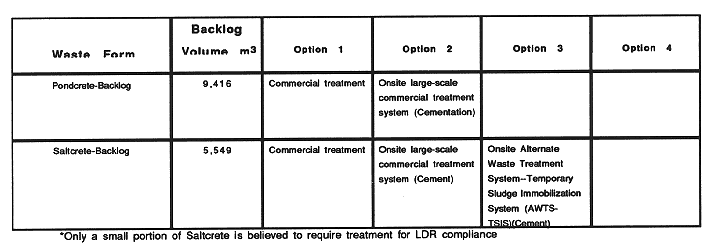
Table II Tier 2 Waste Forms Option Summary
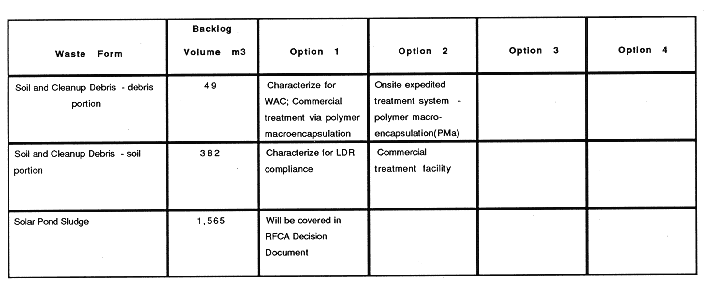
Table III Tier 3 Waste Forms Option Summary
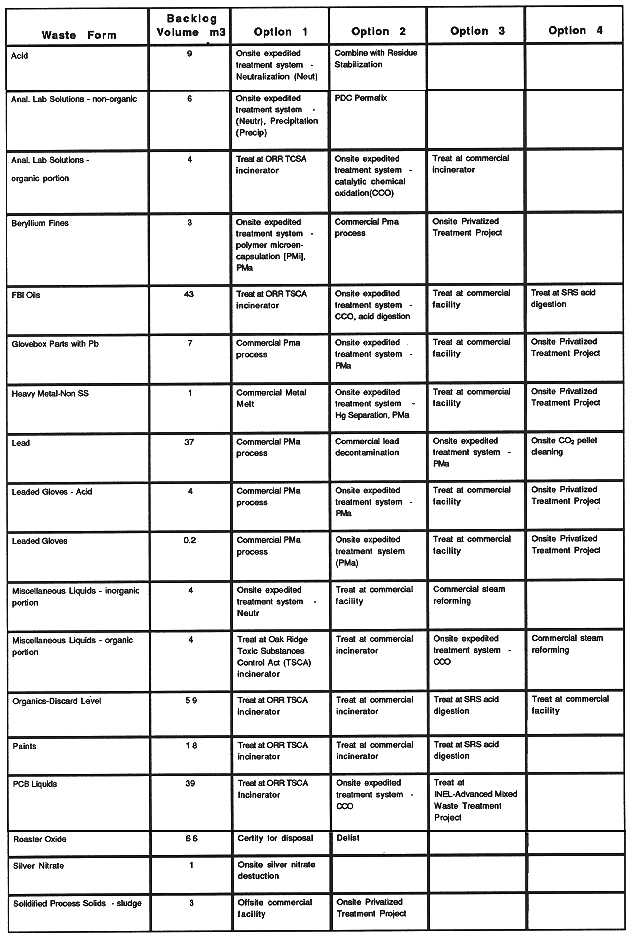
Table IV Tier 4 Waste Form Options Summary
Patrick M. Arnold, Alan R. Hohl and Joseph D. McKaig
Rocky Mountain Remediation Services, LLC
ABSTRACT
Rocky Flats Environmental Technology Site (RFETS) received a Compliance Order from the State of Colorado on October 3, 1995, approving with modifications the radioactively contaminated hazardous (mixed low level [MLL]) waste strategies outlined in the RFETS Proposed Site Treatment Plan (STP) (1) and committing the Department of Energy (DOE), Rocky Flats Field Office (RFFO) to actions that will achieve compliance with the Resource Recovery and Conservation Act (RCRA) land disposal restriction (LDR) regulations covering the hazardous portion of mixed wastes presently stored at the site. The STP was submitted to the State of Colorado per the mandates of the Federal Facility Compliance Act of 1992 (FFC Act) and was the result of an iterative process between the DOE, the lead regulatory agency from the State of Colorado, and local stakeholders. The STP presented a baseline LDR-compliant implementation approach that was heavily reliant on onsite treatment via expensive capital treatment systems.
With the change to an Integration and Management Contractor (IMC) at RFETS came new strategies for the safe but accelerated deactivation, cleanup, and closure of the Site. A new Rocky Flats Vision and a formal Rocky Flats Cleanup Agreement (RFCA) (2) have been negotiated and signed by the DOE, the Colorado Department of Public Health and Environment (CDPHE), and the Environmental Protection Agency (EPA). The Rocky Flats Ten-Year Plan (3) and the Integrated Site Baseline (ISB) (4) have been developed to plan the projects necessary to ensure the safe and accelerated cleanup and closure of the Site. Given the new RFETS strategies and the severely constrained DOE funds available for waste treatment and disposal, the original STP baseline strategy using onsite treatment systems became unworkable. Rebaselining STP planning and implementation activities and integrating them with Site priorites became an imperative.
The STP Rebaseline methodology was developed by the Sites waste management contractor, Rocky Mountain Remediation Services (RMRS); the methodology includes the development of waste form-to-primary and contingency options, waste form prioritization via a tiered arrangement, and development of 3-year and 10-year work plan targets and milestones. Onsite and offsite primary and contingency treatment options agreed upon by DOE, RFFO and the CDPHE will maximize treatment flexibility while achieving the objectives of the FFC Act. The STP Rebaselines goals of reducing treatment and disposal costs and accelerating scheduled completion while providing protection of human health and the environment appear achievable. DOE, RFFO submitted the Proposed STP Rebaseline, Final Draft, to the regulators for review and comment on January 9, 1997. Subsequent to incorporation of regulator comments, a formal public comment period will occur, pertinent public comments will be addressed and incorporated, and the STP Rebaseline will be issued as a formal Revision to the original STP Compliance Order. It is anticipated that the formal Revision will be in effect by April 1997.
INTRODUCTION AND OVERVIEW
In April 1995, the Proposed Site Treatment Plan (PSTP) was submitted to the Colorado Department of Public Health and Environment (CDPHE) by the U.S. Department of Energy at the Rocky Flats Environmental Technology Site (RFETS, or Site). This document described the Sites strategy for treating mixed waste. The PSTP was required by the Federal Facility Compliance Act of 1992 (FFC Act) for each DOE site that stores or generates mixed waste. A Compliance Order requiring that the Site implement the PSTP as amended (now referred to as the Site Treatment Plan [STP]) was signed by DOE and CDPHE in October 1995. The Rebaseline document describes the proposed changes and revisions to the STP mixed low-level (MLL) waste strategy that have resulted from recent developments at the Site and presents a new baseline for achieving the objectives of the FFC Act. No changes to the STP mixed transuranic (MTRU) waste strategy are proposed at this time.
RATIONALE FOR THE STP REBASELINE
Reasons for the rebaselining of the STP include the development of new Site strategies, reduced funding allocations, and the development and maturing availability of new treatment and disposal options as described below:
NEW SITE STRATEGIES FOR SAFE CLEANUP AND CLOSURE
With the change to an Integration and Management Contractor (IMC), Kaiser-Hill, in June 1996 came new strategies for the safe but accelerated deactivation, cleanup, and closure of the Site. RMRS is the waste management subcontractor at RFETS, charged with managing waste generated by all Site subcontractors. RMRS is responsible for the safe and compliant storage, treatment, and disposition of waste generated at the Site.
The activities outlined in the approved STP were in many cases inconsistent with the new Site priorities outlined in the Rocky Flats Cleanup Agreement (RFCA), the Rocky Flats Vision, Integrated Site Baseline (ISB), and the Rocky Flats Ten-Year Plan. The STP Rebaseline integrates the STP strategy with the overall Site priorities and aligns with the new vision of accelerated Site closure while achieving the goals of reducing treatment and disposal costs and accelerating scheduled completion. The STP Rebaseline will also provide an equal degree of protection of human health and the environment to that provided with the original STP.
FUNDING AVAILABILITY
The baseline in the PSTP was based on programmatic and funding assumptions that required re-alignment with and integration into the Rocky Flats Vision and the budget planning requirements of the RFCA. Available budget allocations within Waste Management are necessarily delineated and prioritized between baseline activities such as sewage treatment plant and sanitary landfill operations, mortgage reduction activities such as the expedititious treatment/shipment of Pondcrete and Saltcrete, risk reduction activities such as accelerated environmental remediation actions, and compliance activities such as chemical management and STP treatment systems implementation.
Additionally, in accordance with RFCA, RFETS has developed the ISB, which will form the basis for performing work, including waste management and treatment. The ISB is based upon Site priorities and planning targets, and hence will form the basis for implementation of certain treatment and other management options as the Site proceeds with cleanup. The ISB will be used to establish enforceable current and future year milestones to ensure adequate progress of Site activities and facilitate planning. It will be updated at least annually. ISB work prioritization activities, which will include STP activities, are discussed monthly at ISB Principals Meetings between CDPHE, EPA, and DOE, RFFO.
RFCA provides that, although requirements of the STP Compliance Order are not regulated under RFCA, efficient use of tax dollars mandates the efficient integration of management and regulation of all Site activities. This is to be accomplished in part through the annual budget planning process outlined in RFCA. Thus, funding levels for the rebaselined STP will be based on the agreed-to ISB activities.
NEW TREATMENT OPTIONS
New onsite and offsite treatment options have developed or matured since completion and approval of the original STP in October 1995. These new options have the potential to treat the Sites waste faster and less expensively than the original STP Compliance Order capital line item projects. Examples of some offsite options include use of the Toxic Substances Control Act (TSCA) incinerator at DOEs Oak Ridge, Tennessee facility to treat MLL organic liquids; Envirocare of Utah for very low level bulk and/or debris-type waste forms; and Waste Control Specialists of Texas and other commercial vendors for the treatment, storage, and disposal of various MLL wastes. Some commercial treatment and disposal capability listed in Tables I through IV are planned or feasible, but not yet real. The new treatment and disposal options vary in maturity and viability but are included as either primary or contingency options to ensure maximum flexibility. New onsite options include making operational use of bench and pilot-scale research equipment, including the Research, Development, and Demonstration (RD&D) permitted polymer encapsulation units for expedited treatment.
STP REBASELINE DEVELOPMENT METHODOLOGY
Waste Form-to-Primary and Contingency Treatment Options Analysis
The STP Rebaseline methodology, developed within the context of the Rocky Flats Vision, RFCA, and the Rocky Flats Ten-Year Plan, begins with the development of a matrix that matches Rocky Flats MLL waste forms to viable primary and contingency options. Primary and contingency option descriptions for each waste form are provided with sufficient technical, schedule, and cost data to support treatment and disposal decisions. All viable options are included to offer the most flexibility to DOE and CDPHE in making optimal treatment and disposal decisions. New commercial or DOE offsite options will be given the highest consideration with the assumption that the Rocky Flats capital treatment systems will neither be funded nor constructed, and that offsite treatment can result in reduced cost and schedule as compared to the STP Baseline. Detailed information regarding the various treatment and disposal options considered is presented in Appendix A of the STP Rebaseline document, while brief descriptions of the waste forms and the rationale for the selection of various options for each is included in Appendix B of that document.
Waste Form Prioritization via Tiers
The STP Rebaseline methodology follows with the prioritization of the waste forms into four distinct tiers using various factors, such as waste volume, availability of treatment and disposal facilities, and cost. Descriptions of the four tiers is as follows:
Tier 1 Wastes - Tier 1 waste forms are the highest priority wastes under the rebaselined STP. These waste forms have a large volume and relatively low radioactivity. These wastes will be the first priority under the new baseline, and resources will be directed to the certification, treatment as necessary, shipment, and disposal of these wastes in the near term to facilitate rapid closure of the pads on which they are currently stored. Tier 1 wastes represent approximately 75% of the stored MLL waste volume at Rocky Flats, and the shipment of these wastes offsite will provide a significant mortgage reduction opportunity for the Site.
Tier 2 Wastes - Tier 2 wastes are similar to Tier 1 wastes in that they are excellent candidates for shipment to commercial facilities for treatment in the near future. They are designated as secondary priority based on a lesser degree of available characterization data and slightly lower confidence in the potential for success of the listed options relative to Tier 1.
Tier 3 Wastes - Tier 3 wastes are those whose physical, chemical, radiological constituents, and volume render the wastes potentially treatable within five years provided sufficient funding is available (i.e., "quick wins"). These wastes could potentially be treated utilizing onsite pilot-scale equipment with little or no modifications or are strong candidates for existing offsite treatment facilities. Although Tier 3 wastes represent only 2 percent of the total MLL waste volume, over half of the MLL waste forms are included in this Tier.
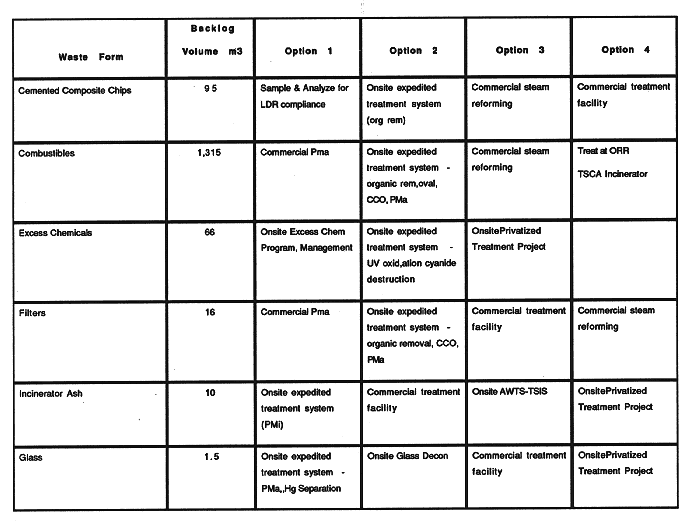
Tier 4 Wastes - Tier 4 waste forms are the remaining wastes that are more difficult to sample, analyze, and treat. Great heterogeneity of subpopulations, higher radioactivity, and limited treatment and disposal options are all factors that caused wastes to be placed in Tier 4.
For Site mortgage reduction purposes, Tier 1 wastes are the focus of resource expen- ditures during FY 1997 through FY 1999. Wastes in Tiers 2 through 4 have greater uncertainty in selecting effective treatment options. The prioritization of wastes is an ongoing process and will be re-evaluated as needed to ensure that resources are directed toward the most critical waste management needs at the Site.
Work Plan Targets and Enforceable Milestones
The STP Rebaseline concludes with the development of 3-year and 10-year work plan target dates and enforceable milestone schedules. The STP Rebaseline presents new work plan target dates and milestones based on the viable primary and contingency options for each waste form. Activities such as characterization, sampling and analysis, permitting, treatment, waste shipment, and disposal activity schedules are included. The new work plan dates and milestones were developed by allocating anticipated funds to the various tiers; integration of STP activities with ISB activities ensures progress toward attaining the overarching goals of RFCA and the Rocky Flats Ten-Year Plan.
Assumptions
Important assumptions made during development of the STP Rebaseline included: 1) MLL waste treatment will be to LDR standards and disposal site waste acceptance criteria (WAC), 2) no major changes to waste regulations will occur; regulatory relief from LDR standards will be neither sought nor granted, 3) Rocky Flats capital treatment systems requiring capital line item funding will not be constructed, and offsite or onsite commercialized treatment can result in reduced cost and schedule as compared to the STP Baseline,4) funding levels will be sufficient to maintain the STP Rebaseline activities within the context of RFCA and the Rocky Flats Ten-Year Plan, and 5) flexibility will be maintained to interchange each waste forms primary and contingency treatment/disposal options dependent upon technical, schedule, cost, or other pertinent data. Notification to the regulators of such proposed changes can be made via STP Quarterly Progress Update or Annual Progress Reports, and formal Revisions and Changes stemming from treatment option changes within the approved STP Rebaseline will not be necessary.
REBASELINE RESULTS SUMMARY
A summary of the results of the primary and contingency options analysis and waste form prioritization is presented below in Tables I, II, III, and IV. Option 1 describes the primary or currently preferred option based on available data. Viable contingency options follow the primary option and are also based on available data. Please note that, for brevity, not all contingency options are shown. Cost, schedule and technical data remains to be ascertained for the final STP Rebaseline document. Of necessity, viable options lacking such data are relegated to contingency options at this time. As new data becomes available, however, such options may be deemed the most preferable, or primary option. New option selections and rationale for such changes will be documented in the STP Quarterly Progress Update and Annual Progress Reports; any proposed changes will be presented during monthly STP Project Managers Meetings.
After treatment and disposal options were identified for each waste form, the wastes were prioritized into four tiers based on the probability of near-term compliance and the degree of certainty with which treatment and disposal decisions can be made. Various other factors were considered, including volume of the waste, risk of continued storage, and ease of characterization. Commercial treatment capabilities, in some cases, may not yet be available.
Tables I Tier 1 Waste Forms Option Summary
Table II Tier 2 Waste Forms Option Summary
Table III Tier 3 Waste Forms Option Summary
Table IV Tier 4 Waste Form Options Summary
MILESTONES AND TARGET DATES
To be consistent with RFCA, the Rocky Flats Ten-Year Plan, and the ISB, the STP Rebaseline developed both a 3-year and a 10-year work plan baseline for each tier of wastes; all wastes are planned to be treated and/or disposed by FY 2006.
The majority of progress in FY 1997 through 1999 will focus on the certification, shipment, treatment as necessary, and ultimate disposal of Tier 1s Pondcrete and Saltcrete. Because these two waste forms represent approximately 75% of the MLL waste inventory, focusing resources on them for the first three-year window will allow a major reduction in the Sites MLL waste inventory and in mortgage reduction.
Specific work plan target dates and milestones include planned activities such as characterization, sampling and analysis, permitting, construction, system testing, onsite or offsite treatment, and shipment to a disposal site. The proposed target dates and milestones for the STP Rebaseline have been submitted as part of the Final Draft that is presently under review by the CDPHE prior to a formal public comment period. Again, to maintain maximum flexibility, it is planned that any of the primary or contingency options presented in Tables I through IV for a given waste form can be used to achieve completion of work plan and milestone activities.
CONCLUSION
The STP Rebaseline integrates and realigns STP implementation activities with new Site closure priorities while achieving the goals of reducing treatment and disposal costs and accelerating scheduled completion. The Rebaseline minimizes capital line item investment at Rocky Flats yet maintains a coordinated plan to achieve MLL waste compliance with the provisions of RCRA and the FFC Act. For example, it is anticipated that the STP Rebaseline will eliminate the capital expenditure of at least $17 million from the development and construction of just one Rocky Flats treatment system planned under the original STP.
Onsite and offsite primary and contingency options developed for each MLL waste form offer maximum treatment and disposal flexibility to the DOE. Given the present state of constrained DOE funding, the potential future development and maturation of treatment technologies, and increasing waste form characterization knowledge, flexibility in options selections will become increasingly important.
Early communication and negotiation with the CDPHE and the public regarding STP rebaseline plans enabled an orderly transition from the original capital-intensive STP Compliance Order to the more expeditious but less costly STP Rebaseline. The STP Rebaseline relies heavily on a combination of offsite treatment for the higher volume, more easily treated wastes, and on small onsite systems for the more difficult to treat wastes.
REFERENCES