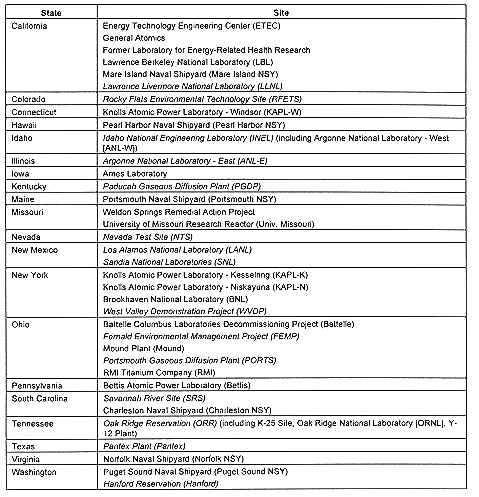
Table I Sites Considered in the Residuals Analysis Project (sites shown in italics were evaluated for their disposal capabilities in the performance evaluation project (3)
Robert D. Waters and Marilyn M. Gruebel
Sandia National
Laboratories
Joel T. Case
U.S. Department of Energy, Idaho
Martin J. Letourneau
U.S. Department of Energy, EM-35
ABSTRACT
For almost four years, the U.S. Department of Energy (DOE) through its Federal Facility Compliance Act Disposal Workgroup has been working with state regulators and governors' offices to develop an acceptable configuration for disposal of its mixed low-level waste (MLLW). These interactions have resulted in screening the universe of potential disposal sites from 49 to 15 and conducting "performance evaluations" for those fifteen sites to estimate their technical capabilities for disposal of MLLW. In the residuals analysis project, we estimated the volume of DOE's MLLW that will require disposal after treatment and the concentrations of radionuclides in the treated waste. We then compared the radionuclide concentrations with the disposal limits determined in the performance evaluation project for each of the fifteen sites. The results are a scoping-level estimate of the required volumetric capacity for MLLW disposal and the identification of waste streams that may pose problems for disposal based on current treatment plans. The analysis provides technical information for continued discussions between the DOE and affected States about disposal of MLLW and systematic input to waste treatment developers on disposal issues.
INTRODUCTION
The Federal Facility Compliance Act (FFCAct) of 1992 (1) requires the U.S. Department of Energy (DOE) to work with its state and federal regulators and with members of the public to establish plans for the treatment of DOE's mixed low-level waste (MLLW). Along with other radioactive and hazardous waste, MLLW has been generated for more than 50 years through DOE activities related to the production of materials for nuclear weapons and research with nuclear materials. Because MLLW has a hazardous component, it must usually be treated to comply with the land disposal restrictions of the Resource Conservation and Recovery Act (RCRA) (2). The DOE currently generates, stores, or expects to generate (over the next five years) about 130,000 m3 of MLLW managed under FFCAct agreements at 39 sites in 19 states. In collaboration with the States and the National Governors' Association, the DOE has developed the required site treatment plans (STPs). Although the FFCAct does not specifically address disposal of treated MLLW, both DOE and the affected States recognize that disposal issues are an integral part of treatment discussions.
The DOE established the FFCAct Disposal Workgroup in June 1993 to work with the States in defining and developing a process for evaluating disposal options for treated MLLW. The focus of the process and of discussions on disposal with the States has been to reach consensus on the number and location of facilities required for disposal of MLLW.
A three-volume report describes a performance evaluation (PE) that quantified and compared the potential capabilities of fifteen DOE sites for disposal of stabilized residuals resulting from the treatment of MLLW (3). That report discusses the methodology, describes the evaluated sites, and provides estimates of permissible concentrations of radionuclides in MLLW for disposal at each site. The fifteen sites considered in the PE (Table I) were selected from an initial universe of 49 DOE sites that either stored or were expected to generate MLLW over the next five years (3).
Table I Sites Considered in the Residuals Analysis Project (sites shown in italics were evaluated for their disposal capabilities in the performance evaluation project (3)
In the residuals analysis described here, we used reported inventories of DOE MLLW to
The comparison of concentrations of radionuclides in residual MLLW with the limits estimated by the PE project was a scoping-level analysis for two primary reasons. First, the method that we used to estimate after-treatment concentrations was a simplified approach to quantifying the effects of treatment processes. Second, the concentration limits estimated in the PE project were determined by using a set of modeling assumptions that included sufficient detail to capture major site-specific characteristics but were general enough for consistent application at all sites. Waste streams that we identified in our analysis as being potentially problematic should not be considered as waste that cannot be disposed of at any of the fifteen sites evaluated in the PE project; instead, they should be viewed as waste that needs more careful scrutiny. All other waste streams that we evaluated are likely to present no significant issues for disposal. In this sense, the scoping-level nature serves to eliminate from further analysis those waste streams that appear to present no significant issues for disposal and to focus attention on the waste that requires more analysis.
DATA USED IN THE ANALYSIS
We based our analysis on characterization data collected by the DOE in 1995 for its Mixed Waste Inventory Report (MWIR) (4) and on STPs compiled into a database. The MWIR report contains characterization data for MLLW streams managed under agreements resulting from implementing the FFCAct. The National Low-Level Waste Management Technical Support Program located at INEL collected the data for the MWIR. The program staff recognized two factors that affected data quality:
Although the input data sets used in our analysis contain gaps and uncertainties, the MWIR and STP databases represent the best available source of data for DOE MLLW. In addition, the input data and results of the calculations were reviewed by personnel at the generator sites on two separate occasions during our analysis.
The waste streams that we initially identified for our analysis were the 1689 streams that were contained in both the MWIR and STP databases. In addition, although the Hanford Site was not required to develop an STP because it has a Tri-Party Agreement (1), the waste streams at this site were also included in the analysis. The sites having MLLW that was considered in this analysis are listed in Table I.
The 1689 MLLW streams were sorted depending on whether the RCRA hazardous constituents they contain are defined as characteristic or listed hazardous waste. In general, a waste containing a hazardous characteristic is required by RCRA to be treated to remove the characteristic. This waste may then be disposed of as LLW in RCRA non-Subtitle C disposal facilities.
Because of the "derived from" requirements of RCRA (40 CFR Part 261.3 (c)(2)), waste streams indicated in RCRA as listed hazardous waste will remain MLLW even after treatment to remove the listed constituent. This waste will be disposed of as residual MLLW in Subtitle C disposal facilities. Treated waste containing combinations of listed and characteristic hazardous constituents was assumed to be disposed of in facilities for MLLW due to the presence of the listed waste. In addition, MLLW debris treated under the debris rule using waste stabilization methods must still be disposed of as residual MLLW in a Subtitle C disposal facility.
We used the treatment processes identified in the STPs, represented by process flow diagrams, as the basis for determining the effects of treatment on the volume of waste and on the concentrations of radionuclides in treated waste. While most of the sites identified existing treatment facilities for many of their waste streams, some sites identified new, unbuilt treatment facilities or described the preferred treatment process for some of their waste in general terms. For these latter two cases, either (1) we made assumptions to arrive at a process flow diagram, or (2) the waste streams were identified as not having enough information to make reasonable assumptions. These latter streams were not analyzed further; additional site-specific decisions for type of treatment will be required before plans for disposal can be finalized.
TREATED MLLW VOLUMES FOR DISPOSAL
One consideration addressed in our analysis was a volume estimate of MLLW that will require disposal as MLLW after treatment. The volume of waste after treatment, VF, was estimated by the following equation:

where
VCI is the current inventory for the waste stream
(m3);
VP is the 5-year projected inventory for the waste
stream (m3);
AMR is the activity-per-unit-mass ratio (the ratio of
the
activity per unit mass before treatment to
the activity per unit mass
after treatment)
(dimensionless);
 b-initial is
the initial bulk density of the waste (g/cm3);
b-initial is
the initial bulk density of the waste (g/cm3);
and
b-final is
the final bulk density of the treated waste
(g/cm3).
The preliminary estimates for b-initial for the waste streams were based on the matrix parameter categories associated with each waste stream in the MWIR database (5). The values for AMR were based on work done at the SRS (6). The sites reviewed and updated the estimates for all parameter values for each of the waste streams.
The waste streams were categorized based on whether they were expected to be disposed of as MLLW or LLW. Some sites also identified waste streams known to contain transuranic (TRU) radionuclides with concentrations between 10 and 100 nCi/g. Treatment of these waste streams by a process that reduces the mass of waste by more than a factor of 10 (e.g., incineration) will result in TRU waste. Because the resulting concentrations of TRU radionuclides will be greater than 100 nCi/g, the regulatory threshold for TRU waste, the resulting waste cannot be disposed of as MLLW.
Complex-Wide Volumes for Disposal
The total volume of pre-treatment MLLW used in this analysis is estimated to be 130,000 m3. The after-treatment volumes of waste can be distributed into five categories (Fig. 1): residual MLLW, LLW, and TRU waste for disposal; volume reduction due to treatment; and volumes not included in the analysis due to lack of data.
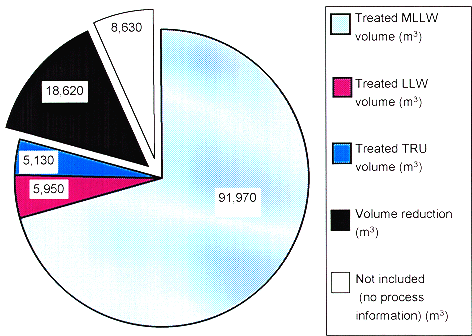
Fig. 1. Categorization of the initial total volume of MLLW.
About 7% (9000 m3) of the initial total volume of MLLW was not included in the analysis because a preferred treatment process had not been specified by the sites. As characterization of waste continues and feasible treatment alternatives are identified, this volume is expected to decrease.
The volume reduction of MLLW due to treatment and subsequent stabilization is expected to be about 14% (19,000 m3). Some waste streams will increase in volume due to treatment (e.g., the addition of a stabilizing agent such as Portland cement). Other waste streams will be reduced in volume due to treatment (e.g., incineration of combustible materials). This estimate of volume reduction is the aggregate of the volume changes for each individual waste stream and treatment process combination.
Of the initial total volume of MLLW, about 70% (92,000 m3) is estimated to require disposal as MLLW. This volume of MLLW is composed of waste streams that contain one or more "listed" RCRA constituents and hazardous debris waste that is immobilized under the debris rule. The procedure for reporting waste stream data in the MWIR database sometimes causes the volume estimate for waste that will require disposal as MLLW to be high by an unknown amount. In the MWIR database, if any part of a waste stream contains a particular RCRA constituent, then that RCRA code was applied to the entire waste stream. As waste characterization continues, some of the waste identified as MLLW may be determined to be LLW or non-radioactive hazardous waste.
About 5% (6000 m3) of the initial total volume of MLLW is expected to result in waste that can be disposed of as LLW. This volume of waste is composed of waste streams that either contain only "characteristic" RCRA waste or are hazardous debris waste that is treated with an extraction or destruction process under the debris rule.
About 4% (5000 m3) of the initial total volume of MLLW is expected to require disposal as TRU waste. This volume of MLLW is composed of waste streams that contain high activities of one or more TRU radionuclides that, when concentrated by volume reduction in treatment, will exceed the TRU concentration limit of 100 nCi/g.
As part of our review process, we asked the sites to identify waste streams that they planned to send to commercial sites for disposal. Of the estimated 92,000 m3 of treated waste that will require disposal as MLLW, the DOE sites are planning to dispose of about 49,000 m3 (53% of total treated MLLW) at commercial facilities. The sites indicated that either disposal plans for the remaining 47% of treated MLLW were incomplete or the waste was designated for disposal at a DOE site yet to be determined. Many of the sites indicated that disposal of MLLW in a commercial facility was being pursued because currently there are no other viable options. Some sites indicated that they were evaluating commercial disposal for some of their waste but that existing plans were too preliminary to identify these waste streams as being planned for disposal at commercial facilities. Based on this input, 53% of total treated MLLW may be a low estimate of waste volumes planned for commercial disposal by the DOE sites.
Site-Specific Volumes of MLLW for Disposal
Of the sites considered in the analysis, nine have estimated volumes of less than 1 m3 each; 17 of the sites have estimated volumes of less than 10 m3 each; and 22 of the sites have estimated volumes of less than 100 m3 each. About half of the waste is located at the ORR (ORNL, K-25 site, and Y-12 plant); approximately 97% of the waste is located at four sites (ORR, PORTS, RFETS, and Hanford). The ORR has both the largest volume of MLLW and the largest volume planned for disposal at a commercial facility (i.e., pond sludges already contracted for disposal at Envirocare of Utah). The RFETS has the largest volume of waste that is not currently associated with commercial disposal. Hanford and NTS are planning for on-site disposal of their MLLW. Approximately 33,000 m3 of the MLLW in streams at ORR, Hanford, and NTS may not have a planned location for disposal.
Most of the sites have relatively small volumes of inventoried MLLW that will be managed as LLW after treatment. Only three sites (ANL-W, Hanford, and SRS) will have over 1000 m3 of this waste.
Four sites (ANLE, INEL, Mound, and ORNL) have volumes of inventoried MLLW that will be disposed of as TRU waste after treatment. The majority of this waste (about 5000 m3) is located at INEL.
RADIONUCLIDE CONCENTRATIONS IN RESIDUAL MLLW AND LIMITS ON DISPOSAL
Another disposal consideration that we addressed was an estimate of radionuclide concentrations in the waste streams. Comparison of these concentrations with the limiting concentrations of radionuclides in waste developed in the PE report (3) provided information about the acceptability of waste for disposal and about waste streams that require further evaluation.
Radionuclide Concentrations in Residual MLLW
Many of the waste streams identified in the MWIR and STP databases had sufficient radiological characterization to allow us to make estimates of the after-treatment concentrations of radionuclides in the waste. In our analysis, sufficient radiological characterization meant that both the radionuclides in a waste stream and estimates of their concentrations were available from the MWIR database or from site input. Waste streams with insufficient radiological characterization were not analyzed further; additional radiological characterization will be required prior to evaluating these waste streams.
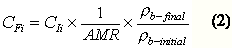
The concentration in waste after treatment for each radionuclide i, CFi, was estimated using Eq. 2 and assumptions similar to those associated with Eq. 1:
where
CIiis the initial concentration of radionuclide
i
for the waste stream (µCi/m3).
Radionuclides with half-lives less than 5 years were not included in either this analysis or the PE project due to their limited effect on the long-term aspects of disposal.
The values that we assumed for CIi were the mean concentration values given in the MWIR database or were based on a given range. We used mean values because (1) treatment processes tend to provide a homogenization that results in concentrations of radionuclides near their mean, and (2) the range of radionuclide concentrations was generally based on a smaller scale (e.g., drums), which generally results in a wider range of values than when aggregated to a larger scale (e.g., waste stream).
Distributions of radionuclides were assumed for waste streams in which radionuclides were identified as mixed fission products, mixed activity products, depleted uranium, and natural uranium. For example, for natural uranium we assumed that of the given activity, 49% would be U-234, 2% would be U-235, and 49% would be U-238. We based these distributions on an average of 20 years decay (an estimate of the average time between waste characterization and disposal). For waste streams that had one or more radionuclides without concentrations, the listed radionuclide concentrations were evaluated and the missing data noted.
Comparison of Waste Stream Concentrations with the PE Limits
About 71% (65,000 m3) of the estimated volume of treated MLLW that will require disposal as MLLW was included in the comparison with the PE limits. This volume of waste is associated with about 61% (390) of the 640 waste streams that will require disposal as MLLW. Therefore, about two-thirds of the treated MLLW has sufficient radiological characterization data to make comparisons with the PE limits.
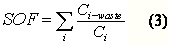
The comparisons of radionuclide concentrations to the PE limits were made using the sum-of-fractions (SOF) method described in 10 CFR Part 61.55:
where
Ci-waste is the concentration of radionuclide i
in the treated waste
(µCi/m3); and
Ci is the concentration limit for
radionuclide i in waste as
estimated in the PE project (µCi/m3).
Depending on the result of the calculations in Eq. 3, each waste stream was placed into one of four categories for the fifteen DOE sites. These categories are summarized in Table II.
Table II Categories for Comparison of Radionuclide Concentrations in Residual MLLW with the PE Limits
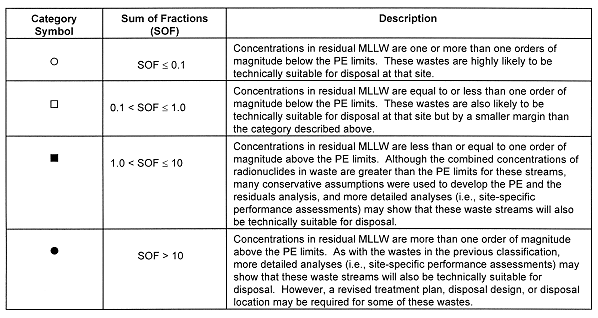
Because of both the differences in scale and the conservative nature of the analyses in the PE project related to site-specific performance assessments, direct comparisons of the concentrations of radionuclides in waste streams with the PE limits cannot result in definitive statements about the acceptability of a particular waste stream at a particular site. The concentrations of radionuclides in waste estimated in the PE project were based on an average for the volume of waste over the entire disposal facility, while the concentrations of radionuclides in the treated waste were averaged for the volume of the waste stream, a volume which is generally much less than that of the disposal facility. However, the comparison of the concentrations of radionuclides in the waste streams to the PE limits can provide an indication of the potential acceptability of the waste streams for disposal.
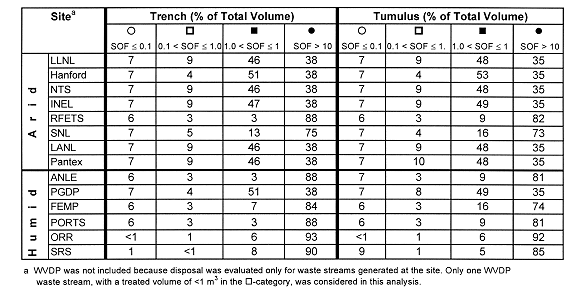
A summary of the volume percentages of residual MLLW by evaluated disposal
site that are associated with one of the four categories defined in Table II is
given in Table III. To develop this table, all residual MLLW is assumed to be
disposed of at each of the fifteen sites, and the distribution of waste by
categories is shown as a volume percent of the total treated volume of MLLW for
disposal. For the trench design, about 40% of the waste at the arid sites and
about 50 to 90% of the waste at the humid sites is associated with the
 -symbol, indicating
that, in general, more of the MLLW could be disposed of at arid sites, although
more refined analyses may indicate that more waste could be accepted at all
sites. These percentages do not change appreciably when comparing trench and
tumulus values at arid sites but decrease by up to 10% for tumulus values at
humid sites. This result indicates the additional benefit from using more
engineered disposal facilities in humid regions of the country.
-symbol, indicating
that, in general, more of the MLLW could be disposed of at arid sites, although
more refined analyses may indicate that more waste could be accepted at all
sites. These percentages do not change appreciably when comparing trench and
tumulus values at arid sites but decrease by up to 10% for tumulus values at
humid sites. This result indicates the additional benefit from using more
engineered disposal facilities in humid regions of the country.
Table III Volume Percentage (%) of Residual MLLW by Category for Each of the 15 DOE Sites Evaluated for Disposal (Total Treated Volume = 65,090 m3)
A summary of the volumes of residual MLLW by generating site that are
associated with the best technical waste stream/site combination for disposal is
shown in Table IV. In parentheses after each site name is the percentage of the
total treated waste at the site that was included in the comparison of
radionuclide concentrations with the limits estimated in the PE project. For the
trench design, the combined volumes of waste for which the best technical
combination of waste stream and disposal site was represented by ,
 ,
,
 or
or
 is about 59,000 m3;
for the tumulus design, the combined volume for this waste is about 60,000 m3.
The majority of the waste in the
category is pond
sludges at ORR that are planned for disposal at Envirocare of Utah.
is about 59,000 m3;
for the tumulus design, the combined volume for this waste is about 60,000 m3.
The majority of the waste in the
category is pond
sludges at ORR that are planned for disposal at Envirocare of Utah.
Table IV Summary of Best Technical Combinations of Waste and Disposal Sites for Residual MLLW, Based on Radionuclide Content
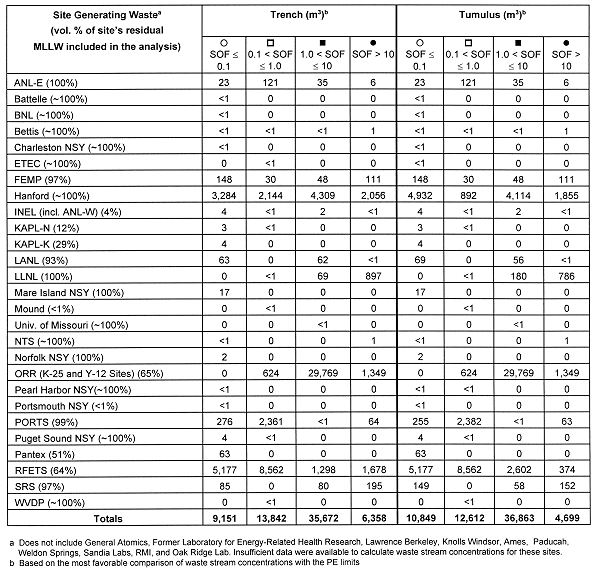
In Table IV, the combined volumes of waste are generally shifted slightly to the left (i.e., to more technically acceptable disposal combinations) for the tumulus design compared with the trench design, indicating the slight additional performance gained by using the tumulus design. The additional benefit from using a tumulus design instead of a trench design is small because the best technical combinations of waste streams and disposal sites for both facility types typically represent disposal at more arid sites; these sites generally do not benefit from using more engineered disposal facilities. At disposal sites in the humid region of the country, the additional performance gained by using a more engineered disposal facility design would be greater; more engineered disposal facilities are used at ORR and SRS for disposal of low-level waste.
DISCUSSION
The DOE has disposed of approximately 50,000 m3 of LLW at its sites every year since 1990, and has disposed of approximately 100,000 m3 of LLW every year between 1982 and 1989. The DOE estimates that it has disposed of a total cumulative volume of about 3 million cubic meters of LLW (8). If the 43,000 m3 of MLLW estimated in our analysis for disposal at DOE sites were disposed of over the 5-year period of the projected volumes, the rate would be equal to about one-sixth that of LLW disposal throughout the 1990s. Additionally, the 43,000 m3 total volume of MLLW is less than 2% of the total volume of LLW disposed of by DOE. These comparisons indicate that the magnitude of MLLW disposal, both in terms of rates and total volumes, will be much smaller than that of LLW.
Two DOE sites, Hanford and NTS, have developed disposal capacity for MLLW in anticipation of disposing of their own waste. At Hanford, approximately 50,000 m3 of capacity has been developed and another 1.7 million m3 has been proposed. At NTS approximately 100,000 m3 of proposed capacity is available. From a technical viewpoint, these two sites, in conjunction with the planned use of commercial disposal, provide more than enough capacity for disposal of the estimated volumes of treated MLLW under agreements resulting from implementation of the FFCAct. Additional disposal capacity may also be required for MLLW generated by processes not managed under FFCAct agreements (e.g., waste generated by future decontamination and decommissioning and by environmental restoration activities). Other less technical factors, including ethical, social, economic, and policy considerations relevant to disposal of MLLW, will also need to be addressed in determining the preferred configuration for disposal of DOE MLLW.
CONCLUSIONS AND RECOMMENDATIONS
The analysis described here was a scoping-level evaluation. Although the analysis provided quantitative results that indicate the technical capability of a site to dispose of the evaluated waste streams, the conclusions derived from this evaluation are more of a general nature than a site-specific or waste stream-specific one. The major strengths of the evaluation are that (1) it provides a substantiated estimate of the overall volume of treated MLLW that will require disposal, (2) it delineates those waste streams that are potentially problematic, allowing the DOE to focus its attention on a smaller portion of the MLLW inventory and narrow the scope of further analysis, and (3) it indicates the need for further waste characterization and continued updating of existing databases.
Conclusions
Of the approximately 130,000 m3 of MLLW considered under the FFCAct that is either currently stored or projected to be generated within the next five years and is designated for treatment, approximately 92,000 m3 will require disposal as treated MLLW. Of this volume, approximately 49,000 m3 is currently planned for disposal at commercial facilities; therefore, up to 43,000 m3 of MLLW will require disposal at one or more DOE facilities. About 9000 m3 of the current and projected inventory of MLLW was insufficiently characterized to be assigned a preferred alternative for treatment.
All fifteen sites considered in this analysis have the technical capability to dispose of some treated MLLW, with sites located in the arid region of the country tending to have higher permissible limits on radionuclide concentrations in waste than sites in the humid region of the country. Comparing the limits estimated in the PE with estimates of concentrations of radionuclides in treated MLLW indicates that up to 90% of the treated MLLW could be disposed of at several arid sites with little additional analysis; about 50% of this waste could be disposed of at several humid sites. More detailed analyses would likely increase both of these percentages.
Based on the volume estimates calculated in this analysis, enough capacity currently exists in commercial sites and at DOE's Hanford Site and NTS for disposal of all of DOE's treated MLLW. Additional disposal capacity may also be required for MLLW generated by processes not managed under FFCAct agreements (e.g., waste generated from future decontamination and decommissioning and environmental restoration activities). This conclusion is based on the technical aspects of disposal only--ethical, social, economic, and policy considerations relevant to waste disposal were not considered in the analysis.
The results of our analysis indicate that waste streams associated with about 90% of the total residual MLLW evaluated in the concentration analysis are likely to present no significant issues for disposal and require little additional analysis. The remaining waste streams identified as potentially problematic require further evaluation of their treatment and disposal plans.
Recommendations
Additional waste characterization data should be collected. Of the total current and 5-year projected volume of MLLW that has been reported, about 7% (9000 m3) is attributed to waste streams that do not have enough characterization and treatment information to be included in the calculation of after-treatment volumes. Of the after-treatment volume of MLLW that was calculated in our analysis, about 30% (27,000 m3) is attributed to waste streams that could not be included in the comparison of radionuclide concentrations with the limits estimated by the PE project. The data on these latter waste streams either did not include a listing of radionuclides or did not provide concentrations for any of the listed radionuclides. In addition, of the waste streams that were included in the comparison, many did not have concentrations for all of the listed radionuclides.
Future studies should focus on the potentially problematic waste streams identified in this analysis. These waste streams should be re-evaluated with regard to
REFERENCES
* This work was supported by the United States Department of Energy under Contract DE-AC04-94AL850000.