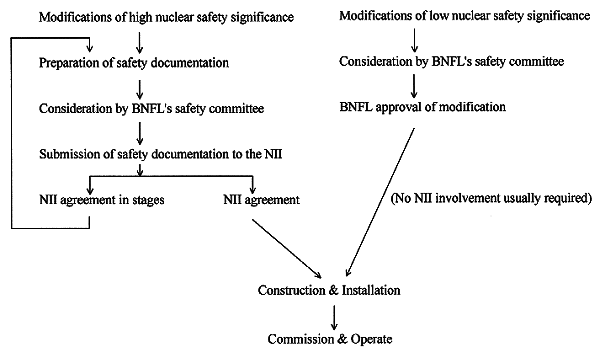
Fig. 1. Control of modification.
Graeme Thomas
HM Inspector
HM Nuclear Installations
Inspectorate
HSE Nuclear Safety Directorate
Bootle, Merseyside
UK
ABSTRACT
The safety of nuclear installations in the United Kingdom is regulated by Her Majesty's Nuclear Installations Inspectorate (NII), a part of the Health and Safety Executive (HSE), using a largely non-prescriptive licensing system. This paper follows on from the overview of the UK Regulatory system for licensing nuclear facilities given previously at WM'96, and describes the practical implementation of regulatory control as carried out by a typical NII inspector, in considering a proposal from a licensee and arranging for appropriate assessment in order to determine that the licensee's safety case is adequate in advance of the proposed change taking place. The example described relates to the processing of acidic liquors, arising from the reprocessing operations carried out in the Purex Separation Plant in Hanford, USA, in the Magnox reprocessing plant of British Nuclear Fuels plc (BNFL) at Sellafield in the UK.
INTRODUCTION
The safety of nuclear installations in the United Kingdom is regulated by Her Majesty's Nuclear Installations Inspectorate (NII), a part of the Health and Safety Executive (HSE), using a relatively non-prescriptive licensing system. This paper follows on from the overview of the UK regulatory system for licensing nuclear facilities given previously at WM'96, and describes the practical implementation of regulatory control as carried out by an NII inspector, in considering a proposal from a licensee and arranging for appropriate assessment in order to determine that the licensee's safety case is adequate. The example described relates to the processing of acidic liquors, arising from the reprocessing operations carried out in the Purex Separation Plant in Hanford, USA, in the Magnox reprocessing plant of British Nuclear Fuels plc (BNFL) at Sellafield in the UK.
The reprocessing of Magnox (magnesium alloy clad) uranium metal fuel has been carried out at Sellafield since 1964. In 1995 BNFL proposed to use several hundred tonnes of nitric acid sourced from the redundant Purex separation plant at Hanford, where it was no longer required, to supplement their normal acid supplies used in the Magnox reprocessing plant. The nitric acid from Hanford contained uranium in solution together with impurities which were outside the range found in the acid normally used in BNFL's reprocessing plant. BNFL proposed to use the Hanford acid mixed with their fresh nitric acid supply, the resulting liquor being fed into the uranium purification cycle of the reprocessing facility.
As the holder of a nuclear site licence, BNFL produce safety cases to consider fully the safety implications for all proposed modifications. Licensees are required to seek the NII's agreement to modifications which are categorized as having a high nuclear safety significance, or when the NII chooses to examine a specific modification. The processing of Hanford acid was categorized by BNFL as a modification having relatively low nuclear safety significance, and which therefore could be implemented without first seeking the NII's agreement. However, in view of the novelty of processing this acid, BNFL were informed by the NII Site Inspector that they would need to submit a safety case to NII for agreement prior to the introduction of the Hanford acid into the reprocessing plant. The NII's main concern about the use of the acid related to the chloride and fluoride ion concentrations in the acid which were considerably higher than the concentrations normally encountered in the acid supplied to the plant, since these impurities could lead to enhanced corrosion at elevated process temperatures.
The paper describes the approach the NII adopted to ensure that the nuclear safety implications of the use of the acid in the Magnox reprocessing plant had been fully considered.
UK NUCLEAR REGULATORY SYSTEM
All civil nuclear installations in the UK are subject to the Health and Safety at Work etc. Act 1974 (1). Amongst the relevant statutory provisions of this Act are those parts of the Nuclear Installations Act 1965 (2) which refer to issues of safety. Under the Nuclear Installations Act, no site may be used for the purposes of installing or operating any prescribed nuclear installation unless a nuclear site licence has been granted by the HSE and is, for the time being, in force. The HSE has delegated the responsibility for administering this licensing function to the NII.
HM NUCLEAR INSTALLATIONS INSPECTORATE (NII)
The declared aim of the NII is 'to secure the maintenance and improvement of standards of safety at civil nuclear installations and the protection of workers and members of the public from ionizing radiations'.
Since October 1996 the NII has dealt not only with health and safety matters resulting from the nuclear processes on the site but also with conventional (non-nuclear) safety. Radioactive discharges from a licensed site are not regulated by the NII, and separate authorization, under the Radioactive Substances Act 1993, is required from the Environment Agency within the Department of the Environment.
There are Memoranda of Understanding between the NII and other Government enforcing authorities to ensure that the division of responsibilities is clearly defined; however, joint action may be taken with them when this is appropriate. To ensure consistency within the UK national policy on radioactive waste, and to avoid unnecessary duplication of work between government bodies, regular liaison meetings are used to check on the workings of the memoranda of understanding and to clarify the detailed responsibilities of the various government departments and agencies involved.
THE LICENSING REGIME
The licensing regime is established by NII through powers provided under the Nuclear Installations Act to attach to a site licence conditions which the NII can vary at any time. The regulatory system is based upon thirty-five conditions, which are legally enforceable, and the control which is effectively exercised by the NII through it approval of the licensee's own systems or 'arrangements'. Consents, approvals and directions are specific powers identified in the conditions attached to a nuclear site licence. The licensee's arrangements formally require them to communicate their safety-related proposals to the NII, as the NII's agreement may be required before the licensee can carry out some activities. The NII also effects control by granting or withholding any necessary agreements.
In addition to the above powers, the NII also has discretion to use the more general powers available under the Health and Safety at Work etc. Act, through the issue of Improvement Notices and Prohibition Notices. Improvement Notices may be issued, following notification of the intention to issue such a notice, when an Inspector believes there is a contravention of a statutory provision. Failure to comply within the specified timescale is an offence and may result in prosecution. Prohibition Notices may be issued when an inspector believes there is or will be an imminent risk of serious potential injury. When a Prohibition Notice is issued, the activity must cease, and failure to act in accordance with the notice is likely to result in prosecution.
This regulatory regime has been successfully applied to a wide variety of nuclear installations within the UK over many years and has been shown to provide a powerful yet flexible system of control capable of being matched to the degree of hazard involved. The overall intent of the regulatory system is to require the Licensee to justify the safety of a plant or operation and to demonstrate safe operating practice.
The licensing regime covers a nuclear installation through its full life cycle from design to decommissioning and takes into account the need to regulate and control the management of radioactive waste.
BNFL'S SITE LICENCE REGULATIONS
BNFL address each of the thirty-five conditions attached to the licence by the use of Site Licence Regulations (SLRs). The SLRs are the 'highest tier' safety documents within BNFL's arrangements which are approved at company director level and are complied with on a site-wide basis. They define the general responsibilities of a Facility or Process Area Manager to ensure that all aspects of the work undertaken are carried out in accordance with the requirements of each licence condition. The SLRs also identify the minimum necessary features of any system set up to implement the requirements of the licence. The SLRs are reviewed on a two yearly basis and are considered by an appropriate safety committee.
Most of the licence conditions include the requirement for the licensee to submit for approval, if so specified by the NII, any part of the arrangements set up to meet the requirements of the licence conditions. Typically, these are the SLRs or subsidiary procedures or instructions. If approved, the regulation, procedure or instruction cannot be changed without further reference to the NII for a new approval.
ARRANGEMENTS FOR THE CONTROL OF MODIFICATIONS
Licence Condition No. 22 'Modification or Experiment on Existing Plant' requires the licensee to make and implement arrangements to control any modification or experiment carried out on any part of the existing plant or processes which may affect safety.
The purpose of this condition is to ensure that adequate arrangements exist to categorize and control all modifications and experiments on existing plant that may effect safety. Modifications are defined in the standard licence as any alteration to buildings, plants, operations, processes or safety cases and includes any replacement, refurbishment or repairs to existing buildings, plants or processes. Therefore, modifications apply to changes in hardware, staffing levels, procedures, instructions and safety cases.
As part of the arrangements for the control of modifications, the licensee makes use of a safety committee to consider key safety issues of each modification proposal. The licensee's arrangements should cover all stages of the modification or experiment, from its initial proposal through to active commissioning, thus ensuring the update of all relevant safety documents including plant drawings, maintenance schedule and operating instructions. These requirements apply to any proposed modification to any plant or process that may affect radiological or nuclear safety, and include temporary modifications and any changes to the process flowsheet. A key aspect of controlling the modification process is the categorization of the modification in terms of its safety significance, as the extent of the regulatory involvement of the NII in the modification process is normally dependent upon its categorization.
BNFL's procedures require a modification to be placed in one of four categories ranging from trivial through to major radiological safety implications. In establishing the categorization of a modification a number of factors are taken into account, such as planned and accidental operator exposures, effects on liquid and aerial discharges, changes to the design safety principles, changes to Operating Rules which define the conditions and limits necessary for safe operation, and fault sequences which could give rise to a dose uptake to a member of the public.
BNFL's arrangements permit them to implement fully, ie construct, install, commission and operate, modifications in the two lowest categories, ie those which have either a trivial or a minor nuclear safety significance (Fig. 1). Summary documents, outlining such modifications which have been approved for implementation, are sent to the NII for information and local BNFL management keep the NII informed of notable modifications and developments. Although the NII can object to the categorization and implementation of these modifications, in most cases they proceed with no regulatory involvement.
Fig. 1. Control of modification.
Modifications which are categorized as having a higher nuclear safety significance are controlled by BNFL in a different manner and can not be implemented without the involvement of the NII. The amount of regulatory involvement which the NII decides to impose depends upon its view of the safety significance of the modification. For these higher category modifications BNFL are required to produce formal safety cases and submit them to the NII before the modifications can start.
Following the receipt of a formal application from BNFL together with the preliminary safety documentation for a modification, the NII responds by issuing a document called a 'licence instrument' which has legal status. In the case of some modifications, the licence instrument simply acknowledges receipt of the safety documentation and allows the modification to proceed. In other cases, the licence instrument both acknowledges receipt of the safety documentation and notifies BNFL of the NII's intention to examine the modification process throughout all or some of the stages, ie to assess the subsequent safety documentation and inspect the on-plant implementation of the modification up to active commissioning. The NII can introduce hold-points in the program which require BNFL to seek formal agreement before proceeding from one stage to the next.
REPROCESSING OF MAGNOX FUEL AT SELLAFIELD
In the reprocessing of Magnox fuel, the fuel received from the reactor ponds is stored under water at Sellafield in a purpose built facility, the Fuel Handling Plant, for at least 200 days, to allow short lived volatile isotopes to decay, principally Iodine 131. The fuel is then decanned by stripping the Magnox cladding to expose the bare uranium metal rod. The stripped rods are then transported in a flask to the Magnox reprocessing plant on the Sellafield site.
In the reprocessing plant the uranium rods are dissolved in nitric acid and the resulting uranyl nitrate overflows continuously from the dissolver to the solvent extraction process. At the first separation stage the uranium and plutonium are extracted into the solvent, Tri-Butyl Phosphate diluted in odorless kerosene, leaving almost all of the fission products in the aqueous stream. The plutonium and uranium are subsequently 'back-washed' into the aqueous product stream. The fission product stream (highly active raffinate) is 'stripped' free of solvent, concentrated and stored in high-integrity stainless steel tanks, prior to being converted to a glass.
The aqueous product stream containing the uranium and plutonium undergoes a further extraction stage to remove residual fission products before the plutonium and uranium are split into separate streams for subsequent purification into plutonium nitrate and uranyl nitrate.
The uranyl nitrate and plutonium nitrate products are converted into their oxide forms in separate buildings adjacent to the reprocessing plant. In the Medium Active Evaporation and Thermal De-Nitration facility the uranyl nitrate is concentrated by evaporation and undergoes thermal de-nitration to produce uranium tri-oxide powder which is stored in drums. This facility also handles the intermediate level liquid waste arising from the second solvent extraction stage in the reprocessing plant which allows the recovery of the nitric acid for re-use in reprocessing. In a separate facility the plutonium nitrate is precipitated as plutonium oxalate before being thermally converted to plutonium dioxide.
BNFL'S PROPOSAL TO USE HANFORD ACID AT SELLAFIELD
As part of the clean up operation at the Hanford site, Westinghouse Hanford (WHC) wished to dispose of approximately 700m3 of trace active nitric acid and weak uranyl nitrate solutions arising from the reprocessing operations which were carried out in the Purex Separation Plant. BNFL's reprocessing facilities are able to use recovered nitric acid as a process feedstock and also recover uranium from weak uranyl nitrate solutions, therefore these facilities were identified as a suitable processing route.
The proposal was to transport the acid by means of iso-freight containers to Sellafield for use in the Magnox Reprocessing Plant. Although the acid contained impurities which were outside the range found in either the fresh or recycled acid normally used in the plant, BNFL proposed to use the acidic liquors in their facilities with no pre-treatment. To facilitate this, BNFL raised a Plant Modification Proposal which categorized the modification as one which had no more than a minor radiological safety significance. As previously stated this category of modification does not require the formal agreement of the NII.
However, in view of the novelty of processing this acid, BNFL were informed that the NII intended to examine the safety case for this modification. Although the NII's powers under the licence are wide-ranging, they are normally restricted to those activities which the licensee undertakes on the licensed site. Therefore, the NII could not require BNFL to obtain its agreement prior to the import of the Hanford acid into the UK. Instead, the NII specified, under licence condition 22, that 'the licensee shall not commence or permit any person to commence the discharge of liquors from the off-site transport containers holding liquors from the Hanford Plant, USA, without the Consent of the Executive', which had the same effect!
PROPOSED PROCESSING ROUTE FOR HANFORD LIQUORS
BNFL's initial proposals for the processing of trace active nitric acid and uranyl nitrate solutions are schematically illustrated as options a), b) and c) in Fig. 2. The nitric acid was to be discharged directly from the transport containers into acid blending tanks which normally received and stored acid recovered from the solvent extraction process (a). The 'Hanford' acid was then to be blended with other recovered acid and used as a feedstock to the reprocessing plant.
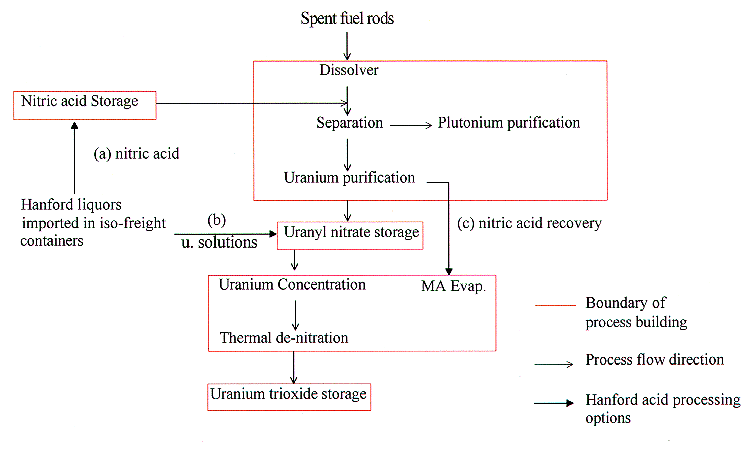
Fig. 2. Hanford acid processing
options.
The uranyl nitrate solutions were to be discharged into uranyl nitrate storage tanks located adjacent to the reprocessing plant (b). These tanks store uranyl nitrate solution for subsequent conversion to uranium trioxide powder; however, they are also used as stock tanks for the recycling of uranyl nitrate back into the reprocessing plant to maintain flowsheet conditions. BNFL's proposal for the 'Hanford' uranyl nitrate was to feed the liquor to the uranium purification stage of the reprocessing plant and generate a solution at the appropriate acidity and concentration for conversion to powder. As the effect of introducing additional uranium into the process during normal operations would have displaced reprocessing throughput, BNFL proposed to co-process the 'Hanford' liquors during periods of reduced throughput. BNFL also proposed to recover the nitric acid arising from the Hanford solutions (c).
Two iso-freight containers, each containing 15m3 of acid, were to be transported to Sellafield each week. BNFL intended to discharge the Hanford liquor from the iso-freight containers via a flanged flexible hose into the uranyl nitrate storage tanks. The Hanford liquor was then to be fed directly into the uranium purification cycle of the solvent extraction process via an existing pipeline. The acid was to be fed from the storage tanks in batches of 8m3 per day to a conditioner where it would supplement the fresh 12M nitric acid before entering the mixer settler for purification. The combined Hanford and fresh acid was then to be processed in parallel with the Magnox derived liquor in the mixer settler, ie the uranyl nitrate from the previous solvent extraction stage. The uranium contained in the Hanford acid would transfer to the solvent during the purification cycle and the traces of plutonium and neptunium would remain in the aqueous stream due to appropriately chosen conditioning.
The solvent from the purification cycle, containing principally the Magnox and Hanford derived uranium, was then to be fed through to the next uranium purification cycle where it would be backwashed into the aqueous phase. The aqueous product from this cycle would then be fed through to the uranyl nitrate storage tanks before being transferred to the thermal de-nitration plant for conversion to uranium trioxide.
ASSESSMENT METHODOLOGY OF THE NII
The NII have developed a set of Safety Assessment Principles (3) which are used as guidance by NII assessors in their examination of licensee's safety cases for all licensed installations including nuclear chemical plant. The principles are not 'standards' imposed on licensees, but have been published so that anyone can be aware of the criteria against which safety cases are judged. The principles are intended primarily for assessing the safety cases associated with new plant and major modifications; however, they are also used when reviewing older plant in comparison with modern standards.
The majority of the principles reflect good engineering practice which can be regarded as the basis of safe design. The principles also contain overall risk targets which NII uses to assess whether the licensee's probabilistic analysis demonstrates that the risks from its plant are balanced and not dominated by a single failure or fault sequence. Tolerability of risks associated with normal operation and accident conditions are separately addressed, each having defined levels of risk denoted by a Basic Safety Limit, and a broadly acceptable level by a Basic Safety Objective (4).
In the UK's non-prescriptive regime, the licensee is free to propose any means to achieve an appropriate level of safety but must demonstrate in a clear and unambiguous way that the proposals are adequate. This is achieved through the safety case which is intended to demonstrate, in an objective and traceable manner, the safety adequacy of the proposed activity from the design through commissioning and operation to the end of plant life and decommissioning. In particular it must link the underlying safety concepts, supporting research and development to the design criteria. From this the safety case identifies the operational limits and constraints for safe operation of the plant throughout its lifetime.
The involvement of the regulator does not remove in any way the licensees' responsibility for safety. NII's assessment of a safety case is carried out on a sampling basis to establish confidence in the arguments put forward and to determine whether the licensee has, as a minimum, met their own criteria. The assessment is carried out in a probing manner, using the principles as the framework, to test the licensee's claims and assumptions - taking into account the safety significance of the chosen aspects. Dialogue between the assessors and the licensee is maintained until the NII is satisfied with the safety arguments and has achieved any safety-related changes that it deems necessary.
ASSESSMENT OF BNFL'S PROPOSALS
As explained above, the NII prioritizes its inspection and assessment work taking into account the nuclear safety significance, and proceeds on a sampling basis. Consequently, the depth of any assessment which the NII undertakes is commensurate with the safety significance of the licensee's proposal.
The NII's main concerns relating to the use of trace active nitric acid and uranyl nitrate in BNFL's reprocessing plants were the effects of the impurities contained in the liquors on the process chemistry, the possibility of corrosion of the process vessels, the effects on facilities down-stream of the reprocessing plant, ie the effluent treatment plants, and the conventional safety aspects of the proposals. Therefore, the NII's assessment was essentially limited to these aspects.
POSSIBLE EFFECTS ON THE PROCESS CHEMISTRY
As part of BNFL's safety case, the NII required confirmation that the effects of the Hanford liquors on the process chemistry had been adequately assessed. BNFL submitted to the NII a copy of the original sample analysis carried out by Westinghouse of the contents of each of tanks containing the liquors. BNFL also confirmed that they had obtained small samples of the liquors to allow them to carry out their own confirmatory analysis of the impurity levels. The results of BNFL's experiments into the effects of the Hanford liquors on a simulated uranium purification solvent/aqueous system demonstrated to the NII that there would be no significant change in the system performance of the uranium purification contractor in the reprocessing plant as a result of any contained impurities or the fact that the molarity of the acid liquors was less than the normal 12M acid used in the facility.
The NII also required BNFL's safety case to adequately define the quality assurance arrangements, both at Hanford and Sellafield, to ensure that the liquors which were received for processing in BNFL's facilities were within the limits already defined in the sample analyses, that there were no additional impurities such as solvents, and that there was no mixing of liquors from other tanks. To overcome the possibility of contamination or cross-mixing of the liquors, Westinghouse proposed to empty the tanks containing the liquors to be processed and leave a residual 'heel' of liquor of approximately 1000 gallons in each tank to ensure that any interfacial solids and solvents remained in the tank. The details of the arrangements to prevent this occurrence were defined in a transportation plan prepared by Westinghouse entitled 'Purex LSA/Nitric acid loading procedures' and this document was submitted to the NII as part of BNFL's safety case.
POSSIBLE CORROSION EFFECTS
The presence of chloride and fluoride ions in significant quantities in the Hanford liquors, gave rise to NII's concern about the effects of corrosion on the process vessels. The maximum fluoride levels in the Hanford liquors were approximately 100 times greater than the typical levels found in fresh or recycled acid.
BNFL's early options studies included the possibility of recovering the nitric acid by feeding it through the medium active evaporators. This option was considered to be undesirable by both BNFL and the NII because of the presence of zirconium sections in the evaporator vessel and the fact that the corrosive effect of the fluoride on this material would be greatly enhanced at elevated temperatures. To permit the acid to be recovered, BNFL initially proposed to dilute the Hanford acid to reduce the fluoride levels down to those normally encountered in the fresh or recycled acid . However, as the recovered acid would be used for a variety of purposes, the possibility of the fluoride becoming routed to other high temperature processes could not be ruled out. BNFL's eventual decision not to pursue the acid recovery option enabled the production of a straightforward safety case, which met the NII's requirements, and in which the process routes (a) and (c) identified on Fig. 2 were not used.
The final safety case submitted to the NII was based upon the following proposal. BNFL intended to lock off all of the process routes from the uranium purification contractor, apart from one which would be an effluent route to the Enhanced Actinide Removal Plant (EARP) which removes trace plutonium and neptunium from effluents. By adopting this route the maximum temperature which the Hanford solutions would be subjected to was 30°C. At this temperature BNFL had demonstrated that the effect of fluoride on stainless steel systems was negligible. Therefore, the NII accepted that the introduction of the high fluoride concentration liquors in the Magnox reprocessing plant and the subsequent processing of the residual acid in EARP would not lead to any detrimental effect on these systems.
EFFECTS ON DOWNSTREAM FACILITIES
As a result of BNFL's confirmation of their intention to isolate and lock-off all of the process routes from the uranium purification contractor, other than the effluent route to EARP, the NII limited its assessment to the safety case covering the effects of the contained impurities on this facility. BNFL's safety case addressed each of the impurities contained in the Hanford liquors, including mercury, chromium and iron, and showed that these were well within the limits normally found in the Magnox reprocessing plant and the waste streams processed by the EARP facilities. BNFL also demonstrated that any discharge of these elements to sea would be well within the total permissible discharge limits specified by the site discharge authorization which is regulated by the Environment Agency.
The NII was satisfied that BNFL's radiological dose uptake assessment demonstrated that the radiological hazards arising from the processing of the Hanford acid were not significantly greater than those encountered during the normal operation of the Magnox reprocessing plants.
CONVENTIONAL SAFETY
The major conventional safety hazard associated with the processing of the 'Hanford' liquors was acid burns resulting from a possible spillage during the transfer of the liquors from the iso-freight containers to the storage tanks.
BNFL's proposals for the transfer of the acid were inspected on site. Only one physical modification was required to the plant, associated with the transfer facility between the iso-freight container and the uranyl nitrate storage tanks. Although the uranyl nitrate storage tanks were located within an adequately bunded area, BNFL proposed the construction of a temporary bund around the iso-freight container whilst acid transfer operations were underway. An emergency drench shower was also provided in the vicinity of the container.
NII AGREEMENT TO THE PROCESSING OF THE HANFORD LIQUORS
Following the NII's assessment of BNFL's safety case for the processing of the Hanford liquors in the Magnox reprocessing plant, a Consent was issued to BNFL allowing them to introduce the material into the uranium purification cycle. This Consent limited the quantity and sourcing of the Hanford liquors to those which had been identified in their safety case. The drums of uranium trioxide recovered from the acid were sent back to the USA.
Following the issue of the Consent for the processing of 700m3 of the acidic liquors, BNFL informed the NII of their proposal to process an additional 50m3 of nitric acid arising from the Purex separation plant, albeit from an additional source to the material already processed. In accordance with BNFL's arrangements a separate plant modification proposal had been prepared. Although the sample analysis provided by BNFL indicated that some of the impurity levels in the additional liquor marginally exceeded the limits for the original quantity, it was considered by the NII that BNFL's original safety case for the processing of the 700m3 was sufficiently robust for this not to present any new concerns. In view of this, the NII chose not to examine BNFL's proposal and therefore BNFL were able to process the additional acid without the need first to seek the NII's permission.
CONCLUSIONS
REFERENCES
*Note: The views in this paper are those of the author and do not necessarily represent those of Her Majesty's Nuclear Installations Inspectorate.