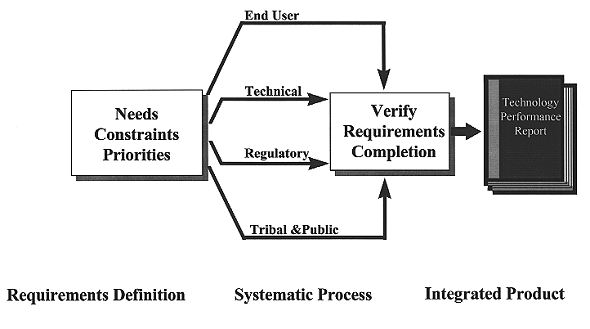
Fig. 1. MWFA systems engineering
process.
Richard Kimmel
Manager, Regulatory and External Affairs,
Mixed Waste Focus Area
U.S. Department of Energy
Idaho Operations
Office
Roger Scott
Tribal and Public Involvement Resource Team
Leader
Mixed Waste Focus Area
Lockheed Martin Idaho Technologies Co.
ABSTRACT
The authors describe the Mixed Waste Focus Area's approach to involving interested Tribal and public members in the mixed waste technology development process. Evidence is provided to support the thesis that the Focus Area's systems engineering process, which provides visible and documented requirements and decision criteria, facilitates effective Tribal and public participation. Also described is a status of Tribal and public involvement at three levels of Focus Area activities.
INTRODUCTION
The Mixed Waste Focus Area (MWFA) is sponsored by the Department of Energy (DOE) Office of Science and Technology to develop technologies that will enable or enhance systems for mixed waste characterization, treatment and disposal. The focus Area has adopted a highly structured systems engineering process to develop and deliver technologies to its end-users, primarily site operations programs within the DOE Office of Environmental Management. (See Fig. 1.).
The process was initially designed to tie very closely with the technology end-users in identifying technology needs and developing technical requirements to meet those needs. The Focus Area is now inviting affected Tribes and the public to participate in its needs identification and requirements development process. Other stakeholders, such as regulators and private industry are also being engaged in the mixed waste technology development process. However, the primary focus of this paper is on Tribal and public participation.
Fig. 1. MWFA systems engineering
process.
MWFA SYSTEMS ENGINEERING APPROACH TO TECHNOLOGY DEVELOPMENT
The Focus Area's product is a Technology Performance Report. This Performance Report includes, as a minimum: technology description, demonstration and test reports; applicable trade studies; documentation of end-user involvement; resolution of regulatory issues; and a Record of Tribal and Public Involvement. The Record of Tribal and Public Involvement is intended to document who among Tribal and public members was involved in the development of a particular technology, how they were involved, what their concerns were and what impact their involvement had on the technology.
During Calendar Year 1995, the MWFA established its initial Technical Baseline. The fundamental units of the Technical Baseline are the technology "deficiencies" for mixed waste characterization, treatment and disposal. "Deficiencies" are significant technology barriers that must be overcome for DOE to characterize, treat and dispose of mixed waste. Overcoming these barriers could result in completing waste treatment systems not now available, or in improvements to existing systems that would allow significant cost or schedule savings. These deficiencies are the gaps that the Focus Area is filling with its technology development work; they have been prioritized to facilitate funding decisions. The systematic processes by which the deficiencies were identified and prioritized are documented in the Focus Area's Department of Energy Complex Needs Report and the Integrated Technical Baseline Report Phase I, Volumes 1 and 2. While these processes are not simple, they are transparent to anyone who is willing to devote some time to reviewing the documents. Assumptions are stated, decision criteria are defined and weighted, and scoring is open and visible.
The Focus Area has prepared Technology Development Requirements Documents (TDRDs) for each deficiency currently being fulfilled or that will be started in Fiscal Year 1997. These documents describe an expected end state of technical performance for any technology to fulfill a deficiency. Therefore, a TDRD provides the "technical targets" at which the principal investigator should aim his or her work. A TDRD also helps the Focus Area decide when development work is complete. That is, the deficiency is fulfilled when the TDRD's technical performance requirements are demonstrated to be met.
WHY INVOLVE TRIBES AND THE PUBLIC?
Practitioners and teachers of systems engineering generally recognize the need to include "stakeholder" perspectives in program requirements. Dr. Jerry Lake (personal communication, September 23, 1996) states the concept in this way:
" As complete a set of stakeholder requirements as possible is important to be defined for each building block undergoing development...It is recommended that appropriate stakeholders participate as team members in a development...effort when multidisciplinary teams are utilized to accomplish teamwork."
According to Lake, there is a benefit to this approach:
" With every type of stakeholder perspective considered as early as possible in the life cycle, there is a better chance that stakeholder satisfaction will be attained. Involves every potential user (directly or indirectly) in the design of the system to ensure that they buy into the system early on."
A well-constructed systems engineering process actually facilitates stakeholder participation because the bases for decisions (i.e. assumptions, decision processes, decision criteria, criteria weights) and program requirements are clearly documented and highly visible. This allows stakeholders to participate early and effectively in decision processes by providing input to those key decision bases.
MWFA APPROACH TO TRIBAL AND PUBLIC PARTICIPATION
The MWFA is inviting Tribal and public participation at three levels of activities and decisions: management activities and decisions; technical baseline activities and decisions; and site-specific activities and decisions. The approach is illustrated in Fig. 2. It provides a framework for interactions between Tribal and public representatives and MWFA management and technical personnel.
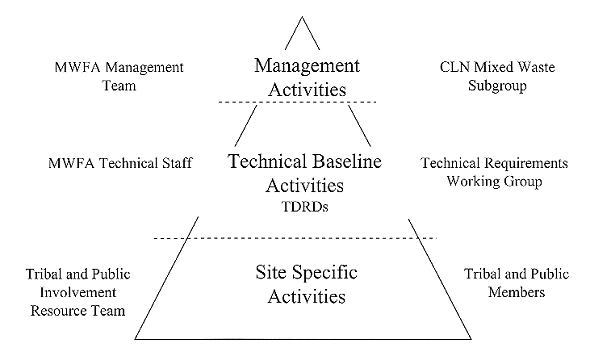
Fig. 2. MWFA approach to tribal and
public participation.
Site-Specific Activities and Decisions
The MWFA is developing technologies that will ultimately be deployed at most major DOE sites for use in mixed waste characterization, treatment and disposal. Two key assumptions underlie our efforts to seek input from the people who live around these sites: 1) they are concerned about the performance of those technologies and their potential impact on public and worker health and safety and the environment and 2) some of their concerns can, and should, be addressed prior to deployment during technology development. Operating on the systems engineering principle stated earlier, the Focus Area is gathering pertinent issues, needs and concerns from the people who live around the DOE sites.
Virtually all the DOE sites have established infrastructures for Tribal and public involvement. The major sites have Site-Specific Advisory Boards (SSAB's) or Citizens' Advisory Boards (CABs). In some cases, Tribal and public members sit on Site Technology Coordination Groups (STCGs). The infrastructures are different at each site. As a program of national scope, the MWFA is working with the existing infrastructures in order to identify and gather site-specific issues, needs and concerns.
Concerned Tribal and public members have given us a key input regarding this task. They have urged the Focus Area to seek input from a broader constituency at the DOE sites than is represented in the existing infrastructures for public involvement. The context of their input has centered on strengthening credibility of the task's results by demonstrating that we sought input from a broad cross section of concerned people around the sites.
The MWFA responded to this input in designing the process for gathering site-specific issues, needs and concerns. We altered the original approach to include engaging SSAB, CAB, and STCG members and staff for assistance in identifying affected Tribes and members of the public who are not represented within their groups.
The first step in the process was to review existing, documented Tribal and public input related to mixed waste. This included such items as public comments on Environmental Impact Statements, minutes of SSAB and CAB meetings, reports from ad hoc citizens' task forces, etc. We reviewed and gleaned those documents for Tribal and public commentary related to mixed waste characterization, treatment and disposal at the sites. Pertinent comments were identified by date, source, commenter's affiliation (if known), and categorized initially by site.
The information compiled from existing sources provided input to the next step in the process, which was to design the approach for gathering additional, pertinent information at the major DOE sites: INEL; Hanford; Savannah River; Oak Ridge; Los Alamos/Sandia. This effort is currently underway. The approach is different at each site. Depending on the situation at a given site, a combination of interactions is being used: discussions with SSABs and CABs during their regular meetings and/or interviews with individual members; interviews with other concerned individuals and groups; "focus group" interactions with a cross-section of concerned citizens.
The Tribal and public input gathered through direct interactions is being compiled along with that gleaned from documentation. This information is the primary input to the next level in the Focus Area's public participation strategy. The pertinent concerns and needs of the people living around the sites are being integrated into the Focus Area's technical requirements.
MWFA Technical Baseline and Requirements
In December 1996 the Focus Area formed a Technical Requirements Working Group to assist the MWFA's technical staff in integrating the Tribal and public issues, needs and concerns discussed above into the existing and new Technology Development Requirements Documents (TDRDs). The Working Group consists of eight external Tribal and public members who are technically trained or conversant in mixed waste technical topics. In their assistance on the integration task, the MWFA asked them to present a variety of Tribal and public perspectives for the Focus Area's consideration, rather than to represent specific Tribes or public interest groups themselves. Each has agreed to perform a specific scope of work, and has been offered an honorarium. We estimate that their effort will require the equivalent of approximately 15 working days for each participant over the first four months of Calendar Year 1997.
At its second meeting in January 1997, the Working Group identified those deficiencies and corresponding TDRDs that, in their view, would have the greatest degree of impact on and interest from Tribes and the public. They collaborated with members of the Focus Area's technical team to identify those TDRDs that needed their attention first from a scheduling perspective. The Working Group selected and began review of the technical requirements associated with the following deficiencies: Polymer Encapsulation; Salt Stabilization; Waste Form Performance; Radionuclide Partitioning; and Continuous Emissions Monitors for Mercury, alpha, heavy metals, and Dioxin/Furans. Their input to these requirements should be complete by mid-April 1997.
We are encouraging open, informal communication among Working Group and Focus Area technical staff members. The Working Group is relatively small, and all have access to the Internet. A list server has been established with the Working Group and key technical staff as members of the list. The list server provides a highly democratic, open communication model in that a question or comment posted on the server, and its response, is seen by all the list members. The Focus Area's Tribal and Public Involvement Resource Team monitors messages on the list server to ensure that questions or comments are answered in a timely way. This is a new tool. Initially, the Working Group members are asking questions primarily to better understand the background or origin of specific requirements
A key input this group has given the Focus Area regards the importance of independent technical review. They have stressed the importance to stakeholders of DOE inviting independent review of its technical work, and being made aware of the results of the review--even being able to witness the review. DOE and contractor technical staff should not perceive this as the public's questioning their competence or credibility. The motivation for independent review appears to more closely resemble the common practice in medical matters of obtaining a "second opinion". Does more than one expert agree that the diagnosis of the problem is correct, and is the recommended treatment the most appropriate one to correct the problem? In response to this input, we are considering how to make accessible to Tribes and the public some independent technical reviews scheduled for early summer 1997.
MWFA Management Activities and Decisions
The third aspect of the Focus Area's approach is to provide Tribal and public access to its management activities and decisions. This has been accomplished primarily by a series of interactions with the Mixed Waste Sub-Group of the Community Leaders' Network (CLN). The CLN is an informally structured external stakeholder organization sponsored by the DOE Office of Science and Technology. CLN members with a particular interest in mixed waste technology development comprise the Sub-Group. Its membership represents an excellent cross-section of the national social context in which the Focus Area operates: Tribal; technical; business and commercial; public advocacy; state regulatory; academic; and local government.
In September, 1996, the MWFA management team met with the Sub-Group and agreed to their continuing involvement in three major areas of MWFA management activities and decisions by:
The Focus Area management staff have been interacting regularly with this CLN group for about six months. They are not engaged as a formal advisory group. Rather, they provide the benefit of their individual opinions and perspectives; they tell the managers what is important to them as stakeholders and how they, as members of the public, perceive certain management decisions or actions. In these give-and-take discussions, MWFA management receives not specific, formal recommendations but a variety of external perspectives and opinions.
It was from these citizens that we learned we should talk to more people than those represented in the site stakeholder involvement infrastructures, if we want to improve the validity (and credibility) of our Tribal and public involvement process results.
Our citizen participants have told us very clearly that they have seen and heard more than enough long, detailed DOE viewgraph presentations. The CLN as a whole has undertaken a project to develop a set of guidelines, and an example presentation, for how to prepare and present a technical topic to the public. The MWFA is cooperating in this effort.
Several members of the CLN Group have pointed out that they, as stakeholders, are more interested in understanding the basis for budget decisions than in the budget itself. That is, seeing a list of activities and assigned dollar amounts provides little or no insight into the thought that went into the list. Why do some activities receive more funding than others? What is the rationale underlying the order of funding and completing activities?
The Focus Area's systems engineering processes have been especially well-suited to facilitating these kinds of discussions with the CLN group. As part of the Focus Area's Technical Baseline revision, MWFA management met with members of the Sub-Group in early December and again in early January. The Focus Area's decision process was presented to the group through relatively informal discussions. This stimulated a rich variety of opinions about Tribal and public concerns already considered in the decision criteria, what others should be considered, and what the resulting effect on the decisions might be. The members of the Sub-Group certainly have not always agreed with the Focus Area's criteria and its weighting of the criteria. They have, however, provided consistently positive feedback concerning the fact that the bases for the decisions are available for anyone to see and understand. These discussions will continue.
CONCLUSION
The Mixed Waste Focus Area is implementing a multi-level strategy to integrate Tribal and public concerns and needs into its technology development requirements, as well as its key process decision criteria. The systems engineering process, with its highly visible requirements and decision criteria, facilitates effective Tribal and public involvement.
The effort to gather site-specific Tribal and public needs and concerns is just getting underway. A (Tribal and public) Technical Requirements Working Group has been recently formed to assist the Focus Area in integrating site stakeholder needs and concerns into our technical requirements. They are assisting in designing the effort to communicate with site stakeholders, and they are beginning to collaborate with members of the Focus Area's technical staff.
At this time, interactions have been most extensive between Focus Area management and the Community Leaders' Network Mixed Waste Sub-Group. These have yielded valuable insights to management about several public constituencies' priorities and interests in mixed waste technology development.
Emphasize has been, and will continue to be, on face-to-face communication and collaboration with interested Tribal and public members. Considerable attention and resources are being invested in the design of communication environments that will foster positive communication and collaboration efforts. At this early stage of engaging Tribes and the public in the processes, it is fair to say that the Focus Area staff' has gained a heightened awareness of Tribal and public needs and concerns. By the end of Fiscal Year 1997, we expect to report how the Focus Area's technical requirements and decision criteria have changed as a result of Tribal and public. After that it will be up to the Tribes and public to decide whether or not the mixed waste technologies we deliver are more acceptable and responsive to their needs and concerns.
BIBLIOGRAPHY
J.A. ROACH, "Mixed Waste Focus Area Department of Energy Complex Needs Report," INEL-95/0555, Idaho National Engineering Laboratory (December 1995).
Mixed Waste Focus Area, "Integrated Technical Baseline Report Phase I," Volumes 1 & 2, DOE/ID-10524, U.S. Department of Energy, Idaho Operations Office (January 1996).
*Work supported by the U. S. Department of Energy, Assistant Secretary for Environmental Mangement (EM) under DOE Idaho Operatations Office Contract DE-AC07-941ID13223