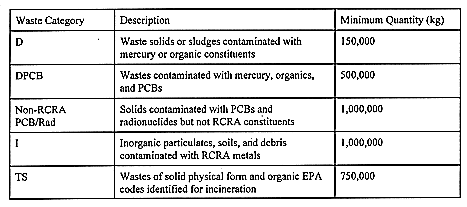
Table I Preliminary Waste Category and Quantity Assumptions
Katherine L. Yuracko, Stanton W. Hadley and Michael I. Morris
LMER
Richard D. Korynta
DOE
Clemence M. Noakes and Fred H. Miller
LMES
ABSTRACT
High costs projected for mixed low-level waste treatment, coupled with decreasing U.S. Department of Energy (DOE) budget profiles, have led the DOE Oak Ridge Operations Office (OR) to investigate innovative methods for reducing the costs of mixed waste treatment. Because estimates indicate that the cost of waste treatment can be reduced through increased private sector competition, DOE-OR has initiated a major privatization initiative for private sector treatment of mixed low-level wastes. A Broad Spectrum Procurement has been initiated to establish treatment contracts for certain mixed low-level waste streams at the Oak Ridge Reservation (ORR) for which DOE does not have existing treatment capability. Because DOE-OR recognizes the benefits that such a procurement will offer other government sites needing mixed waste treatment, these contracts will be made available across the government.
A preliminary analysis of the relative economics of private sector treatment of Broad Spectrum Procurement mixed wastes versus treatment in a government-owned, contractor-operated facility in Oak Ridge has been performed based on currently available data. All of the options that were examined included disposal at a commercial mixed waste disposal site. The results suggest that for some mixed wastes, selecting the private sector option would result in lower costs to the government.
Major steps towards accomplishing the Broad Spectrum Procurement have already been completed: candidate mixed wastes at seven DOE sites have been identified, classified according to treatment categories, and prioritized for treatment. Based on consideration of waste chemical and physical properties, the wastes have been divided into multiple treatment categories. These treatment categories form the basis for much of the cost analysis, and will comprise the basis for the solicitation. Subdividing the wastes into these treatment categories is anticipated to result in additional cost savings resulting from greater competition; this is because the bidding will be open to many more companies, both large and small, than would be possible with a single comprehensive procurement.
The present scope of the broad spectrum national procurement would allow treatment of approximately 40 million kg of waste from across the DOE complex. It is anticipated that there will be multiple vendors and multiple awards made. The contract is of national interest for two reasons: wastes from throughout the DOE complex may be treated under the broad spectrum contracts; and the procurement will promote establishment of commercial treatment for a "broad spectrum" of mixed waste.
OVERVIEW OF THE BROAD SPECTRUM PROCUREMENT
This paper provides an introduction to DOE-OR's Broad Spectrum Procurement, a contracting action to acquire mixed waste treatment and disposal capability from the private sector, and presents the status and lessons learned to date in implementing this innovative privatization program. The preliminary analysis of the relative economics of on-site and off-site treatment of mixed wastes is described. Because these analyses suggested cost savings to the government from private sector treatment of certain mixed wastes, DOE-OR has initiated the Broad Spectrum Procurement to obtain private sector treatment services. The current status, lessons learned, and potential advantages of participation in this procurement are described.
The DOE owns numerous facilities and laboratories throughout the country. Over the years, plant process operations and associated support activities at these facilities have generated large quantities of multiple stream mixed wastes. Most of these wastes are containerized and are currently managed in compliant storage on one of the DOE sites. Site Treatment Plans (STPs), developed for each of the DOE sites, identified and quantified many different wastes that are currently stored at these sites. Waste from other Government sites may also be available for treatment. Resource Conservation and Recovery Act (RCRA) Land Disposal Restrictions (LDRs) and the new Federal Facilities Compliance Act mandate that all mixed waste on federal reservations be treated to meet LDR standards in accordance with compliance schedules. In order to comply with this mandate, DOE is implementing plans to treat and dispose of all identified mixed wastes.
The Broad Spectrum Procurement is a DOE-direct procurement: 1) allowing competitive bids for multiple different categories of waste that reflect the spectrum of legacy mixed wastes in DOE; and 2) allowing for treatment of mixed waste from across the DOE complex.
PRELIMINARY COST COMPARISON FOR TREATMENT OF MIXED WASTES
An analysis was conducted of the relative economics of private sector off-site treatment of mixed wastes versus treatment in a government-owned, contractor-operated facility on the ORR. Several analyses were conducted last year of the mixed low level wastes potentially available to seven privatization contracts within the DOE. Waste amounts listed in the Site Treatment Plan database were assigned to contracts such as the Broad Spectrum, the Advanced Mixed Waste Treatment Plant at INEL, the Waste Receiving and Processing facility at Hanford, and national stabilization and macro encapsulation facilities. Possible treatment schedules and project costs were defined. The analyses indicated a significant cost advantage from consolidation and privatization of the waste treatment plans. As a result of the initial analyses, preliminary estimates of the cost to the government for on-site treatment and private sector treatment for five categories of mixed wastes were developed and the results are summarized here.
Approach
Preliminary cost estimates were developed to include treatment costs and disposal costs. In most cases, preliminary cost estimates for waste treatment were developed using the cost information found in the INEL cost guidance report "Waste Management Facilities Cost Information for Mixed Low-Level Waste" and a cost estimation model developed at ORNL which estimates private sector costs using the INEL data. The INEL report presents life cycle cost estimate information on DOE treatment of mixed low-level wastes. The ORNL cost estimation model was then used to generate cost estimates for private sector treatment. These cost estimates do not represent the cost for treatment at a specific facility; rather, they are estimated costs for generic facilities based on hypothetical treatment scenarios. In the remaining cases, exogenous cost estimates were used in place of these models. The computer models were used to generate costs for the following: private sector incineration; low temperature thermal desorption; on-site grout stabilization; and shred. Exogenous cost estimates were used for the following: TSCA incinerator; private sector grout stabilization; organic destruction; mercury amalgamation; and disposal.
A make-buy cost comparison must compare the total cost to the government -- not simply the cost of the treatment contract -- in the comparison of on-site (make) and off-site (buy) treatment alternatives. To make an equitable comparison of competing treatment technologies, disposal costs must be included in the cost comparison. This is because different treatment technologies will result in different volume reductions and therefore different disposal costs. Costs which are assumed to be the same under the two cases (e.g. project management, sorting and segregating the waste) and costs which will not significantly affect the relative cost comparison (e.g. transportation) were not included in the cost comparison. In addition, characterization costs were assumed to be comparable for on-site and off-site facilities and therefore were not included in the analysis. However this assumption may not be valid but in either case it is expected that characterization costs may be significant. DOE contractor project management, packaging if required, staging, and management review costs were also not considered for this estimate.
The waste categories assumed for this preliminary analysis are shown in Table I. These categories are preliminary and may differ from those in the Broad Spectrum Procurement Statement of Work. Because of the sensitivity of treatment cost to waste quantity, the effect of varying the waste quantities over a range of values was evaluated. Three cases were considered for each waste category: minimum quantity, mid-estimate, and maximum quantity. The minimum quantity is the quantity characterized and visually inspected. The mid-estimate, 3 times the minimum quantity, was selected to very roughly approximate the quantities of wastes available from throughout DOE-OR. The maximum quantity, 10 times the minimum, was chosen to roughly approximate mixed wastes from throughout the DOE complex. The quantities assumed are presented in Table I.
Table I Preliminary Waste Category and Quantity Assumptions
To facilitate analysis of many different cases rapidly and efficiently, generic treatment trains were postulated for on-site and off-site treatment. These are presented in Figs. 1 and 2, respectively. The percentage of waste going through each treatment step (e.g., thermal desorption, mercury amalgamation) varies with the characteristics of the waste in each waste category. While the assumptions for treatment method are based on best professional judgment, given the limited current understanding of the waste characteristics, the assumed treatment methods should be considered preliminary. In addition, there are other possible treatment processes beyond those evaluated here. The treatment processes identified and costed here represent a base case analysis in which only technologies proven for these types of applications were considered, and treatment capability available at other DOE sites also was not considered. There are other possible treatment methods, including potential innovative technologies, which may be available for waste treatment, e.g. vitrification, plasma arc, metal bath, and steam reforming.
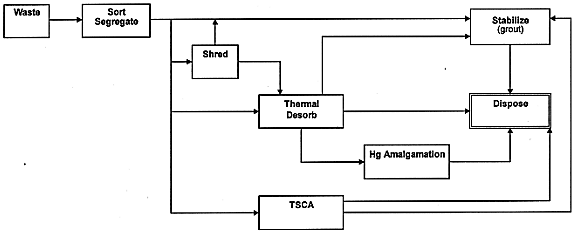
Fig. 1. On-site treatment train.
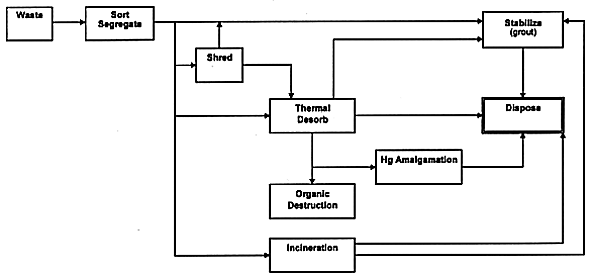
Fig. 2. Off-site treatment train.
Other Key Assumptions
Results
Although cost estimates for both private sector and onsite treatment options contain significant uncertainties, private sector treatment offers some potential economic advantages which should be thoroughly explored. In analyzing the results, it became apparent that the wastes are logically grouped into three types. Those types, and the results for each, are as follows:
Use of the generic cost estimates developed for this preliminary analysis will probably be most helpful during the initial screening and comparison of on-site and off-site treatment. Where this initial evaluation indicates that private sector treatment appears to be a potentially viable, cost-effective option, more specific information on private sector treatment capabilities and costs should be obtained from the private sector.
KEY ASPECTS OF THE BROAD SPECTRUM PROCUREMENT
Because these preliminary analyses suggest cost savings to the government from private sector treatment of certain mixed wastes, DOE-OR is proceeding with development of the Broad Spectrum Procurement. Key advantages of the Broad Spectrum Procurement approach include the following:
There is a need to structure the procurement to be attractive to vendors yet result in the best deal for the DOE. In order to accomplish this, feedback from vendors has been solicited.
The objective of the Broad Spectrum Procurement is to minimize cost while providing a treatment outlet for all Broad Spectrum mixed wastes; therefore treatment options will be selected to minimize the total cost of treatment and disposal of all Broad Spectrum wastes. Accordingly, vendors will have the option to bid on treatment of individual waste categories as well as on combinations of waste categories. Qualified bidders must have existing, or applications for, RCRA part-B permits, NRC licenses, and/or TSCA approvals, depending on the categories on which they are bidding. For all waste in each category, vendors will transport the raw waste to their treatment facility and treat to meet waste acceptance criteria of a licensed mixed waste disposal facility or successfully recycle the waste. The vendor's on-site activities will be limited to picking up containerized waste from staging areas at each site. After treatment, the vendors will be required to package, transport to, and dispose of all treated and ancillary waste at a licensed mixed waste disposal facility.
STATUS AND LESSONS LEARNED
Major steps towards accomplishing the Broad Spectrum Procurement have already been completed: candidate mixed wastes at seven DOE sites have been identified, classified based on treatment, and prioritized for treatment. Current efforts also include development of an industry survey and development of a process to target individual waste containers to suitable vendors based on waste codes, radionuclides, and waste form.
DOE-OR is also exploring ways to use the latest developments in communications technology to assist this innovative program. For example, CD-ROM technology is being used to provide visual information on the wastes to potential vendors to aid them in their preparation of bids. The CD ROM summarizes available analytical data and visual inspection results with waste photographs in an easily accessible format that will minimize misinterpretation of bidding categories. These, and other technologies, are being explored to determine ways to provide the best information available to potential vendors.
The major challenges for the program are the limited characterization data, the division of the mixed wastes into logical waste groupings or "waste categories", and the uncertain waste quantities. Efforts continue to improve the assignment of wastes to categories in accordance with the basic concept that wastes within a given category can be treated using similar treatment processes. Subdividing the wastes into these treatment categories is anticipated to result in additional cost savings resulting from greater competition; this is because the bidding will be open to many more companies, both large and small, than would be possible with a single comprehensive procurement for all mixed wastes.
OR has put in place plans to reduce some of the current uncertainties and is developing innovative methods to address other uncertainties. For example, the incomplete current characterization of the wastes is one of the major hurdles; to address this, DOE-OR is using CD-ROM to provide visual and other information available on the waste to potential vendors.
NATIONAL PROCUREMENT
While preliminary cost analyses suggest cost savings for off-site treatment of DOE-OR wastes, even greater cost savings are anticipated as other sites commit waste to the Broad Spectrum project. The structure of the Broad Spectrum allows treatment of mixed waste from all DOE sites, as well as other federal agencies within the continental U.S., under the maximum waste volumes in the contracts.
There are significant administrative, procurement, and financial benefits for sites that choose to participate in the Broad Spectrum Procurement. Sites can benefit from the procurement services provided by DOE-OR. A consolidated national DOE procurement also eliminates duplicative M&O audits of vendors that can occur when each site has its own contracts. Furthermore the prices negotiated by DOE-OR are likely to be lower than any site could obtain on its own due to the economies of scale associated with the larger treatment volumes and the enhanced competition under the Broad Spectrum Procurement.
In addition, there is a key financial advantage for other sites to participate in the Broad Spectrum Procurement. DOE-OR has received privatization funds to guarantee the treatment contracts. Therefore, participating sites will not be required to commit funds sufficient to cover the full obligation of the contract, as is ordinarily the case. Rather, participating sites are only required to budget for payment for services rendered. Thus, the Broad Spectrum Procurement provides significant budgetary advantages for participating sites, both by reducing their requirement for up-front budget authority and for reducing the total cost of treatment through lower negotiated prices.
SUMMARY AND CONCLUSIONS
The objective of the Broad Spectrum Procurement is to use one procurement action to treat to LDR standards and dispose or recycle the legacy mixed wastes located at the Oak Ridge Reservation which cannot currently be treated onsite. Preliminary cost estimates suggest that this will result in significant cost savings to the government. In addition, the Broad Spectrum Procurement is available to all DOE sites. This is expected to produce further cost savings to the government. Major steps towards accomplishing the Broad Spectrum Procurement have already been completed.
REFERENCES