David Hoel
U.S. Department of Energy
K. Cornelius, J. Loving, and C. Mueller
Argonne National
Laboratory
F. Skidmore
Louis Berger and Associates
ABSTRACT
The U.S. Department of Energy (DOE) published the Draft Waste Management Programmatic Environmental Impact Statement (WM PEIS) in September 1995 and will publish the Final WMPEIS in early 1997. The WMPEIS examines the potential environmental impacts and costs of managing DOE's radioactive and hazardous wastes over the next twenty years (40 years for HLW storage). A 5-month public comment period, which included public hearings in 18 different locations, produced over 5000 public comments. The changes made as a result of these comments include more up-to-date site-specific waste inventory projections; a reevaluation and expansion of cumulative impacts which better integrate predicted impacts from other DOE programs; clarification of various transportation issues; and revised, more comprehensive evaluations of environmental justice and privatization considerations. This paper summarizes these changes, and the final results of the WM PEIS analyses. The factors and criteria which the Department will use to identify preferred alternatives and the status of the subsequent decision-making process and related public involvement activities are discussed.
INTRODUCTION AND OVERVIEW
The Waste Management Programmatic Environmental Impact Statement (WM PEIS) is a comprehensive Department-wide study examining the potential health, environmental and cost impacts of strategic management alternatives for managing five types of radioactive and hazardous wastes. These wastes have resulted and will continue to result from nuclear energy research and the development, production, and testing of nuclear weapons at a variety of sites around the United States.(1,2) The five waste types are: low-level mixed waste (LLMW); low-level waste (LLW); transuranic waste (TRUW); high-level waste (HLW); and hazardous waste (HW). This study provides information on the impacts of various siting alternatives which the U.S. Department of Energy (DOE) will use to help decide at which sites to locate additional treatment, storage, and disposal capacity for each waste type. However, the siting, construction and operation of any new facility at a selected DOE site will not be decided until completion of a sitewide or project-specific environmental impact review.
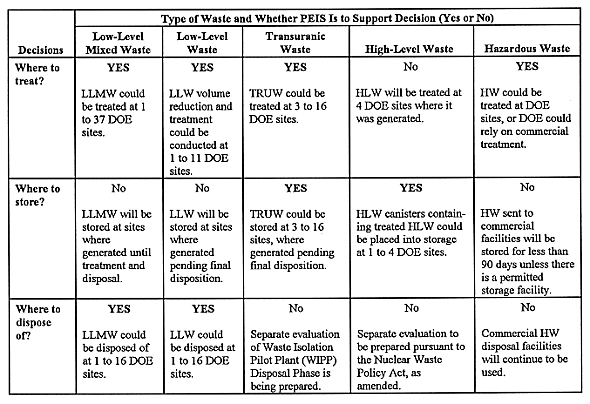
Table I summarizes the range of decisions DOE needs to make with respect to the treatment, storage, or disposal of the waste types discussed. To assist DOE in making decisions regarding the sites at which it should conduct waste management activities, the WM PEIS considers four categories of alternatives for each waste type: a no action alternative that is generally consistent with current practice; a decentralized alternative that would, in general, result in wastes being managed where they are generated or stored currently; regionalized alternatives that would locate waste management facilities at a few sites throughout the nation; and centralized alternatives that would locate large waste management facilities at only one or two sites. For certain waste types, DOE considered more than one regionalized or centralized alternative to present a wide variety of options on the number and location of sites that currently have major waste management facilities and the sites at which the facilities could be located. Fig.1 identifies the sites where wastes are generated or stored under the alternatives evaluated.
PUBLIC COMMENTS ON THE DRAFT WM PEIS
An extended, 150-day public comment period was conducted from September 22, 1995, to February19, 1996. During this period, DOE received more than 5,000 comments from more than 1,200 individuals, tribal nations, states, agencies, and organizations. During this period, DOE conducted 13 public meetings in 18 cities throughout the country. Comments were received from virtually all of the communities near the major DOE sites and from many other interested members of the public. Many citizens and organizations posed questions, or made comments or objections regarding proposed waste management activities at particular DOE sites. Some suggested other alternatives for waste management activities; others expressed their preferences for certain alternatives described in the WMPEIS. A few expressed their support for DOE's current efforts.
In compliance with the provisions of the National Environmental Policy Act (NEPA) and regulations of the President's Council on Environmental Quality (CEQ), DOE assessed and considered all public comments on the Draft WMPEIS, both individually and collectively. Many public comments provided valuable suggestions for improving the Draft WM PEIS that led to modifications which are incorporated into the final document. For example, some comments resulted in a response to explain or communicate government policy, to clarify the scope of the WM PEIS, to explain the relationship of this WMPEIS to other related NEPA documentation, to refer commenters to information in the WMPEIS, to answer technical questions, to further explain technical issues, or to correct readers' misinterpretations. Several important changes that were made in preparing the final WM PEIS, and as a result of the public comment process, are summarized in the following paragraphs.
TABLE I Range of Decisions to be Supported by the WM
PEIS
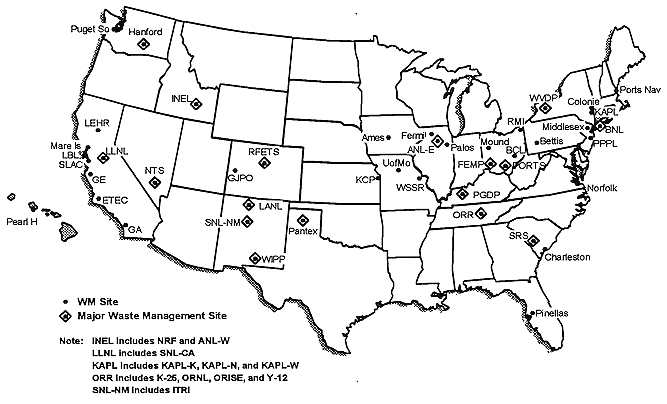
Fig. 1. Waste
management sites.
Updated Waste Inventory Information
DOE prepared a new appendix that presents updated waste volume inventories and projections for all waste types. This appendix contains site-specific comparisons with earlier reported inventories and projections upon which the analysis in the Draft WM PEIS was based. The comparisons were made to determine if any of the newer waste volumes would substantially change any of the impacts described in the Draft WM PEIS. DOE used this information to identify needs for new analysis using updated waste inventory data at selected LLMW, LLW, and TRUW sites. The results of those new analysis were incorporated into the final WM PEIS.
Cumulative Impacts
DOE revised the chapter on "Cumulative Impacts" to include a more comprehensive evaluation of other DOE actions (such as tritium supply and recycling, weapons material stockpile stewardship management, and storage and disposition of excess fissile materials). DOE also expanded the cumulative impacts presentation to include the range of cumulative transportation impacts to an individual in the region around each site and the effects to groundwater quality at each site for waste management and other activities.
Clarification of Transportation Issues
DOE clarified the comparison of radiological risks in truck and rail transportation and included the potential number of waste shipments that would enter and exit each site. DOE also reiterated that the intersite routes used in the analysis are representative of possible routes, not prescriptive of actual routes to be used. A description of how DOE determines transportation routes for shipments has been added, as well as a description of interagency coordination and emergency preparedness planning.
Consideration of Privatized Facilities and Operations
DOE expanded the discussions of privatization with respect to waste management. For purposes of the WMPEIS, the term "privatization" refers to situations where a private entity constructs (including financing and obtaining necessary permits), operates, maintains, and would decontaminate and decommission a DOE waste management facility on a DOE site for the exclusive use of DOE. The private entity is reimbursed by DOE on a competitive, fixed price basis. The potential environmental impacts of privatized waste management facilities would not be expected to differ from those managed by DOE.
Environmental Justice
DOE modified the analysis of potential environmental justice impacts regarding the estimates of whether high and adverse human health impacts could disproportionately affect minority or low-income populations. Maps that illustrate the proximity of these populations to the major DOE sites were also included.
FINAL RESULTS OF WM PEIS ANALYSIS
For each waste type, the alternatives were evaluated and impacts identified. Highlights of the results are as follows:
Low-Level Mixed Waste
Costs are a greater discriminator than risks and environmental impacts.
Low-Level Waste
Transportation risks and overall costs are the greatest discriminators.
Transuranic Waste
For the transuranic waste alternatives, which evaluate treatment, retrieval, and storage but do not evaluate disposal, estimated risks and environmental impacts are generally low.
- The analysis predicted that two sites utilizing thermal treatment to meet land disposal restrictions (Los Alamos and the Waste Isolation Pilot Project) may need mitigative measures to meet radionuclide emission standards.
- Treatment and storage costs over 20 years (including retrieval) vary by 26% among alternatives, with the highest costs for alternatives postulating more intensive treatment to meet land disposal restrictions. Transportation costs are less than 10% of total costs.
High-Level Waste
For the high level waste alternatives, which evaluate only storage of treated waste in canisters following immobilization, differences in risks, costs, and environmental impacts are small.
Hazardous Waste
The WM PEIS evaluated alternatives of increased on-site treatment of nonwastewater hazardous waste versus the continued current practice of relying on commercial facilities for treatment for most waste. The analysis indicated that estimated risks and environmental impacts were likely to be small for all alternatives. Costs were less for those alternatives with the greatest reliance on commercial facilities.
WM PEIS DECISIONS AND PREFERRED ALTERNATIVES
The alternatives that were analyzed describe the roles of different sites where waste management facilities could be constructed and operated. Table II lists factors and criteria DOE is considering to screen, evaluate, and narrow the alternatives to select agency preferred alternatives for each waste type analyzed in the WM PEIS. At the time of submission of this preparation, the Department has not selected its preferred alternatives. However, when that selection has been made, they will be identified in the final WM PEIS.
Table II Factors and Criteria DOE Will Use in Selecting Preferred
Alternatives for the Final WM PEIS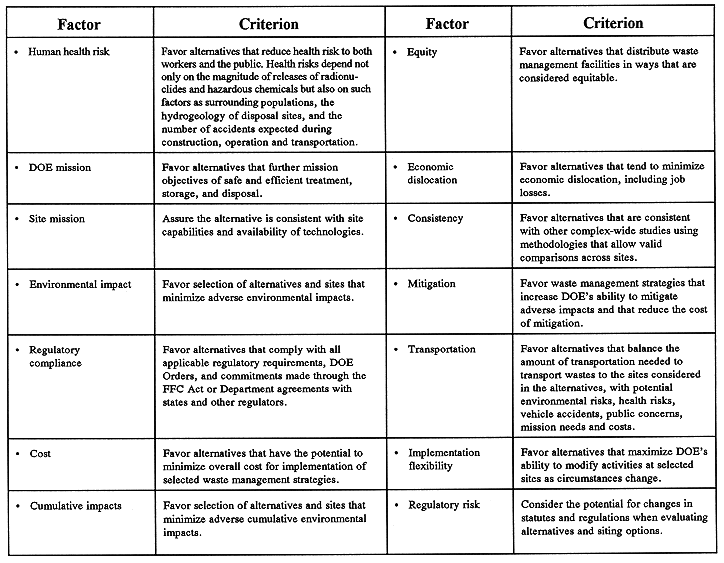
Completion of this comprehensive Department-wide study will culminate six years of intensive data gathering, analyses and public interactions. The decisions which will result from this effort will establish the strategic foundation for management of these wastes well into the twenty-first century. DOE anticipates issuing Records of Decision (RODs) by waste type starting in calendar year 1997.
After RODs are issued, particular sites may propose to use commercial or privatized facilities for waste management activities. Such proposals would be analyzed in sitewide or project-level NEPA reviews as appropriate. The WM PEIS impact projections would be similar for waste management facilities constructed and operated by private entities on DOE sites at DOE's direction.
It should be emphasized that the construction of specific new facilities which may be required to implement DOE's decisions would be subject to additional environmental impact review as appropriate.
ACKNOWLEDGMENTS
Work by Argonne National Laboratory authors was supported by the U.S. Department of Energy, Office of Environmental Management, under contract W-31-109-Eng-38.
REFERENCES