Fig. 1. 94-2 Tasks.
Martin Letourneau, Julie Ayres
U.S.Department of Energy
Kirk Owens, Derek Widmayer
Science Applications
International Corp.
Brandt Meagher
Lockheed Martin Idaho Technologies
ABSTRACT
In 1990, the Defense Nuclear Facilities Safety Board (DNFSB) identified that the Department of Energy's (DOE) radioactive waste management Order, 5820.2A, did not adequately address DOE's radioactive waste management activities. As a result, an effort to revise the Order was initiated in 1991. In September, 1994, the DNFSB issued Recommendation 94-2, Conformance with Safety Standards at Department of Energy Low-Level Waste and Nuclear Disposal Sites, which further identified problems with DOE's radioactive waste management system specific to low-level waste (LLW). DOE has embarked on an integrated effort to address these concerns through a broad-based systems engineering based effort. Since September 1996, DOE's efforts to address the DNFSB concerns and the efforts to revise the radioactive waste management Order have been fully integrated. Through these efforts, DOE is emphasizing the need to establish a sound technical basis for its radioactive waste management activities and requirements, the need to focus on risk, the role of performance based requirements, and opportunities to address stakeholder concerns. This paper focuses on how DOE is addressing these challenges while capitalizing on its opportunities to address risk, performance, and stakeholder issues.
BACKGROUND
In 1990, the Defense Nuclear Facilities Safety Board (DNFSB) identified that the Department of Energy's (DOE) radioactive waste management Order, 5820.2A, did not adequately address DOE's radioactive waste management activities. As a result, an effort to revise the Order was initiated in 1991. In September 1994, the DNFSB issued Recommendation 94-2, Conformance with Safety Standards at Department of Energy Low-Level Waste and Nuclear Disposal Sites, which further identified problems with DOE's radioactive waste management system specific to low-level waste management.
The DNFSB's findings, as reported to DOE in Recommendation 94-2, were that: 1) DOE had not kept pace with the evolution of commercial practices for waste disposal; 2) that six years after the issuance of DOE Order 5820.2A, the performance assessment process had not been completed for any of DOE's low-level waste disposal facilities; 3) that the performance assessments excluded waste buried prior to September 1988; and 4) that there was considerable uncertainty in the DOE projections of low-level waste volumes.
In June, 1995, the DNFSB was provided a draft of the revised DOE Order 5820.2B. The draft revised DOE Order 5820.2B was an extensive, detailed set of requirements. However, the relationship of the requirements to guidance within the Order and the technical basis for each was not clear. When distributed for review, the draft revision drew 1,500 comments from reviewers within DOE and from the Defense Nuclear Facilities Safety Board. DNFSB staff identified 41 significant safety concerns and 8 additional observations which they determined would adversely affect the safety of DOE's management of its radioactive waste and/or which conflicted with commitments made by DOE in response to other DNFSB Recommendations, including 94-2.
Based on the DNFSB's concerns and those raised by the numerous comments on the draft Order, a significant number of issues were raised internally within DOE. As a result, the Office of Environmental Management (EM) committed to a new approach to revising the radioactive waste management Order, and also committed to issuing a draft of the revised Order by February 28, 1997 for review. This commitment was presented to the DNFSB on September 20, 1995 by Thomas P. Grumbly, Assistant Secretary for Environmental Management (EM-1).
In addition to the milestone that Mr. Grumbly committed to for providing a draft of the revised Radioactive Waste Management Order (to be designated 435.1 under the new DOE directives system) by February 28, 1997, specific guidance was provided to DOE staff to integrate these efforts. The integrated effort was to: 1) incorporate DOE commitments in response to other DNFSB Recommendations; 2) develop a clear and sound technical basis for the requirements and guidance; 3) incorporate considerations of risk, including the processes being developed under DOE's emerging Integrated Safety Management System; 4) develop less prescriptive and more performance-based requirements; 5) address stakeholder concerns; and 6) address other emerging considerations, such as the movement toward external regulation, legislation requiring the adoption of industry consensus standards, and DOE's ongoing efforts to delegate decision-making and managerial controls from Headquarters to the Field Office level.
STATUS OF DOE IMPLEMENTATION OF DNFSB COMMITMENTS
Recommendation 94-2, Conformance With Safety Standards at DOE LLW Sites
On September 8, 1994, the DNFSB issued Recommendation 94-2. The DNFSB recommended that DOE: 1) conduct a comprehensive complex-wide review to determine "the dimensions of the LLW problem" and identify necessary corrective actions; 2) take steps to complete LLW disposal facility performance assessments, and in completing the performance assessments, include all of the radioactive source term at each site; 3) develop and issue additional requirements, standards, and guidance on safety aspects of low-level waste management; 4) conduct studies to improve modeling capability, enhance waste form, deter intruders, minimize radionuclide migration, and increase volume reduction; 5) establish a regularized program for forecasting low-level waste burial needs versus disposal capacity; and 6) study the safety merits and demerits of LLW disposal privatization.
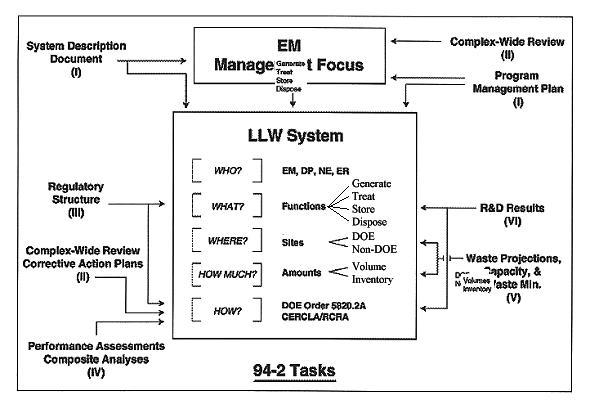
In March 1995, the Department developed an Implementation Plan describing how it would address the Board's recommendation. In May 1996, a revision to the plan was issued. The Recommendation 94-2 Implementation Plan describes activities in six Task Initiatives:
A programmatic diagram of the DOE LLW system and the relationship among these Task initiatives is presented in Fig. 1.
Fig. 1. 94-2 Tasks.
As shown in Fig. 1, the activities in these six task areas work synergistically to address improvements in the low-level waste system. To date, over 30 commitments under DNFSB Recommendation 94-2 have been completed by DOE. The status, accomplishments, and remaining commitments of each of the Task Initiatives are discussed briefly below.
Under the Systems Engineering Task Initiative, the core LLW system infrastructure has been analyzed and defined. A System Requirements Document was prepared which identified existing regulatory and programmatic requirements on the low-level waste system. The System Requirements Document was incorporated into the System Description Document which presented a functional analysis of the DOE low-level waste system and the basic structure for developing low-level waste requirements. Another initiative in this task area was an evaluation of the safety merits and demerits of disposing of waste under the U.S. Nuclear Regulatory Commission/Agreement State regulatory regime as compared to disposal under the DOE Order 5820.2A. The report concluded that either system would likely provide adequate protection of workers, the public, and the environment. The final document generated under this Task Initiative, the LLW Program Management Plan, will integrate all of these analyzes and establish direction for the management of DOE's LLW programs, and will be completed by March 1997.
Under the Complex-Wide Review Task Initiative, a Complex-Wide Review of DOE low-level waste management was completed and reported in May 1996. The review involved assessment of 36 sites to identify potential vulnerabilities that could result in risk to workers, the public, or the environment. Based on the site assessments, site-specific vulnerabilities were identified. By evaluating common themes in the site-specific vulnerabilities, complex-wide vulnerabilities were identified, including: 1)inadequate LLW forecasting and capacity planning; 2) ineffective characterization of LLW; 3) low-level waste that has an identified path forward for disposal but which remains in storage; 4) inadequate storage conditions for low-level waste; 5) LLW in storage for which no technical path forward for disposition has been identified; and 6) performance assessments are unapproved and lack adequate requirements. Many of these findings confirm the initial findings of the DNFSB in issuing Recommendation 94-2. Complex-wide and site-specific corrective action plans have been prepared for each of the identified vulnerabilities, and are currently being implemented.
Under the Regulatory Structure and Process Task Initiative, interim policies, requirements, and guidance for DOE's management of LLW have been developed and issued addressing: 1) responsibilities and processes for preparing, reviewing, and maintaining radiological assessments; 2) preparation of composite analyzes to assess the impacts of interacting source terms that potentially add to the projected dose from a disposal facility; and 3) clarification of methods for complying with DOE Order 5820.2A for corrective actions taken under the Comprehensive Environmental Response, Compensation, and Liability Act (CERCLA) or the Resource Conservation and Recovery Act (RCRA). Remaining activities in this Task Initiative focus on conducting the evaluations and analyzes to support development of low-level waste requirements for inclusion in the revised radioactive waste management Order.
Under the Radiological Assessments Task Initiative, efforts have focused on the development of guidance for conducting radiological assessments, composite analyses, and the preparation of and timely completion of performance assessments. In addition, guidance has been prepared for the format and content, standard review plan, and maintenance of performance assessments. Since the Department received Recommendation 94-2, DOE field organizations have completed two performance assessments and submitted them to Headquarters for review. Headquarters has reviewed and accepted three performance assessments, some of which had been submitted prior to the issuance of Recommendation 94-2. Completion, review, and approval of all the performance assessments for DOE LLW disposal facilities will culminate with the issuance of disposal authorization statements for each approved facility which document the facility operating conditions.
Under the Waste Projections Task Initiative, an initial evaluation of waste projections versus disposal capacity at DOE facilities was prepared. This analysis indicated that on a volume basis, DOE has adequate capacity to accommodate expected waste generation. This analysis will be updated in 1997 to include consideration of the radionuclide inventory of the waste. Evaluations of waste minimization for LLW and MLLW, and guidance for development of waste projections have also been completed.
Under the Research and Development Task Initiative, efforts will commence in March 1997 to identify areas where technical and data needs exist. These include problem areas identified by the DNFSB in Recommendation 94-2 as well as others identified by DOE sites and through the Complex-Wide Review. These needs will be compared to planned and ongoing testing and research activities, then a strategy will be developed for addressing the outstanding needs.
The activities completed to date and remaining to be completed under each Task Initiative are integral to DOE's overall efforts to revise and improve its LLW management system. The findings and developments of these Task Initiatives are being integrated with DOE's efforts to revise DOE Order 5820.2A.
Revision of DOE Order 5820.2A
As noted, the activities being taken under the Regulatory Structure and Process Task Initiative of DOE's plan for implementing DNFSB Recommendation 94-2 are only one part of a larger effort to revise DOE Order 5820.2A. The revised Order, to be designated DOE O435.1, will establish requirements for management of radioactive waste consistent with the Department's Atomic Energy Act responsibilities to provide for radiological protection from DOE operations.
The scope of DOE O 435.1 will include: 1) high-level waste, including closure of high-level waste tank systems and management of associated incidental wastes; 2) transuranic waste, including safe treatment, storage, and characterization/certification to support disposal at the Waste Isolation Pilot Plant; and 3) low-level waste, with attention to disposal and the impacts of interacting source terms on projected public dose.
Four main objectives are key to DOE's efforts to revise DOE Order 5820.2A to: 1) determine the requirements for managing the radioactive waste that are necessary to ensure worker and public safety and environmental protection; 2) develop and issue sufficient requirements, guidance, and standards to assist DOE in complying with those requirements; 3) revise the Order in a timely and efficient manner; and 4) provide a documented, sound technical basis for the requirements and guidance.
In revising the radioactive waste management Order, DOE is drawing on the technical expertise of its Headquarters and Field staff and contractors to assist in the analysis of waste management functions and development of requirements. Four subteams have been formed, one to address each waste type, and one to address the Order's general requirements. The initial starting point for each of these teams efforts to identify and develop radioactive waste requirements has been a systems engineering functional analysis similar to that developed for LLW under DNFSB Recommendation 94-2. This analysis was used to develop a functional map for each waste type, from which further requirements analysis and development could be tiered.
Following the development of functional maps, a qualitative hazards and safety analysis was developed and applied. Through this analysis, scenarios were developed for each waste management function for each waste type to identify events that could result in an exposure to a worker or the public, a release of radioactivity to the environment, or an impact on disposal facility performance. For each scenario, the likelihood and consequences of the exposure or release was estimated qualitatively. This assessment, associated with the function and scenario, lead to the identification of weaknesses in the management of each waste type for which controls, requirements, and mitigating actions would be appropriate.
These results were then used to support analysis of the requirements associated with each identified waste management function under existing EPA and NRC regulations, and other national, international, and industry consensus standards. Where appropriate, applicable requirements will be adopted, referenced, or otherwise used for developing specific DOE radioactive waste management requirements. These requirements will be supplemented, where appropriate, with other administrative requirements deemed necessary for the successful management of the program. For each of the final requirements, a technical basis is being documented which indicates the role of each specific requirement in protecting workers, the public, and environment.
RISK ISSUES AND INITIATIVES
The focus of the 94-2 effort and the radioactive waste management Order revision effort have provided numerous challenges and opportunities to DOE for addressing risk. These opportunities and challenges have operated at several different levels. As sources for understanding the overall scope of risk throughout the DOE complex and its operations, the DOE Risk Report to Congress and the findings of the Complex-Wide Review implemented under DNFSB Recommendation 94-2 have been invaluable. Through these sources, DOE has been able to conceptualize both the breadth and causes of the major risks within DOE's operations at the complex-wide and site-specific managerial levels.
DOE's emerging Integrated Safety Management System (ISMS), which establishes a logical process for integrating risk into all of DOE's activities has provided a uniform and common process for thinking about the problems of risk and developing solutions. In particular, the Integrated Safety Management System dictates a simple but logical process for understanding and mitigating risks. Under the ISMS process, the development of work processes should follow a simple five-step approach: 1) identify the functions that must be performed to complete the work; 2) conduct a safety and hazards analysis of those functions; 3) develop the appropriate mitigating measures and controls based on that analysis; 4) apply the controls and implement a periodic reassessment of the activities, and 5) provide for a feedback to revising the work processes as necessary. As described above, this analytical approach has been incorporated into the heart of DOE's effort to revise the radioactive waste management Order and represents the overall philosophical approach and major steps of this effort.
As noted, the lessons learned, findings, and corrective actions identified by a number of complex-wide and site-specific efforts, including 94-2 and the Complex-Wide Review, have provided key sources of programmatic risk information. However, the level of work performance where waste management tasks are managed and implemented provides the opportunities and challenges for addressing risk. The emphasis of the efforts to develop waste management requirements is on developing and implementing requirements at the level at which the risks are borne by the workers, the public, or the environment. A key aspect of developing more risk-based requirements that can be implemented at the level where the risks exist is the inclusion in the requirements development process of the workers who have to live with those risks and are most familiar with them. As noted, the technical expertise of both Headquarters and Field waste management staff, including radioactive waste management workers, has been a key to the overall efforts to develop the requirements. Throughout this effort, site-specific radioactive waste management workers have drawn upon their site-specific and operation-specific knowledge to augment the requirements development process.
PERFORMANCE APPROACH TO ORDERS AND REQUIREMENTS
One of the other factors which has contributed heavily to the shaping of the efforts to revise DOE's radioactive waste management requirements is the emphasis on performance-based requirements. Through the Department's new directives system there has been a strong movement away from detailed prescriptive requirements toward higher-level and more performance-based requirements. However, the implementation of performance-based requirements requires methods of measurement or demonstration in order to determine effective implementation and/or compliance. Such requirements are difficult to implement if the requirements are not clearly written, complete guidance is not provided, or the technical basis of the requirements is not known or understood. A particular challenge to this effort, therefore, has been to develop not only the appropriate level of performance-based requirements, but to also develop the appropriate level of associated guidance and technical basis. Notably, these key elements of an effective performance-based requirements system have also been some of the key areas of failure with DOE's past requirements, especially with regard to DOE's radioactive waste management requirements.
When both the goals of performance-based and risk-based requirements are considered, an approach is necessary which if developed and used properly would provide the avenue for implementing such requirements effectively. One method of achieving this balance and allowing for a graded approach in the application of the requirements is to implement the requirements at the site level through the development of operation-specific authorization basis documentation. Under the concept of authorization basis documentation, each site-specific waste management operation would develop its own vehicle for demonstrating methods of compliance, documenting implementation level procedures and requirements, and providing the baseline for measurement of performance. The authorization basis is developed based on site-specific conditions and the particular risks and performance needs of the wastes being managed at that site, and would be approved by the cognizant DOE manager.
An example of such authorization basis documentation is the process that DOE currently uses for developing Safety Analysis Reports (SARs) and authorizing facilities to operate. Under this approach, each operation or facility is required to analyze and understand the key hazards of their own facility's operations and processes, describe them, develop and describe the controls to mitigate these activities and the technical basis for such, and provide an overall framework for the operation of the facility. When authorized, the facility then operates to the procedures and operational envelope identified in the authorization basis documentation. Events or occurrences which deviate from the authorization basis trigger re-evaluation and develop of additional work process and requirements as necessary.
As previously noted, there has also been a movement within the Department to push more decision making and implementation control to the Field Office levels. The concept of authorization basis as applied to waste management operations helps further move decision making to the Field Office level and achieve this goal. In so doing, however, there are several key issues to be addressed. For such an approach to be implemented effectively at the Field Office level, as noted, the appropriate guidance and technical bases must be developed. Additional controls may also be necessary to provide the assurances that such operations are being effectively managed. One of the must problematic issues, however, will be to ensure that stakeholder and public involvement can be provided to the development of such processes and that the appropriate level of assurance can be provide that such a performance-based system will be protective of the workers, public, and environment.
STAKEHOLDER ISSUES AND OPPORTUNITIES
Since four years ago when DOE embarked on its aggressive efforts to engage the public and be more open about its operations, activities, and decision making, many things have occurred. Site-specific advisories boards and citizens advisory boards are now the rule, not the exception. Meetings occur regularly among DOE decision makers, stakeholders, governors, and regulators from across the DOE complex to discuss decision making before it has occurred. Public and Stakeholder involvement in DOE planning is now a responsibility of all employees, not a function implemented by a staff office or support organization. The change in DOE's attitude toward and approaches for stakeholder involvement over the past four years has also provided a number of interesting challenges and opportunities for the revision of DOE's radioactive waste management Order. An assumption was made early in the Order revision process that a draft of the Order would be made available for public and stakeholder review and comment. It is expected that the draft revised Order will also be discussed among focused groups such as Citizen Advisory Boards (CABs), State regulators, and Governors' representatives though the National Governors' Association and other avenues.
In addressing the lessons-learned and messages received from the past four years efforts at stakeholder and public involvement, especially from implementation of the Federal Facility Compliance Act, a number of specific issues have been raised regarding DOE's radioactive waste management requirements. Typically, the issues of greatest concern to stakeholders and the public regarding DOE waste management operations have included: 1) who controls what waste comes on site; 2) how are treatment and disposal decisions made; 3) who determines what levels of treatment and disposal control are considered safe; and 4) how can the public and stakeholders be provided more direct roles in affecting these processes at the site- and operation-specific level. How DOE addresses these issues could result in departures from DOE's past positions concerning stakeholder and public involvement and the role of state regulators in overseeing DOE waste management operations. Currently, consideration is being given throughout the efforts to revise the radioactive waste management Order as to how to address these concerns. As noted, it is also expected that the draft Order will be discussed extensively with the public and stakeholders.
Radioactive waste management, especially regarding LLW, remains one of the bastions of the DOE's self-regulatory authorities in implementing its responsibilities under the Atomic Energy Act of 1954. However there have been a number of recent efforts to transition the DOE to external regulation. As such, a key issue with the stakeholders and public has been the level to which or ability of their own elected state and local officials to have oversight authority over DOE waste management operations. While discussions in these areas are still ongoing, one concept the DOE has discussed has been the potential role of State regulators, either through existing regulatory agencies (NRC, EPA) or directly, in taking on more oversight and regulatory authorities over DOE's site-specific waste management activities. As such, consideration is being given in the revision of DOE's radioactive waste management Order how such provisions could be implemented. While any final concerning these issues would be premature, it is evident that the current impetus for increased stakeholder and public involvement will indeed also leave its mark on DOE's revised radioactive waste management Order.
CONCLUSIONS
The Department has been working over the last two years to make changes in its radioactive waste management system and requirements. However, the forces that are shaping these efforts -- risk, performance, and stakeholder involvement -- have been building and shaping DOE for many years. In the past four years, these forces have converged to provide the necessary impetus for DOE to overcome many of the past inherent programmatic problems with its management of the radioactive waste. Both the implementation of DNFSB Recommendation 94-2 and revision of DOE Order 5820.2A have been successful due to the involvement and support of the appropriate technical staff from Headquarters and the Field. As such, these efforts can truly be called team efforts. This cooperation has resulted in verifiable improvements in the management of DOE's programs. The increased management focus on these programs has contributed greatly to the resolve of DOE to grapple with these problems, and it can truly be said that Field organizations will own these processes when they are completed. Most importantly, however, the concerted effort of these teams in developing the revised Order and associated documentation will yield an extremely valuable product for DOE. Based on this work, DOE will be able to assure stakeholders that it has a set of requirements that protect worker and public health and safety, and the environment. Implementation of these requirements will be facilitated by the availability of guidance and by the involvement of field personnel in the process of developing the requirements and guidance. And finally, DOE's assurances of protection will be backed by documentation of a technically sound process of development.
REFERENCES