Patrice Bubar, Eugene Schmitt, and Douglas Tonkay
U.S.
Department of Energy
Washington DC 20585
ABSTRACT
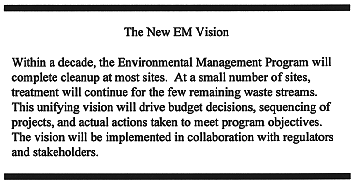
The Environmental Management (EM) Program has developed a Ten-Year Plan based on a vision that cleanup at most sites can be achieved in a decade, with some remaining waste streams (primarily high-level waste and transuranic waste) at a few sites. The Plan sets forth specific time tables and costs, restructuring most work in projects that contribute directly to achieving the cleanup of the site to the desired end state. The Plan builds on previous strategic planning, such as the Baseline Environmental Management Report, taking advantage of breakthrough opportunities to achieve the vision.
The new vision and Ten-Year Plan are guiding strategic thinking and decision making. The Plan will serve as a baseline to monitor progress throughout the next decade. Each EM site is currently developing a Ten-Year Plan, which collectively will make up the EM Ten-Year Plan. The EM Ten-Year Plan will provide a cross-cutting program view.
This paper discusses the origin and evolution of the Ten-Year Plan initiative from a Headquarters perspective. Next steps include further implementation of the integrated strategic planning, budgeting, and management system of which the Plan is a cornerstone. The Plan will be revised annually to reflect future budget and scope changes.
THE NEW EM VISION
EM Ten-Year Plan is part of a new Integrated Strategic Planning, Budgeting and Management System (ISPBMS) currently being implemented. The Ten-Year Plan is guided by a vision that involves accelerating cleanup at DOE sites and completing cleanup at most sites within the next ten years. This paper describes the origin and principles behind the initiative and seeks to address the evolution of the Ten-Year planning process from a Headquarters perspective. A complementary paper in this session will provide insight into the Field Office experience.
Strategic planning has been a fundamental and evolving aspect of the EM program since its inception in 1989. The publication of the January 1995 report, Closing the Circle on the Splitting of the Atom provided an understanding for the depth of the EM mission. With the 1995 and 1996 Baseline Environmental Management Reports, EM focused on determining the cost and scope of the Program over a 70-year period. With the Ten-Year Plan initiative, EM is focusing on achieving results in a manageable time frame, using innovative approaches to accelerate cleanup.
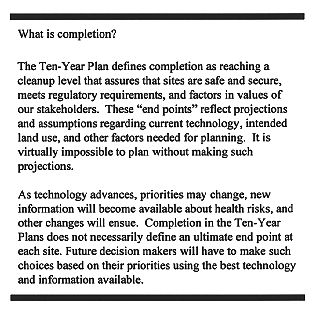
In early June 1996, Assistant Secretary Alm requested all sites with EM activities to develop a Ten-Year Plan to meet the objectives of the new EM vision. The purpose of the plans is to sequence projects or activities to complete clean-up at most nuclear sites in a decade as well as identify those activities that will continue beyond the ten-year period. Examples of continuing activities include long-term groundwater pump and treat operations, high-level waste treatment, and transuranic waste disposal. Work is organized into projects with discrete scopes of work, having beginning and end dates leading toward achievement of the site end state.
Principles of the Ten-Year Plan
The Ten-Year Plan will integrate EM strategic planning, budgeting and management. The Plan reflects strategic decisions which form the basis for requesting appropriations through the Congressional budget process. In addition to guiding budget development, the Ten-Year Plan data forms the basis for annual commitments between the field and headquarters staff as well as the management tracking system for work performed.
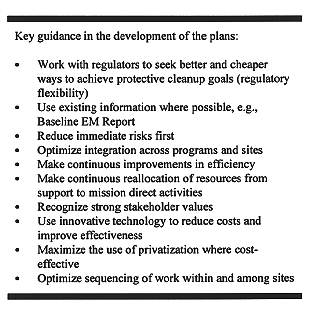
The Ten-Year Plan, when complete, will consist of the "EM Ten-Year Plan," supported by individual site ten-year plans containing detailed project data. The site plans are being developed entirely by the field. The field is challenged to use "break-through thinking" to perform and complete work more efficiently - to do more with less. Strategies are being developed which accelerate mission accomplishment, reduce support and other non-value added costs, and sequence projects to reduce risks and long-term cost liability or "mortgage".
Evolution of the Planning Process
The role of HQ in the Ten-Year Plan initiative is to: provide leadership and direction, foster communications, provide systems support, and integrate site plans into an EM Ten-Year Plan.
Eleven initial draft plans covering about 400 projects are being proposed for the Ten-Year Plan. Portions of the plans are available for review on the EM Internet site (http:\\ www.em.doe.gov). The draft plans prepared by the field were reviewed, and a team of senior HQ managers, including the Assistant Secretary for Environmental Management, met with site managers to discuss the plans and incorporation of additional opportunities. Meetings with stakeholders and regulators were also held to elicit their views on the plan and address concerns of new site-specific assumptions.
As the Ten-Year Plan initiative has progressed, Headquarters has adapted the planning process significantly in order to be responsive to stakeholder concerns. The management approach and organizational structure of the HQ planning team has also evolved in response to various line management concerns over optimal use of EM HQ personnel and cross-program integration concerns.
Revisions to the Ten-Year planning process schedule have allowed more opportunity for stakeholder input. This input occurs at the site level, between site managers and their Site-Specific Advisory Boards, as well as at the Headquarters national level through the EM Advisory Board and other forums, such as the National Governors' Association. In order to improve the opportunities for stakeholder involvement, EM formed a Stakeholder Team to work with EM stakeholders. The path forward strengthens stakeholder involvement. The opportunity exists to separate those issues that can be addressed at field sites with the collaboration of local stakeholders from those that present intersite or national policy issues for broader participation. Field offices will work with their Site-Specific Advisory Boards, stakeholders, and the public to ensure that all interested parties are informed and have a chance to participate in the decision making process. Many issues can be resolved within the time period for development of the initial Ten-Year Plan. Issues that cannot be resolved will be addressed in action plans that present a timeframe and steps to resolution.
Path Forward
The completion of the initial Ten-Year Plan will be integrated with the EM FY 1999 budget formulation process. Field and headquarters staff are continuing to work the issues and opportunities raised during the review of the draft plans by DOE and the stakeholders. The Ten-Year Plan will be based on those decisions that have formally been made by DOE and accepted by stakeholders. When decisions have yet to be made, action plans will be prepared, working with stakeholders in local and national forums. As future decisions are made, site Ten-Year Plans will be updated accordingly. The Ten-Year Plan is intended to be a living document, updated annually to factor in decisions reached on outstanding issues and other changes that occur over the planning period.
National issues dealing with transfer of wastes and materials between sites and cleanup levels will take time to determine whether and how to precede. A systematic effort to examine opportunities across the complex is now underway. Results of this effort are being screened for inclusion into the process for discussion of national issues.
The current schedule for completing the initial Ten-Year Plan is September 31, 1997. Field organizations are currently working with their stakeholders to develop project data sheets describing the projects. The process will include revised draft site Ten-Year Plans and a draft EM Ten-Year Plan in March 1997. Also included will be a public review of the draft Plans and further opportunity for stakeholder involvement as part of the FY 1999 budget formulation process.
As mentioned earlier, the Ten-Year Plan is part of the initial implementation of the EM ISPBMS. The streamlined business approach is being implemented over time to allow efficient transition of current business. Next steps will include modifying current project management tracking and budgeting systems consistent with ISPBMS requirements.
The EM organization is looking forward to having a Ten-Year Plan that will establish firm commitments for making substantial cleanup progress over the next ten years. We are looking ahead to maintaining a strong working relationship with stakeholders, regulators, and Tribal Nations, as we continue to reduce risks associated with our current and former nuclear weapons production sites.