 (1)
(1)
Nick Abate, Geoff Courtin, Michelle Wright, Christy Anderson,
Richard Mead, Terese Gabocy, Mark Bailey, John Bier, Sherisse Smelser, Brenda
Thomas
MWB CONSULTING
University of New Mexico
Albuquerque, NM
ABSTRACT
A radioactive waste unit ( e.g. seepage basin) has vegetation growing in the sediments and in the immediate area of the designated waste unit. The vegetation at this site has absorbed radioactive cesium and strontium. The purpose of this report is to present the MWB Consulting design team's solution with supporting discussions regarding the proposed removal and subsequent remediation of the vegetation at this site.
To defoliate the area efficiently and effectively, a selective harvesting procedure is employed. The thrust of MWB Consulting team's design is to treat the in situ contamination by a continuous replenishment plan that ensures the ongoing integrity of the environment and ecosystems, and minimize the exposure to the workers and the general public.
Strontium and cesium are removed by a combination of physical processes dominated by pressurization and ion exchange. A slurry of wood pulp and vegetation is fed to a three-stage counter-current decantation station comprised of mixing tanks and decanter centrifuges. The final wood product is 20% water by weight and is clean enough to be processed at a municipal landfill or be used as mulch. The water by-product of the process contains 99.99% of the radionuclides in solution. This stream will be acidified with nitric acid and will run through an ion exchange column. An ion exchange process was selected to remove cesium and strontium from the liquid effluent because of the high removal efficiency and waste reduction opportunity. The stream exiting the last ion exchange column contains a high amount of organic material. In order to reuse the water, this stream is evaporated to leave an ionic resin and the water is recycled.
Re-planting and harvesting will occur until the radiation in the vegetation reaches the safe limit of 1.37 mrem/day (or 500 mrem per year.) The remedial action for the existing 40,000 cubic yards will take approximately 7.5 years based on a continuous process running 24 hours per day with a projected up-time of 240 days per year. A structure for the processing plant will be built 200 feet from the containment area allowing for safe and easy transport of the contaminated material.
Costs associated with this design solution are approximately $29.2 million. Radiation dose rates from the vegetation are estimated to be 40-60 mrem/hr. Exposures will be reduced by remote handling, shielding, administrative procedures and protective and monitoring equipment applying any and all ALARA principles. Community relations policies will be based on the view that the contamination is in a forest. MWB Consulting has identified sectors of the public most likely to be affected by the remedial action and has tried to predict their responses in making further community relations decisions.
BACKGROUND
It has been discovered that contamination from a seepage basin containing the radio-isotopes 137Cs and 89,90Sr has leached into the surrounding environment. Analysis of local vegetation shows that it is now contaminated at levels of 10-310 pCi/g from Cs and 1,630-120,600 pCi/g from Sr in the trees and 6,750-8,190 pCi/g from Cs and 2,430-25,240 pCi/g from Sr in the grass and bushes.(1) These levels have an associated disintegration level of 20,000-40,000 dpm beta/gamma and a dose rate of 40-60 mrem/hr1. The purpose of this report is to present a design solution with supporting discussions regarding the proposed removal and subsequent remediation of the vegetation. Note that it is assumed the waste site is now inactive and fresh wastes are not being added to it.
PROCESS DESIGN
Theory of Approach
Due to the large volume of living waste, the treatment process will be on-going until the contamination is reduced to background levels. Strontium and cesium cations resemble calcium, magnesium, sodium, and potassium ions and pass into live cells by active transport. Once a plant dies, ion transport no longer works. The radioisotopes must be released from the cell by breaking the cell walls. To remove the radioisotopes effectively, the cesium and strontium must be completely in solution. The theory of MWB Consulting is to treat the in situ contamination by a selective harvesting and continuous replenishment plan that ensures the ongoing integrity of the environment and ecosystems and maintains the soil integrity. This plan also minimizes the exposure to workers and the public from uncovered and redistributed radionuclides.
Forest Management
A ten foot fence will be constructed around the seepage pit to prevent undesired intrusion and delineate the radioactive area. A second fence, built 200 feet outward from the first fence, will mark the buffer zone. To defoliate the area effectively, a selective harvesting procedure is employed. Initially, the outlying pines, grasses, and shrubs are harvested and treated. At the same time, the deeper-rooted hardwoods are injected with a 1:1 mixture of Tordon 101 and glyphosate. Empirical data indicates that this mixture will kill the hardwood trees within a two-year period facilitating the removal of the deeper-rooted trees.(2) After harvesting, replanting of fresh pines and a more resilient grass species such as brassica and mustard plants will prevent soil erosion. It will also contain the radionuclide in the soils, reducing exposure to personnel and the public. The replanted species will maintain the forest in its original grass-herbaceous stage. Harvested vegetation (eventually including replanted material) will be loaded onto a cart and carried to the process facility, which is located on the edge of the buffer zone. The trees are removed by pulling the entire plant from the ground using a crane equipped with a contained cabin. A bulldozer then removes the bushes and a mower clears away contaminated grasses. Water is sprayed on the soil before any disruption. The trees will be cut to 6-inch-diameter size by workers with chainsaws. The plant matter is chipped to one-inch pieces and the processed vegetation is transported by conveyer to the hopper in the contaminant removal building.
Radionuclide Removal Scheme
Strontium and cesium are removed through a combination of physical processes dominated by pressurization and ion exchange. The chipped wood is fed into an autoclave at the rate of 1000 lb/hr and water is added at the rate of 250 lb/hr. The radionuclides are stored within the cells of the plants, so 200°C and 750 psig are applied to ensure complete lysing of the cell walls, thus releasing the components of interest. A maximum of 1% by weight of nitric acid and 0.5% by weight of hydrogen peroxide are added to enhance the process efficiency. The autoclave relief valve will vent to a scrubber.
The wood slurry is fed to a three-stage counter-current washing decantation train comprised of mixing tanks and decanter centrifuges. The solubilities of the ions present in the system were modeled using code called PHREEQE at total ion concentrations ranging from 4,000 mg/L to 40,000 mg/L. The cesium and strontium were dissolved and the precipitates formed were mainly sulphates and phosphates of calcium and magnesium. Based on this simulation, the clean water flow for this cake-washing process is 600 lb/hr. The final wood product is 20% water by weight and the radioactivity is low enough for municipal disposal and may be used for mulch. The water product contains 99.99% of the radionuclides in solution at parts-per-thousand levels and will be further processed.
Ion exchange process
Cesium removal - A hexacyanoferrate-based ion exchanger was chosen to remove cesium because it is highly selective of cesium over a wide pH range (2 to 12) in the presence of high concentrations of competitive ions such and Na+ and K+3 The ion exchange matrix selected is potassium cobalt hexacyanoferrate attached to a polystyrene iminodiacetic acid chelating resin. Studies on cesium removal from nuclear waste indicate this ion exchanger is superior to any other cesium-specific ion exchange medium presently known.(3) The process works by exchanging the potassium ions with cesium ions according to the following equation:
(1)
The ion exchange resin may then be washed with a strong acid to remove the cesium.
Strontium removal - A strontium-specific ion exchange resin has been developed using a crown ether.(4) The crown ether is a cyclic organic molecule which binds strontium because of the similarity between strontium's atomic radius and the diameter of the cyclic crown ether. The crown ether used is 4,4'(5')-bis(tert-butylcyclohexano)-18- crown-6 (DtBuCH18C6) sorbed onto a base resin. The extraction is based on the following equilibrium equation:
 (2)
(2)
The nitrate ion is normally provided by nitric acid, but sufficient nitrate ions are formed by the high temperature and pressure decomposition of the organic plant matter. This crown ether has been found to be effective for removal of strontium in acidic solutions unlike previously-used crown ethers which are only effective for strontium removal in basic and neutral solutions (pH 2.5 to 7).(4) The column is then washed with 3 M nitric acid to remove the adsorbed strontium.
Final Steps
The strontium and cesium solutions from washing the ion exchange columns are allowed to naturally evaporate to near-dryness. The total strontium and cesium in the 40,000 cubic yards of material is 18.4 g and 0.07 g, respectively. This material can be sealed in cement in a 55 gallon drum and sent in one shipment.
The stream exiting the last ion exchange column contains a high amount of organic material. In order to reuse the water, this stream will be evaporated leaving an ionic resin and the water will be recycled to either heat the autoclave or to wash the processed wood.
A layout of the full-scale operation is shown in Fig. 1. The wall between the process and the general use rooms consists of lead for maximum radiation protection and each room contains monitoring equipment. The layout presents a general idea of where equipment and needed rooms are should be placed.
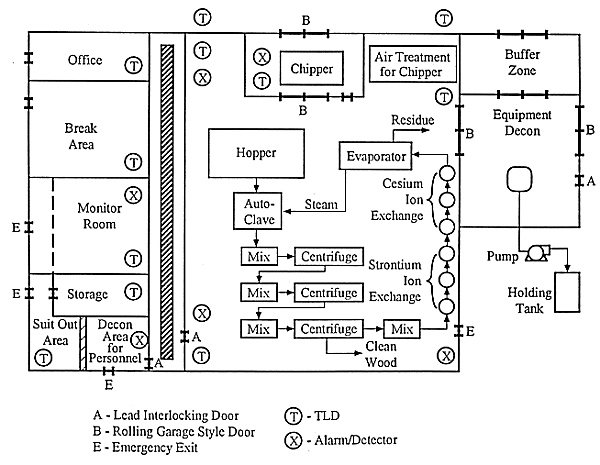
Fig. 1. Layout of the
Processing Building
Assumptions
The assumption has been made that the seepage pit will remain in place and that this process is not a precursor for further remediation, based upon the relatively short half life of the elements involved. In short, the vegetation will be used to contain the radionuclides, drawing the substances gradually and safely from the ground for processing. This assumption is within recent ecological and environmental regulatory requirements for ecological preservation. It is the supposition of this team that this method presents a natural, cost effective alternative to high impact, high volume methods.
The water content of the trees is assumed to be 32% by weight. White pine is the representative pine wood and hickory the representative hardwood. Hickory was chosen for the model hardwood density because it has the highest density of the empirical data used for calculations.(5,6) The process is designed to manage the highest expected concentration of the radionuclides in the plants. Generic plant matter constitutions were assumed to determine ion compositions in the vegetation.(7)
Alternatives
Alternative methods to handle the contamination problem at the site were considered. First of these was no action. This approach was rejected because of the persistent high risk presented to the public and wildlife from possible exposure to radiation spread by environmental, meteorological, and hydrological processes. Thermal oxidation (incineration) of the plant matter was also considered, but was determined unfeasible due to community concern.
Another approach to this project would be to raze the entire seepage pit, store the material and treat it at 100 tons/day. This would take one year, but the potential for accidental release would be greatly increased and the ecosystem would be ruined. The long-term approach treats the problem without this undesired side effect.
METHODS FOR TESTING OF UNIT OPERATIONS/PROCESSES
Methods of Exploring Cell-lysing Alternatives
The initial concern in freeing the radionuclides from the plant matter is lysing of the cell walls. To address this issue, a variety of chemical and physical methods were explored. Samples of uncontaminated pine shavings were subjected to three different treatments. The first experiment was treatment with sulfuric acid at concentrations of 20, 40, 60, and 80 percent by volume. One physical method used was thermal oxidation where sufficient oxygen was supplied in a controlled vessel with an ignition source. A third experiment was to apply pressure to a heated sample in a rocking bomb reactor. The shavings from each of these experiments were examined under a microscope.
Method of Sample Preparation
Strontium and cesium chloride salts were used to prepare a contaminated wood shaving sample. The sample was prepared by dissolving 0.0570 g CsCl and 0.1258 g SrCl2*6H2O in DI water and adding the mixture to 0.100 Kg of pine wood shavings. Deionized water was added until the shavings were completely covered and the mixture was boiled gently for one hour. The shavings were then completely dried. Final contamination concentrations were calculated to be 450 mg Cs/Kg and 413 mg Sr/Kg.
Methods for Testing Bomb Reactor
Small samples of contaminated wood shavings were placed in the bomb reactor. The bomb was first heated to the desired temperature (optimum range: 150-250°C) and pressurized to 750 psig. The reactor was left in this state for one hour and then cooled. Experiments were performed to optimize the water, acid and hydrogen peroxide needed to enhance the reaction.
Methods for Testing Other Unit Operations
Tests were done to determine the type of washing process to be used. A sample of effluent from the bomb reactor was washed and centrifuged three times. A similar sample was washed and filtered using vacuum. The wash water was tested using atomic adsorption to determine the amount of cesium and strontium was left in the wood.
Ion chromatography and atomic adsorption were performed on wash water which was evaporated and condensed. This evaluation was performed to justify water recycling. If the water contained high salt content and cesium or strontium, it would have to be disposed of rather than reused.
RESULTS OF TECHNICAL ASSESSMENT
Physical and Chemical treatments
The acid treatment was effective only at 80% sulfuric acid. The 20% solution had no change, the 40% solution had broken cell walls, but only a few, and the 60% solution was effective but did not completely lyse the cell walls. The 80% solution decomposed the wood completely. Thermal oxidation also thoroughly destroyed the wood structure. The temperature/pressure approach broke most of the cell walls, leaving a pulp and a yellow liquid, and was studied further.
Bomb Reactor Experimental Results
After seven experiments, the pulp was collected and placed on slides for microscope viewing. The cell structure was destroyed in all seven experiments. A small amount of acid and hydrogen peroxide seemed to enhance the process, but the advantage did not increase with increasing amounts of chemicals added. The amount of nitric acid and hydrogen peroxide added for the full-scale design was determined to be 1% and 0.5% by weight, respectively.
Discussion
Thermal oxidation was ruled out because of the unknown effects on the environment due to off-gases and to public concern. One hundred people on campus were asked what they thought of incineration and 84% were unfavorable.
Atomic adsorption results showed that 99.99% of the cesium and strontium were removed from the wood using either washing process. Centrifugal decantation was chosen for the lower percent of water left in the wood pulp. Strontium and cesium were not detectable in the condensed wash water. Nitrates and sulfates were well below average drinking water standards. Reuse of the water was deemed feasible.
Ion exchange efficiencies were found in the literature.(3,4) The resins must be prepared, but only a small amount is needed for the full-scale operation. Evaporation was considered as an alternative to ion exchange. This process would result in 512 tons of waste from the 40,000 cubic feet of vegetation. MWB Consulting felt that ion exchange is economically feasible in that it greatly reduces the amount of waste to be shipped to a radioactive material disposal site and the overall cost of the implementation was small.
CONSTRUCTION DETAILS OF PROTOTYPE
The prototype is a bench-scale process that demonstrates the full-scale design. The unit operations are represented closely for the chipper, the autoclave, and the evaporator. Minor modifications were made to the counter-current washing process and the ion exchange. The expected products from the prototype demonstration are clean, pulverized wood, salt residue from the evaporator, and a clean water stream.
The first step in the process is particle size reduction. This will be represented by a mini-leaf mulcher which accepts branches up to 2 inches in diameter and debris8. The shredded vegetation product is then treated with pressure and temperature.
A 1940's model rocking bomb reactor was refurbished by the team. A schematic is shown in Fig. 2. The reactor is capable of handling pressures to 6000 psig and temperatures to 350°C.(9) The pressure is provided by compressed nitrogen. A heating coil is wrapped around the bomb casing and was modified for variant-control. The bomb is rocked by a 1/6 hp motor at a rate of 36 undulations per minute. The expected operating range for the demonstration is 700 to 1000 psig. The reactor pressure is automatically relieved if it reaches 2000 psig through a spring-loaded valve and is manually controlled through a ball valve. The outlets of these two valves is directed to a scrubber.
The scrubber consists of a 2 ft high stainless steel column with a diffuser plate on the bottom. The column will be filled with glass beads to increase contact time and will contain a buffering solution of sodium bicarbonate. This will stabilize the pH and trap dangerous off-gases such as hydrogen sulfide and nitrates and sulfates.
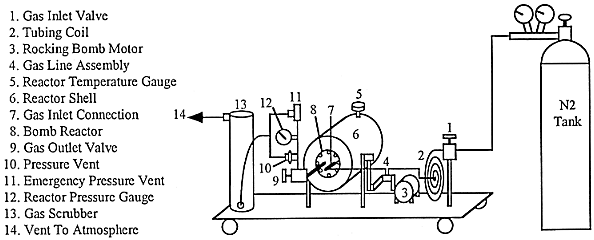
Fig. 2. The
Experimental System
The washing train is represented by three filtering flasks equipped with Buchener funnels. The solid will be washed with a slightly acidic deionized water solution for the first two washes and with deionized water the third wash, and will be dried in a toaster oven.
The wash water will be run through ion exchange columns containing strontium and cesium specific exchangers. Due to money constraints, the resins suggested for the full-scale design may not be obtainable. Once the strontium and cesium are removed, the water is distilled by evaporating in an Erlenmeyer flask on a hot-plate. The vapor is directed to a condenser, which will be cooled with water, and will be ready for re-use in the process.
ECONOMIC ASSESSMENT AND BUSINESS PLAN CONSIDERATIONS
Business Plan Considerations
The remedial action for the existing 40,000 yd3 of contaminated material will take 7.5 years based on a continuous process running 24 hours per day, 240 days per year. The up-time of 240 days is chosen based upon expected levels of process down-time for repairs, holidays, etc. The new growth will be treated until contamination reaches background levels. The process will be enclosed inside a concrete structure. Decontamination, maintenance, and harvesting will be the only times of high contact, the system will be operated remotely to ensure lower doses.
Operating Costs
The yearly operating cost is 2.6 million dollars. This accounts for 11 operation laborers (2 per shift), 3 radiation technicians, a health physicist to do dose calculations, and a supervisor. All workers are paid salary for full-time work. A 20% contingency allowance is also included in the operating cost estimate. Transportation costs of the radioactive waste is included in the contingency. Utilities are estimated to cost $55,000 per year as a maximum estimate based on the electricity needs of the equipment, water for the process, gasoline for the field equipment, etc.
Capital Expenditures
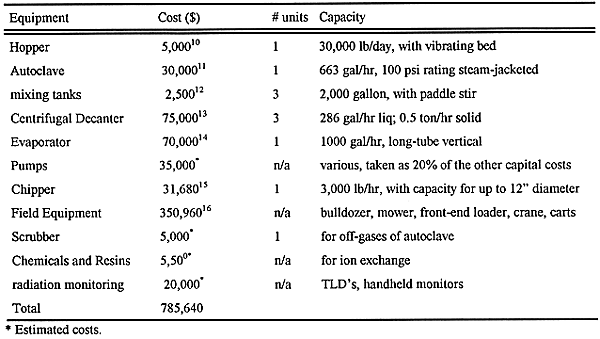
Capital costs associated with equipment needed for the process are outlined in Table I. The indirect costs such as contingency, freight, piping, electrical and process controls, and installation are figured by percentage of the capital cost as outlined in the 1996 AIChE Design Competition guidelines, and represent 365% of the equipment cost. Pumps were estimated to be 20% of the cost of the equipment cost. The total capital expenditure including direct and indirect costs, then is $9,407,634. This includes construction, contracting fees, installation of piping, electrical and controls, buildings, fencing, engineering design, supervision and a 10% contingency.
TABLE I Capital Costs
Summary of Treatment Costs
The total cost is $29.2 million to treat the 40,000 cubic yards over a period of 7.5 years. This consists of $9.4 million for capital expenditure and $2.6 million per year operating costs and is reported in March 1995 dollars. Upon termination of the project, the equipment will be decontaminated and sold. Because of the undetermined time scale, the resale value of the equipment is not known.
LEGAL, HEALTH, AND REGULATORY CONSIDERATIONS
Radiation Health Considerations
Radiation dose rates from the vegetation are estimated to be 40-60 mrem/hr1. Exposures will be minimized by remote handling, shielding, administrative procedures, and use of protective and monitoring equipment applying any and all ALARA principles. The International Commission on Radiological Protection (ICRP) recommends a dose limit 100 mrem for the general public and a worker dose limit of 5 rem for workers.(17,18)
Equipment and Building Safety Design
Measures will be taken in the construction of the facility for personnel monitoring, decontamination processes, remote procedures, and disposal and handling of radioactive material in order to provide maximum protection to the workers and the public. Personnel will be located in a restricted area, and the processing room will be constructed with a maze style exit. The outer wall of the facility will be 2 feet of concrete. Workers will be isolated from the process by a double row of cement walls with 1/8" lead plate shielding within the cement layers. Operations will be monitored by camera. Personnel who need to enter the chipper room will enter the area through a single, monitored entrance when necessary. Ventilation to this room will be monitored, filtered, and pumped in from on-site, with a secondary off-site air flow that can be used for decontamination. Exhausted air will be HEPA filtered and monitored for radionuclide content.
Radiation detectors with preset alarms will be located at various stages of the production (e.g., monitoring room, chipper room, and at entrance for the wood). The ventilation system will be equipped with monitors to assure the air quality is acceptable for workers inside the facility. The monitoring room and beyond will be considered a clean area.
Personnel protection and monitoring measures will include hand and foot monitors located at entrances and exits, protective gear, and personal Thermoluminescent Detector (TLD) badges. These badges will also be located at various areas of the complex to monitor ambient exposure. Doses to the workers and public will be assessed quarterly. Decontamination procedures for personnel will be conducted whenever they exit the facility.
Field equipment will be decontaminated at the end of each working day. Process equipment will be decontaminated when maintenance is needed. Samples of decontamination water and equipment swipes will be collected and monitored. Standard sampling of local air, flora, fauna, and water samples will be made (approximately bi-weekly) to ensure protection of the environment. Environmental sampling, personnel monitoring, equipment and facility sampling will prevent or at least minimize contamination.
Legal and Regulatory Considerations
In order to remediate the contaminated area, MWB Consulting Firm must comply with federal, state and local laws and regulations. The primary federal regulations include the Federal Facilities Compliance Act (FFCA), the National Environmental Policy Act (NEPA), the National Pollutant Discharge Elimination System (NPDES), and the Resource Conservation and Recovery Act (RCRA). The principal state and local regulations include the New Mexico Hazardous Waste Management Regulation (NMHWR) and Land Disposal Restrictions (LDR). Governing regulatory agencies are the Environmental Protection Agency (EPA), the Department of Transportation (DOT), the Department of Energy (DOE), the Office of Safety and Health Admission (OSHA), and any applicable state and local regulatory bodies, such as the New Mexico Environment Department.
MWB Consulting Firm must submit a Proposed Site Treatment Plan according to FFCA. This act also requires MWB Consulting Firm to submit reports to the EPA for approval. If the autoclave has any discharges, MWB Consulting Firm must obtain an Industrial Discharge Permit from the Las Cruces Publicly Owned Treatment Works (POTW). The release of NO2 must be reduced by 65% and SO2 by 90%.(19) 40 CFR, 264 covers all requirements for monitoring, closure and post-closure standards, storage, disposal quantity at each location and all record and reports needed for operation facilities for treatment and disposal of hazardous waste. MWB Consulting will also need to comply with all Land Disposal Restrictions under 40 CFR 268, which applies to general treatment standards for land disposal sites.(20) Procedures for the disposal of radioactive waste are regulated by various EPA, DOT, and DOE guidelines and regulations. The municipally disposable waste will have an activity of less than 2E-9 Curies/L This is in accordance with DOT and EPA regulations. Disposal of hazardous waste will follow the guideline in 49 CFR ,100-199.
Safety Regulations and Considerations
The MWB Consulting Firm will comply with OSHA regulations. Various procedures (i.e., the Workers Right to Know and personal protective equipment) are established under these regulations. OSHA regulations provide standards for medical records, working surfaces, environmental control, first aid, radiation, personal protective equipment, material handling, and hazardous material.(21) Construction safety procedures are regulated by 29 CFR 1926. In compliance with the workers' Right to Know, Material Safety Data Sheets (MSDS) and training will be provided. The personnel will be issued and be required to wear appropriate protective equipment according to OSHA and EPA regulations 29 CFR 1920 and 40 CFR 300. There will be radiation technicians on site to advise and monitor the proper handling of radioactive material20.
The MWB Consulting Firm also needs to ensure that the total dose to each employee receives is As Low As Reasonably Achievable (ALARA) as stated in 10 CFR 20.1201(a1) and 10 CFR 835. There will be a radiation program to ensure that the exposed and potentially exposed individual meet these requirements.
PLAN TO ESTABLISH COMMUNITY RELATIONS
Community relations policies will be based on the assumption that the contamination and exposure comes solely from the radioactivity in the forest. This assumption is based on the vegetation distribution. The MWB Consulting Firm has identified sectors of the public most likely to be affected by the remedial action and has tried to predict their responses in making further community relations decisions. The sectors expected to be most affected are rural citizens, forest workers, environmentalists, and recreational outdoors-people. Media contacts are essential; communication networks will be established through the news media and direct discussion with community groups.(22) Door-to door visits with rural neighbors is effective as well. Remedial action plans and environmental impact are the main concerns of the public with the price being a minor concern. By informing the public and holding public information meetings which will include visual explanations, questions within sensitive issues can be dealt with and resolved.(22) The MWB Consulting Firm will identify reliable sources of information and expertise to answer questions. A citizen's task force will be set up. Compliance with laws and regulations along with proper training and operating procedures will be demonstrated to the public and to regulation enforcers.
CONCLUSIONS
The MWB Consulting design team has established an ecologically-friendly and environmentally-safe design solution for a problem which, if left unattended, could be disastrous to eco-environmental systems in the area of the seepage basin. Costs are high, but the design solution is effective and results in almost total remediation of the contaminated area over a period of several years, leaving the forest intact. The MWB Consulting design team looks to the opportunity to further demonstrate their unique solution.
REFERENCES