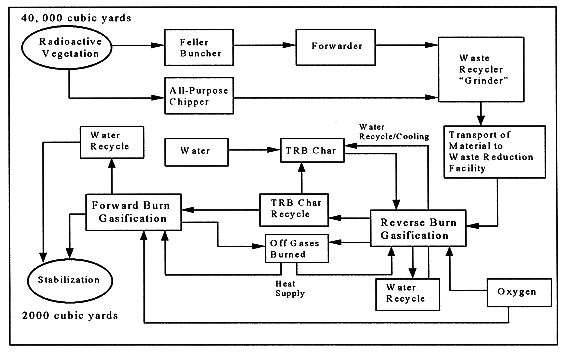
Fig. 1: Overall
process design.
Christopher Doten
Jennifer Meehan
Dr. Ron Crawford
Dr. Wudneh Admassu*
*Department of Chemical Engineering
University of
Idaho
Moscow, Idaho 83944-1021
ABSTRACT
In 1995 the Waste-management Education & Research Consortium put forth a task that required an ex-situ primary treatment of radiologically contaminated vegetation (Task III). This task involves the removal and treatment of 40,000 cubic yards of radioactive vegetation containing 60% pine trees, 20% hardwood trees, and 20% grasses and shrubs. In order to accomplish this task, the proposed design will utilize equipment from the forest product industry to harvests the vegetation and reduce the waste's volume using reverse burn gasification, and use cementation or vitrification to stabilize the final product.
The harvesting process uses five major pieces of equipment: a feller/buncher with a shear type cutting head that cuts down trees and leaves them in bunches, a forwarder that collects the tree bunches and hauls them to a central location, an all-purpose chipper that chips smaller vegetation and hauls it to a central location, a waste recycler that grinds the waste, and trucks with trailers that gather the waste and haul it to the volume reduction facility. The volume reduction process uses reverse burn gasification to trap the radionucleotides contaminating the waste in a triple reverse burn char matrix, a low grade activated carbon. This char material absorbs the radionucleotides and prevents them from escaping the reactor while the remaining waste is reduced to ash. Gasification, a versatile process that can be used on radioactive sludges, liquids and contaminated soils, reduces the volume to approximately 2% of the original waste. After the volume reduction a simple process such as cementation will be used, which will increase the volume to only 5% of the original waste, or vitrification which is a viable alternative can be used as a final stabilization step that can be done cost effectively at the facility.
This design will handle the waste treatment process efficiently and economically while minimizing the risk to the environment, employees, and surrounding communities. It also addresses the regulatory, legal, health, and safety requirements. Overall, the design creates a format for an efficient and cost effective process that effectively removes and treats the vegetation reducing the volume by 95%.
INTRODUCTION
WERC, of Las Cruces, New Mexico, has requested a process design to harvest and reduce the volume of 40,000 cubic yards of radioactive vegetation. The vegetation contains 60% pine trees, 20% hardwood trees, and 20% grass and undergrowth. The count and dose rates from the vegetation are approximately 20,000 to 40,000 dpm and 40 to 60 mrem/hr of beta and gamma radiation.
The design plan includes to harvest the vegetation, reduce its volume and stabilize the remaining material for disposal. In combining several innovative technologies to accomplish this, the design provides a flexible and safe solution to a complex problem.
PROCESS DESIGN
The design involves three major parts: harvesting the vegetation, reducing the volume, and stabilizing the remaining waste. Several pieces of equipment from the forest products industry will be used to harvest the vegetation, a reverse burn gasifier will reduce the vegetation, and vitrification or cementation will stabilization the gasification products. Together these processes work efficiently and allow for an economic design. Fig. 1 represents the overall process diagram.
Fig. 1: Overall
process design.
Harvesting
The design completes harvesting of vegetation with the following equipment:
The feller/buncher allows the operator to cut down trees and large shrubs using a shear. The shear type cutting head creates less dust than a saw type cutting head and can cut trees to ground level, eliminating stumps. 23 As the feller/buncher removes vegetation it creates an operating path and stacks trees for easy pick up.
A forwarder collects the bunches and places them on the bunk with a hydraulic boom. Although the forwarder resembles another device called a skidder, it carries the trees, instead of dragging them, which helps to eliminate dust production. Once the forwarder gathers a load, it moves the trees to a central location on site.(22)
The all-purpose chipper moves along the operating path picking up the smaller vegetation. This mobile unit chips material while moving and relocates the chips into a tag along trailer. 23 The front of the chipper is designed to scoop up material and chip it as it moves. This allows the chipper to harvest tall grasses and small shrubs and plants economically in the harvesting process. The chipper will not remove the vegetation to the root level. The design eliminates dust by leaving the smallest vegetation on the site to reduce contaminated soil erosion. After the chipper's trailer is full, the chipper will haul the trailer back to the center of the site and add the material to the rest of the waste. The chipper and trailer then returns promptly to harvesting the vegetation.
Once the trees and vegetation have been moved to a central location, the waste recycler will grind it to fine chips. The waste recycler comes equipped with dust control mechanisms such as a hood and a location for water addition. The recycler will process material at 25 tons per hour and move it automatically into a trailer.(23)
The trailer is entirely enclosed and sealed with an internal lining to prevent the escape of material. It has a capacity of approximately 30 tons which means the waste recycler will fill it in just over an hour.(3) A truck will pull the trailer 2.5 miles off site to the volume reduction facility, the VRF. An empty trailer will replace the full one keeping a constant rotation between the two trailers. In keeping the weight inside the trailers to just 30 tons, the trucks and trailers will safely fall under the DOT's 80,000 pound weight restriction.(20)
All of these devices have enclosed pressurized cabs with air conditioning. These cabs will be lined with lead on the interior to reduce worker exposure to the radiation. Air conditioning will also provide relief from any discomfort caused by the protective clothing.
Volume Reduction
Once the harvesting has begun, the volume reduction phase can begin vegetation gasification. In this stage the design uses the following materials to complete a continuous feed reverse-burn gasification volume reduction: (13)
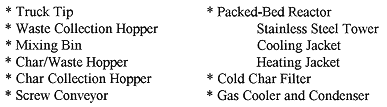
Before the radioactive vegetation is harvested for gasification, it is necessary to create the triple reverse burn char, the TRBC, which traps the radionucleotides while at the same time reducing the volume of the waste. The TRBC is a low-sulfur, non-swelling, highly-alkaline subbituminous coal that is prepared in advance by running it three times through the reverse burn gasifier described below.(16) The preparation of the TRBC will also give the operators time to become familiar with the equipment before having to deal with radioactive material. It will take approximately 90.86 hours to produce 1656 tons of char. Although it seems that adding char to the waste will only increase its volume, after the entire gasification and stabilization processes the final treated volume will only be approximately 5% of the original vegetation's volume. The TRBC has an extremely porous surface with a surface area of approximately 100-200 m2/g.(9) This allows the cesium and strontium in the vegetation to be retained in the TRBC's support matrix while the vegetation volume is reduced. The TRBC is extremely versatile and has several applications in the volume reduction of sludges, liquids, soils, and other materials contaminated with organics and mixed wastes.(9)
Once the TRBC has been made, the VRF is ready to receive the first trailer from the harvesting site. The actual process begins when the truck backs into the truck tip where its load is dumped into the waste collection hopper. The waste moves from the hopper to the mixing bin. The mixing bin combines nine parts waste and eleven parts TRBC which contains 5% by weight of water to help control the temperature in the reactor.
The material is mixed continuously and sent to a char/waste hopper where it enters the gasifier. From the char waste hopper material enters the column at 50 tons per hour and oxygen is added at 250 ft3/min at the top. The gasifier can be seen in greater detail in Fig. 2. As it moves through the gasifier the char/waste mix first encounters the cooling zone which is surrounded by a cooling water jacket to keep the material from igniting prematurely. When the material exits the cooling zone, it enters a small insulated perimeter before entering the incandescent thermal zone, the ITZ. In the ITZ which is a stationary flame front, the char/waste mix is ignited. The material then leaves the ITZ and enters the heated secondary reducing zone, the HRZ. A heating jacket surrounds both the ITZ and the HRZ and is created by burning the off gases from the process in an insulated jacket around a portion the packed-bed tower. After leaving the HRZ the mixture enters the char cooling zone.(16)
The off gas from this process exits the bottom of the reactor and is sent through a gas cooler and condenser, where the water is recycled and added to the char/waste mixture and the gases are sent through a cold char filter and burned to provide the heat for the HRZ. The TRBC is also recycled throughout the system. After being gasified once the char is collected, moved to the top of the gasifier system with a screw conveyor, and used again in the char/waste hopper. The screw conveyor is used because it creates less dust than other types of conveyors. Fresh TRBC is added as a recovery stream to the recycled char.
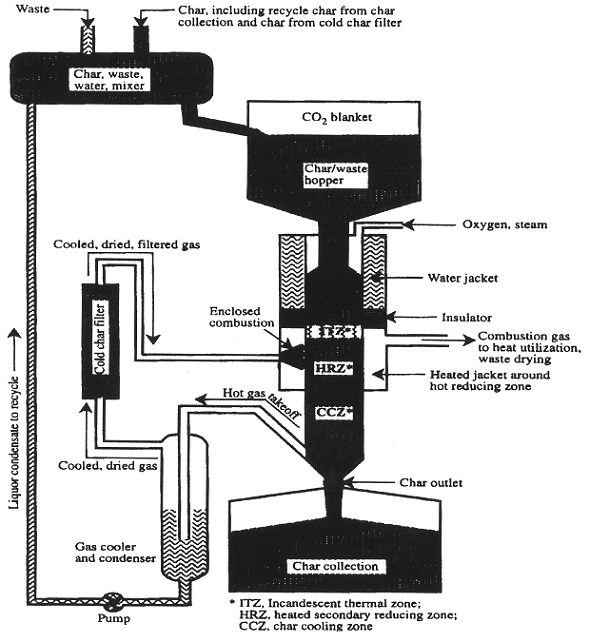
Fig. 2. Gasification
of Mixed Waste(16)
After the reverse burn gasification is completed, the oxygen port on the top of the column is moved to the bottom of the column and the off gases are collected off the top of the reactor. This set-up produces a forward burn which reduces the remaining bulk of the material.
In the end, the remaining char/ash material treated in the gasifier retains 99.9% of the cesium and strontium. The remaining 0.1% of radioactive material is retained in the cold char filter so that the off gases only contain combustible gases such at CO2, H2O, CO, H2, and CH4. This material can then be vitrified or cemented and the resulting final waste product will only be approximately 5% of the original waste's volume. (1, 9, 16)
Stabilization
After the key step of reducing the volume of the waste, it can be stabilized through either cementation or vitrification. The cementation would require mixing 1.0 part cement, 0.075 parts lime, 2.0 parts waste ash/slag and 2.5 parts water. This material would provide a stable non-leachable form for disposal, but may increase the volume of material being prepared for disposal more than vitrification. Vitrification could be accomplished by adding small pieces of borosilicate glass to the ash/slag and then melting the material in a reactor that contacts the material with an electrical current. Although quite a bit of power is required for this process, it creates a stable non-leachable waste that has less volume than the cemented stabilized product. In the end, a cost analysis comparing disposal cost versus production cost will determine which form of disposal is the most favorable. (1,9,16)
TECHNICAL ASSESSMENT
A bench scale quartz reactor was used to test and watch the gasification as it happened. The flame front, a bright orange/yellow glow that moves cross-sectionally through the reactor, moved through the entire reactor in approximately 50 seconds for the reverse-burn section of the process. The reverse-burn reduced the weight in the reactor by 30%. The forward burn reduced the weight by 88% and the volume by 94% and takes from 20-30 minutes depending on the flow rate of oxygen used. This result was consistent after several repeat experiments. The gases that are produced in the gasification burn smoothly which is desired for the upscale process, since the burn of the off gases is required to maintain the heated jacket of the reactor. The off gases that were tested in the nitric acid solution show no trace of the cesium or strontium, indicating that the cesium and strontium remain in the solid waste produced in the reactor.
After the metals were added to the vegetation and it was gasified, a glassy metallic solid formed in the reactor. The metallic looking solid was not present in the residue of the non-contaminated vegetation gasifications. Overall the results of the bench-scale support the conclusion found in literature. (9)
REGULATORY AND LEGAL CONSIDERATIONS
The process Design must comply with all federal, state, and local environmental statutes and regulations. Environmental Protection Agency (EPA), Nuclear Regulatory Commission (NRC), and state regulations will be considered. The major statutes affecting radioactive remediation include the Atomic Energy Act (AEA) and the Energy Reorganization Act (ERA).
The first step is that proper licenses and permits regarding the handling and disposal of radioactive waste must be obtained. The NRC governs radioactive waste licensing of byproduct manufacture, production, transfer, receiving, possession, byproduct material use, and disposal in 10 CFR 30. The 10 CFR 30 states that no person shall handle byproduct material except as authorized in a specific or general license issued pursuant to the regulations in that chapter. Application for permits covered under Protection of the Environment are covered in 40 CFR 124 and include RCRA, UIC, PSD, and NPDES permits. Individual states can increase requirements, but the NRC retains the right to overrule state authority. New Mexico State has no increases over federal requirements.(14)
Next, regulations regarding employees must be considered. The 10 CFR 19 establishes requirements for notices, instructions, and reports to employees. The 10 CFR 20 sets standards for protection against ionizing radiation resulting from activities conducted by NRC licensees.
Logging on the proposed site requires many considerations. NEPA policies outline the requirements for an Environmental Impact Statement (EIS). NEPA requires an EIS when the proposed remediation occurs on a federal site, significant environmental impact results, and a major action occurs. Since the WERC site is a federal facility, the DESIGN will complete an EIS for the site. Also, many sections of this remediation process including harvesting, grinding, and gasification have the ability to create airborne radionucleotides. These emissions must be monitored to comply with the Clean Air Act (CAA). The 40 CFR 61 provides air emission standards for radionucleotides.
Finally, the transportation of the radioactive product from the remediation site must be addressed. The Department of Transportation (DOT) regulations establish criteria for the safe transport of radioactive material on public highways in 49 CFR 170-178. The NRC governs packaging, shipment preparation, and transporting radioactive material in 10 CFR 70 and 71. 2
Considering the many different sources of radiation regulations, it is suggested that WERC obtain the services of a professional legal consultant. This will avoid costly time and monetary penalties and may result in exemptions and variances which could lead to financial and production benefits.
HEALTH AND SAFETY
The most important consideration during the radioactive remediation process should be the protection of employees and surrounding communities. A guiding principle behind all radioactive management is "as low as reasonably achievable" (ALARA). This follows the assumption that risks cannot be completely eliminated, but every effort should be made to reduce exposures to the lowest possible extent. 2
The Occupational Safety and Health Administration establishes very stringent requirements for health and safety programs at hazardous waste sites in 29 CFR 1910.120. This requires providing a medical surveillance program, site-specific health and safety training for all site employees, air quality monitoring, site access control, and a decontamination system for employees leaving the site. (2)
Consideration should be given for both internal and external doses when assessing exposures. Three factors which determine the external exposure to an individual working with radioactive materials include time of exposure, distance from the source, and amount of shielding present. Limiting exposure time will minimize external exposure during the work day and year, implementing lead lined heavy equipment cabins, working with a remotely controlled reactor, and outfitting each worker in level C protective clothing. Internal exposure will be reduced by using pressurized equipment cabins, and outfitting each worker with a National Institute for Occupational Safety and Health approved respirator.
Continuous monitoring of work site radiation levels and airborne contamination levels will allow supervision to determine appropriate safety precautions and personal protective equipment most advantageous to the process. Protective clothing worn on site will be removed at the end of the work shift, or as necessary, in a worker decontamination process. The clothing can be shredded and incorporated into the ground vegetation meant for gasification. Respirators and other reusable items can be decontaminated and used with new filters.
CONCLUSIONS
The proposed design for the removal and treatment of radioactive vegetation fulfills the requests and meets the requirements of WERC. Using harvesting equipment from the forest products industry to remove the vegetation, reverse burn gasification to reduce the vegetation's volume, and then providing cementation or vitrification for the stabilization of the remaining material, the design is able to reduce the volume of the vegetation to approximately 5% of the original waste.(9) This design manages the waste treatment process efficiently and economically, while at the same time reducing the risk to the environment, employees, and surrounding communities. It also provides a description of the regulatory, legal, health, and safety requirements and issues that were taken into consideration while developing the design and discusses approaches for working with the community.
REFERENCES