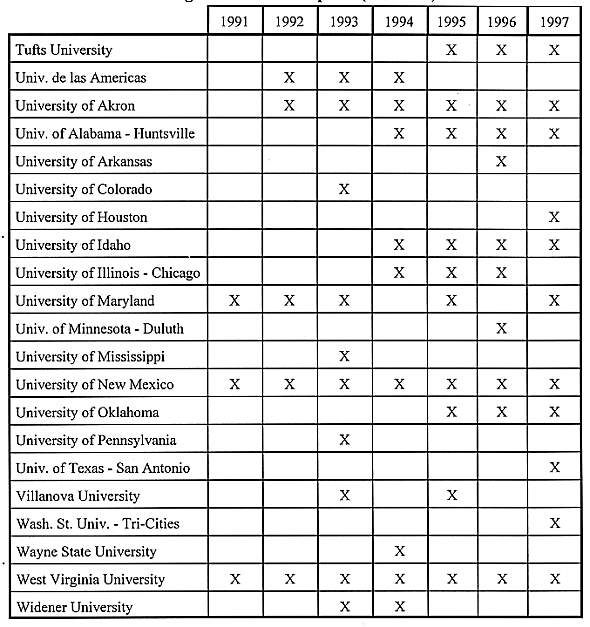
Design Contest Participants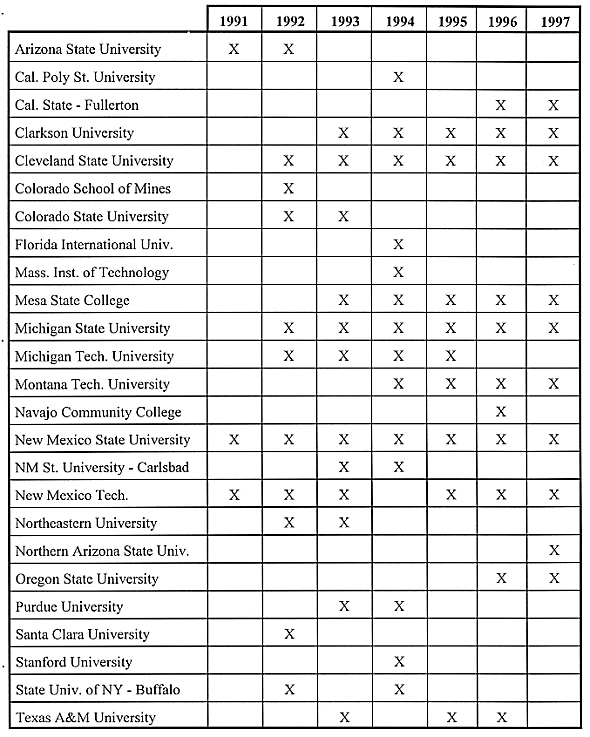
Abbas Ghassemi and Ron Bhada,
WERC
J. Derald
Morgan, Dean of Engineering,
NMSU
PO Box 30001, Dept. WERC, NMSU
Las Cruces, NM, 88003
ABSTRACT
Environmental Science and Engineering is an important element of all aspects of life throughout the world and is consequently being offered at universities. The WERC Environmental Design Contest offers many students interested in the environmental arena an opportunity to compete, communicate, develop a network and earn award money while solving a real world environmental problem. This contest is in its seventh year and is successful in bringing together, in one location, top environmental students and professionals. The contest exposes the participating students to real world problems and challenges in the environmental field. Participating universities represent states from across America as well as Mexico. For the first time, a team from United Arab Emirates University will be competing as a part of the Oregon State University team.
For the 1997 Contest, teams may elect to participate in one or more of three separate tasks. The students are provided with the task information during their Fall semester and spend the following months working on their design. The participating teams must consider not only the technical and economic issues associated with remediation but also address all regulations, health and other issues associated with the particular task. The teams must address the public communications aspect of their proposed solution. Many of the participating universities use this contest as a senior level design class.
In addition to mileage, prize money is also provided in a variety of categories to the contestants. 1996 prize and travel expenses awarded to the participants totaled nearly $60K. The last half day of the contest is filled with anticipation as the judges make their final decisions. The morning of the final banquet, WERC hosts a Job Fair which caters to the participating students. Trophies and awards are announced during the final banquet.
THE 1997 DESIGN CONTEST TASKS
TASK 1: Deployment of Surface Sampling Equipment in Large Tanks. The objective is to design and demonstrate a versatile, low-cost, deployment system and sampler tool. This system must be capable of taking a waste sample at the bottom of a high-level radioactive waste tank.
TASK 2: Groundwater Treatment and Remediation. The objective is to design and demonstrate the best treatment and innovative technology that can be used to remediate radionuclide contaminated groundwater.
TASK 3: Filter Media Decontamination. The objective is to develop and demonstrate a process to put the contaminate HEPA filters and frames into suitable forms which meet the land disposal requirements. The filters are contaminated with plutonium and nitric acid.
INTRODUCTION AND PURPOSE
The Waste-management Education and Research Consortium (WERC) was created in 1990 by the U.S. Department of Energy as a partnership between New Mexico State University, the University of New Mexico, and the New Mexico Institute of Mining and Technology in collaboration with Los Alamos National Laboratory and Sandia National Laboratories. The Navajo Community College joined as an affiliate in 1991. The mission is to expand the nation's capability to address issues related to the management of all forms of wastes, via education, technology development and information transfer. Currently, over 2000 students (pre-college, college to professional) receive these educational benefits, and over 40 technology development projects are progressing on all aspects of waste management and environmental restoration.
Currently, there are undergraduate and graduate educational programs throughout the world on environmental management and engineering. However, there has been no vehicle to bring students from various universities together for discussions and solutions of major environmental issues. Consequently, for the past six years, a unique and innovative environmental design contest for universities throughout America has been conducted by WERC.
The Design Contest is co-sponsored by industrial organizations, the Department of Energy and other government agencies. The contest is structured to give university student groups from all over America an opportunity to exchange information and participate in an contest for design, development, and testing of a realistic environmental control process. The judging is performed by experts from academia, government, and industry. The judging is based on technical, as well as other criteria such as economics, risk analysis, health regulations, public policy and communication that are important in today's world.
For the Design Contest, all teams must address their particular task with the following:
- the process design
- detailed total plant design
- the engineering basis for the design
- the economics of the process
- a discussion of the legal and health implications
- a plan for presentation to the community for public acceptance so that problems are minimized after construction
SPECIFIC TASK INFORMATION
1997: TASK 1
Deployment of Surface Sampling Equipment in Large Tanks. The objective is to design and demonstrate a versatile, low-cost, deployment system and sampler tool. This system must be capable of taking a waste sample at the bottom of a high-level radioactive waste tank.
The tank bottom is 60 feet below grade. Tank access is through a vertical 12 inch schedule 40 pipe, 12 feet long. The load limit on the access port is 200 pounds in any direction. The access port extends two feet out of the ground and is surrounded by stable soil with a 10,000 pound load limit. The system is expected to reach a sample point from 0 feet to 15 feet off of the axis of the access port at the tank bottom, in any radial direction. (Capability to reach farther is advantageous). The deployment system must be adaptable to a variety of tools weighing up to 50 pounds. (Tool design for this task may exceed 35 lbs.) Your team's task is to fill a 100 ml sample bottle (acrylic) with simulated waste (the consistency of soft chalk), that must be scraped free from the tank bottom. Assume that the tank bottom has a metal bottom covered with patches of waste several feet across and up to 2-3 inches thick.
The sample bottle is to be brought to the surface and transferred to a shielded container (standard design will be provided). Plan to handle sample bottles reading 100 Rad on contact. Current robotic systems used for this purpose are considered very expensive and a simpler system is required. The deployment system of your choice may be manually controlled but must be actuated. A vehicle system is also permitted. It is expected that the sampling tool configuration will affect the deployment system design. Simplicity, cost effectiveness, waste minimization, and contamination control are major factors in evaluation of the proposals .
As indicated earlier, the deployment system itself can be modeled at reduced scale for presentation. However, the sampling tool must be a full scale working model for the presentation in Las Cruces. Your team is to place a minimum of 50 g of the simulant into the sample bottle (250 ml glass). While filling the entire sample bottle is not mandatory, the final amount collected will be measured for evaluation of your process performance. WERC will collect one sample from each team.
1997: Task II
Groundwater Treatment and Remediation. The objective is to design and demonstrate the best treatment and innovative technology that can be used to remediate radionuclide contaminated groundwater.
Each team is to assume the water is being pumped out of the aquifer at a rate of 100 gallons per minute (GPM). Based on this rate, the scale of the treatment process must be discussed and implications of scale-up, from bench scale, must be addressed. Due to the individual characteristics associated with the proposed treatment processes, modifications to the throughput rate are permitted. Treatment process must be designed to handle a minimum of 50 GPM flowrate.
The teams are to design and demonstrate an innovative treatment process applicable to the remediation of proposed ground water problems. The proposed process must remove and treatthe Sr-90 and Cs-137 from the ground water. The concentration of Sr-90 contamination ranges from 0 to 320,000 pCi/L and the concentration of Cs-137 contamination ranges from 0 to 2,000 pCi/L. When addressing the Sr-90 treatment problem, the design should note specific treatment options that could address lower concentrations of Sr-90 (0 to 2,000 pCi/L) and elaborate on those options in your design.
The solution must:
Minimally, the design must address remediation and treatment of the Cesium and Strontium listed above. Extra credit will be given for creativity, ease of maintenance as well as to the designs that address treatment options when there are other contaminants present. (i.e. how does the natural chemistry affect the treatment process?) The results of this option should be separately addressed in the final report.
1997: Task III
Filter Media Decontamination. The objective is to develop and demonstrate a process to put the contaminate HEPA filters and frames into suitable forms which meet the land disposal requirements. The filters are contaminated with plutonium and nitric acid.
HEPA filters (normal size 8 in x 8 in x 6 in) consist of filter media contained within a wooden or metal frame. The filter medium is composed of glass fiber, with a small percentage of asbestos. An organic binder, elastomeric adhesive, or polyurethane sealant was used during construction. The medium also contains corrugated aluminum foil. The newer HEPA media consists of glass and aromatic polyamide fibers (Nomex) and aluminum alloy metal coated with a thermoset vinyl or epoxy. Various sealants could also be present. The material is not homogenous due to different materials, sizes, and manufacturers of these kind of filters. However, for your design, you are to assume that all filters have been made by the same manufacturer. The frame material will be either 3/4" fire-retardant, exterior-grade plywood or wood-particle board and 14-gage cadmium-plated or chromized carbon steel. Neoprene, closed-cell expanded rubber gaskets, precoated with a rubber-based adhesive will be present on each filter.
Historically, the used HEPA filters were separated into two groups: high and low plutonium content. The used wood frames were separated from the filter media and usually disposed of as alow level mixed waste by packing in a drum. The filter media pieces were placed into another category if they were high in radioactivity and packaged and stored for future treatment. The filter media may be heavily contaminated with nitric acid since they serviced boxes where aqueous dissolution operations were conducted. The filter media will most likely be packed with loose Portland cement to neutralize the acid and absorb any moisture that might be present.
Because of the level of radionuclides associated with these residues, the media is considered transuranic mixed (TRM), i.e. they are above 100 nCi/gram. The frames are considered low level mixed (LLM) i.e. they are below 100 nCi/gram. Consequently, the media must be treated to meet the Waste Isolation Pilot Plant (WIPP) Waste Acceptance Criteria (WAC), as well as DOT shipping requirements while the frames must be treated to meet Land Disposal requirements, as well as DOT shipping requirements. This, however, does not preclude other regulatory requirements that might be triggered. It is intended that all waste will be sent offsite for disposal.
Design team is given the following tasks:
ACKNOWLEDGMENT
We would like to thank all of the schools for participating. The Authors would also like to thank the sponsors, the individuals who gave their time and effort to serve as judges for all of the Design Contests, as well as the faculty members of the participating institutions
DESIGN CONTEST SPONSORS
The Authors are deeply indebted to the sponsors of this contest without whom the program would not be possible. The sponsors are:
CONCLUSION
The WERC Design Contest has proven itself in many ways. Each site that has a "Task" in the contest, receives 10 - 20 creative and innovative solutions. In the past, specific sites have sponsored further research on a particular process which results in additional funds going to the university involved. These funds support students over the summer break to do more research on their process.
All of the students involved have passed a rigorous test of their skills by beginning with the "written" word to a bench-scale working model. They have close interaction with the students from the other teams and continue their learning process during the actual competition. The faculty advisor for each team benefits from close association with their students and well as interaction during the contest with the other faculty advisors. Last, but certainly one of the leading benefits, the involved industry and government personnel, benefit by seeing in action the top environmental students from across the United States. We constantly hear of students being hired because of their presence at the Design Contest. A few companies come specifically to look for the brightest stars attending the contest.
Design Contest Participants