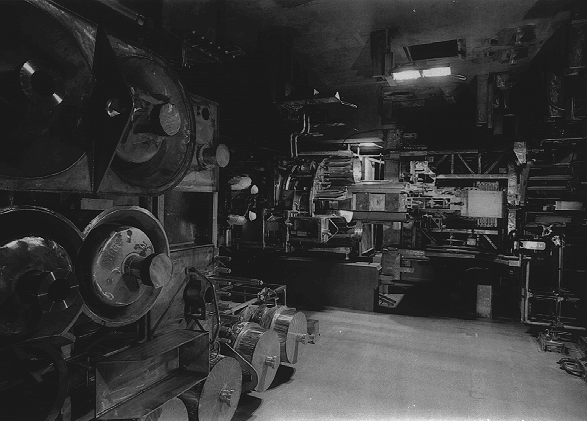
Fig. 1. Photo of DWPF's vitrification
cell prior to radioactive operations.
Stephen P. Cowan, Ralph E. Erickson, Ted W. McIntosh, and
Kenneth G. Picha, Jr.
Department of Energy, Office of Environmental
Management
Robert E. Lawrence
West Valley Nuclear Services Co.,
Inc.
ABSTRACT
This paper addresses the successful initiation of radioactive vitrification processing at the Defense Waste Processing Facility (DWPF), Savannah River Site in Aiken, South Carolina, and the West Valley Demonstration Project (WVDP) Vitrification Facility in West Valley, New York, and provides a Department of Energy-Headquarters (DOE-HQ) perspective on these accomplishments.
Most countries that have produced high-level waste (HLW) from reprocessing nuclear fuel have selected or are evaluating borosilicate glass as a final waste form. Differences in storage tank systems, along with other influences, have led to variations in melter system design throughout the international community. Nevertheless, stainless steel-canistered borosilicate glass is the waste form of choice of all current producers. Differences in types of spent fuel reprocessed at Savannah River compared to West Valley have led to different approaches to glass-forming chemical addition preparation and consequently to contrasts in specific detail for process control and waste form qualification. The review and approval employed by the DOE-Office of Environmental Management (DOE-EM) has been similar for both projects and has facilitated acceptance in both cases of the process control methodology by the DOE-Office of Civilian Radioactive Waste Management (DOE-RW).
In similar fashion, the difference between the Savannah River and West Valley site mission, facility layout and use, and quantity of waste has led to divergence in vitrification facility design, construction sequence, and startup testing approaches between the two sites. In each case, however, facility and staff operational readiness has been demonstrated through production of a nonradioactive waste form, using HLW simulants representative of the site's waste inventory, that performs better than the required stability/leach resistance test criteria imposed by DOE-RW, and through extensive startup testing of the respective facilities. The Office of Waste Management (EM-30), supported by RW and the Office of Environmental Safety and Health (DOE-EH), as well as other EM groups, has been actively involved in each phase of these readiness demonstrations and evaluations. In addition, the Nuclear Regulatory Commission (NRC) has been actively involved during the WVDP readiness activities.
Startup and continuing radioactive operation of the Savannah River and the West Valley vitrification facilities are key accomplishments in achieving DOE's risk reduction and cost management commitments to the taxpayers and stakeholders. Two such startups within a short time frame bring to fruition important elements of the DOE cleanup mission and demonstrate the can-do attitude and ability of the Headquarters, Field Offices, Site Offices, and contractor teams involved.
INTRODUCTION
This past year proved to be a very successful year for the DOE, marking the start of high-level radioactive waste solidification efforts at both the DWPF and the WVDP and the reduction of risk stemming from the underground storage of radioactive high-level liquid wastes. These successful facility startups followed exhaustive safety and readiness evaluations conducted by multiple tiers of DOE management, independent industry experts, and contractor personnel. The readiness evaluations were consistent with the Defense Nuclear Facility Safety Board (DNFSB) recommendations for the conduct of Operational Readiness Reviews (ORRs). The DOE's entry into the international HLW vitrification community was deliberate by choice in order to assure the immediate and continued safety of the public, workers, and the protection of the environment.
BOROSILICATE GLASS AS A HIGH-LEVEL WASTE FORM
Evaluation of borosilicate glass as a HLW form began as early as the 1950s, continued in the early 1960s with the vitrification of radioactive waste in France, and was further defined at the Savannah River Laboratory, the Oak Ridge National Laboratory, and the Battelle/Pacific Northwest Laboratory in the late 1960s and early 1970s. Today, vitrification is still the technology of preference for high-level radioactive wastes. As confirmed by evaluations of long-term durability of glass at Pacific Northwest National Laboratory, Argonne National Laboratory, Clemson University, and the University of Florida, borosilicate glass is an appropriate means to solidify a greater variety of wastes than is feasible with other technologies. In 1979, DOE selected borosilicate glass as the most suitable material for waste immobilization based on the combination of durability and ease of processing. Since then a wealth of supporting data; including laboratory, pilot-scale, and full-scale operating experience; has been amassed. The recent startups of the two vitrification plants demonstrate that DOE is making progress toward the reduction of liquid radioactive waste inventories. This progress is graphically demonstrated by the DWPF and WVDP's combined production of over 100 canisters of solidified HLW as of this writing and the immobilization of over one million curies into a form meeting federal repository acceptance specifications. Refer to Figs. 1 and 2.
Acceptability of the vitrified waste for ultimate disposal in a geologic repository by DOE-RW is assured by full-scale production, sampling, and extensive laboratory analysis confirming that the waste forms being produced at the DWPF and the WVDP are consistently repeatable, durable, and stable. Early nonradioactive testing programs at each site confirmed that acceptable waste/glass could be produced using widely varying feed compositions. These waste/glasses were thoroughly evaluated against the criteria established for the DWPF Environmental Assessment (EA) reference glass as measured by the Product Consistency Test (PCT), and endorsed by the Environmental Protection Agency (EPA) and the Nuclear Regulatory Commission (NRC). Comparable analysis on the performance of borosilicate glass in repository conditions is also being conducted internationally, for example in Japan and the United Kingdom, with results indicating satisfactory stability and durability.
Fig. 1. Photo of DWPF's vitrification
cell prior to radioactive operations.
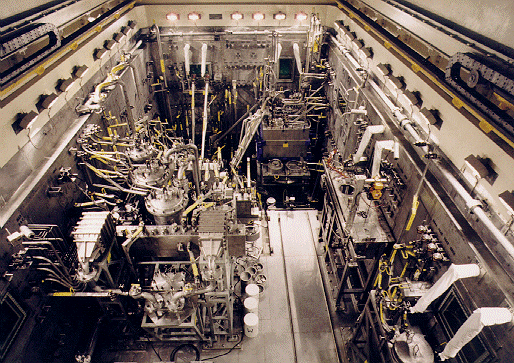
Fig. 2. Photo of WVDP's vitrification
cell at cell closure.
DOE MANAGEMENT OF WASTE FORM DEVELOPMENT
To ensure that the vitrified HLW produced will be suitable for geologic disposal, the DOE has taken measures to confirm product quality at its earliest stage. DOE-RW, with support from DOE-EM, proactively developed the Waste Acceptance Systems Requirements Document (WA-SRD) to establish the basic performance objectives and requirements for HLW and spent nuclear fuel. This document will support the licensing of the federal repository. DOE-EM next collaborated with the national laboratories and potential glass producers (Savannah River, Hanford, Idaho, and West Valley) to develop and define the Waste Acceptance Product Specifications for Vitrified High-level Waste Forms (EM-WAPS), consistent with the WA-SRD.
In parallel, DOE-RW developed and imposed a HLW quality assurance program (RW-0333P) to ensure that the quality of the waste product is appropriately addressed throughout the design, procurement, testing, and operating cycles at all levels (i.e. DOE-Headquarters, DOE Field Office and Area Office, and operating contractor). Additionally, DOE approval of the producer's RW-0333P program was made a prerequisite to initiation of radioactive waste form production. DOE-EM performed numerous audits of each site's implementation of the program that also included in-depth audits of respective field offices and area offices. Representatives from DOE-RW, the NRC, and the State of Nevada were also frequently present as observers during these audits.
Integral to the RW-0333P program was the formation of the Technical Review Group (TRG) chartered by DOE-EM to perform independent technical reviews of waste acceptance documentation; the documentation being a description of activities and commitments that demonstrate the ability of the waste forms to meet the WAPS requirements. The TRG was chaired by an EM-30 senior level staff member, and participants included well-known experts from selected consulting organizations and national laboratories. The TRG's mission was to independently evaluate the correct application of the: EM-WAPS, DOE Orders and guidelines, use of sound engineering and scientific practices, use of technical references, and suitability of the proposed technical direction to support programmatic decisions by EM-30.
ASSURANCE OF READINESS
In addition to assurance that the respective HLW vitrification plants will consistently produce repository-acceptable waste forms, DOE-EM senior management required assurance that the DOE field and contractor staffs were prepared to safely operate their facilities in a manner that will protect the public, workers, and the environment. The specific management program requirements to be satisfied are embodied in DOE Order 5480.31, "Startup and Restart of Nuclear Facilities." Line management assessments and ORRs were conducted by each site's line management and respective DOE area/field offices. These reviews, at a very fundamental level, were used to verify that the plant, people, and programs were ready and in place to startup and operate a HLW vitrification facility. More specifically, verification of the soundness of the physical plant and its associated systems, the preparedness and knowledge of the operating and managing personnel, and the satisfactory compliance with DOE Orders regarding documentation, procedures, and staffing were performed at a level equivalent to that for the startup of a commercial nuclear reactor. This more stringent and structured evaluation and verification approach applied to nonreactor nuclear facilities like the DWPF and WVDP provide added assurance that the facilities' management and operating staffs and the installed hardware and software demonstrated readiness to a level beyond requirements based solely on facility type and hazard categories.
DOE-HQ was able to craft a single startup and readiness program that encompassed both facilities and served to streamline the approval process even though the approaches to startup followed by these facilities were diverse. The DWPF's progression to startup being: reduced-scale testing, building of the production facility, integrated testing, and then waste acceptance. The WVDP's progression to startup being: full-scale testing, waste acceptance, converting the test facility to a fully remote production facility, and then integrated testing. An integrated approach was vital from the DOE-HQ perspective due to the overlap in time of readiness preparations for the two facilities.
An important aspect of the approval for readiness was the early and proactive emphasis placed on achieving and demonstrating readiness for both facilities. Although not part of the formal DOE Order 5480.31 process, the WVDP conducted a 45-day waste acceptance remote demonstration for DOE-EM, DOE-RW, and the NRC in 1989 at the end of the waste acceptance full-scale development program. In a comparable vein, the DWPF readiness confirmation started as early as 1992 with a Headquarters-piloted review prior to commencement of nonradioactive (cold) chemical tests that were a precursor to their waste acceptance runs. Both facilities prepared the Order-required Readiness Plans of Action and subsequently issued Operational Readiness Review Implementation Plans developed by both the Westinghouse and DOE ORR teams. These two documents formed the commitments between the DOE and their contractors for the approach to achieve the requisite level of readiness.
Inherent to the successful attainment of site readiness was the parallel development of site DOE infrastructure to oversee and approve contractor operations. Significant energy was expended at both sites for the training and qualification of DOE facility representatives and in DOE oversight and evaluation of contractor progress toward attaining the required state of readiness.
DOE-HQ managed ORRs for the DWPF and the WVDP in a manner that would best provide senior management with the assurance that repository requirements would be met in a reliably safe manner characterized by operational excellence. Each review team was led by a senior DOE manager experienced in conducting such reviews and sensitive to concerns raised by the DNFSB relative to the conduct of ORRs. The teams were comprised of similarly experienced DOE and subcontractor personnel representing strong technical backgrounds in each of the relevant review subject areas. Since the reviews and site visits overlapped and some members were common to both review teams, the teams were able to pull the string at each site based on what was observed at the other location. This type of communication between teams enhanced the conduct and credibility of the overall reviews. Since the DWPF and the WVDP have a strong history of exchanging lessons-learned, technological developments, and providing short-notice assistance to one another, it was fitting that the DOE ORR teams would also exchange information.
From a DOE-HQs' perspective, the startup-approval process operated as intended. In each case, the operating contractor, Westinghouse, completed the startup test program, completed line management and independent readiness reviews, and notified the local DOE office of readiness. The local DOE office then completed their line assessment and recommended initiation of the independent DOE readiness review for both sites.
One specific lesson learned during the WVDP review that was applied to the DWPF review concerned the DOE-ORR Team requirement to observe each facet of waste processing from the introduction of simulated slurry into the process cell to delivery of solidified waste into the interim storage facility. Because this cycle is a longer duration than the standard DOE ORR site visit, a premium is placed on communication with line management to understand the specific activities that occur, when these activities are expected to occur, and how to adjust the reviewers' schedules to accommodate production activities that may occur only once or twice (or require arrival on site in advance of formal ORR initiation). This type of review need also stresses the importance of the line organization being prepared to demonstrate not only hardware activities and operation interfaces but also software activities such as preparation of quality records that become part of the repository production record package.
SUMMARY
With the startups of the DWPF and the WVDP, the focus has shifted from long-term management of liquid HLW in carbon steel tanks and concerns for eventual leakage to management of production facilities dedicated to meeting repository waste acceptance specifications in a way that protects workers, site neighbors, stakeholders, and the environment. These startups represent a culmination of years of research and development, design, construction, testing, and tangible progress for stakeholders. Each solidified canister of high-level radioactive waste produced by the DWPF and the WVDP brings the DOE closer to completion of its risk and cost reduction goals. Refer to Figs. 3 and 4.
Ongoing research continues to confirm that borosilicate glass is the most viable medium for high-activity waste solidification. This technology is supported by years of international and domestic processing and production experience, and an abundance of engineering expertise. It should remain our path forward for many years to come. Furthermore, the synergy developed by sharing vitrification technology and operating experience, as well as readiness evaluation practices, was beneficial.
The communication between sites, as exhibited by the sharing of design, testing, and operating lessons by the DWPF and the WVDP, are a model and should continue to be encouraged and emulated throughout the DOE complex. Shared information serves to accelerate operations and drive down costs by avoiding duplicate efforts. The cooperation and teamwork displayed by the DWPF and WVDP Westinghouse operating teams, the Savannah River and West Valley DOE teams, and all the other DOE laboratory and support contractor personnel are to be applauded. These DOE sites are genuinely demonstrating the final step in the nuclear fuel cycle and the safe, productive management of radioactive waste.
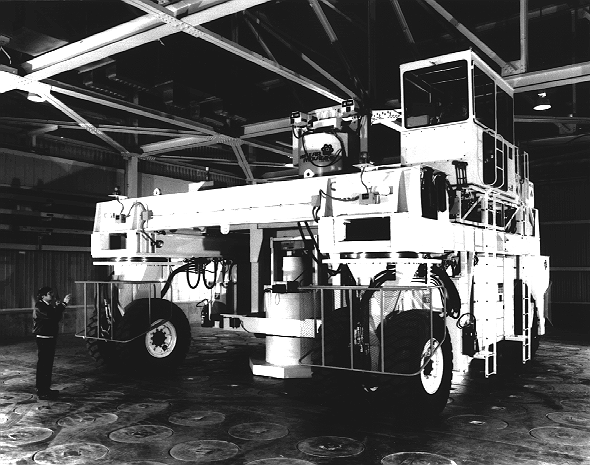
Fig. 3. Photo of DWPF's Canister
Transporter and Storage Facility.
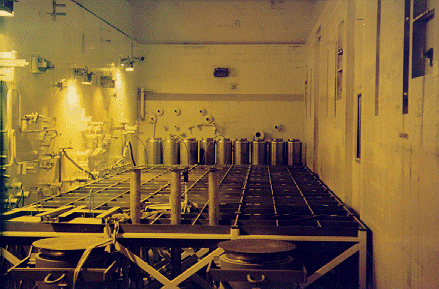
Fig. 4. Photo of WVDP's High-level
Waste Interim Storage Cell.