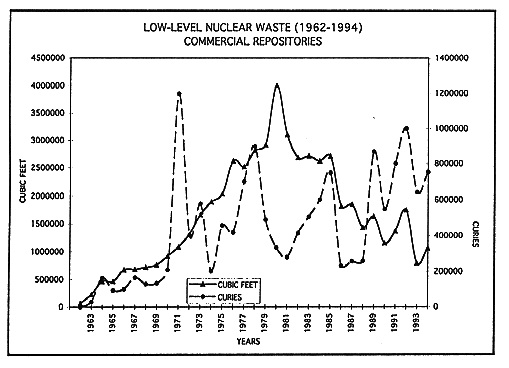
Fig. 1. Low-level nuclear waste
(1962-1994) commercial repositories.
David V. LeMone
Department of Geological Sciences
University of Texas at El Paso
El Paso, Texas 79968
(915)747-5275
Lawrence R Jacobi, Jr.
Texas Low-Level Radioactive Waste
Disposal Authority
7701 North Lamar
Ste. 300
Austin, Texas, 78752
(512)451-5295
ABSTRACT
Low-level waste minimization technology has changed the volumetric character of the commercial low-level radioactive waste stream. The shift to lower volumes since 1980 has resulted in significant economic and environmental gains. The relatively lower anticipated volumetric quantities of the commercial operational low-level wastes can be handled with relative ease in the proposed state and compact low-level radioactive waste repositories.
Conversely, the future streams generated from decommissioning wastes will require careful planning in order to avoid logistic and storage problems in the form of increased volumes as well as the generation of non-standard sized waste packages. Another area of future consideration will be the tracking of the radiometric content of the waste not only for content, but also for source. Historical commercial low-level curie content indicates an inverse relationship with volumetric data. Accurate data will be necessary for efficient repository planning and operation. Historical data developed by the DOE waste stream is of little comparative value to the analysis of the commercial low-level waste stream.
In the interim period between the lower volume operational streams and the higher volume future decommissioning waste streams, the developing state and compact low-level repositories will have to restructure their volume and/or radioactivity charges to guarantee the economic stability of the system and ensure the current and future operational integrity of the repositories.
THE LOW-LEVEL WASTE STREAM
The character of the low-level radioactive waste stream from both private-sector and public-sector entities has radically shifted during the evolution of the low-level radioactive waste disposal system. This shift has been most pronounced in commercial low-level radioactive waste repositories in the private sector. These private-sector repositories are primarily engaged in the acceptance of civilian medical, industrial, research, and power reactor low-level wastes for final disposition. Federal low-level wastes are generally less handled by the commercial firms. The major change that has taken place in the radioactive waste stream in the private-sector has been the development of an economically driven, multifaceted system of waste minimization. Even though the volume of low level radioactive waste is declining precipitously, the radionuclide content within the waste stream remains unchanged and appears to be increasing.
The trend was clearly set during the earlier years (1962-1980) with a continuing increase in volume until the peak disposal year of 1980 (3,997,711 cubic feet or 113,218 cubic meters). Since 1980, the volume has been dramatically falling and is currently running below one million cubic feet annually (Fig. 1).
Fig. 1. Low-level nuclear waste
(1962-1994) commercial repositories.
The historical record of undecayed radioactivity (Table II), however, does not reflect this relationship at all. Significantly high peak years occur in 1971 (1,197,124 ci), 1978 (896,541 ci), 1989 (866,898 ci), and 1992 (1,000,103 ci). The curie content in 1980, the banner volumetric year, displays a remarkably low value (333,145 ci). The overall trend, as would be expected, reflects an increasing content in curies in the low-level waste. This increase seems to be occurring without significant shifts in the low-level categories of Classes A, B, and C. Likewise, there does not seem to be any major increase in the amounts of remote handled waste versus contact handled waste. One reasonable explanation for this increase in curies without a concurrent change in the volume-based waste stream classifications might be the increase in the disposal of very highly radioactive discrete sources such as reactor components or sealed sources.
The volumetric and radiometric changes in the low-level waste stream may be documentable with accurate waste stream data (Tables I, II, and III). These data are obtainable through industrial and governmental records.(1,2,3) The historical shifts that have taken place in the commercial low-level repositories best reflect the vagaries of the waste stream changes.
Table I Historical Annual Additions and Total Volume of LLW Buried
at Commercial Sites from 1962 through 1994 (1,2,3)
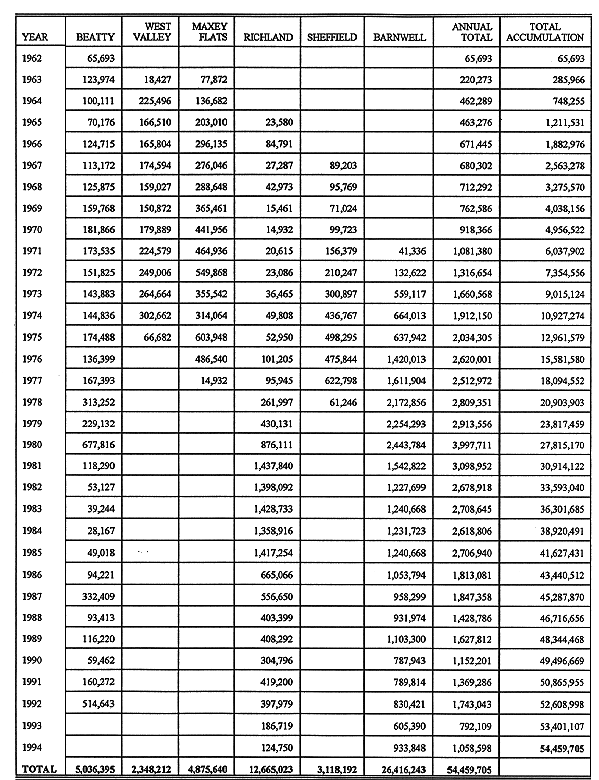
Table II Historical Annual Additions and Total Undecayed
Radioactivity in Curies of Low-Level Commercial Disposal Sites - 1962-1994
(After DOE/RW-0006, Rev. 11) (3)
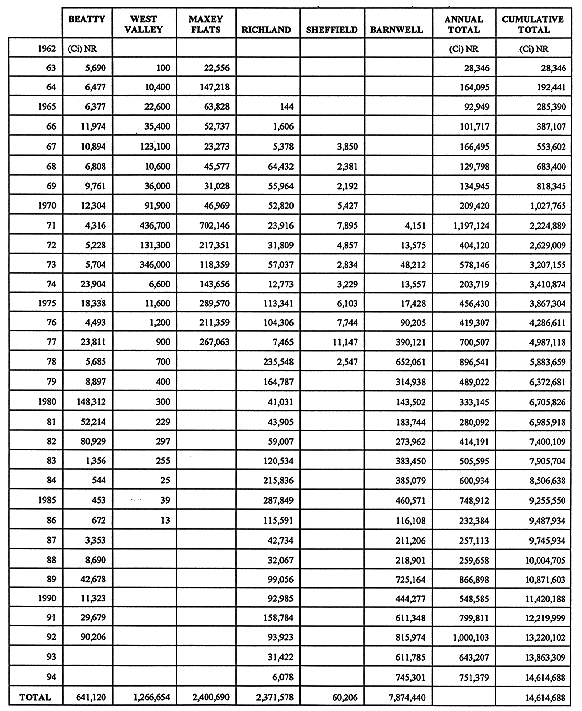
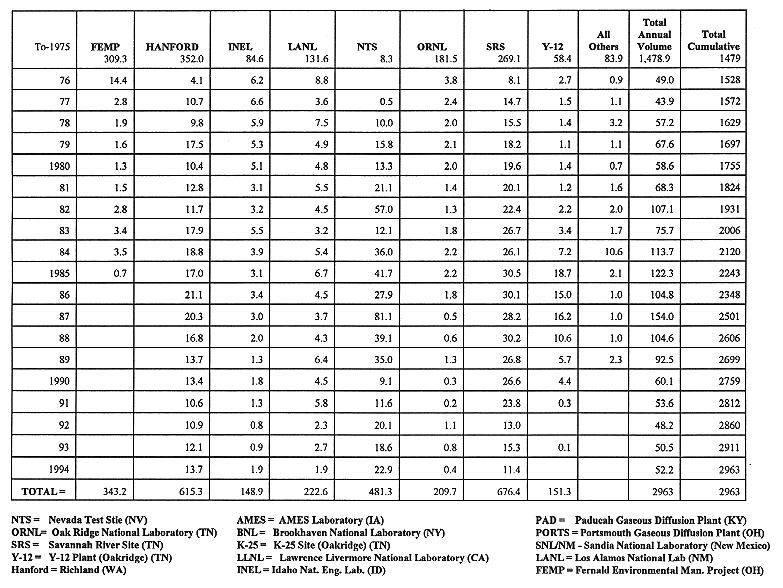
Table III Volume of Low-Level Waste (103m3)
DOE Sites (3)
In general terms a commercial low-level radioactive waste repository is an enterprise, normally private, that will accept solid, low-level radioactive waste (Classes A, B, and C) charged on a scale based on the waste's volumetric dimensions and/or radiometric content.
Currently, only three commercial low-level repositories are operational. They are: Richland, Washington (U. S. Ecology); Clive, Utah (Envirocare); and Barnwell, South Carolina (Chem-Nuclear). The repository at Richland is still accepting low-level waste, but in the last years it is confining it to the Northwest and Rocky Mountain state compacts. Envirocare of Utah handles only four basic classes of mildly radioactive materials; they are: NORM, LLRW, 11e.(2), and mixed/RCRA hazardous wastes. Envirocare currently lists incoming wastes from seven private, seven Environmental Protection Agency (EPA), eleven Department of Defense (DoD), and twelve Department of Energy (DOE) generators. (4) In general terms, the radioactivity in the waste that they accept does not exceed that of lower Class A low-level waste.
Chem-Nuclear of Barnwell, South Carolina, conversely, will accept all classes of solid low-level waste from any national waste generator with the exception of those wastes generated in the state of North Carolina. Chem-Nuclear, consequently, represents the only operational, national repository for commercial low level waste.
Since the inception of the commercial low-level repository in the period of the early sixties, there have been six major commercial repositories. None of these organizations have operated continuously since the first records were compiled in 1962. The selected repositories are: West Valley, New York (2,348,192 cubic feet - 66,501 cubic meters; 1963 - 1975); Sheffield, Illinois (3,.118,192 cubic feet - 88,307 cubic meters; 1967 - 1978); Maxey Flats, Kentucky (4,875,640 cubic feet - 138, 078 cubic meters; 1963 - 1977); Richland, Washington (12,665,023 cubic feet - 358,680 cubic meters; 1965 - [1994 = last data]); Beatty, Nevada (5, 036,395 cubic feet - 142,634 cubic meters; 1962 - 1992); and Barnwell, South Carolina (26,416,243 cubic feet - 748,124 cubic meters; 1971 - [1994 = last data]) (Table I). Total accumulated low-level waste is placed at 54,459,705 cubic feet - 1,542,330 cubic meters. The data given in Table I is in cubic feet as it is the normal recording mode and fee structure base in the United States. Cubic meter data may be determined by either dividing cubic feet by 35.31 or multiplying the data by 0.02832. Cumulative data are available only through 1994. (2,3) More recent unaggragated data is available from the DOE's Low Level Radioactive Waste Manifest Information System.
The historical annual additions of undecayed radioactivity in curies (ci) of low-level waste do not have a linear relationship with the volume of low-level waste (Table II). These values are: West Valley (1,266,654 ci), Sheffield (60,206 ci), Maxey Flats (2,400,690 ci), Richland (2,371,578 ci), Beatty (641,120), and Barnwell (7,874,440 ci). Total cumulative curie content is placed at 14,614,688 ci. (3)
Comparative cumulative volumetric quantities in thousands of cubic meters of disposed low-level waste are available for DOE sites from 1976 through 1994 (Table III). (3) These data, given in cubic meter volumes, are accumulated for this table from the following DOE sites: Fernald Environmental Management Project, Ohio (FEMP), 343.2, Hanford Site, Washington (Hanford) 615.3, Idaho National Engineering Laboratory, Idaho (INEL) 148.9, Los Alamos National Laboratory, New Mexico (LANL) 222.6, Nevada Test Site (NTS) 481.3, Oak Ridge National Laboratory, Tennessee (ORNL) 209.7, Savannah River Site, Tennessee (SRS) 676.4, Y-12 - Oak Ridge, Tennessee (Y-12) 151.3, all others 114.2. All others data includes the total volume from the following DOE sites: Ames [Iowa State Laboratory], Iowa (Ames), Brookhaven National Laboratory, New York (BNL), K-25 Oak Ridge, Tennessee (K-25), Lawrence Livermore National Laboratory, California (LLNL), Paducah Gaseous Diffusion Plant, Kentucky (PAD), PANTEX Plant, Amarillo, Texas (PANT), and Portsmouth Gaseous Diffusion Plant, Ohio (PORTS), and Sandia National Laboratory, New Mexico (SNL/NM). The total cumulative volume for all these DOE sites is 2,963,000 cubic meters or 104,623,530 cubic feet. (3) Up-to-date data concerning the radiometric content of this waste in curies are not readily available.
The historical volumetric data developed from the DOE low-level waste disposal is too complex and too disjointed to allow any sort of simple analysis. It requires, among other things: a solid understanding of the foreign and domestic military and political necessities of the last fifty years, an adequate declassified paper trail, and a knowledge of the growth in the awareness of the environmental impacts involved.
Conversely, some conclusions can be drawn from the historical track of the commercial low-level radioactive waste repositories. The clearest conclusion that can be derived from the data is that there has been significant improvement in the ubiquitous process of waste minimization.
The progress has been in large part a reaction to the economics in this system. The cost for disposal of radioactive waste per cubic foot over the last few decades has escalated from $5 - $10/cubic foot to estimates on the order of $360/cubic foot or $12,712/cubic meter.
LOW-LEVEL WASTE STREAM
The sources of radioactive waste in commercial low-level waste repositories typically do not include large quantities of federal waste. The majority of the low-level waste is primarily from nuclear power plants with an additional component from medical (e.g., radiation sources for treatment), industrial (e.g., nuclear logging devices), and research (e.g., veterinary and biological experiments) generators. The latter three represent a smaller part of the waste stream because they use smaller quantities of radionuclides and have developed a series of good practices in minimization over the years. Veterinarian research involving the use of radiation studies, for example, now routinely incinerate the resultant carcasses. The fifteen component University of Texas System, as another example, has reduced its anticipated system-wide low-level disposal from an estimated 5,000 cubic feet/year to less than 200 cubic feet/year.
Though nuclear power plants still are the largest contributor of radioactive waste in terms of overall curies, there has been substantial reduction of reactor low-level waste volume in the past five years. In Texas, for instance, nuclear power plants will account for only 19% of the as-disposed volume of low-level waste at current levels using current waste minimization techniques.
The best trackable low-level generator is the nuclear power plant. The majority of power plants, globally and nationally, are Pressurized Water Reactors (PWR) with a distant second being the Boiling Water Reactor (BWR). (5) Each reactor type has a distinct waste stream with the BWR producing slightly more radioactive waste on the average.
The low-level waste stream from nuclear power reactors may be divided into two categories: operational and decommissioning. The operational low-level radioactive waste stream continues for the life of the plant (30 to 40 years) during which it develops a reasonably constant waste stream. Decommissioning is that point in time when it is decided to return the plant to "greenfield" status. This process involves the disposal of a one-time large quantity of low-level waste. While the great bulk of today's low-level waste is operational, the decommissioning of numerous ageing earlier nuclear plants in America will result in a major alteration in the quantity, quality, and character of the low-level waste stream in the coming early years of the twenty-first century.
WASTE MINIMIZATION
Waste minimization may be developed in three basic manners; they are: the reduction of wastes arising at the source of generation; waste processing, treatment, and conditioning; and the recovery of non-low-level waste for reuse and/or recycling. (6) Source reduction or "solid waste pretreatment" has been defined by the IAEA as any activity that will reduce or eliminate the generation of wastes in the process utilized. Processing in low-level waste is the general term applied for the reduction of the volume of the waste requiring disposal, changing the waste form, and separating the radioactive components from the non-radioactive components. Processing also may be divided into conditioning and treatment.
The term conditioning may refer to any process that transforms the low-level waste, with or without prior treatment, into an acceptable form for transportation and disposal. In the processing of wet solids, for example, solidification and absorption are used. (6)
The term treatment involves the processing of radioactive wastes to produce a waste stream of lesser volume and slightly higher specific radioactivity. Treatment may be further subdivided into transfer, concentration, and transformation technologies. (6) Recycling and reuse is defined as any waste minimization activity (either volumetrically or by radiological content) that will yield a material of future value. Treatment, as defined, is virtually the same as recycling and reuse except that the material yielded does not necessarily result in the development of a commercially valuable product.
The International Atomic Energy Agency (IAEA) concepts differ slightly from these definitions. They envision the system as having two basic objectives: volume reduction and removal of radionuclides from the waste with or without a compositional change. (7,8,9,10,11) The driving force behind all aspects of today's rapidly expanding technology in waste minimization has been in the simple form of the economics in the volumetric costs per cubic foot of low-level waste.
OPERATIONAL SOURCE REDUCTION
In operational source reduction in nuclear power plants, the first phase of waste minimization should be the implementation of a policy concerned with source reduction. This is accomplished by careful planning and, in part, by an aggressive waste segregation campaign. (12) The campaign can be initiated with the simple physical separation of noncompactible waste (metals, glass, etc.) from compactible wastes (paper goods, plastics, etc.). This initial process is a highly desirable goal. The normal result for an unsegregated mixture of different waste types is a complex problem in the treatment for volume reduction. In addition to segregation, another successful approach has been to adopt reusable items rather than disposable ones. An example would be the adoption of washable fabrics that can be recycled by washing one hundred times rather than using one hundred one-time plastic disposables. Hornibrook (12) estimates that dry active waste (DAW) constitutes seventy percent of the low-level waste generated at a nuclear power plant.
OPERATIONAL WASTE TREATMENT
Operational wastes beyond source reduction are typically subject to treatment processes and, if necessary, to conditioning. The different types of treatment processes are usually classified as: transfer, concentration, or transformation technologies. (13)
Transfer Technology
Transfer technologies are processes involved in the removal of radioactive components from the waste stream and transferring them to another medium. These technologies are utilized in order to develop a solid waste suitable for disposal from a low-level liquid or wet solid waste. This would include such processes as chemical precipitation, ion exchange, evaporation, membrane processes, solvent extraction, biotechnological processes, and electrochemical processes. (13) The transfer technology treatment of low-level liquid organic wastes typically involves incineration , oxidation, distillation, and/or biotechnological processes.
Concentration technologies are those processes which reduce the waste volume. Liquid waste concentration technology would include such processes as evaporation, crystallization, or precipitation. Wet solids, for example, would utilize dehydration and dewatering. Solid low-level waste concentration technologies include shredding, bailing, and compaction.
The current concentration technology of choice for solid wastes is compaction as supercompaction. The problem is that supercompaction does not alter the waste product. The stability of waste over a significant length of time is a factor that should be considered. As the time passes after final disposal, normal gas generation by biodegradation of the organic wastes as well as the less likely consideration of radiolytic decomposition and chemical reactions between the waste, matrix material, and/or the containment vessel may be expected. (5,14,15). Designers of radioactive waste facilities must be cognizant of these potentials for organic reactions.
Transformation Technology
Incineration of combustible low-level radioactive wastes results in a spectacularly high volume decrease. A substantial proportion of low-level wastes which are a products of the nuclear fuel cycle and the medical, industrial, and research generators utilize this transformation technology. Incineration develops radioactive ashes and residues that are non-flammable, chemically inert, and in a significantly more homogenous form than in the original. Incinerator design and combustion processing methods are a critical part of a generator or processor's utilization and safe operation. (15) Thermal treatment technology in incinerator systems includes excess air, controlled air, pyrolysing, fluidized bed, slagging, and rotary kiln types. Secondary treatment of ash from incinerators includes: supercompaction, immobilization, sintering, and melting processes. (16) Improper conditioning of ashes and poor combustion performance may result in waste form problems such as changes in chemical reactivity or chemical reactivity in mixtures with grout. Care must be exercised also in the separation of metals from combustible waste prior to incineration. (16)
Chemical (e.g., acid digestion, chemical oxidation processes, electrolysis, etc.), biological and photochemical treatment processes are usually the least preferred types of transformation technology because of the initial high cost of implementation and the continuing high cost of operation. (5,16)
DECOMMISSIONING
Decommissioning is considered normally to be primarily a problem confined to the nuclear power industry; however, other radioactive systems (e.g., university research reactors, source manufacturing facilities, etc.) will require similar processes in their dismantlement. Decommissioning may be defined as those actions taken at the end of a nuclear facility's life to retire it from service in a manner that will provide adequate protection for the health and safety of the decommissioning workers and the general public, and for the environment. (17) The ultimate goal of decommissioning is the unrestricted release or use of the site (frequently referred to as "Greenfield" status). The time frame involved in the return of the facility site to an unrestricted release is a variable that, dependent on conditions and classification, may range from a few years to several hundred years. (11,17)
The U.S. Nuclear Regulatory Commission (18) recognizes three decommissioning waste alternatives DECON (dismantlement), SAFSTOR (deferred decontamination), and ENTOMB (mothballed). The selection by management and regulators of the time frame of the decommissioning will be critical in predicting the impact of decommissioning on the low-level waste stream. The decommissioning option selected for a facility (for example, ENTOMB) could mean a delay in excess of over one hundred years before the facility could enter into the decommissioning phase (DECON).
Planning for the future and developing an adequate database for the waste developed during decommissioning will continue to be difficult until a lower limit is established below which the waste is not considered to be radioactive. (19,20) The application of techniques and technologies that are now being utilized and developed for the operational waste streams as well as those being developed in decontamination technology, dismantling techniques, and decommissioning strategies will be applicable to decommissioning waste.
Facility reuse and metal recycling are important recoverable resources for the decommissioning process. Newly developed techniques of painting and coating cement walls in radiation prone areas of nuclear facilities, for example, will allow the rapid and thorough decontamination of the these areas. This procedure alone, if viable, could dramatically lower the volume of low-level waste and the cost of decommissioning of a facility by allowing the accumulated radioactive waste to be contained and concentrated for easy stripping potentially permitting the facility's future reuse instead of its probable demolition. Metal recycling is of particular interest in decommissioning projects. Studies recently completed by Argonne National Laboratory and supported by the DOE and the European Community (OECD, NEA, etc.) indicate excellent possibilities for the recycling of metals (copper, iron and steel, and stainless steel) from decommissioned PWR and BWR plants. (21)
This study divides decommissioned metal into four separate categories of radioactivity: suspect radioactive (SR), surface-contaminated-removable (SC-R), surface contaminated-fixed (SC-F), and activated (ACT). Recoverable metal is always considered to be at least suspectradioactive; in other words, all metal is suspect. The suspect radioactive (SR) and surface contaminated-removable (SC-R) are the only two categories that are considered for recycling.
DISCUSSION
The data (Table I) cited in this study clearly demonstrates the historical impact of waste minimization on the disposal of low-level of low-level radioactive wastes at commercial radioactive waste repositories. Volumes of waste from 1962 consistently increased to a maximum level of 3,997,711 cubic feet (113,218 cubic meters) in 1980 at which time the volume cost of low-level radioactive waste disposal was recognized as a significant cost factor. The annual low-level waste disposed in commercial repositories shows a continual decline. The waste by 1994 had decreased to a volume of 1,058,598 cubic feet (29,980 cubic meters).
Conventional wisdom would seem to assume that the undecayed radioactive curies disposed of in commercial repositories should closely track with the volumes disposed. The data (Table II) clearly shows that it does not. There are apparently unexplained peaks in 1971 (1,197,124 ci), 1978 (896,541 ci), 1989 (866,898 ci), and 1992 (1,000,103 ci). During 1980, the peak volume year only 333,145 ci are recorded. The causes for these variations needs to be tracked back to the facilities which deposited this waste and determination of the waste type and class that has been disposed of if any sense of the system is to be realized.
It was hoped that an examination of the volumes of low-level waste disposed of by the fifteen DOE facilities (Table III) would show a similar pattern of decline in waste volume from 1976 to 1994 to that illustrated in the volumes in the commercial repositories. It does not. Peak annual accumulations primarily occur in 1982 and the period between 1984 and 1988. Peak annual accumulation occurred in 1987 with 154,000 cubic meters (5,437,740 cubic feet) being disposed of. The data does however reveal that the major DOE low-level waste disposal sites are the Savannah River Site (676,400 cubic meters = 23,883,684 cubic feet), Hanford (615,300 cubic meters = 21,726,243 cubic feet), and the Nevada Test Site (481,300 cubic meters = 16,994,703 cubic feet).
As previously stated, the historical volumetric data developed from the DOE low-level waste disposal stream is too complex to allow any sort of simple analysis. It will require, as a minimum, a solid understanding of the foreign and domestic military and political necessities of the last fifty years, an adequate declassified paper trail, and a knowledge of the growth in the awareness of the environmental impacts involved. Decommissioning activities of both governmental and civilian waste generators will profoundly alter and shift the characteristics of the volume and the radioactive content of the future low-level waste stream.
CONCLUSIONS
Low-level waste minimization technology has changed the character of the primarily private-sector commercial low-level radioactive waste stream. The shift to lower volumes has resulted in significant economic and environmental gains. The relatively lower anticipated volumetric quantities of the operational low-level wastes can be handled with relative ease in the proposed state and compact low-level radioactive waste repositories.
However, in the immediate future the volumes of decommissioning wastes that will be generated will require careful planning in order to avoid logistic and storage problems. Repositories must be able to respond to the predicted increased volumes of the low-level radioactive wastes as well as the generation of non-standard sized waste packages.
In the interim between the operational and the future decommissioning waste streams, the developing state and compact low-level repositories will have to restructure their volume and/or radioactivity charges to guarantee the economic stability of the system and ensure the current and future operational integrity of the repositories.
REFERENCES