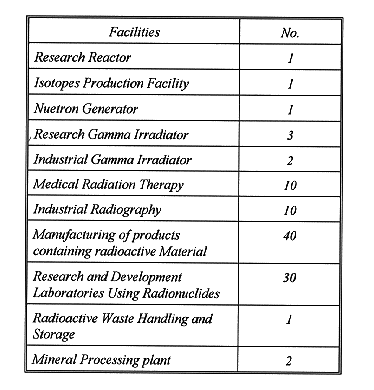
Table I Types of Nuclear and Radionuclides Utilizing Facilities in
Thailand
Pathom Yamkate
Office of Atomic Energy for Peace
Waste Management Division
Chatuchak, Bangkok, Thailand
ABSTRACT
The paper describes the sources and types of radioactive wastes arising in Thailand. The regulation as well as the classification for the management of radioactive waste is demonstrated. Inventory and the projection for a certain period of time in the future is also summarized.
INTRODUCTION
The production of radioisotopes, the operation of research reactors, the use of radioisotopes in industry, medicine and research has resulted in the accumulation of radioactive wastes which is now stored at Office of Atomic Energy for Peace (OAEP) premise at Chatuchak, Bangkok, Thailand.
Currently, there are about 100 licensed radioisotopes users in Thailand. These licensees are a heterogeneous mixture of individuals and institutions which possess the radionuclides of activity ranging from a few kilo becquerel up to some giga becquerel. Table I reveals the types of nuclear and radionuclides utilizing facilities in Thailand.
INFORMATION ABOUT CURRENT INVENTORIES OF WASTE GENERATION
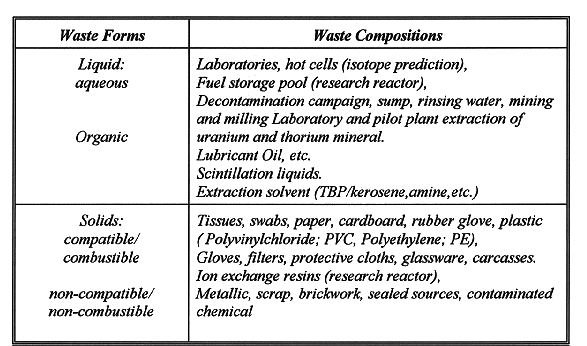
Apart from net benefits of nuclear utilizations, such development is inevitably accompanied by the increasing production of radioactive wastes in quantities and forms. Table II and III follow, disclose the inventory of waste stream arising from their usage.
Table I Types of Nuclear and Radionuclides Utilizing Facilities in
Thailand
Table II Distribution of Type of the Institution by Waste Stream
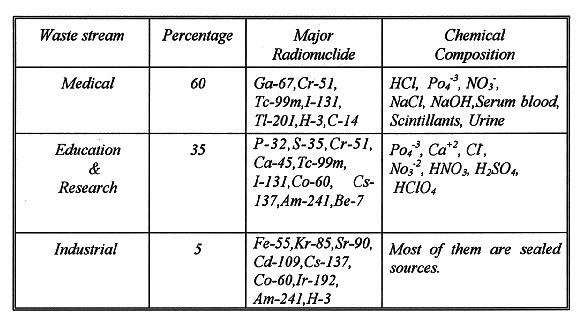
Table III The Principal Type of Radioactive Waste Generated in
Thailand
RADIOACTIVE WASTE MANAGEMENTS IN THAILAND
OAEP is in an unusual position because of its role as the countrys radiation protection and nuclear regulator while at the same time conducting nuclear activities. It is anticipated that an independent regulatory body covering all aspect of nuclear activity will be set and split off from OAEP when the nuclear power option will be adopted in Thailand. But up to now the OAEP try its best to fulfill the mission both as the regulatory body and as the national laboratory in nuclear science and technology.
Radioactive waste needs to be safely managed because it is potentially hazardous to human health and the environment. Thailand needs also to have a national framework for radioactive waste management. The Thai Atomic Energy Commission (Thai AEC.)set the policy that OAEP has to render the service of management of the radioactive wastes arising, to all radioisotope user in Thailand. The mission has been assigned to the Radioactive Waste Management Division(RWMD), serving as the National Waste Management Operating Organization of Thailand.
RADIOACTIVE WASTE REGULATION
It is a worldwide practice that radioactive waste has to be kept under control, their potential impact to man and his environment ,now and in the future, should be acceptably low. We realize that the safe management of radioactive waste relies on:
In process of setting laws and regulations framework, RWMD has established the guide lines for the management of radioactive waste. It is based on internationally agreed principles as recommended by IAEAs Radioactive Waste Safety Standards(RADWASS) program.
It is stipulated in the guide lines that:
DEVELOPMENT OF OPERATIONAL CAPABILITY
Since the main radioisotope users are those in the medical sector, thus, most of the wastes originated from the hospitals in Bangkok. The waste from this quarter can be estimated at 60 per cent of the total volume of waste production annually, while the wastes from agriculture and industrial sectors are less than 5 percent. The remainder figure ascribed to OAEP waste. All the waste emanated is accumulated at the place of the waste producer and, later on, transported by means of truck to OAEP.
The liquid wastes are predominantly aqueous solutions with low content of salts, and small amount of organic liquids. The quantities of untreated waste is about 200 cubic meter per year. The raw solid wastes constituted refuse or debris contaminated with radionuclides as well as biological waste are about 45 cubic meter per year. There are also a small volume of the spent radiation sources of Co-60, Kr-85, Sr-90, Cs-137 and Ra-226 sent to OAEP for further handling every year.
For liquid waste, the chemical co-precipitation process has been employed. For the solid waste, after segregation, the burnable waste was incinerated in a small incinerator, and non-burnable waste was packed in a compactor. The treated wastes such as the sludge residues, ash, compaction product and the used ion exchange resin, were then transferred to conditioning process, using cement as an immobilization means. The spent sealed radiation sources are kept in lead-shielding and packed in the high density concrete container. The end product, which is in the concrete container was kept in temporary storage in situate the OAEP locale. The amount of such waste product is about 400 drums.
The waste produced in Thailand is categorized as low level wastes and spent radiation sources. The activities of the low level wastes are in the range of 3.7 - 37 Bq/l for liquid, and about background level to 20 microsievert per hour. While, the activities of the spent radiation sources can be considered as a high activity waste ranging from a few kilo-becquerel up to some ten gega-becquerel per piece. The conditioned waste drums have been kept at the temporary storage at the present OAEP site.
The OAEP has a plan to establish a new nuclear research center at Ongkarak district in Nakornnayok province in a very near future. The new center, so called the Ongkarak Nuclear Research Center, constitutes of a research reactor, isotope production facilities, a number of physical and chemical laboratories and the waste processing and storage facilities (WPSF). At this WPSF, there will be facilities for accepting of incoming waste from within the center and from outside the center, treatment plants for both liquid and solid wastes, a conditioning facility, a well equipped decontamination hall, and a storage building for accumulation of conditioned waste packages. It is hoped that the new nuclear research center will be completed in the first year of next century.
At the same time, OAEP considers that there will be a need for a repository in the future, therefore, a plan for central disposal site has been set up. The option is the near surface disposal, for the reason that its technology is simple, very well-known, and the cost of operation is inexpensive and it is considered adequately safe by international community. Furthermore, the remedial actions can be achieved in case of abnormal situation. The proposed repository will be a fully engineered facility provided with-multi-barrier system to minimize and maintain within acceptable levels the consequence of any potential releases of radioactive materials into biosphere. The OAEP will commence the feasibility survey on various location for such disposal facility in Thai soil in the coming year.
THE PROJECTION OF WASTE FOR THE NEXT 30 YEAR
For estimating the amount of waste production in the next 30 year, the personal communication obtained from the survey are used along with the following assumptions.
Therefore, approximately, the total accumulated waste generation to be disposed of at the end of the year 2025 will be 3,500 m3. This amount of estimated wastes excludes the LLW and ILW from Nuclear Power Plant which may be operated at about the middle of the project plan period.
REFERENCE