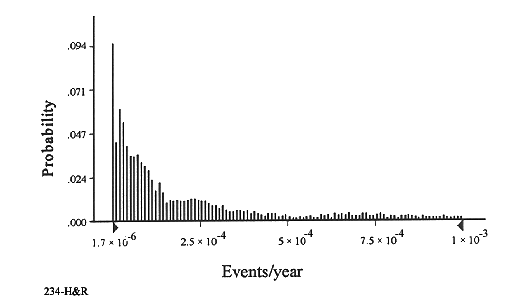
Fig. 1. Distribution of pipe leak
frequencies.
James E. Goss, P.E.
H&R Technical Associates, Inc.
151 Lafayette Drive, Suite 220
Oak Ridge, Tennessee 37830
J. Michael Singleton, P.E.
H&R Technical Associates,
Inc.
151 Lafayette Drive, Suite 220
Oak Ridge, Tennessee 37830
ABSTRACT
In this era of shrinking budgets and emphasis on costeffective cleanups, health and safety risk is an increasingly important factor in deciding among alternative waste-handling and remediation actions. This presentation describes a project in which a DOE site used worker and public health impacts as a decision tool and thereby succeeded in gaining waivers from specific regulatory requirements. DOE was thus able to choose a less costly alternative without compromising worker or public safety.
A key to the successful use of risk assessment as the basis for project and regulatory decisions is the development of reasonable assumptions concerning basic risk factors associated with the project. Historically, a common technique for health and safety risk assessment was to use highly conservative assumptions to ensure that all risks were bounded and to reduce assessment costs. Often, if the risks were found to be acceptable when these conservative assumptions were used, the assessment ended at that point. Paradoxically, this conservative approach sometimes led to misleading and unrealistically conservative results that left stakeholders and regulators with erroneous perceptions of the risk to the public, leading to more expensive cleanup projects with little real risk reduction. In the risk assessment described in this presentation, Monte Carlo techniques were used to quantify unknown values and thereby more accurately characterize health and safety risks.
At the DOE Site discussed in this presentation, the Federal Facility Agreement (FFA) requires that waste systems handling liquid low-level radioactive waste be doubly contained and equipped with leak detection systems. However, some short sections of piping that are embedded in concrete shield walls are single-walled and thus do not meet the FFA requirement. The health risk to the public from postulated leaks from the pipes as they now exist was compared with the health risk to workers in modifying the pipes. State and federal regulators used the results of this comparison as the basis for a waiver of the double containment regulatory requirement for the sections of pipe in question.
As the use of health and safety risk assessment as a decision tool increases, health and safety professionals must recognize the need to present risk models that more closely reflect the actual risks associated with operation (or failure) of a process or project and that are perceived by regulators and the public as reasonable.
INTRODUCTION
The Federal Facility Agreement (FFA) for a DOE site handling liquid low-level radioactive waste requires that the waste systems be doubly contained and equipped with leak detection systems. However, some short sections of piping that are embedded in concrete shield walls are single-walled and thus do not meet this requirement. The health risk to the public and facility workers from the pipes in their existing configuration was compared with the health risk to workers from modifying the pipes. State and federal regulators used the results of this assessment as the basis for a waiver of the double containment requirement for these pipe segments. DOE was thus able to choose a less costly alternative without compromising worker or public safety.
Earlier, simpler risk assessment techniques assumed worst-case conditions to ensure that the analysis bounded the risks. For example, a bounding assessment of the risk to the public originally showed a 3-mrem dose from a massive release of liquid waste, but a more realistic analysis showed a medium expected dose of 9.6 x 10⁻³ mrem. This philosophy, by projecting the most severe risk, was thought to adequately address all risks. In practice, such assessments frequently produced extremely conservative results that were unrealistic. Furthermore, regulators and the public often incorrectly assumed that the worst-case scenario was likely to occur, leading to unnecessarily expensive cleanup projects. For this assessment, the analysts estimated both the likelihood of a leak and the amount of contamination that would reach the environment. Monte Carlo techniques were used to develop a range of impacts and to model the uncertainty and variability of calculated health risk so that decision makers could make a more fully informed judgment of the health risk. Finally, the cost of the more realistic analysis was only slightly more than the cost of the bounding analysis.
Two primary scenarios were investigated: 1) health risk to the public from leaks of liquid low-level radioactive waste into surface water used for drinking and 2) health risk to workers that would result from radiation exposure while modifying the piping to meet regulatory requirements. Other potential modes of exposure are dominated by these scenarios. The assessment of the risk in each of the scenarios as well as the likelihood of a leak led to the following results:
In conclusion, suitable techniques are readily available to economically construct reasonable models of potential health and safety concerns, even when many unknown variables exist. When based on reasonable risk models, risk assessments are effective tools for deciding among alternative courses of action.
METHODOLOGY
In this section, the assumptions underlying this risk assessment are explained and the regulatory bases and specific techniques used to conduct the frequency and exposure assessments are described.
In this risk assessment, risk to workers and members of the public that could result if liquid low-level radioactive waste leaks from embedded piping is compared with the postulated risk to workers replacing or modifying the embedded piping. Leaks that flow into a secondarily contained area equipped with leak detection would be handled with existing procedures and would present no exposure consequences to workers or the public; therefore, leaks of this nature are not considered in this risk assessment.
Accepted risk assessment techniques were used. The public and workers were considered separately because of their differing potentials for exposure. Exposure of the public resulting from a leak in the embedded piping would require a breach in the system pressure boundary and the migration of waste material off the site. Projected exposures to workers participating in maintenance or replacement activities associated with the embedded piping would be more direct. Through Health Physics surveys and analysis of the material in various liquid low-level radioactive waste tanks, radiation levels in the work areas are known to be high and worker exposure is certain.
Risks to the public from a leak in a single-walled, embedded pipe are expressed in terms of the likelihood of a leak and the amount of radiation exposure resulting. Risks to workers replacing the embedded single-walled piping are expressed in terms of the radiation exposure and the ability to perform the work safely. The frequency assessment determines the likelihood of a leak from embedded piping. The exposure assessment addresses the uncertainty associated with the size of the leak and how much of the leak would be transported to and then through the soil to the receptors.
Leaked material that reaches the soil may migrate to groundwater or upward to the soil surface or may remain localized at the site. Most of the material that migrated is assumed to percolate to the groundwater table; however, a very small amount is assumed to migrate to the soil surface as vapor. Some of the material is assumed to be adsorbed onto the soil and to remain in place. (1)
A river downstream from the site is the first place at which surface water or groundwater from the site is used for drinking water. Users of the river for drinking water are assumed to be the off-site population group with the potential for exposure to the highest level of contaminants.
Basic Assumption
The basic assumption underlying both the frequency and exposure assessments is that a leak of concern from a section of embedded piping can migrate through the concrete and into the soil beneath the concrete wall. It should be noted that a crack in the concrete is not necessary for the migration of liquid low-level radioactive waste through the concrete. However, we assumed the presence of a crack because a crack could direct and increase the transport rate of liquid low-level radioactive waste to the soil. (2)
General Approach
Frequency assessment. For the frequency assessment, an empirical model developed by H.M.Thomas (3) was used. Thomas used a large data base of industry experience to develop his model for use by the nuclear industry to predict piping and vessel failures resulting from internal mechanisms. The modelwhich uses information on component size, shape, thickness, and construction details (such as the number of welds)yields a predicted failure frequency for a typical section of embedded piping. The Thomas model has been used by the chemical industry as well as by U.S. and foreign commercial nuclear power industries.
Uncertainty and sensitivity analyses were used to account for uncertainties in quantifying some factors in the Thomas model as well as other factors in the scenarios. Parameters for each variable that are known or could be estimated with some reasonable basis were fitted into one of several general distribution curves in a commercially available computer software package (Crystal Ball®). Using readily available software packages such as these enables the analyst to easily develop reasonable and defensible assumptions without adding significantly to the cost of the assessment.
Once distribution curves had been assigned to all applicable variables, a simulation, or series of iterations, was run by using a commercially available spreadsheet (Excel®) for the calculations. Using the output from each of these iterations, the computer software produced a distribution of results that showed the number of outcomes and the probability of occurrence for each. For example, one factor in the Thomas model, a weld penalty factor, accounts for the fact that leaks occur more often in welds than in the base metal of pipes. Industry literature contains a distribution of weld penalty factors that includes the probability of occurrence for each.
Rather than a single weld penalty factor, a distribution curve for the range of factors that appears in the literature was used in this assessment. A simulation was then run in which the Thomas model equation was solved 10,000 times. During each run through the equation, the computer selected a value for the weld penalty factor from the distribution. Over the course of many runs, the values selected by the computer approached the distribution curve for the factor. This same technique was used for several uncertain quantities. The results of the simulation are also shown as a distribution of frequency vs. probability in the results. To give the reader a sense of the data spread, the results distribution is also shown as a function of confidence level.
For this frequency assessment, contributions from seismic events were not considered. Seismic events would dominate the frequency of large leaks and ruptures (1 (breve) 10-3/year for a 0.19-g event according to Kennedy (4) and would likely affect the entire liquid low- level radioactive waste system, thereby causing multiple leaks and ruptures of tanks and piping and resulting in consequences more significant than those analyzed in this report. Because the entire system is designed to the same seismic criteria, an event that caused failures in the embedded lines would likely have similar effects on the doubly contained lines and tank systems.
Exposure assessment: the public. In the public exposure scenario used for this assessment, radioisotopes from a leaking embedded pipe migrate beyond the facility boundary by way of either the groundwater or surface water pathways. The leaking contaminants follow the geologic gradients or other flow paths toward the river tributaries that drain the site. Off-site transport by means of atmospheric dispersion following suspension of radioisotopes into the air is considered insignificant. The radioisotopes 90Sr, 244Cm, and 241Am account for approximately 99% of the potential dose to the public.
The techniques for assessing public exposure are based on the guidance and methods in the EPA report Limiting Values of Radionuclides in Air, Water and Soil (5) and other guidance specific to the site. An individual residing outside the site boundary is assumed to use contaminated water for domestic and recreational purposes. The following pathways are postulated:
Exposure through ingestion of foodstuffs that have been irrigated with contaminated water is considered insignificant, because rainfall is usually abundant in the area and irrigation is not widely practiced. Furthermore, if irrigation were widespread, ingestion of foodstuffs that have been irrigated by contaminated water usually results in lower doses than direct ingestion of radioisotopes in drinking water. The dose from all pathways is determined almost entirely by the dose from the drinking water pathway alone. Because the public dose from swimming in contaminated water and ingesting milk and meat from cattle that drink contaminated water would be less than 4% of the total dose, these pathways are not considered in this assessment.
To assess the potential dose to persons whose drinking water source is the river, an appropriate comparative index must be selected. EPA has established general regulations for radioisotopes, in terms of allowable doses, under the Clean Water Act, 40 CFR 141.16, "Maximum Contaminant Levels for Beta Particle and Photon Radioactivity from Man-Made Radionuclides In Community Water Systems." The regulation limits the average annual concentration of beta and photon radioactivity from man-made radionuclides in drinking water to that which will not produce an annual dose equivalent to the total body or any internal organ greater than 4mrem/year. EPA has not developed concentration limits for every radioisotope. However, if an effective dose equivalent of 4 mrem/year from any radioisotope is assumed, established dose conversion factors (5) can be used to determine the dose for the isotopes of interest. In this assessment of public exposure, a hypothetical distribution of contaminant releases to the public water supply was used to account for the uncertainties in leak size and the amount of a leak that would actually reach the soil.
Exposure assessment: workers. Although accidental releases during piping replacement are a potential source of worker exposure, assessment of the likelihood and consequences of an accidental release is outside the scope of this analysis. If the replacement option is pursued, the likelihood and consequences associated with postulated accidents would be reviewed during a safety analysis of the piping replacement.
The techniques for assessing worker exposure are based on the guidance and methods presented in the EPA's External Exposure to Radionuclides in Air, Water, and Soil. (6) In the scenario used for this exposure assessment, workers are exposed to direct radiation from the liquid low-level radioactive waste in nearby tanks when removing and replacing the existing single-walled embedded piping. Although workers would be prepared for the exposure and extensive safeguards would be implemented, the external doses would be high.
The calculated effective external dose for workers in the liquid low-level radioactive waste storage tank vaults provided the bounding dose for all other tanks. An allowable cumulative dose for all workers would be established during the replacement project to comply with DOE as-low-as-reasonably-achievable (ALARA) guidelines in DOE Order 5480.11, Radiation Protection for Occupational Workers (7) (replaced by 10CFR835), and administrative controls would limit the exposure of any single individual. For the purpose of calculating the projected doses from the sludge and liquid, the exposed workers are assumed to be standing on top of the tank for the liquid dose rate or standing near the bottom of the tank for the sludge dose rate. Calculations for the cumulative project dose were completed under the assumption that all exposure would be to the liquid because most of the work would take place near the top of the tank.
Actions to reduce worker exposure may be possible. In some cases, the radiation source may be removed, temporary shielding may be installed, or robotic equipment may be used. However, no alternative storage place will be available for the waste in the storage tanks until 1998. Installing shielding in the work areas would be difficult because of congestion in the vaults. The congested environment would also make the installation or operation of robotic equipment impractical, given the technology currently available. Justification thus exists for assuming significant worker exposure.
RESULTS
Risks Associated with Leaving the Single-walled Embedded Piping in Place
Frequency Assessment. The distribution of forecasted pipe leak frequencies is presented in Fig.1. The predicted frequency of a pipe leak is shown on the x-axis, and its probability of occurrence during the simulation is shown on the y-axis. Distributions for the scaling factor, weld factor, quality factor, number of embedded piping penetrations, and pipe wall thickness were the assumptions used in the simulation.
The forecasted values of a leak in the embedded piping range from 2 (breve)10-6/year to 5 (breve) 10-3/year with a median value of 2 (breve) 10-4/year.
Fig. 1. Distribution of pipe leak
frequencies.
Exposure Assessment: the Public. Potential exposure of the public is presented as a distribution in Fig. 2. The only pathway of significance is the drinking water route. Distributions of the leak size, concentration reduction factor, flow rate of the river, and potential concentrations of radioisotopes in the storage tanks were the assumptions used in the simulation to generate the distribution of postulated doses. The forecasted values of postulated doses to the public from a leak range from 9 (breve) 10-5 mrem effective dose equivalent (EDE) to 0.34 mrem EDE, with a median value of 9.6(breve)10-3 mrem EDE. The allowable dose through drinking water, as established by EPA in the Safe Drinking Water Act, is 4 mrem/year EDE.
Exposure Assessment: Workers. The exposure assessment for workers who would replace embedded piping focused on the risks associated with replacing the piping in the walls of vaults containing the liquid low-level radioactive waste storage tanks. Egress from and ingress into the vaults to reach the piping would be laborious and time-consuming because of the congested conditions in the vaults and the need for workers to use personal protective equipment. Additionally, the congested environment limits the use of robotic equipment with currently available technology and complicates the installation of shielding to protect the workers. Removing the source of radiation from many of the tanks is not possible now because suitable alternate storage facilities are lacking.
The distribution of the expected hourly dose rate is presented in Fig. 3. The dose rate ranges from 710 to 5600 mrem/h, with a median of 3000 mrem/h. The dose to individual workers engaged in modifying the piping to meet FFA requirements would be limited by DOE requirements and administrative controls. However, total exposure to the workers as a group would be high, and spreading the dose across a larger group to control individual doses is not consistent with the ALARA principles under which DOE operates.
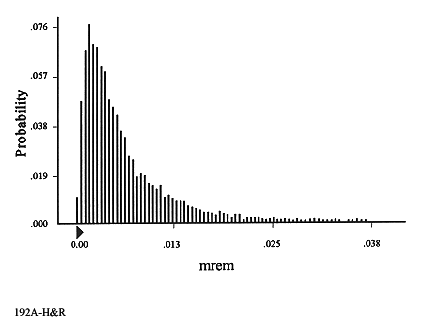
Fig. 2. Distribution of postulated
radionuclide doses to public from drinking water.
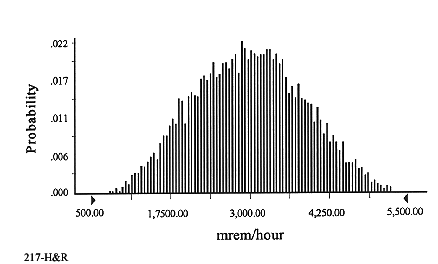
Fig. 3. Distribution of worker dose
rate from liquid concentrate during replacement of piping.
A distribution was also calculated for a cumulative project dose and expected cancer fatalities for the project to replace the embedded piping associated with the storage tanks. The cumulative dose was calculated by using the dose rate distribution for the liquid concentrate in the tanks. The length of time that workers would be exposed to sludges during the replacement project was not projected to be significant. Distributions of the expected cumulative dose are shown in Fig. 4. The range of cumulative dose is 2300 rem to 18,000rem, with a median of 8800 rem.
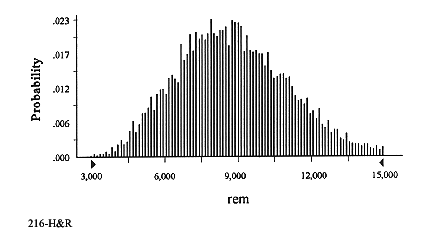
Fig. 4. Distribution of cumulative
worker dose rate for all workers from replacement of piping.
CONCLUSIONS
The conclusions of the risk assessment are as follows:
This risk assessment demonstrates that the very low risk to the public from drinking river water after a postulated leak of low level waste into the river does not justify the risk to workers from radiation exposure while modifying the piping system. As a result, state and federal regulators granted a waiver from the requirement that these pipe segments be doubly contained. In conclusion, suitable techniques are readily available to economically construct reasonable models of potential health and safety concerns, even when many unknown variables exists.
This project demonstrates that risk assessment can be a highly effective and economical decision tool when based on reasonable assumptions that are clearly presented to regulators and the public. Effective use of this tool results in the selection of waste management alternatives that protect the public, workers, and the environment while efficiently using the dollars available in shrinking budgets.
REFERENCES