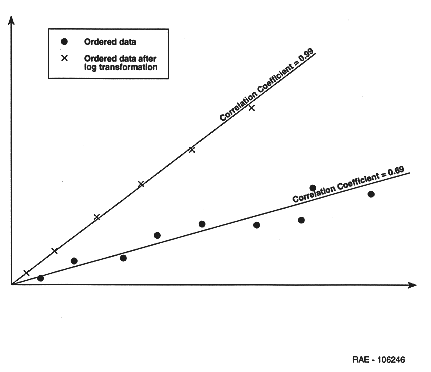
Fig. 1. Correlation coefficient
comparison for distribution type identification.
Vern Rogers and Robert D. Baird
Rogers & Associates
Engineering Corporation
P.O. Box 330
Salt Lake City, UT 84110-0330
Phone: (801) 263-1600
FAX: (801) 262-1527
ABSTRACT
The license application process for a low-level radioactive waste disposal facility requires that a preoperational monitoring program be implemented to determine natural background levels of potential contaminants and other natural conditions at the facility site. Data from preoperational monitoring are used to evaluate the facility's environmental performance as it begins operations. To ensure that the preoperational data serve as an adequate baseline for performance assessment: 1) data variability, distributions, and trends must be characterized, 2) regulatory-based detection limits must be identified, 3) appropriate treatment of lower-than-detection-limit values must be established, and 4) the overall statistical validity and adequacy of the preoperational and operational monitoring programs must be determined. Incorrect baseline data or inadequate program requirements, if left unaddressed, could result in remedial actions being triggered unnecessarily. For example, if not accounted for, data trends attributable to random variation or seasonal changes could unnecessarily trigger remedial actions. Deficient baseline data or monitoring requirements also could lead to action levels being set too high and thus allow contaminant releases to be overlooked. A general approach has been developed and applied to a specific site to determine the statistical validity and adequacy of preoperational monitoring programs and necessary data characteristics.
INTRODUCTION
The license application process for a low-level radioactive waste disposal facility requires that a preoperational monitoring program be implemented to determine natural background levels for certain baseline environmental conditions at the facility site and to identify possible fluctuations in these data. These baseline data are used to evaluate the environmental monitoring results and performance of the facility once it begins operations.
The data provided by the preoperational monitoring program are important because they will be used with operational environmental monitoring data to initiate environmental protection measures depending on the degree of environmental release detected. Because action levels are generally determined on the basis of distribution medians, standard deviations, and time trends, the preoperational program must adequately characterize each environmental parameter.
A general approach has been developed and applied to a specific site to determine the statistical validity and adequacy of preoperational monitoring programs and necessary data characteristics. Data variability, distribution, and trends are characterized. Regulatory-based detection limits are identified. Appropriate treatment of lower-than-detection-limit values are established. The overall statistical validity and adequacy of the preoperational monitoring program has been determined. Finally, a summary is given and conclusions are drawn.
APPROACH
The general approach developed to evaluate preoperational monitoring program data involves the following six steps:
IDENTIFY PREOPERATIONAL MONITORING PROGRAM DATA
Preoperational monitoring program background measurements are generally presented in license applications and in Preoperational Monitoring Program annual reports. Background contaminant levels are generally measured in air particulate, groundwater, surface water, vegetation, mammal tissue, surface soil, and sediment soil. The contaminant parameters measured also may include, where applicable, gross alpha activity, gross beta activity, suspended solids, pH, alkalinity, conductivity, corrosivity, dissolved solids, and various radionuclides and chemicals. Additionally, the background gamma radiation and radon flux from soils is generally measured. All of these measurements from a specific site were reviewed for a 4-year period spanning September 1993 through the end of 1995.
IDENTIFY DATA VARIABILITY AND BIASES
Identifying sources of variability and bias in the preoperational monitoring program data is vital to determining when different action level responses should be taken. Data variability and bias sources can be grouped into four categories: a) random, b) cyclic, c) systematic, and d) classification.
Random variations and biases represent those uncertainties and variations that generally are present in sampling and measurement processes. Even when the same person samples the same source using the same equipment over and over, random variations will unavoidably cause a distribution of results. For example, the content of K-40 in soil sampled at the test location from January 1995 to October 1995 ranges from 13.8 pCi/g to 15.6 pCi/g, even though the K-40 content of soil generally does not change over such a short period of time.
In many cases, random variations in data from the test site have shown a pattern of increases for three consecutive monitoring periods (gross beta in vegetation at two locations; gross alpha/beta in surface water at one location; gross alpha in several groundwater wells; Cs-137 and K-40 concentrations in sediment at the sampled locations; Cs-137 in the soil at one location; K-40 in the soil at one location; and total suspended solids at two locations. For example, tritium concentrations in surface water in a lake increase consecutively over 3 measurements from 900 pCi/l to 22,630 pCi/l (by a factor of over 25). While such a large difference is partially attributable to random variation, it is possible that other sources of bias and variability are also present. According to criteria generally applied, such a series of increases could trigger an action level response if it were to occur during disposal operations. In fact, if taken during disposal operations, the preoperational monitoring program measurements from the test site would require that over 20 action level responses be initiated, even before waste has been disposed of at the facility.
Cyclic variations and biases represent the effects of cyclic changes in environmental conditions. Cycles affecting data can include seasonal or even daily changes in the environment. Without prior recognition of cyclic or seasonal trends, an action level response could be triggered unnecessarily during operations. For example, gross alpha and beta measurements in vegetation taken in September and October at the test location are generally lower than those taken during March and April. However, C-14 concentrations in vegetation are higher in September and October than those measured in March and April.
Systematic biases can also affect data. For example, when several laboratories are used to analyze preoperational monitoring program samples, the effects of potential differences in equipment and analysis procedures between these laboratories can lead to systematic differences and bases in the results. For example, data analyzed by a separate laboratory between 1992 and 1993 were found to be erroneously high in systematic bias and excluded from this study. This first laboratory measured an average gross beta count in air as 0.014 pCi/m3 while a second found as high as 0.037 pCi/m3 (2.6 times higher).
Finally, classification errors (attributable to both humans and equipment) can lead to erroneous conclusions. Small gamma-ray peaks in crowded spectral regions can lead to misidentification of nuclides, especially when automated spectrum analysis software is used to make the identifications. For example, an average concentration of 2 pCi/g of Cd-109 in soil and sediments at the test location was reported between September 1993 and October 1994. In the initial analysis of the preoperational monitoring program data, this result was identified as questionable because Cd-109 is neither naturally occurring nor a typical product of weapons-testing fallout or other potential sources. Cases like these require explanation if they are to represent the site's background conditions.
CHARACTERIZE DATA DISTRIBUTIONS
While measurement distributions can take several forms, only normal and log-normal distributions are considered in the analysis to simplify the use of the data obtained during preoperational monitoring program. Environmental data generally have been found to be of one of these two distribution types.
To characterize data distributions, the normality or log-normality of the distributions of preoperational monitoring program measurements is first determined from distribution symmetry. Since 95.4 percent of all data fall within two standard deviations of the mean for a normal distribution, (1) concentrations should remain positive even when they are two standard deviations below the mean for normally distributed measurements. Using this criterion, distributions are classified as log-normal whenever the 95-percent lower confidence limit was less than zero.
In instances where the lower 95-percent confidence limit is positive, the distribution is further characterized using the method of Nielson and Rogers. (2) As illustrated in Fig. 1, this method is based conceptually on the normal probability plot. Data are ordered and then are compared directly and after log-transformation to a computed normal cumulative probability scale. The comparison resulting in the highest correlation coefficient (exhibiting the most linear relationship) classifies the distribution as either normal or log-normal. Distribution testing for groups of less than 10 measurements is imprecise and therefore inconclusive. (3)
Fig. 1. Correlation coefficient
comparison for distribution type identification.
The results from the test location indicate a general pattern of log-normality, consistent with the fact that log-normality in environmental monitoring is commonly observed. (4) The main exception to this generalization is alkalinity, which is predominantly found to be normally distributed in environmental groundwater samples.
ESTABLISHING REGULATORY-BASED MINIMUM DETECTION LIMITS
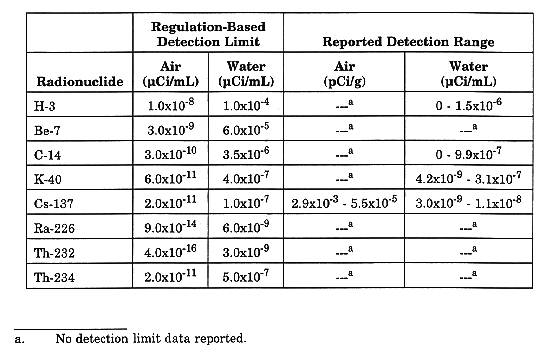
The primary objective of establishing regulatory-based minimum detection limits is to ensure that contamination can be detected at a level less than or equal to the regulatory release criteria. Several regulatory limits exist that apply to the radiological performance of a low-level radioactive waste disposal facility. For example, 10 CFR 61.41 specifies that any member of the public should not receive more than 25 mrem/year to the whole body, 75 mrem/year to the thyroid, and 25 mrem/year to any other organ. Additional limits are stated in 10 CFR 20 for worker safety. However, both sets of regulations specify exposure limits for the sum total of all radionuclides present in releases. Because of this, minimum detection limits cannot be easily established based solely on these regulations. 10 CFR 20 does, however, also specify maximum allowable effluent concentrations in air and water for individual radionuclides that are applicable to the assessment and control of dose to the public. By applying a conservatism of 10 percent to these limits, resulting nuclide-specific detection limits can be calculated for those nuclides included in preoperational monitoring program data. Example lower detection limits are given in Table I. A detection limit specified at 10 percent of the applicable concentrations is typical of conditions found in radioactive material licenses.
Table I Lower Detection Limits Based on Applying a 10-percent
Conservatism to the 10 CFR 20 Effluent Requirements
While other regulations such as those of the Clean Air Act govern applicable pathways, they do not specify effluent or detection limits and thus are not as applied in the evaluation of preoperational data.
COMPUTE UNBIASED PREOPERATIONAL PROGRAM STATISTICS
In environmental monitoring of radionuclides, chemical compounds, and trace elements, measurements representing a single pathway often span wide ranges. Using measurements to characterize background levels for these sources requires a central value and variation parameter. When estimating central values and variation parameters, the effect of biases should be taken into account. Three common causes of bias in estimated distribution parameters are a) the choice of distribution attributed to the data, b) the method of dealing with the fraction of data reported to be below the measurement detection limit, and c) variations in sample volumes.
Values that are below the detection limit are sometimes ignored or reported as zero, as "below the detection limit," as the numerical detection limit itself, or as the analytically measured values. To interpret data distributions containing below-detection-limit data points, special methods are required to avoid biased estimates of the means and standard deviations. Using these methods (2) expected values of data below detectable limits are extrapolated from the cumulative probability scale discussed above. These values then are included to avoid the biases from improper handling of measurements below the detection limit. Two possible results of excluding below-detection-limit data are a higher median and lower geometric standard deviation. Conversely, including below-detection-limit data as zero results in an artificially lower mean and an unrepresentatively large standard deviation.
Biases in statistical distributions may also result from variations in sample volume. For example, sampling programs that use different sample volumes to repetitively monitor the same parameter may yield different geometric mean concentrations if the parameter is not always detected. (5) This effect is statistical in nature and results from the sample volume being too small in comparison to the scale of heterogeneity for the material being monitored.
EVALUATE PREOPERATIONAL PROGRAM DATA TRENDS
To prevent action level responses from being taken unnecessarily, trends in the preoperational monitoring program data must be reviewed and accounted for before comparing the data with operational monitoring program data. Several possible trends in the preoperational monitoring program data have already been discussed with respect to sources of bias and analysis of distribution types. Trends such as successive increases attributed to random variation require careful data selection and rejection to accurately define true background distributions. These trends also call for precautions to avoid similar problems throughout the remaining preoperations period and during the operational monitoring program.
The first trend generally observable in the preoperational monitoring program data is attributable to cyclic changes in the environment. For example, gross alpha and beta measurements in vegetation taken from the test location in September and October are generally lower than those taken during March and April. However, C-14 concentrations in vegetation are higher in September and October than those measured in March and April. Further evidence of cyclic trends is visible in the surface water measurements. For the test location, collection tanks are generally reported as dry for the summer and fall months. Additionally, average radon concentrations in the air are also generally higher in October than in July. Although sampling procedures cannot be altered to eliminate these trends, cyclic background values can be used during the operational program to appropriately account for them. These seasonal fluctuations in background data would trigger action level responses if not correctly identified as cyclic in nature.
A second overall trend is in the difference among sampling locations for some of the measurements. For example, differences in measurements from different locations around the test site indicate that data averaged over these different locations should not be used to estimate background distributions of groundwater and total suspended solids in airborne particulates. This is evident in the medians calculated for the suspended solids measured at two locations (85 µg/m3 and 131 µg/m3). A location-averaged background distribution may give a standard deviation that are too high for sensitive recognition of contamination during the operational program. (The test location with the highest mean is next to a road, and so it would naturally have a higher level of suspended solids due to vehicular traffic.)
Precautions must be taken to prevent action level responses from being taken unnecessarily. Precautions may even require procedural changes in the Preoperational and Operational Programs to avoid seasonal and location-specific trends.
RESULTS AND CONCLUSIONS
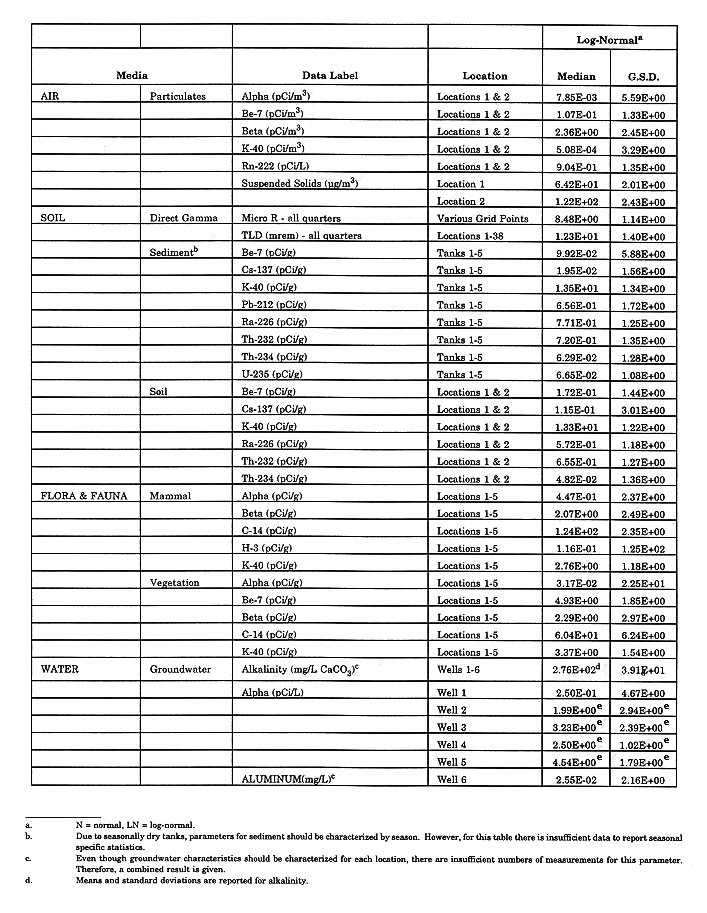
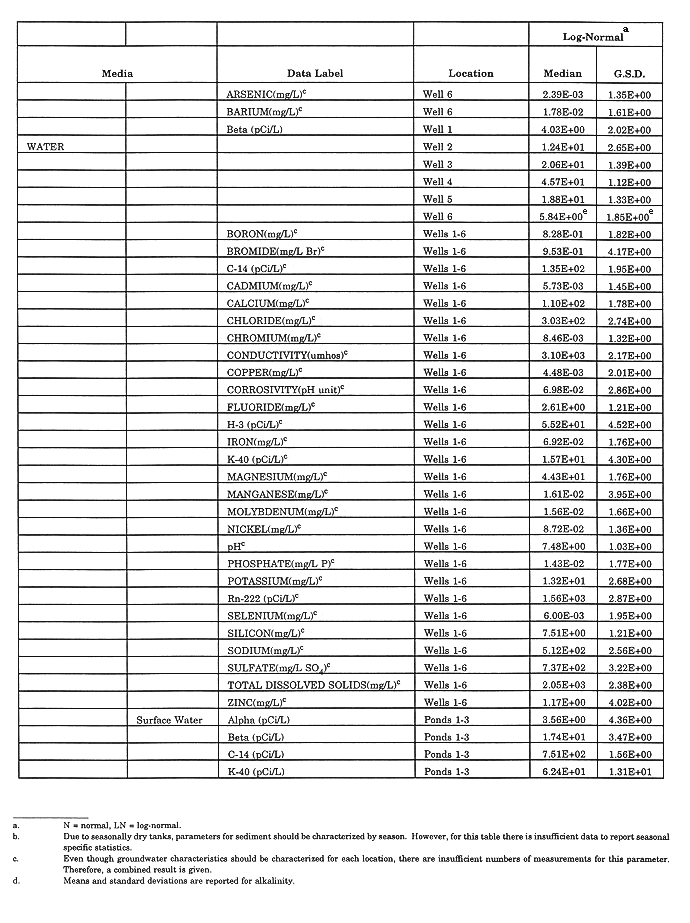
For each distribution type, unbiased central values (medians for log-normal distributions and means for normal distributions) are computed that include below-detection-limit data. The unbiased statistics computed are summarized in Table II. Separate statistical parameters are reported for each groundwater location and for the total suspended solids in air.
Table II Summary of unbiased statistics
REFERENCES