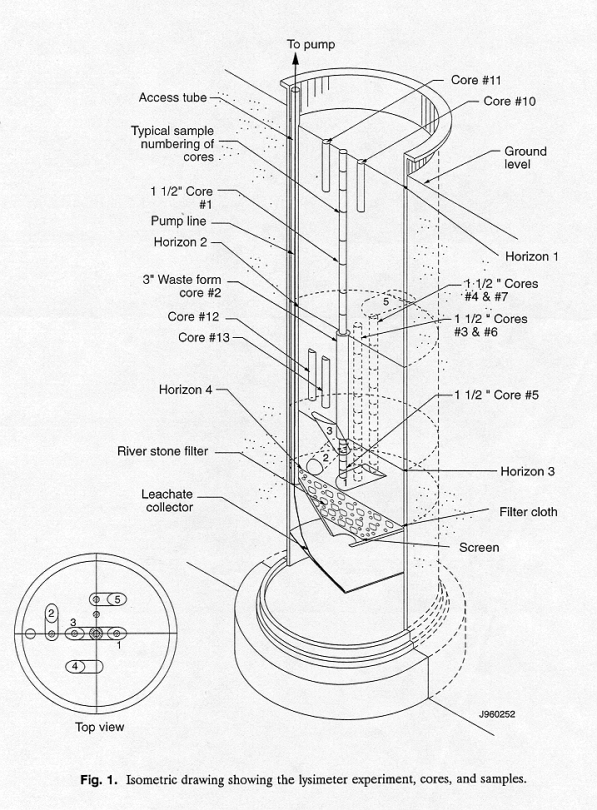
Fig. 1. Isometric drawing showing the
lysimeter experiment, cores, and samples.
John W. McConnell, Jr., Robert D. Rogers
Idaho National
Engineering Laboratory
P.O.Box 1625
Idaho Falls, Idaho 83415
Julie D. Jastrow
Argonne National Laboratory
Argonne, IL 60439
William E. Sanford
Colorado State University
Fort
Collins, CO 80523
Steven R. Cline
Oak Ridge National Laboratory
Oak
Ridge, TN 37831
Terry M. Sullivan and Mark Fuhrmann
Brookhaven National
Laboratory
Upton, NY 11973
Phil R. Reed
USNRC
Rockville, MD 20852
ABSTRACT
The Field Lysimeter Investigations: Low-Level Waste Data Base Development Program is obtaining information on the performance of radioactive waste forms. These experiments were recently shut down and have been examined in accordance with a detailed waste form and soil sampling plan. Ion-exchange resins from a commercial nuclear power station were solidified into waste forms using portland cement and vinyl ester-styrene. These waste forms were tested to a) obtain information on performance of waste forms in typical disposal environments, b) compare field results with bench leach studies, c) develop a low-level waste data base for use in performance assessment source term calculations, and d) apply the DUST computer code to compare predicted cumulative release to actual field data. The program, funded by the Nuclear Regulatory Commission (NRC), includes observed radionuclide releases from waste forms in field lysimeters. The purpose of this paper is to present the experimental results of two lysimeter arrays after 10 years of operation, and to compare those results to bench test results and to DUST code predictions of releases using recently developed partition coefficients. This paper discusses soil and waste form sampling in which vertical cores were removed from the lysimeter soil columns for laboratory characterization. Those samples will be analyzed for radionuclide movement from the waste forms and through the soil columns. Further analysis of soil cores taken to define the observed upward migration of radionuclides in one lysimeter is also presented.
INTRODUCTION
This paper presents 10 years of experimental results of two instrumented field lysimeter arrays. While results of this program have been presented at previous WM meetings, this paper will give an update of the study, which will include discussion of the results of the examination of the soils and waste forms of the two lysimeter arrays after experiment shutdown and exhumation. During the examination, the waste forms are being characterized, after removal from the lysimeter, and these results compared to the original characterizations, thus providing the basis for a material balance of the radionuclides present. Vertical soil cores were taken from the soil columns and are being analyzed by radio chemistry to determine movement of radionuclides after release from the waste forms. A comparison is made of the DUST code predicted releases to releases previously determined and reported from the lysimeter leachate analyses. That comparison uses new distribution coefficients (Kd) recently obtained from laboratory analysis of the lysimeter soils and sand.
Concern over the practices associated with the disposal of low-level radioactive waste (LLW) has resulted in a very real need to obtain accurate data on the long-term field performance of these wastes. The U.S. Nuclear Regulatory Commission (NRC) has enacted regulations that link LLW acceptance criteria to the long-term satisfactory performance of the waste. Under Code of Federal Regulations (CFR) 10, Part 61, "Licensing Requirements for Land Disposal of Radioactive Wastes" (1)f, commercially generated LLW is classified as Class A, B, C, or Greater Than Class C. Wastes classified as either Class B or Class C must be stabilized for a minimum of 300 years.
To verify the 300-year stability of waste forms, the NRC originally specified the use of short-term standardized tests with the intention that such tests would provide information relevant to near-surface disposal performance objectives. Those tests, which were initially published in the NRC Branch "Technical Position on Waste Form" (2), and have been revised in Revision 1 of the Technical Position (3), continue to undergo critical reviews to determine their applicability to the 300-year stability requirements.
A central requirement for disposing LLW is the need for a detailed understanding of the waste form behavior. That is necessary because the radionuclide source is the driving force behind the site performance. A major requirement in any site licensing is the site performance assessment, which is used to evaluate whether or not a proposed disposal site will meet performance objectives. Assumptions regarding the performance of the buried waste form have a direct bearing on the outcome of the performance assessment.
The objective of the Field Lysimeter Investigations: Low-Level Waste Data Base Development Program is to compare the results of short-term laboratory leach testing, performed earlier by the INEL, with actual leaching in the field. Also, the waste forms are being field-tested to develop a low-level radioactive waste leach rate data base. This program, funded by the NRC, has been operating lysimeters for over 10 years to obtain information on the performance of radioactive waste forms in a disposal environment and to investigate waste form stability per requirements of 10 CFR 61. The experiment measures the releases of radionuclides and chemical species from the waste forms and the subsequent transport through soil columns to sampling locations within the lysimeters. This study was developed to field test waste forms composed of solidified ion-exchange resin materials from EPICOR-II prefilters used in the cleanup of Unit 2 of the Three Mile Island Nuclear Power Station (4). Wastes used in the study are significant because they have high loadings of radionuclides and are comprised on ion-exchange media of the type used by the nuclear industry.
EXPERIMENT DESCRIPTION
Wastes used in the experiment include a mixture of highly loaded, nuclear-grade, synthetic, organic ion-exchange resins from EPICOR-II prefilter PF-7 and a mixture of organic-exchange resins and an inorganic zeolite from prefilter PF-24. Solidification agents employed to produce the 4.8x7.6-cm cylindrical waste forms used in the study were portland typeI-II cement and DOW vinyl ester-styrene (VES). Seven of the waste forms were stacked end-to-end and inserted into each lysimeter to provide a 1-L volume. The PF-7 waste contained 89% of the radionuclide activity as Cs-137, while PF-24 contained 94% Cs-137. The PF-7 waste also contained 5% Sr-90, and PF-24 contained 1% Sr-90. There were also measurable amounts of Cs-134, Co-60, and Sb-125 found in those wastes. Details on waste form descriptions, formulations, and technical position testing are given in Refs. (4) and (5). A listing of lysimeter waste form and fill material types are given in Ref. (6).
Ten lysimeters were used in this study: five at Oak Ridge National Laboratory (ORNL) in Tennessee and five at Argonne National Laboratory-East (ANL-E) in Illinois. The lysimeters were designed to be self-contained units that will be disposed at the termination of the study. Each lysimeter is a 0.91(breve)3.12-m right-circular cylinder divided into an upper compartment that contains fill material, waste forms, and instrumentation, and a lower compartment for collecting leachate (Fig.1). Four lysimeters at each site are filled with soil; a fifth, used as a control, is filled with inert silica oxide sand. The lysimeters at ANL-E contain soil indigenous to the site, while the ORNL lysimeters contain soil taken from Savannah River Laboratory in South Carolina. The soil columns are 2.21mdeep.
Fig. 1. Isometric drawing showing the
lysimeter experiment, cores, and samples.
Instrumentation in each lysimeter includes moisture cup soil-water samplers and soil moisture/temperature probes. The probes are connected to an onsite data acquisition system (DAS), which also collects data from a field meteorological station located at each site. Porous cup soil-water samplers and the leachate collection compartment comprise the water sampling components of each lysimeter (Fig. 1). Incoming precipitation moves downward through the soil column to the waste form, then on to cups 3 and 1, and finally to the leachate collector at the bottom. Moisture entering the soil at the edge of the lysimeter encounters cups 5, 4, or 2 as it moves downward. Samples of moisture are withdrawn from the cups and the collector. Radial movement of waste form releases are detected in cups 5, 4, and 2, while vertical release is observed by cups 3 and 1. Lysimeter design, installation, instrumentation, operation, and data acquisition are explained in Ref. (6).
Monitoring of the lysimeters at ANL-E and ORNL began with the collection of liquid samples in September 1985 (3 months from the time of placement) and continued through shutdown in October 1995 with sample collection on approximately a quarterly basis. Samples of liquids were taken from locations near the waste forms and from the leachate collectors to track the migration of radionuclides, primarily Cs-137. The water samples were analyzed for Sr-90 and gamma-producing nuclides. Each month, data stored on a cassette tape in the DAS were retrieved and translated into an IBM PC-compatible disk file. Soil moisture and temperature at three elevations in each lysimeter, along with a complete weather history, were recorded on a continuing basis by the DAS. Testing results are presented in Ref. (7) as well as in this paper.
RESULTS AND DISCUSSION
Weather and Soil Data
Precipitation, air temperature, wind speed, and relative humidity were recorded continuously by the ANL-E and ORNL DAS during the experiment. The cumulative volume of leachate from the lysimeters since the initiation of field work, and examples of the lysimeter soil temperature and moisture data obtained at ANL-E and ORNL can be found in Ref. (7). Data recorded in FY-95 indicate that the lysimeter soil columns at both sites have remained moist during the last reporting period.
Radionuclide Data from Leachates
Figure 2 shows examples of data on the cumulative amounts of nuclides as determined in water samples obtained from ANL-E and ORNL leachate collectors. Other data show that not all nuclides consistently appeared in the water obtained from the moisture cups or the leachate collectors. The nuclide that appeared with the most regularity at both sites was Sr-90. Table I contains a comparison of the percent of inventory release of Sr-90 and Cs-137 found in the moisture cups and leachate water.
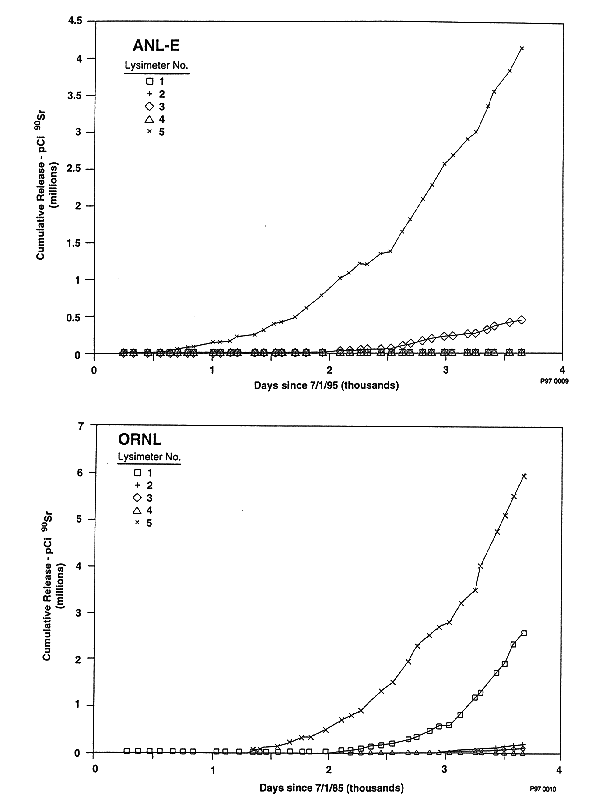
Fig. 2. Cumulative Sr-90 collected in
lysimeter leachate collectors.
Table I Percent Release of Sr-90 and Cs-137 per Lysimeter in
Moisture Cups and Leachate Water through July 1995 (7) 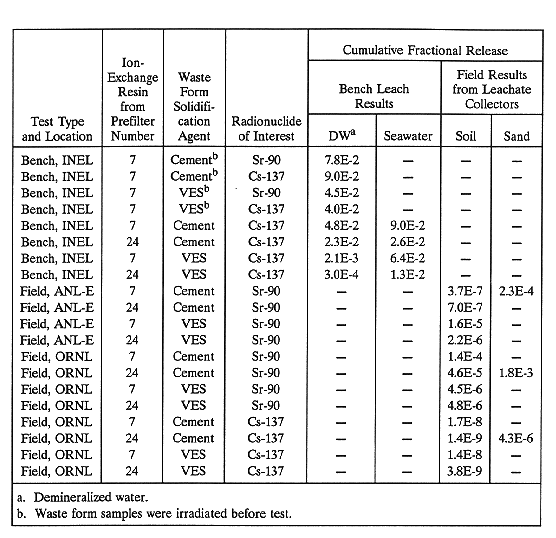
At both ANL-E and ORNL, recovery of Sr-90 in number 3 cups (22.4 cm below the waste form in the soil column) and the leachate collectors indicates a varied waste form performance (Table I). Recovery of Sr-90 in the ORNL cups is comparable for those lysimeters containing the cement waste forms and one of the two containing VES waste forms. However, the cups at ANL-E are recovering much more Sr-90 from the VES waste forms compared to the cement waste forms. These data indicate that releases from the cement waste forms are generally less than from VES waste forms.
Movement of the nuclide into the leachate collectors of the inert, sand-filled control lysimeter 5 is much greater than that of the other lysimeters and thus provides evidence of the moderating effect of soil (versus the inert sand) in those lysimeters. During the past several years, leachate collector water from the control lysimeters at each site has contained amounts of Sr-90 at least an order of magnitude larger than releases from the soil lysimeters (Fig. 2) (7). The total Sr-90 being measured in the leachate collector waters remains somewhat inconsistent between the two sites (Table I). It is suspected that this represents a difference in how the environment at the two sites affects the movement of Sr-90 being released from the waste forms. The higher release of Sr-90 from the ORNL control lysimeter waste form reflects the nearly 50% higher rainfall experienced at that site over that seen at ANL-E.
Gamma-producing nuclides continue to occur with regularity at both sites (Table I). However, only waste forms at ORNL are releasing detectable amounts of Cs-137 to the leachate waters (Table I). It is not possible to make a comparison of Cs-137 releases from cement and VES waste forms at this time due to the small releases.
Table II is a comparison of cumulative fractional releases from field testing EPICOR-II waste forms in lysimeters to releases from bench-leach-testing similar waste forms as reported in Refs. (5) and (8). Releases observed in the lysimeter are at least two orders of magnitude less for Sr-90 and at least five orders of magnitude less for Cs-137 in soil. Release of Sr-90 in the sand-filled lysimeter is only one or two orders of magnitude less than bench test results.
Table II Cumulative Fractional Releases from Lysimeter Field
Testing Compared to Those from Bench Leach Testing (5,7,8)
Lysimeter Waste Form and Soil Core Sampling
The primary objective of the recently completed waste form and soil sampling was to obtain the waste forms from all of the five lysimeters at each site in a cylindrical core, which were then transported to the INEL for detailed examination. Secondary objectives were to extract soil cores, soil microbial samples, selected moisture cups, filter fabric samples, and filter support stone samples. Seven soil cores were to be taken per lysimeter, one for the waste form and six for soils. Four soil grab samples, one filter cloth cut sample, and one filter support rock grab sample per lysimeter were planned. Moisture cup numbers 1 and 3 from each lysimeter also were to be collected. Nearly all soil cores were taken at ANL-E, while only cores number 1 and sample1 of cores number 2 were taken thus far at ORNL. Samples of filter cloth, filter support rock, and moisture cups 1 and 3 were obtained only from the ANL-E control lysimeter.
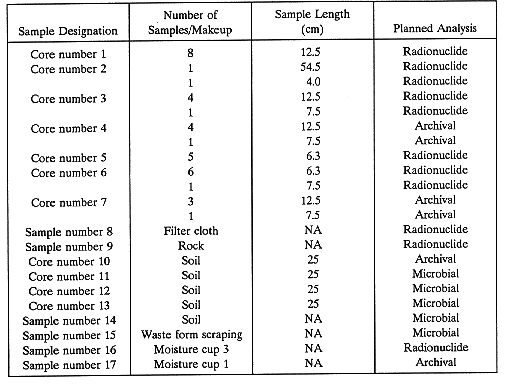
A diagram of the sample locations and sizes is shown in Fig. 1, and Table III lists the cores and samples. The waste form cores (number 2) are 7.5 cm in diameter and 58.5 cm long and extend from horizon 2 to 3. That length contains all seven waste form samples. The soil cores and microbial soil samples are 3.3 cm in diameter and are various lengths. All were taken with coring tools made up of 25-cm long segments. Cores number 1 were taken with a 75-cm top segment, then a 25-cm long bottom segment. All other cores were taken at full depth. The microbial soil samples were also taken with the 3.3-cm diameter tool using one segment. All cores were contained in plastic, cylindrical-core tool liners that were closed with plastic caps on the ends.
Table III Core and Other Samples
Radial and vertical position of the coring tools was controlled during coring operations by use of special guide plates and bushings. The coring tools and tips were specifically designed for this task by Art's Manufacturing and Supply of American Falls, Idaho. The tool driver was a Bosch roto-hammer. The INEL designed the special guide system.
Radiochemical characterization, which is in progress at this time, will include full-length gamma scanning of each seven-sample waste form, which is designed to provide information on the remaining waste form radionuclide inventory, while waste form physical condition will be determined by visual examination, weighing, and compressive testing. Soil cores will be radiochemically analyzed for nuclide content, as will the filter cloth, filter support stone, and moisture cup. These data will then be used to determine radionuclide material balance within each lysimeter, radionuclide pathways through the soil columns, and radionuclide holdup factors of the various components of each lysimeter system. Other soil samples will be examined for microbial activity, which may then be related to waste form physical condition indirectly or more directly by microbial examination of waste form surface scraping samples.
Upward Migration of Radionuclides at ORNL
The presence of both Cs-137 and Sr-90 were discovered at the surface of lysimeter ORNL-5, which is the sand-filled control. Radionuclide activity was first detected in 1991 during a routine gamma survey of the lysimeter's surface. At that time, more activity was found near the center than at the edges. Core samples were obtained from the center of the lysimeter at depths from 0 to 2.5 cm and from 2.5 to 5 cm for analysis of cesium and Sr-90. Scientists detected 1,760 pCi Cs-137, 10 pCi Cs-134, and 0.5pCi Sr-90 per gram of sand in the 0 to 2.5-cm core, and 306 pCi Cs-137, 3 pCi Cs-134, and 0.1 pCi Sr-90 in the 2.5 to 5-cm core material. These data showed that more radionuclides were at the surface, suggesting some type of an active deposition mechanism. There remained a question, however, concerning the source of the radionuclides. In August of 1992, samples were again taken from the lysimeter and analyzed for Cs-137 and Cs-134. The results were similar to the previous sampling, with 1,533 pCi Cs-137 and 6 pCi Cs-134 being found per gram in the surface, and 574 pCi Cs-137 and 2.4pCi Cs-134 per gram in the 2.5 to 5-cm sample. A comparison was made between the ratio of Cs-137 and Cs-134 in the surface material and the ratio in the buried waste form. It was concluded that the contamination of cesium came from the waste form within the lysimeter soil column.
On January 31, 1994, two cores of sand 80 cm long were collected from lysimeter 5. One core was taken from the side of the lysimeter near the wall, and the other core was removed from the center of the lysimeter directly above the buried waste form (located approximately 100cm below the sand surface). These sand cores were sectioned into 5-cm segments. Radiocesium and strontium activity were measured for each segment. Results are given in Table IV.
Table IV Cesium and Strontium Analyses for Sand Segments from the
Center (Core c) and Side (Core s) and Root Fragments from the Center of ORNL
Lysimeter 5
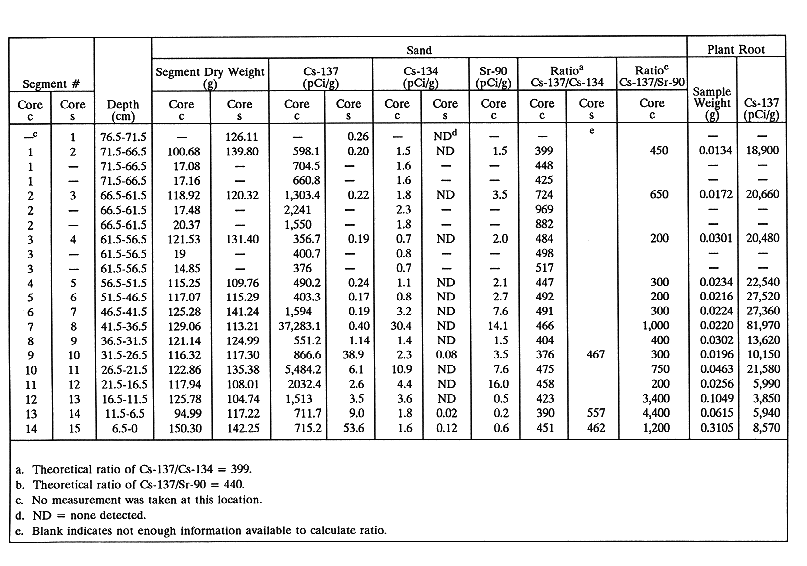
The analyses show that Cs-137 is present throughout the depth of the cores. Three peaks are seen in the cesium content of the center core: one at 24 cm, a large peak at 39 cm, and a smaller peak at 64 cm. Two peaks are seen in the cesium content of the side core: one at 29 cm and another at 3 cm. These peaks may be indicative of some sort of periodic movement of the cesium, but further study is necessary before the cause of this movement can be determined.
During the sectioning of the center core, it was noticed that there was a fine plant root present throughout the depth of the core. The root material was extracted from each segment and counted (Table IV). Cesium-137 activity is associated with the root, and the peaks in the root data occur at the same depths as do the peaks in the sand activity. It can be seen that there are higher concentrations of Cs-137 associated with the root than with the sand. Sand from the deepest three segments was analyzed: each whole segment was analyzed, and two subsamples of each segment were analyzed. Segment 2 (Table IV) has a fairly wide range of activities between the whole segment and the two subsamples, suggesting that the activity in the sand is not evenly distributed. This could be a result of the root being involved in the transport process.
Strontium-90 analysis results show that there is significant strontium throughout the entire depth of the center core (Table IV). Peaks occur in the distribution at the same depths as for cesium in both the sand and roots. This suggests that the same mechanism may be involved for transporting strontium upward as cesium. Strontium and cesium behave very differently chemically, but if the process of migration is more physical than chemical, the ratio of Cs-137 to Sr-90 should be similar at all depths. Table IV includes this ratio versus depth. It can be seen that the ratios are similar for most of the segments of the center core, indicating that the upward transport is possibly related to a physical phenomenon such as transpiration enhanced by the presence of the root. The fact that the sand has a very low cation-exchange capacity is probably the reason that the physical aspect of migration is so evident.
Upward migration of radionuclides is being examined in the waste form, and soil sampling is being carried out. Preliminary results of that work, including gamma surveys of ORNL soil cores number 1 directly above the waste forms, indicate that radionuclides have moved upward from the waste forms in the soil lysimeters.
Partition Coefficients of Lysimeter Fill Material
Partition coefficients for Cs-137 and Sr-90 were measured in the laboratory for the lysimeter fill materials. Batch methods were used (9). Table V lists the Kd values for ANL-E and ORNL soils and silica sands. While the sorption isotherms reported were not linear over the test range for the low concentrations of radionuclides observed in the lysimeter leachates, the coefficients may be treated as linear.
Table V Linear Kd Values for Cesium and Strontium in
Lysimeter Materials 
SOURCE TERM MODELING OF LYSIMETER RELEASES
The Disposal Unit Source Term (DUST) code (10) has been used to model the release of the radionuclides Cs-137 and Sr-90 from the lysimeter waste forms. DUST is a one-dimensional code that accounts for container performance and waste form leaching (including diffusion-controlled release). Transport can be modeled through finite differences or by a multi-cell mixing cascade approach. The finite difference method was used in the simulations reported in this paper because it is more general than the mixing cell approach and permits modeling of dispersive transport. Use of these data in the DUST code was examined in detail in a paper presented at WM'93 (11) and was studied more recently in Refs. (7) and (12).
The releases of Cs-137 and Sr-90 from portland type I-II cement located in the inert, sand-filled lysimeters 5 at ORNL and ANL-E were chosen because releases from other lysimeters were substantially lower; therefore, the data were not yet sufficient to model. At ANL-E, lysimeter 5 contained resin waste from PF-7 solidified in portland type I-II cement; at ORNL, lysimeter 5 contained resin waste from PF-24, which was also solidified in cement (Table I). Diffusion coefficient values measured in laboratory testing of these waste forms were 9.6E-10cm2/s for Sr-90 in portland cement and 6.0E-10 cm2/s for Cs-137 in portland cement (13). The Darcy velocities ranged from 2.96E-6cm/s at ANL-E to 4.3E-6 cm/s at ORNL (7). The soil bulk density values were 1.55g/cm3 at ANL-E and 1.60 g/cm3 at ORNL (6). Moisture content values were found in Ref. (7). In lysimeter 5 at both sites, the average moisture content was calculated to be 21%. The partition or distribution coefficients were measured for Sr-90 and Cs-137 and are presented in Table V (9). The dispersion coefficients have not been measured; therefore, they were estimated based on data in Refs. (14) and (15) and by fitting the model predictions to the data. The cumulative activity collected in the lysimeter leachate water over the first 10years of operation of the experiment, which was used to make comparisons to the DUST code predictions, represented cumulative fractional releases of about 0.0018 and 0.00023 of the Sr-90 in lysimeter 5 at ORNL and ANL-E, respectively (Table I).
ORNL Lysimeter 5 Results
The "best-fit" parameters for four different waste form release and nuclide transport models for Sr-90 are displayed in Table VI. The three waste form release models all limit the total 10-year release from the waste form to about 107 pCi, which is two orders of magnitude less than the release predicted on the base case parameters (Dwf = 9.6E- 10 cm2/s). The best-fit diffusion coefficient was four orders of magnitude below the laboratory-measured value. This low release rate is needed to match the data because of the relatively fast transport time that occurs when using the base case Kd values. The best-fit transport parameter, Kd = 36, is about the same as the laboratory-measured value of 37 and is much larger than the best-fit value found previously based on 8 years of data (Kd = 24). After collecting the additional 2 years of data, it became clear that the previous best fit was too low because the previous model predictions showed a sharp increase in release over the ninth and tenth years.
Table VI Best-fit Parameters for Release of Sr-90 from Lysimeters 5
at ORNL and ANL-E
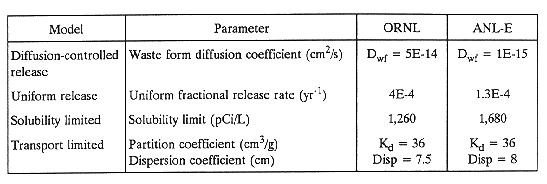
Figure 3 (top) displays the predicted cumulative release of the four different scenarios and compares them to the measured data. All of them predict the cumulative release over 10 years to within 20% of the measured value. This is the result of the fitting procedure used to select the appropriate release parameters. The transport model curve does not compare well to the other curves.
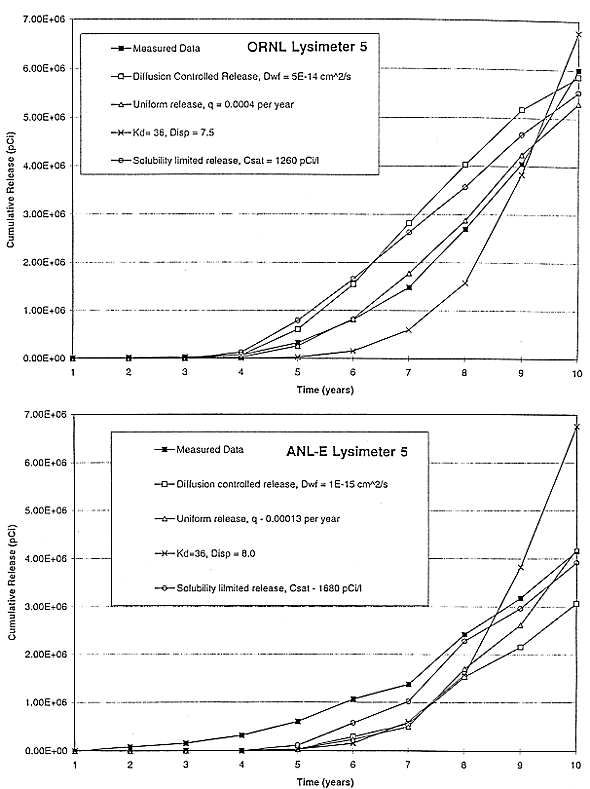
Fig. 3. Comparison of measured and
DUST-predicted cumulative Sr-90 released.
ANL-E Lysimeter 5 Results
The "best-fit" parameters for release and transport of Sr-90 in ANL-E lysimeter 5 for each of the alternative models are found in Table VI. The best-fit parameters differ from those found at ORNL lysimeter 5. The waste form diffusion coefficient and fractional release rate are lower than at ORNL. The ANL-E waste form best-fit diffusion coefficient, 1E-15 cm2/s, is a factor of 50 lower than the best-fit value found for the ORNL data and almost six orders of magnitude lower than the laboratory-measured value. The solubility limit is slightly higher than found at ORNL because of the lower water flow rates found at ANL-E. The Kd of 36 is within the range of the laboratory- measured partition coefficient.
In Fig. 3 (bottom), the cumulative release based on the solubility limited release model tracks the measured value the best. The uniform and diffusion-controlled waste form release models also follow the trends in the measured data reasonably well. The high Kd model shows a much different shaped curve than the data or any of the other models.
CONCLUSIONS
The radionuclide that has appeared with most regularity at both sites is Sr-90, although Cs-137 was observed regularly in the leachate of all ORNL lysimeters. A comparison of total Sr-90 found in leachate of the control lysimeters shows that environmental effects have resulted in a much higher release at ORNL. The data indicate that portland cement and VES waste forms had comparable releases of Sr-90 to leachate passing through the lysimeter.
The waste form and soil sampling is developing important data on radionuclide movement from the waste forms into and through the soil columns. It will help to explain differences in releases between different waste form materials and in waste form behavior between sites.
Cs-137, Cs-134, and Sr-90 were present throughout the upper 80cm of the inert sand in ORNL lysimeter 5 directly above the waste form. The ratio of Cs-137/Cs-134 indicated that the radionuclides were from the buried waste form and not from an outside source and were transported vertically upward by some physical mechanism enhanced by the presence of a plant root. Preliminary soil sampling results indicate that upward migration of those radionuclides occurred in the soil lysimeters at ORNL as well.
DUST-predicted cumulative releases of Sr-90 from both ORNL and ANL-E lysimeters 5, which were plotted over 10 years of data collection, show a reasonable fit to the field data. The accuracy of the DUST modeling study was limited, however, by the small amount of radionuclide releases to leachate. Waste form and soil coring will provide more detail on waste form releases and release patterns to better model the radionuclide movement in the lysimeters.
Data provided by these lysimeter experiments have been shown to be useful in computing many parameters used as input to performance assessment codes. The utility of this reliable source of data will be enhanced by application of radionuclide movement data from soil sampling to source term models such as DUST.
ACKNOWLEDGMENTS
This work was supported by the U.S. Nuclear Regulatory Commission, Office of Nuclear Regulatory Research, under U.S. Department of Energy Idaho Operations Office Contract DE-AC07-94ID13223.
REFERENCES
* References herein to any specific commercial product, process, or service by trade name, trademark, manufacturer, or otherwise, does not necessarily constitute or imply its endorsement, recommendations, or favoring by the United States Government or any agency thereof.