Table I Language and Regulatory Requirements
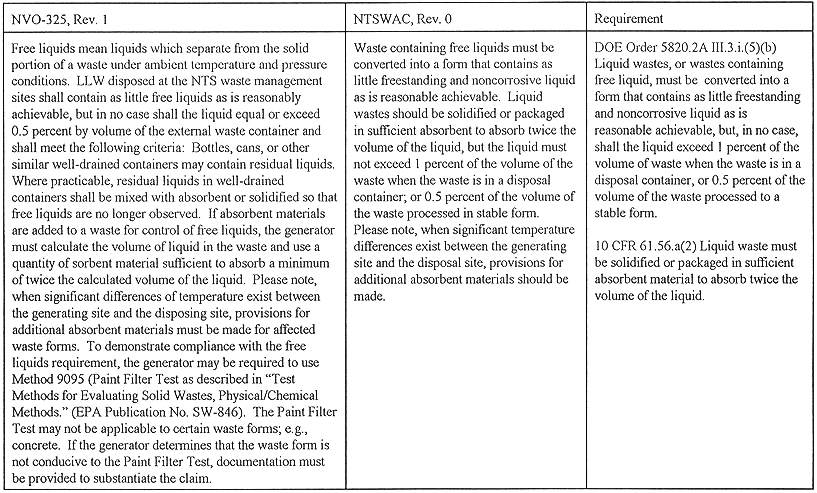
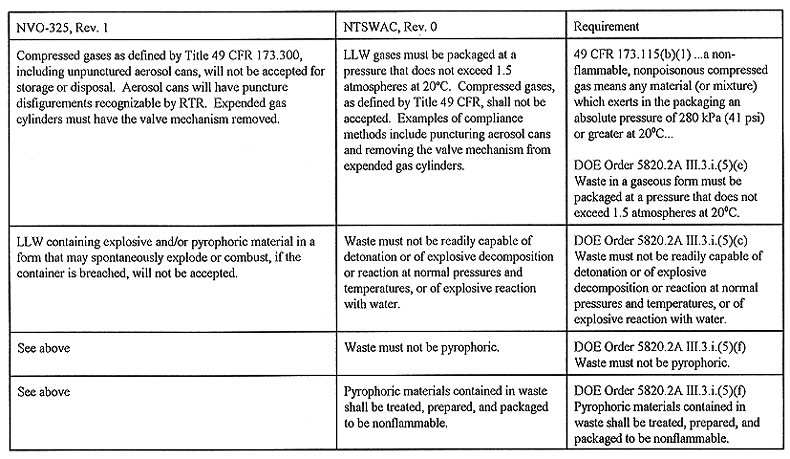
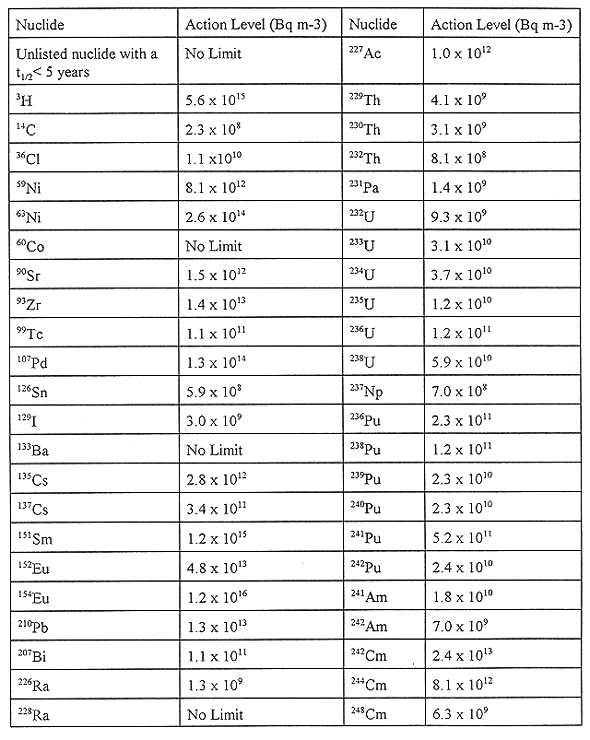
Table II Reportable Radionuclide Action Levels
Susan K. Krenzien, Rebecca M. Guertal
Hazardous and
Medical Waste Services, Inc. (HAZMED)
Wendy A. Griffin
U.S. Department of Energy, Nevada
Operations Office
Brian K. Perkins
Bechtel Nevada
ABSTRACT
The Nevada Test Site currently accepts low-level radioactive waste for disposal from fifteen facilities. The "Nevada Test Site Defense Waste Acceptance Criteria, Certification, and Transfer Requirements" (NVO-325, revision 1), has been revised to the "Nevada Test Site Waste Acceptance Criteria" (NTSWAC). The NTSWAC edits the criteria to include federal, state, operational, safety, and Department of Energy requirements only. The revision also incorporates the use of waste profiles, a three-year audit cycle, and a more flexible program for Low Volume Generators. Implementation of the NTSWAC will streamline the approval of waste streams for disposal.
INTRODUCTION
The Nevada Test Site (NTS) is approximately 65 miles northwest of Las Vegas, Nevada, and encompasses 1,350 square miles. The NTS serves as a major disposal site for Department of Energy (DOE) low-level radioactive waste (LLW). Fifteen government facilities are currently approved to ship LLW to the NTS for disposal. Mixed waste generated by the DOE operations and activities in Nevada is also accepted.
DOE Order 5820.2A, "Radioactive Waste Management" requires disposal sites to have documented waste acceptance criteria (WAC). The previous criteria, "Nevada Test Site Defense Waste Acceptance Criteria, Certification, and Transfer Requirements" (NVO-325, Revision 1), was revised in 1996 to incorporate approval process and criteria changes. Performance Assessment requirements for radionuclide reporting were also added. The revision team consisted of DOE/NV personnel, generator facility representatives, and DOE/NV contractor personnel. Nevada regulatory representatives commented on the revisions. Revisions included deleting or modifying requirements in NVO-325 that did not have a regulatory, safety, or operational driver. The new document, "Nevada Test Site Waste Acceptance Criteria" (NTSWAC), is intended to streamline the approval process and simplify the WAC while maintaining the integrity of the program.
Waste profiling is introduced in the NTSWAC. The Waste Profile (WP) allows streamlined reviews of waste characterization information. The WP replaces the formal application and Level 1 waste characterization data packages required by NVO-325. The WP review process does not require on-site evaluation of the waste, although an on-site evaluation may beperformed.
The NTSWAC incorporates a streamlined Low Volume Generator (LVG) program. This program is designed to allow LVGs to have some flexibility in meeting certain portions of the WAC. If an LVG receives an on-site evaluation, it will have a limited scope and require less time. The NTSWAC also allows LVGs to certify and ship their waste under a larger facility's approved program.
DOE/NV implements the NTSWAC through its Radioactive Waste Acceptance Program (RWAP). DOE/NV and contractor personnel ensure that generator certification programs and waste streams comply with the WAC through facility evaluations and reviews of waste characterization data. The NTSWAC has changed the focus of RWAP from auditing each generator's entire program annually to reviewing generator program changes and final waste form compliance.
APPROVAL PROCESS REVISION
The generator programmatic and performance-based audit schedule has been revised because the formal annual audits were determined to be excessive oversight. The audits have been scaled back from annually to triennially with annual assessments. The audit verifies, by examination and objective evidence, that the facility's program is adequate and implemented to meet the WAC. Quality assurance (NQA-1 or equivalent), waste characterization (procedures and results), and traceability (through characterization, packaging, and shipment) are examined during the audit.
Annual assessments are conducted by RWAP personnel in Las Vegas. It is not anticipated that the generator will be present at these assessments. The assessments examine specific aspects of the facility's program such as program changes that have occurred since the last evaluation, operational concerns expressed by the disposal site, and the facility's last internal assessment results. A questionnaire is being developed to send to the facility prior to the assessment. This questionnaire will explain the scope and list the information needed.
Surveillances are conducted on an as-needed basis. Audits and annual assessments may prompt a surveillance. On-site surveillances may be necessary if a waste stream is unusual or presents unique disposal problems. If the disposal site has problems with a waste stream (i.e., leaking boxes), a surveillance at the generator's site may be scheduled. Surveillances are also conducted to close deficiencies found during an audit. These audit-closure surveillances may be conducted in Las Vegas instead of at the generator facility.
The application required by NVO-325 has been replaced with a Waste Acceptance Package (WAP). This package consists of WP(s), a Waste Certification Program Plan (WCPP), and a list of authorized certification personnel. After approval of this package, new waste streams can be introduced by submitting a WP. Facilities have until March 1997 to transfer approved waste streams to WPs. The WCPP and certification personnel specified in the original application will remain in effect and be reviewed as required.WPs are used to summarize waste characterizationdata. The WPs combine information previously required in applications and Level 1 waste characterization data packages. Under NVO-325, these documents contained similar information in different formats. Revisions or addenda for each waste stream required information from the original application to be repeated. By using WPs, DOE/NV reduces paperwork associated with submitting a waste stream for approval. The WPs consolidate information on waste characterization into one document.
WASTE CHARACTERIZATION REVISIONS
Previous WACs have limited the waste streams that can be characterized by process knowledge (PK) to those that were too heterogeneous to sample or had As Low As Reasonably Achievable (ALARA) concerns associated with sampling. The NTSWAC considers acceptable PK adequate characterization for all waste streams, regardless of the waste matrix. The characterization process must be controlled (i.e., proceduralized) and the results documented. Waste characterization data is summarized on the WP and sent to DOE/NV for review. By allowing the generators to submit new waste streams on the WP, duplicate information required by previous WACs is diminished (i.e., Level 1 waste characterization data package and application revision or addendum).
Sampling and analysis may also be used for waste characterization and the data is summarized on the WP. Sampling and Analysis Plans (SAPs) are no longer sent to DOE/NV for review under the NTSWAC because the review cycle that previous WACs required was determined to be time consuming and unnecessary. Again, the system used (whether SAPs, sampling procedures, or standard practices) must be controlled, and the results documented. DOE/NV will have no up-front contribution on the adequacy of the system to meeting the WAC. However, RWAP may review the SAPs or procedures to ensure that they support the characterization data. Because guidance for SAP development is readily available in other documents, the SAP guidance in NVO-325 has been removed in the NTSWAC.
Annual laboratory audits are no longer required by the NTSWAC. Additionally, specific requirements for the laboratory approval and audit were deleted from the WAC. Laboratories are considered service vendors and should be managed by the generator's vendor quality assurance program.
LOW VOLUME GENERATORS (LVG)
The LVG program is designed for facilities that ship less than 200 cubic meters a year. Under this program the LVG is exempt from developing a site-specific WCPP, if an applicable site-wide quality assurance program is in effect at the facility and is submitted as part of the WAP. LVGs are also exempt from the auditing process. If an LVG requires an on-site evaluation, the evaluation will be of limited scope. LVGs may also certify and ship their waste under a larger facility's approved program, providing all DOE offices involved agree to the arrangement. This program was devised to reduce program costs for the smaller generators shipping waste to the NTS.
WASTE ACCEPTANCE CRITERIA REVISIONS
The WAC has been edited to include onlyfederal, state, operational, safety and DOE requirements. Requirements were researched for regulatory and operational necessity. Some requirements were clarified and made consistent with DOE Order 5820.2A. Each requirement in the NTSWAC includes a reference to its regulatory driver (i.e., 49 CFR 173.45).
General Waste Form
The Transuranic requirement added a list of isotopes for the generators to consider when calculating the less than 100 nCi/g per disposal package limit. This list is intended to remind generators of other transuranic isotopes when calculating per package limits.
The requirement for hazardous waste was revised to include a clarification of the Nevada regulations. These regulations state that waste generated in another state, and considered hazardous in that state, will be considered hazardous in Nevada, even if Nevada statutes do not designate the waste as hazardous (i.e., If California statutes consider a waste to be hazardous, and under Nevada statutes the waste is non-hazardous, any such waste sent to Nevada for disposal is considered hazardous waste). The Nevada requirement was identified for out-of-state generators.
The Free Liquid requirement was changed to reflect the DOE Order 5820.2A requirement. Previous WACs went into great detail on the manner in which this requirement could be met. The change to the simpler language of the DOE Order makes the requirement easily understood and deletes confusing examples (see Table I).
The Gases requirement was simplified to the DOE Order language. Previous WACs added requirements for punctured aerosol cans to be recognizable by Real-Time-Radiography and expended gas cylinders to have the valve mechanism removed. These requirements were changed to examples of how the gas requirement may be met (See Table I).
The Chelating Agent requirement was changed to clarify that the agents of concern were unbound (free) agents.
The Explosive and Pyrophoric requirements were split. These two requirements now mirror DOE Order 5820.2A (See Table I).
Sealed sources present unique disposal requirements; therefore, a Sealed Source Work Group was formed to develop waste acceptance criteria. The regulatory status of the radioactive component of the sources and shielding material was determined and characterization and packaging requirements were developed and added to the NTSWAC. These include having a separate waste stream for sources and detailed individual source characterization data.
The LLW Containing Asbestos requirements were revised to clarify Nevada statutes and include the NTS Asbestos Operations & Maintenance Plan requirements. These requirements include having a separate waste stream and specific package labeling. Asbestos waste is buried in a separate trench, so containers must be segregated.
Waste Package Criteria
NVO-325 sections "General Regulatory Waste Package Criteria and NTS Specific Package Criteria" were consolidated in the NTSWAC as "Waste Package Criteria." The following sections of NVO-325 were removed from the NTSWAC: Design, Nuclear Heating, Radiation Levels, External Contamination, Activity Limits, Multiple Hazards, Nonstandard Type A Packaging, and On-Site Transfer. These are Department of Transportation (DOT) requirements and are not repeated in the NTSWAC. The remaining requirements are NTS specific for operational safety.
The Strength requirement for disposal boxes changed from 4,000 lbs/ft2 to 3,375 lbs/ft2. The NTSWAC permits physical testing or design engineering calculations to be used to prove compliance with this requirement. This requirement was lowered after a recalculation of disposal site subsidence risks.
The Handling section has been revised to specify removable skids as a preferred handling method for boxes. This removes void space between packages and reduces the risk of subsidence. It also allows the disposal site to charge the generator for the outer dimensions of the container and not the additional space taken by permanently attached skids. ALARA concerns associated with disposal packages are to be communicated to the disposal site and any necessary documentation will be available for review.
The Size requirement for boxes has been removed. However, 4' x 4' x 7' (± ½ inch) boxes are still the preferred size for disposal. Innovative packages (i.e., Super Sacks) are permissible, but the disposal facility must be consulted prior to approval to ensure equipment compatibility.
The Package Protection requirements were found to be excessive and have been scaled back and simplified. The new requirements state that the certified waste package must be secured. Examples of securing devices are clips, bands, tamper-indicating-devices, or welding. In-process packages must have controls to prevent intrusion, but these controls can be as simple as a lock or a locked room.
Few changes were made in the Marking and Labeling requirements of packages. The NV-211 "Package Certification" sticker is now called the "Package Certification Label" (PCL) and requires a printed name and signature. Barcode density was changed to low/medium at the request of the disposal facility.
Radionuclide Reporting
Radionuclide reporting requirements were changed to satisfy the Performance Assessment (PA) of the disposal site. The PA developed Action Levels for 44 nuclides (see Table II). If the activity concentration in the final waste form exceeds one percent of the Action Level, it must be quantified and reported to the disposal site. Additionally, if the activity concentration in the final waste form exceeds one percent of the total activity concentration, the radionuclide must be reported.
Mixed Waste
Off-Site Mixed Waste and Transuranic Waste sections were "reserved for future use" as the disposal site is not currently permitted to accept these wastes from off-site generators. Mixed waste generated in Nevada is accepted and the requirements did not change significantly.
CONCLUSION
The NTSWAC will streamline approval of waste streams destined for the NTS. By implementing waste profiles, three-year audit cycles, and LVG programs, DOE/NV will reduce the review and approval process time and effort. The clarification and simplification of the requirements to DOE Order language should allow generators to better understand and comply with the requirements.
Table I Language and Regulatory Requirements
Table II Reportable Radionuclide Action Levels