DEVELOPMENT OF Ci CONTENT DETERMINATION TECHNOLOGY IN
VARIOUS KINDS OF DRUMMED RADIOACTIVE WASTES USING A NON-DESTRUCTIVE METHOD
APPLICABLE FOR NUCLEAR POWER PLANTS IN KOREA
DuckWon, Kang and Kyoung Rock, Park
Korea Electric Power
Research Institute
Radiation Safety Group
ABSTRACT
Various kinds of radioactive waste streams, such as ion exchange resins,
water, compacted paper trash, rolls or stacks of air handling filters and
solidified waste are produced at nuclear power plants in Korea. These wastes are
packed into the drum at the radwaste building and temporarily transferred to a
temporary storage building. Several kinds of drums are used for radioactive
waste packing at nuclear power plants in Korea. However, estimation of nuclides
and their activities in the drummed radioactive waste is still difficult and
unreliable. Nuclear act of Korea requires low and intermediate level radioactive
waste generated at nuclear power plants prior to transportation to permanent
disposal sites to be known in detail. Individual historical records of the
radioactive waste should contain information about the activities of nuclides,
total activity and the type of waste in the drum. Consequently, with the
incorporation of gamma spectroscopy, a fully automated nuclide analysis system
which can accurately evaluate the nuclide and activity in the drum was
developed. The activities of the representative
 -emitters(Cs-137,
Co-60) which are mixed with several materials in the drum were measured by this
system. Then appropriate scaling factors were used to assay the activities of
nuclides which could not be directly analyzed by this system. The scaling
factors were determined by a computer program developed in Korea. The validity
of the scaling factor was checked through comparison with several experimental
results of local samples taken from real waste streams. Demonstration drums with
similar geometries to real waste drums were used for proving the reliability of
Ci content determination in this system. It was performed by putting the
standard sources(Co-60, Cs-137) into demonstration drums. In the results, the
measurement errors were less than 30% in the various demonstration drums.
Therefore, measurements of real radioactive waste drums gave us good results for
the homogeneous and non- homogeneous wastes generated at Kori(the name of a
place in Korea) nuclear power plant in Korea.
-emitters(Cs-137,
Co-60) which are mixed with several materials in the drum were measured by this
system. Then appropriate scaling factors were used to assay the activities of
nuclides which could not be directly analyzed by this system. The scaling
factors were determined by a computer program developed in Korea. The validity
of the scaling factor was checked through comparison with several experimental
results of local samples taken from real waste streams. Demonstration drums with
similar geometries to real waste drums were used for proving the reliability of
Ci content determination in this system. It was performed by putting the
standard sources(Co-60, Cs-137) into demonstration drums. In the results, the
measurement errors were less than 30% in the various demonstration drums.
Therefore, measurements of real radioactive waste drums gave us good results for
the homogeneous and non- homogeneous wastes generated at Kori(the name of a
place in Korea) nuclear power plant in Korea.
INTRODUCTION
Since Kori unit 1 started commercial operation in 1978, 10 PWRs and 1 PHWR
have been in operation in Korea and 4 PWRs, 3 PHWRs have been under construction
by KEPCO (Korea Electric Power Corporation) in Korea. Many activities at nuclear
power plants generate radwastes of various type, such as ion exchange resins,
water, compacted paper trash, rolls or stacks of air handling filters, and
solidified waste. All solid radwaste drums are temporarily stored in on-site
storage buildings at each site until final disposal facilities are available.
The temporary storage capacity is not sufficient to accommodate all radwaste
packages. Therefore, the radwaste drums stored in the temporary building have to
be transferred to the final disposal sites to be buried permanently in future.
Nuclear Act of Korea requires the manifest of radwaste drums generated at
nuclear power plants prior to final disposal. It should contain information such
as the activities of nuclides, total activity, weight and the type of waste in
the drum.
The method to establish an assay technique for determining the kinds of
radionuclides and their activities in homogeneous and non-homogeneous
radioactive materials non-destructively has been continuously developed since
1992. It consists of a fully automated nuclide analysis assay system,
non-destructive analysis and evaluation system of the radioactive wastes in the
radwaste drums. The activities of the representative
-emitters(Cs-137,
Co-60) which are mixed with several materials in the drum were measured by this
system. Then appropriate scaling factors were used to assay the activities of
nuclides which could not be directly analyzed by this system, such as alpha,
beta emitter and low energy gamma nuclide. The scaling factors were determined
by a computer program developed in Korea. Furthermore, this assay system can
automatically mark the analysis results onto the drum. Also the drum handling
machine which was developed could reduce the radiation exposure to workers. It
is designed to move automatically the radwaste drums to the measurement
position, then analyze the activities of the nuclides in the radwaste drums.
This paper discusses the constitution of the radwaste drum assay system, the
evaluation method and results.
MATERIAL AND METHOD
Radiation Measurement
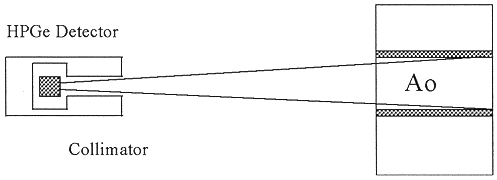
Fig. 1. Simplified geometry of the
measurement for the radioactive waste drum.
Generally, it is assumed that the radwastes in the drum are homogeneous and
self-absorption in the matrix is negligible when measuring the activities of the
waste drum. However, above assumptions may give rise to error when the radwastes
are evaluated by the assay system. Therefore, to measure accurate Ci content for
the waste drum, the main concern is how to reduce the error. The segmented gamma
scanning method has been widely used to effectively measure the activity of
nuclide in the radwaste drum. In particular, it is suitable for analysis of the
low density waste drums. The SGS(segmented gamma scanning)method utilizes the
following techniques to reduce the error from non-homogeniety self-absorption
effects of the matrix.
- Measurement of the segments which are divided into some parts at the
vertical plane to compensate a non-uniformity for the vertical direction
- Rotation of the waste drum to compensate a non-uniformity for a radius of
the drum
- Measurement of the transmission in order to correct the attenuation due to
a matrix of the sample
The following is the basic principle of segmented gamma scanning method.
HPGe detector is shielded to decrease the background radiation and the shielding
material is available as the collimator, as shown in Fig. 1. Therefore,
radiation from the waste drum enters into the HPGe detector as cone type. We can
easily calculate count rate for radiation entering the HPGe detector from
radioactive material through the following equation.
 (1)
(1)
where, K1 = 1-exp(-µh), Zo is net count rate of detector
for standard gamma source, It is equal to Zo = k Ao/4 So2,
Ao is activity of standard gamma source, k = calibration coefficient, So =
distance between detector and waste drum, We assume that Ca, activity
concentration is distributed uniformly over the volume in the waste drum. Fo is
the area of sample in the waste drum entering into the detector. Therefore, In
Eq. (1), we can see the correlation between detector count rate and activity
concentration of radioactive materials. That is, if we know the linear
attenuation coefficient for radioactive materials, µ, we can get the
concentration for radioactive material from the detector count rate. The
equation is the following
So2,
Ao is activity of standard gamma source, k = calibration coefficient, So =
distance between detector and waste drum, We assume that Ca, activity
concentration is distributed uniformly over the volume in the waste drum. Fo is
the area of sample in the waste drum entering into the detector. Therefore, In
Eq. (1), we can see the correlation between detector count rate and activity
concentration of radioactive materials. That is, if we know the linear
attenuation coefficient for radioactive materials, µ, we can get the
concentration for radioactive material from the detector count rate. The
equation is the following
 (2)
(2)
In Eq. (2), the values of Ao, Zo, Fo can be obtained through the assay
system calibration with standard gamma source. The linear attenuation
coefficient, µ is given in the average density attenuation correction,
transmission source correction, differential peak attenuation correction.
Attenuation Calculation
The matrix correction is to correct the measured peak efficiencies for
sample self- absorption. These peak efficiencies may then be used to provide an
improved calculation of sample activities. The three methods of correction used
in this paper are Average Density Correction, Transmission Source Correction,
Differential Peak Correction.
In each of these methods an attenuation correction factor is calculated for
each peak found in the sample, then the individual peak efficiencies are scaled
by this amount. These methods is to calculate an attenuation correction factor
CFi , as shown in the following equation.
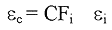 (3)
(3)
where, CFi is the correction factor at energy, Ei
 i
is the uncorrected efficiency at energy Ei
i
is the uncorrected efficiency at energy Ei
c
is the corrected efficiency at energy Ei
The CFi has the following form for each peak
 (4)
(4)
where, µi / is the
mass attenuation coefficient [cm2/gm] at the energy Ei and (t) is the
calculated sample mass per unit area [gm/cm2]. We can use the
following three methods to take a value of (t)
is the
mass attenuation coefficient [cm2/gm] at the energy Ei and (t) is the
calculated sample mass per unit area [gm/cm2]. We can use the
following three methods to take a value of (t)
Average Density Attenuation Correction
The sample average density is calculated from the sample net weight and the
container volume. The density of the sample is then multiplied by the sample
average thickness to find the value of (t). This
is mainly used in case of the uniform matrix.
 (5)
(5)
where, ad is subscription of average density, Mnet is the sample
mass, V is the sample volume, t is the average thickness of the sample.2.2
Transmission Source Correction
This technique uses the energy from the transmission source to estimate the
density. The transmission for a gamma ray of energy Ei is defined as
the attenuation factor.
 (6)
(6)
where x is the mass per unit area for the attanuating material. If we use a
transmission source with a gamma ray at energy ET, then the transmission at
energy Ei is given by:
 (7)
(7)
Alpha is the ratio of the gamma absorption coefficients at two energies. The
transmission for the transmission source gamma peak is found by measuring the
initial peak area due to the transmission source without any attenuating
material and then measuring the same gamma peak area during the assay with
attenuating material present. The transmission measured is then:
 (8)
(8)
where IT(0) is the transmission peak area without attenuating
material, and IT(x) is the peak area with attenuation. Once the
transmission has been calculated then the attenuation correction factor can be
found using the approximation
 (9)
(9)
where Ti is the transmission at Ei. Kappa( ) is a
correction factor which will depend on the particular geometry under
consideration. For a cylinder, it is equal to 0.823 in the our SGS system. This
attenuation factor can then be applied directly to correct the peak efficiency
at each energy Ei. The measured transmission may also be used to calculate a (t) value.
By using the original definition of the transmission Eq. (4 ) we may define a (t) such
that:
) is a
correction factor which will depend on the particular geometry under
consideration. For a cylinder, it is equal to 0.823 in the our SGS system. This
attenuation factor can then be applied directly to correct the peak efficiency
at each energy Ei. The measured transmission may also be used to calculate a (t) value.
By using the original definition of the transmission Eq. (4 ) we may define a (t) such
that:
 (10)
(10)
then the (.t) for
Ei will be
 (11)
(11)
Differential Peak Attenuation Correction
Nuclide that exist in a given sample volume in some case have two peaks that
can be identified from the associated spectrum. In those situations, we can use
the relative attenuation of these two peaks to obtain an estimate of the sample
density. The calculations require that we know the unattenuated intensities of
the two lines. These may be obtained from an initial efficiency(response)
calibration. Then we can calculate the value of (.t) as
the following.
 (12)
(12)
where,
I1(0) = the unattenuated count rate of the low energy peak
I2(0) = the unattenuated count rate of the high energy peak
I1(t) = the
attenuated intensity of the low energy peak
I2(t) = the
attenuated intensity of the high energy peak D
 µ
= µ1 - µ2
µ
= µ1 - µ2
Attenuation Correction of Non-uniformity Matrix
This techniques is to reduce the error of the measurement due to the
non-uniformity of the matrix in the container and the effect of self-absorption
in the matrix. This divides horizontal area into some sectors (we selected 8
sector) to correct the non-uniformity of the radioactive materials in the
container.
This techniques's algorithm is similar to the geometry mean. If a
non-uniformity exists, then a geometric averaging method will be used to reduce
effectively an in homogeneity of horizontal area .
 (13)
(13)
where An is the collected peak data at a sector of the segmented
horizontal area during the rotations of the container.
Constitution of the Radwaste Assay System
The radwaste assay system is composed of a gamma spectroscopy system, an
automatic drum transfer system(stacker crane), a ink-jet labeling system and a
drum rotating device. These systems are connected to a main computer for the
remote control. The simplified processing is shown in the following Fig. 2
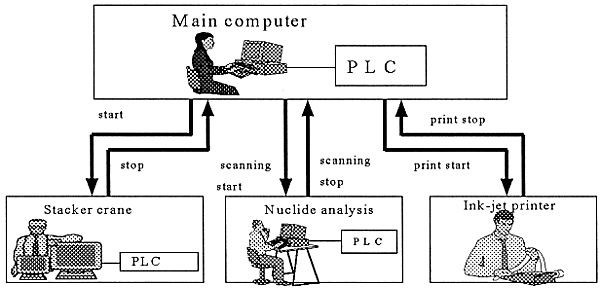
Fig. 2. The
simplified processing of the system.
The gamma spectroscopy system is to evaluate the activities of the nuclides
from radioactive materials. The high purity germanium detector which is
manufactured by Canberra Inc has 50% efficiency. The automatic drum transfer
system which is developed by our engineer is to automatically transfer the waste
drum onto the turn table. The turn table which consists of a part of the waste
assay system is rotated to reduce the error of non-uniformity for a horizontal
area.
Scaling Factor
Since December of 1984 (one year from publication of 10CFR61), utilities
have been required to list the quantities of several very difficult to measure
radionuclides on all radioactive waste shipments to the low level waste burial
sites. some of these nuclides had never before been measured in low level waste.
Furthermore, these difficult nuclides pose analytical problems beyond the
capabilities of power plant laboratories. Therefore, as a indirect method, we
have used the scaling factors which infer the concentration of one radionuclide
from another that is actually measured. That is, the scaling factors are to
relate the difficult-to-measure nuclide in the radwaste packages to those that
are easily measured. It is also able to utility for the non-gamma emitting
nuclides based on the ratio gamma and non-gamma radionuclide measured in the
radwaste packages. All of these nuclides are to classify the wastes according to
requirements of 10CFR61. The scaling factor determining computer code which is
developed in Korea based on the EPRI TR-101960 (RAD SOURCE Volume 1. Part 1:A)
(1) and EPRI NP 2412-19 (2) is to used the specific nuclear power plant in
korea, at KORI site. This computer code requires an initial setup in which the
following plant information is input and stored in the program files:
- Number of Reactor Unit
- Reactor of Coolant Mass
- Purification System Flow Rate
- Reactor Coolant concentration for: I-131, I-132, I-133, I-134, I-135,
Cs-134, Cs-137,Co-60
The nuclides related to the scaling factor is fission products, collision
products, tramp uranium.
Validation of Scaling Factor
This computer code is a scaling factor prediction code developed for use at
nuclear power plant in korea. An important element of the adaptation and use of
this code in nuclear power plant is the validation of the code results. The
approach taken to validate the code results was to compare them against
measurements made in operating plant. But The only scaling factors for the
collision products were validated those comparing with the data which is made by
EPRI NP-4037 and EPRI NP-5077. We selected a Co-60 nuclide for the
representative nuclide of the collision products because the corrosion products
have a similar characteristic for a process of the formation and the
transportation in the reactor coolant. The nuclides which are to predict a
scaling factor among the corrosion products, that is, H-3, C-14, Ni-63, Fe-55,
Nb-94, is selected for one. The Fig. 3 is a compar ision of scaling factor for
the corrosion products of the data analyzed with our nuclear power plant's
samples and the EPRI NP-4037, EPRI NP-5077 data.
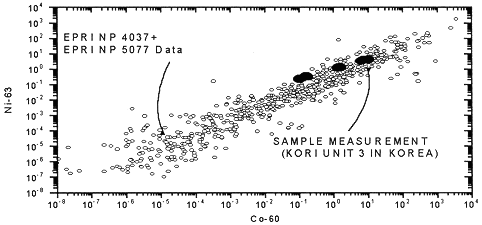
Fig. 3. Ni-63 scaling
factor comparison.
The validation of the scaling factors for the fission products, Tramp
uranium nuclides, was to compare them against realistic sample measurements made
in operating plant. The scaling factor generated by the computer code using
reactor coolant isotopic concentration data obtained during the test period were
plotted against the scaling factors derived from the korea atomic energy
research institute measurement. The Fig. 4 shows the comparisons for the Sr-90,
Tc-99 and TRU. The plots also shows the plus and minus factor 10 boundary lines
established for acceptance within NRC guidance (3) and a relatively random
dispersion of the computer code results around the line that indicates a perfect
fit with measured values. The comparison between the computer code results and
the korea atomic energy research institute measurement were quite good in the
plus and minus factor 10 boundary lines.
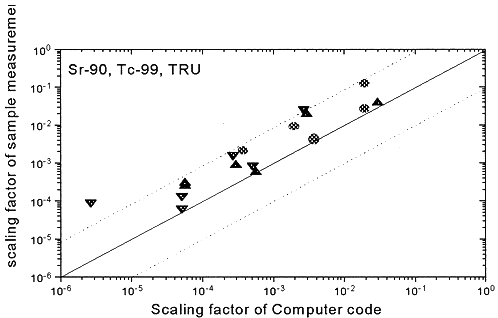
Fig. 4. The
validation of Sr-90, Tc-99. TRU scaling factor.
Measurements of the Radwaste Drums
For the waste assay system which was developed by KEPRI, we accomplished
experiments to optimum its operating condition. The experiment methods were to
determine a rotating speed (rpm) of the waste drum in order to compensate a
non-uniformity and to compare an activity measured from standard gamma sources
against the original activity of standard sources. Demonstration drums with
similar geometries to real waste drums were used for determining a rotating
speed of the waste drum and proving the reliability of Ci content determination
in this system. It was performed by putting the standard sources (Cs-137, Co-60)
into demonstration drums. As shown in Table I, with the results measured from
demonstration drum turning into the speed, we decided that the rotating speed
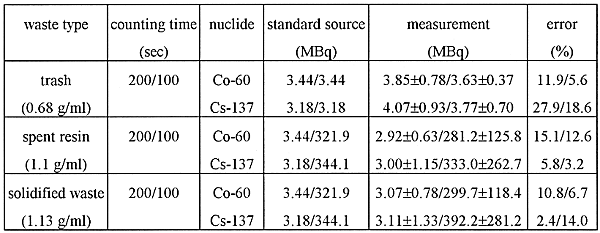
was a 10 rpm as optimization speed for the waste drum. For a reliability of the
measurement for the waste drum, three type's drums which have the different
density was used. In the results, It was a little different in error of the
measurements depending on the source position and its arrangement but the
measurement errors were less than 30% in the various demonstration drums. It
gave us good results for the homogeneous and non-homogeneous wastes. The Table
II is the measurement results of standard sources in the waste drums which have
different densities.
TABLE I The Measurement Results Depending on Varying
the Rotating Speed of the Drum
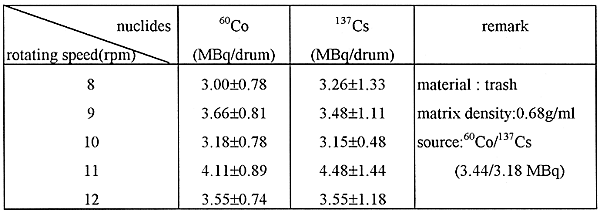
TABLE II The Measurement Results Depending on the
Different Densities of the Drum
RESULTS AND DISCUSSION
The waste assay system was developed to accurately evaluate the nuclides and
their activities in the drum with the incorporation of gamma spectroscopy. The
activities of the representative
-emitters
(Cs-137, Co-60) which is mixed with several materials in the drum were measured
by this system. Then appropriate scaling factors were used to assay the
activities of nuclides which could not be directly analyzed by this system. We
have decided that the rotating speed was 10 rpm to optimize the operating
condition of this system. Demonstration drums with geometries similar to real
waste drums was made and the activity measurements was performed by putting the
standard source into the demonstration drum. In the results, the error was less
than 30%. It was quite good results . But because the radioactive material in
the radwaste drum is more in homogenious than originally assumed, we will try
continuously to make correction for the non-uniformity in order to enhance a
reliability of the measurement through various experiments.
REFERENCES
- KNOLL, GLENN F, "Radiation Detection and Measurement," 2nd ed.,
New York(1989).
- PARKER, J.L.,"The Use of Calibration Standards and the Correction for
Sample Self-attenuation in Gamma-ray Nondestructive Assay", LA-10045(1984).
- HUSE, S.T, T.E.SAMSON, "Nondestructive Assay Techniques and Associated
Measurement Uncertainties," JNMM. 17(1992)
- SPRINKLE, JR., J.K., and S.T.HSUE, "Recent Advances in Segmented Gamma
Scanner Analysis," LA-UR -87-3954(1987).
- CLINE, J. E., K. L. WRIGHT, J. W. HOLLCROFT, "Activity Levels of
Transuranic Nuclides in Low-level Solid Waste from U. S. Power Reactor,"
EPRI NP-1494, Science Applications, Inc., Rockville, (1980)
- BEST, W. T., Updated Scaling Factors in Low-level Radwaste, EPRI NP-5077,
Advanced Process Tech. California,(1987).
- VANCE. J. N., et al., "10 CFR Scaling Factor Analysis Program Users
Manual, EPRI NP 2412-19, Palo Alto, California,(1992)