Masafumi Hata, Toshikazu Yamada, Nobuhiro Yada
Kyusyu
Electric Power Co., Inc.
Yukiya Hirata, Jun Imai, Koichi Yabuuchi
Radioactive
Waste Management Center
Eizou Fukazawa, Kazuo Taira, Toshiyuki Tanaka
Kajima
Technical Research Institute
ABSTRACT
A bentonite-sand mixture incorporating gravel has been developed as a backfilling material which can be utilized in radioactive waste disposal facilities. This material takes advantage of the swelling property of bentonite and the skeleton formation effect of gravel. It also has very low permeability and high bearing capacity. In addition, it can be made at a lower cost than the ordinary bentonite-sand mixture without gravel due to its lower content of costly bentonite.
This report examines the permeability of the bentonite-sand mixture incorporating gravel in laboratory tests with parameters of bentonite mixture ratio and gravel size. The permeability of the material mixed using a forced type mixer with twin horizontal shafts of a concrete plant and compacted by vibration rollers was observed in field tests by varying roller vibration force and material water content.
The results are summarized as follows :
To achieve the same permeability in a bentonite-sand mixture without gravel, the bentonite content must be much higher.
INTRODUCTION
Japan has a policy of disposing of low-level radioactive waste within shallow formations. A disposal facility has been constructed at Rokkasho-mura in Aomori Prefecture, where radioactive waste solidified with cement and encapsulated in steel drums is now being disposed (1)(2).
Drummed waste has been placed in a reinforced concrete pit constructed on bedrock ( Takahoko formation ), and after filling with mortar and covering with a reinforced concrete lid, the pit will be surrounded by a bentonite mixture.
A bentonite-sand mixture incorporating gravel ( here-in-after "BSMG" ) has been developed as the backfill material with lower level of hydraulic conductivity (1 x 10-11 m/s in a laboratory test; 1 x 10⁻¹⁰ m/s in the field) and more economical than the bentonite-sand mixture without gravel.
Laboratory test results showed that the BSMG with a lower mix ratio of bentonite has the same level of the permeability as a bentonite-sand mixture without gravel, and has a high load bearing capacity. However, experimental data on the BSMG were unsatisfactory for the practical use. Before its practical use, tests are required to determine the basic properties of the BSMG and to select an economical mix ratio, together with suitable field rolling compaction tests to establish proper construction procedures. This study investigates how the permeability of the BSMG depends on the maximum gravel size, the gravel mix ratio, the bentonite mix ratio, and the initial water content. It also discusses the conditions of rolling compaction using a vibration roller and the resulting impermeability of the BSMG.
LABORATORY TEST
The laboratory tests investigated the effects of the maximum gravel size (Gmax), the gravel mix ratio (Gm: weight of gravel against total dry weight), the bentonite mix ratio (Bm: weight of bentonite against total dry weight), and the initial water content (w) on the permeability of the BSMG. The lowest bentonite mix ratio to attain a hydraulic conductivity k=1 x 10-11 m/s in laboratory tests was selected as the most economical mix ratio.
Test conditions
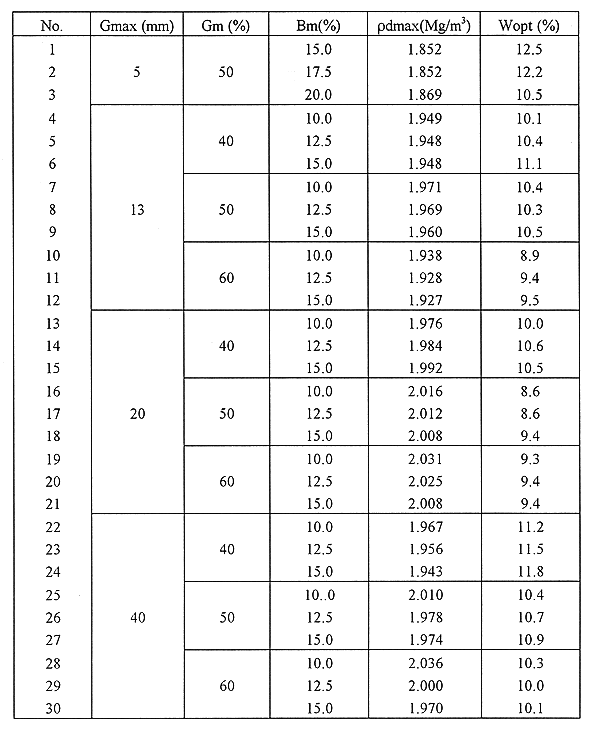
The mix ratios tested are given in Table I. Crushed stone (andesite; Gmax=5-40 mm), terrace-deposited sand (fine-grain component; about 2%), and sodium bentonite (kunigel V1) were used as testing materials.
A compaction test was conducted to obtain values of the optimum water content and the maximum dry density of the BSMG. The BSMG was poured into a compaction test mold (diameter 0.2 m for Gmax=40 mm, and 0.1 m in other cases), and compacted with the standard energy as defined in ASTM D 698 (Method A). Then a permeability test of the specimen compacted in a cylinder with a diameter of 0.13 m was carried out at a constant water pressure.
TABLE I Mix Ratios
Effect of maximum gravel size
The effect of maximum gravel size on the BSMG permeability was investigated. The maximum dry density, rdmax, increased with increasing Gmax, peaking at Gmax=20 mm and slightly decreasing at Gmax=40 mm, as shown in Table I. The same tendency was found when the mix ratios of gravel and bentonite were varied.
Figure 1(a) shows permeability test results for a gravel mix ratio of 50%. The hydraulic conductivity, k , showed a minimum value at Gmax=20 mm and higher values at Gmax=13, 40, and 5 mm in ascending order.
These results indicate that the optimum maximum gravel size is about 20 mm.
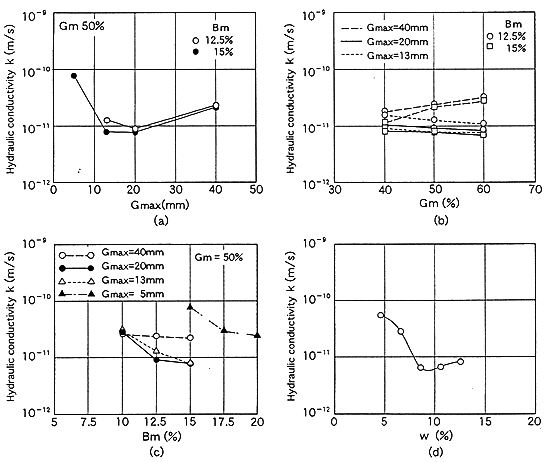
Fig. 1. Relationship between
hydraulic conductivity and mix ratio.
Effect of Gravel Mix Ratio
While it is known that the hydraulic conductivity decreases with increasing gravel mix ratio, Gm, it has been reported that the k value increases when Gm exceeds 70% ( 3 ). The present study thus investigated the permeability of the mixture within a Gm range of 40-60%.
As shown in Fig. 1(b), the hydraulic conductivity slightly decreased with increasing gravel mix ratio, Gm, for Gmax values of 13 and 20 mm, but no significant difference in k was observed in the Gm range of 50-60%. In contrast, k increased with increasing Gm for Gmax=40 mm.
These results indicate that the hydraulic conductivity of the BSMG can be minimized with a maximum gravel size of 20 mm and a gravel mix ratio of 50-60%.
Effect of the Bentonite Mix Ratio
It is very important to minimize the bentonite mix ratio, Bm, because it greatly influences material cost.The relationship between the hydraulic conductivity and the bentonite mix ratio, Bm, is shown in Fig. 1 (c) for a gravel mix ratio Gm=50%. The k value decreased with increasing Bm. The reduction in k was smaller when Bm was 12.5% or greater for Gmax=20 mm, and when Bm was 17.5% or greater for Gmax=5 mm. The reduction was not obvious for Gmax=40 mm. Hydraulic conductivity of less than 1 x 10⁻⁹ cm/s were obtained with a bentonite mix ratio Bm=12.5% for Gmax=20 mm, and with Bm=15% for Gmax=13 mm.
Effect of the Initial Water Content
The relationship between the hydraulic conductivity and the initial water content, w, for the BSMG is given in Fig. 1(d). While k sharply increased when w was lower than the optimum water content, k remained at the same level or lower when w was greater than the optimum water content. The above effect of the initial water content on the mixture is similar to the results found in soil materials in general.
Selection of Optimum Mix Ratios
The above results suggest the following optimum mix ratios to obtain a hydraulic conductivity less than 1 x 10-11 m/s in the BSMG with the optimum water content : a gravel mix ratio of about 50-60% for a maximum gravel size of 20 mm, and a bentonite mix ratio of about 12.5 %.
FIELD COMPACTION TESTS
A mixture with the selected bentonite mix ratio was prepared in a forced type mixer with twin shafts of a concrete plant, and its field quality after roller compacting with a vibration roller was investigated. The rolling compaction conditions were tested based on parameters of roller vibration force, spreading lift, and water content of the mixture.
Test conditions
The roller compaction tests of Table II were carried out based on parameters of roller vibration force and spreading lift.
The materials used were crushed stones for concrete (hard sandstone, maximum gravel size 20 mm), terrace-deposited sand (fine-grain component about 1%), fine concrete aggregate, and sodium bentonite.
The mixture was prepared in a forced type mixer with twin shafts ( capacity 2 m3 ). Materials were fed into the mixer in the order of sand, gravel, and bentonite. After agitating the mix with its natural water content for 45 seconds, water was added to achieve the required water content and the mix was further agitated for 60 seconds. The volume of each batch was 0.7 m3. Batches were prepared homogeneously with fluctuations of 12.5±0.5% for the intended bentonite mix ratio of 12.5%, 50±5% for the intended gravel mix ratio of 50%, and w ±0.5% for the intended water content.
The prepared bentonite mixture incorporating gravel was spread on a test yard with a testing area of 3m x 12m. The mixture was firstly compacted by two passes of a roller without vibration, and then eight passes with vibration.
The permeability was determined through a triaxial permeability test (confining pressure of 0.2 MPa) using core samples with a diameter of 0.1 m obtained from the roller compacted ground.
TABLE II Cases of Roller Compaction Tests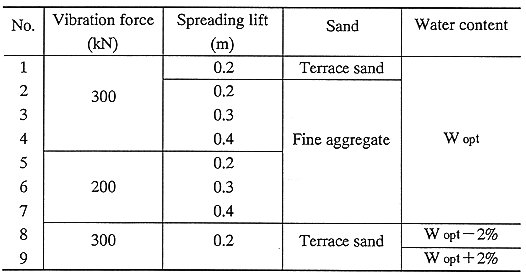
Effects of Roller Vibration Force and Spreading Lift
The dry density of the samples was measured with a moisture and density gauge using radioisotope (Co-60). The initial value was obtained after two passes of a roller without vibration, and further measurements were made after each additional pass.
First, roller compaction tests were carried out on the bentonite mixture containing fine concrete aggregate, by using vibration rollers with capacities of 300 and 200 kN, and spreading lifts of 0.2, 0.3, and 0.4 m.
Figure 2 shows the relationship between the number of passes and the dry density measured with RI, when roller compaction was carried out using vibration rollers with capacities of 300 and 200 kN and a spreading lift of 0.2 m. The dry density reached a constant value after two to four passes with 300 kN, and after four to six passes with 200 kN. The same trend was found when the spreading lift was changed.
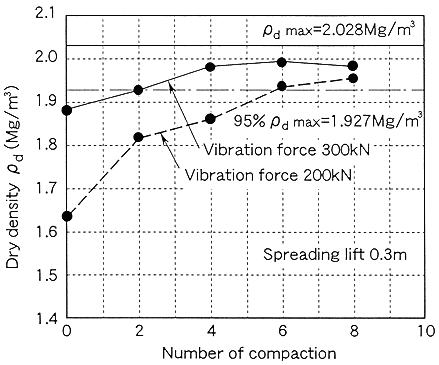
Fig. 2. Relationship between dry
density and number of compaction.
As shown in Fig. 3 (a)-(c), the final dry density of the core samples after eight passes decreased with increasing spreading lift. The effect of vibration force difference was not significant because of the stabilization of dry density after eight passes. However, the number of dry density measurements lower than 95% of the maximum dry density increased when the spreading lift was 0.4 m. This indicates that compaction was not sufficient in this case, even after eight passes with a vibration force of 300 kN.
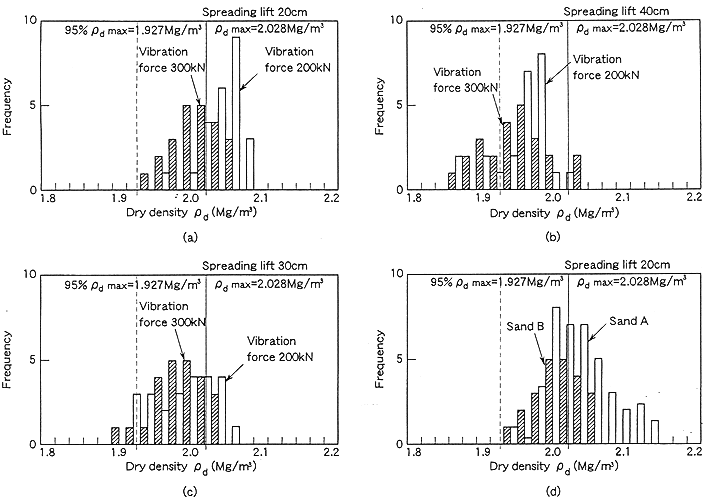
Fig. 3. Relationship
between dry density and spreading lift.
Knowing that a vibration force of 300 kN and a spreading lift of 0.2 m provide compaction results equal to or better than those of laboratory tests, an additional roller compaction test was conducted under these conditions using the terrace-deposited sand.
As shown in Fig. 3 (d), no difference was found between the different types of sand, and the average dry density was 2.04 Mg/m3, which was about the same as the maximum dry density rdmax=2.01 Mg /m3. All the values obtained exceeded 95% of rdmax.
Next, the permeabilities were evaluated through a triaxial permeability test using core samples. The relationship between hydraulic conductivity and spreading lift for the mixture containing fine concrete aggregate is shown in Fig. 4. Though the difference in roller vibration force was not significant after eight passes, the permeability increased with increasing spreading lift. The results indicate that a hydraulic conductivity less than 1 x 10⁻¹⁰ m/s can be achieved by four to six passes of rolling compaction with a spreading lift of 0.3 m for a vibration force of 300 kN, or with a spreading lift of 0.2 m for 200 kN.
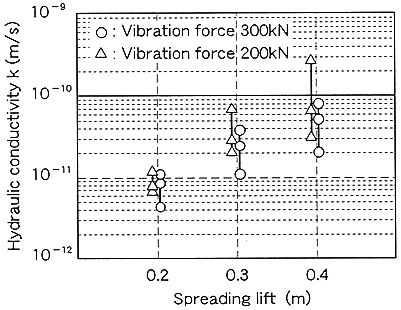
Fig. 4. Relationship between
hydraulic conductivity and spreading lift.
The permeabilities of core samples containing terrace-deposited sand when roller compaction was conducted with a vibration force of 300 kN and a spreading lift of 0.2 m are shown in Fig. 5. For a confining pressure of 0.2 MPa, the average permeability was 5.8 x 10⁻¹² m/s, which was about the same as the permeability of 4.2 x 10⁻¹² m/s obtained in a laboratory triaxial permeability test. Also, no difference was found between the different types of sand.
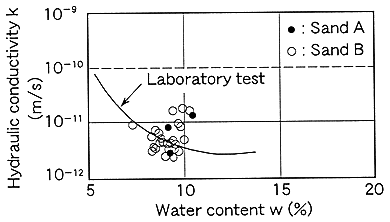
Fig. 5. Relationship between
hydraulic conductivity and kind of sand.
Effect of Initial Water Content
To investigate the effect of initial water content, rolling compaction was carried out with a vibration force of 300 kN and a spreading lift of 0.2 m; 2% higher and lower values than the optimum water content of the bentonite mixture incorporating gravel containing terrace-deposited sand were adopted for comparison.
Figure 6 compares the effect of initial water content on dry density of the mixture in the field test with laboratory test results. In the field test, no difference in dry density was observed between the optimum water content and a content 2% lower than optimum. As in the laboratory test, however, a lower dry density was obtained for a content 2% higher than optimum. Because dry density was unchanged when water content was raised 2% above optimum, and because the dry densities of many core samples exceeded the maximum dry density obtained in the laboratory test, the compaction energy of the vibration roller in the field test was probably greater than that in the laboratory test. This could have resulted in a lower optimum water content and a higher maximum dry density in the field test.
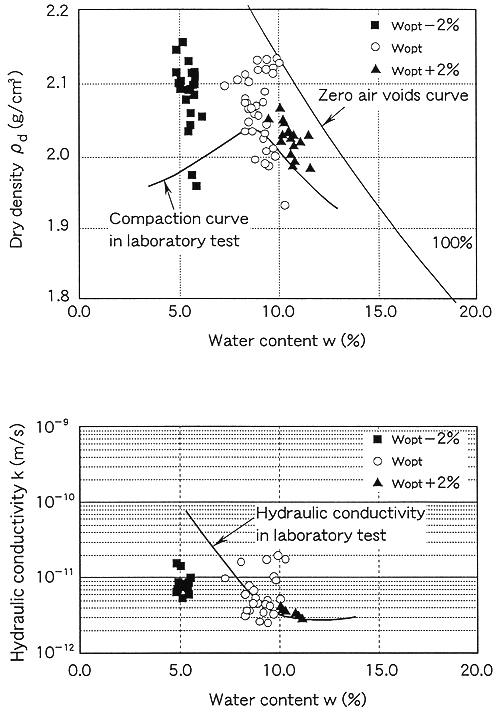
Fig. 6. Relationship between
hydraulic conductivity and water content.
Figure 6 shows the effect of initial water content on the permeability. As in the laboratory test, the permeability did not change when the water content was raised from the optimum value, but became slightly higher when the water content was lowered. However, increase in the permeability with a lowered water content was not as significant as that in the laboratory test. The selected optimum water content is considered to be a reasonable target in the mixture preparation stage because, as stated earlier, the optimum water content shifts to a slightly higher value under the studied compaction conditions.
Using a roller vibration force of 200 - 300 kN, a spreading lift of 0.2-0.3 m, and four to six passes of a compaction roller, the BSMG was found to provide a permeability similar to that obtained in a laboratory test. Other studies also showed no difference in permeability between laboratory and field tests. By using these conditions of rolling compaction, therefore, the impermeability found in a laboratory test is considered to be also achieved in the field.
CONCLUSIONS
Laboratory tests on compaction and permeability were conducted on a BSMG. The mixture's dry density showed a maximum value and its permeability showed a minimum value when the maximum gravel size, Gmax, was about 20 mm and the gravel mix ratio was about 50-60%. For Gmax =20 mm, a bentonite mix ratio Bm =12.5% was required to achieve a permeability less than 1 x 10-11 m/s.
A homogeneous BSMG was prepared in a forced type mixer with twin shafts, and was sufficiently compacted using a vibration roller with a capacity of 200-300 kN, a spreading lift of 0.2-0.3 m, and four to six passes. The field compacted mixture showed a permeability nearly equal to or even lower than those found in the laboratory tests. Under the above conditions of rolling compaction, the BSMG was found to be sufficient for practical use.
REFERENCE