
Fig. 1. Schematic of a conceptual
design for the vitrification pilot plant.
Ung-Kyung Chun, Kwansik Choi, Jung-Kwon Son, and Myung-Jae
Song
Korea Electric Power Research Institute
ABSTRACT
The Republic of Korea is showing interest in using vitrification as a means of managing low level radioactive waste produced from her pressurized-water reactors (PWRs). KEPRI, in coordination with its partners, will design, construct, and erect a pilot plant using data from orientation tests. In the development of the final objective, the establishment of an industrial vitrification installation plant in the Republic of Korea, it is necessary to have the harmful effects of the final waste form to the environment minimized. To insure that the entering waste has been properly treated, then the characteristics of the final waste form must be understood. This leads to the topic and objective of this paper, the examination for the characteristics of the waste after vitrification.
One of the major goals of the project to be undertaken by KEPRI is to obtain good characteristics in the final waste forms after treatment. The final treated waste will be comprised basically of two parts: the final vitrified product and the off-gases resulting from the vitrification process. The purpose of this paper is to give an overview of the examination for the waste characteristics of waste glass and off-gas that will be undertaken by KEPRI and its partners. This includes descriptions of certain aspects of the overall technical scope of the project and available testing/analysis procedures and equipment. A brief overview of the orientation tests and pilot plant tests to be performed is given. In addition, various future analysis tests for waste glass characteristics and off-gas characteristics examination is discussed. KEPRIs investigation and understanding of the waste by-products characteristics will hopefully lead to the optimization of the resulting waste products to minimize any negative impact on the environment resulting from these by-products.
INTRODUCTION
Based on the success of vitrification installations applied to high level wastes in other countries, the application to low level waste should be an easy transition since, in general, high level wastes present more problems due to higher contents of toxic species. Vitrification of low-level radioactive waste (LLW) has the potential of reducing substantially the cost of processing and burial while increasing the long term stability of the waste form for final disposal (1).
The Republic of Korea is showing interest in using vitrification as a means of managing low level radioactive waste produced from her pressurized-water reactors (PWRs). A vitrification facility for LLW has been found to be economically and technically feasible for installation in the Republic of Korea (2). Hence, KEPRI in coordination with various contractors will design, construct, and erect a pilot plant using data from orientation tests. Fig. 1 shows a general schematic of a conceptual design for the vitrification pilot plant. In developing the pilot plant, the waste form composition, processes and equipment to prepare the raw materials for vitrification, a glass melter, and effluent treatment are among the considerations. The purpose of the pilot plant would be to understand these considerations well enough to eventually lead to the installation of a full operating commercial scale vitrification plant in the Republic of Korea.
Fig. 1. Schematic of a conceptual
design for the vitrification pilot plant.
In the development of the final objective, the establishment of the vitrification installation plant, the major goal is the proper treatment of the wastes, not only the toxic species that was in the originally fed waste but also those species created through the various transformations due to the multifarious processes in the vitrification installation. To ascertain whether there was proper treatment, it is then necessary to have the harmful effects of the final waste to the environment minimized. This may mean that the waste is contained, transformed into harmless forms or less harmless forms, or is transformed into less harmless forms and contained. To insure that the entering waste has been properly treated, then the characteristics of the final waste form must be understood. This leads to the topic and objective of this paper, the examination for the characteristics of the waste after vitrification.
One of the major goals of the project to be undertaken by KEPRI is to obtain good characteristics in the final waste forms after treatment. The final treated waste will be comprised basically of two parts: the final vitrified product and the off-gases resulting from the vitrification process. The purpose of this paper is to give an overview of the examination for the waste characteristics of waste glass and off-gas that will be undertaken by KEPRI and its partners. This includes descriptions of certain aspects of the overall technical scope of the project and available testing/analysis procedures and equipment. KEPRIs investigation and understanding of the waste by-products characteristics will hopefully lead to the optimization of the resulting waste products to minimize any negative impact on the environment resulting from these by-products through the optimization of the processes leading to these wastes. To initiate optimization, it is necessary to understand what characteristics are desired in the by-products.
The final waste glass product must be reliable. For the pilot plant, chemical durability, waste form solubility, thermal stability, and mechanical stability of the waste glass will need to be optimized relative to processing considerations such as melt temperature, waste solubility, melt corrosivity, and volatility. To ascertain that the final waste glass product is reliable entails that these aforementioned characteristics are optimized..
Because of the high temperatures (i.e., 1200°C or even higher) associated with vitrification, the conditions are suitable for volatilization of various species from the waste and the glass. There can be various interactions between the glass form and the waste, or the waste with other waste. There may be physical, chemical, or physico-chemical reactions between the volatilized species and the solid wastes, thus, entrapping the volatilized species, making escape from the melter via entrainment less likely. There will be those forms, specifically, aerosols which are solid particulate emissions, gases, liquids that do escape the melter. These aerosols are produced by different mechanisms, the most important being entrainment through drag forces and recondensation of volatilized materials (3). The aerosols that escape as off-gas if emitted freely into the environment without any capturing would surely have deleterious consequences on the environment and the society that lives within such an environment. Since the harmful effects of heavy metals, toxic organics, and radioactive species are well documented (4, 5, 6),understanding the characteristics of the off-gas to help establish an appropriate off-gas treatment system would be necessary.
ORIENTATION TESTS
The first phase of the project to be undertaken by KEPRI entails orientation tests. The purpose of these tests is to quickly provide some basic data on the waste characteristics of those of the waste glass and off-gas. The orientation tests in the laboratory will be concerned with the direct vitrification test of evaporator bottoms, sludges, dry active wastes (DAWs) which include combustibles and noncombustibles, and spent resin with a small existing melter without the pretreatment of the wastes. There will be a vitrification test after pyrolysis of all the wastes. There will also be an examination for the optimal treatment test of the sulfate in cation resin. The characteristics of the waste will also depend on the performance testing of the feeding systems to select the optimal feeding method, the performance of the off-gas treatment system, and the optimization of the process parameters for the waste streams such as evaporator bottoms, spent resins, and combustibles with the melter. The optimization will be for the waste glass form and off-gas characteristics.
PILOT PLANT TESTS
A pilot plant is in the plans for development in Korea to further examine the waste characteristics for the optimization of the waste glass and off-gas. The results here will be used to eventually help design the commercial vitrification or industrial scale vitrification facility. The type of equipment (e.g. melter, pyrolyzer, waste pretreatment equipment, etc.) will affect the nature of the waste glass and hence, off-gas as well.
The plant will likely incorporate a cold crucible melter (CCM). The CCM offers distinct and real advantages over conventional melting techniques: there is no melter to corrode, no electrode to fail, and no highly contaminated equipment to dispose of at the end (7). In addition, the higher temperatures possible with the CCM (in the range of 1200 - 1400°C and even higher) open up possibilities for new glass formulations which could accommodate corrosive, refactory or low-soluble waste (7). Since the crucible is cold and protected from the glass by a cold glass layer, glass can be produced at higher temperatures, which increases the glass formulation range. In addition, because the melt comes in contact only with solid material of the same composition and not with foreign compounds, the final product has a high degree of purity, which is particularly important for complying with product specifications.
KEPRI and the various contractors/subcontractors will design, construct and erect a pilot plant which consists of a 50 kg/hr throughput melter which is heated by direct induction and cooled by a loop with water circulating inside and of an off-gas treatment system. The off-gas treatment system shall be designed considering effluents produced from the treatment of noncombustibles and spent liquid filters by utilizing a plasma melter (PM) with a throughput of 10 kg/hr and effluents generated from the treatment of evaporator bottoms, combustibles, or spent resins with the melter. The results from the pilot plant tests will be used to, as mentioned before, to construct and operate a commercial facility with a 250 kg/hr throughput melter and its subsystems in the Republic of Korea.
WASTE GLASS CHARACTERISTICS
Wastes
Design of the pilot plant has been geared toward the vitrification of inactive surrogate waste such as spent ion exchange resins, dry combustible waste, and evaporator concentrates (e.g. borated concentrates). These would include dried products that may be simulated by using dry raw materials. Ion exchange resins would include dried saturated cationic resins, dried anionic resins, dried mixed bed (50/50), wet cationic resins, wet anionic resins, mixed bed incorporating both types of resins. Solid combustibles would include plastics and cellulose.
Waste Preparation
Prior to feeding, the waste is expected to be prepared by shredding with the use of a knife shredder of dry combustible waste and by the drying of evaporator concentrates. This should help provide better mixing with the glass and the waste for a more homogeneous mixture. In addition, organic products can be treated by pyrolysis in order to destroy part of the element and thus facilitate the final combustion of the product and minimize the amount of waste to be incorporated in the glass. This could be done before vitrification or simultaneously with vitrification.
Waste Glass Characteristics Examination Tests
A primary focus in vitrification is the stabilization of the final waste form. The assessment of the effectiveness of stabilization requires the measurement of physical, engineering, and chemical properties of the stabilized material(8). Hence, it requires a very good understanding of the final waste glass form. It must be understood what requirements are required for the proper stabilization of the vitrified matter.
Leaching Tests
Minimizing the rate at which pollutants contaminate or migrate into the environment is one of the primary reasons for stabilization and solidification of the waste. Leaching is the process by which contaminants are transferred from a solid or stabilized matrix to the leachant (8). The fluid to which the contaminants are leached is called the leachant. After the leachant has become contaminated it is called the leachate. Various leaching tests are expected to be performed. Among them the Toxicity Characteristics Leaching Procedure (TCLP). The TCLP, a U.S. regulatory test, may be used to determine if the waste meets requirements to be land-disposed and to evaluate the effectiveness of the stabilization treatment. Equilibrium leach tests and dynamic leach tests which are used to evaluate the leachability as a function of time is expected to be performed.
Chemical Tests
The chemical analysis of the leachate is expected to be undertaken. This may involve the use of an inductively coupled plasma spectrometer (ICP) or an atomic absorption spectrometer (AA) to analyze the concentration of particular elements in the leachate. These tools can be used to ascertain metals concentrations.
For organic compounds, other methods may be used. A Fourier transform infrared spectrometer (FTIR) may be used to evaluate the presence and type of chemical bonding between the organic contaminants and the binding reagents by interpretation of the shift in the infrared frequencies. Differential scanning calorimetry data can be used to determine the excess energy needed to release toxic substances from the vitrified forms. Gas chromotagraphy and mass spectrometry (GC/MS) techniques may be used to identify products in the stabilized matrix that may result from the degradation of the original contaminants. Taken as a group these three tests can give insight into the nature and extent of the chemical bonding of organic contaminants in the stabilized matrix(9).
X-ray fluorescence, X-ray diffractometry, optical microscopy, scanning electron microscopy, transmission electron microscopy and energy dispersive microscopy can be used to examine the nature of the stabilization processes at work (e.g. physical, physicochemical, chemical). Using the various microsopy techniques, glass homogeneity can be examined. The scanning electron microscopy (SEM) and transmission electron microscopy (TEM), in general, allow for the utilization of energy dispersive spectroscopy (EDS) techniques to also examine chemical composition.
Physical and Engineering Property Tests
The application of a pocket penetrometer which is a standardized cylinder that can be pushed into the material to measure the penetration resistance(force), estimating the unconfined compressive strength in tons/ft2 (8). The Unconfined Compressive Strength Test (10) can be conducted to determine the strength of the cohesive materials. An applied stress and resulting strain can be obtained. The test can be conducted over time to provide a measure of the improvement of the stabilization process (8). In general, for any given stabilization reagent, the stronger the stabilized hazardous waste, the more effective the stabilization process, particularly for inorganic contaminants(8). According to VECTRA, an unconfined compression strength of 500 psi represents a suitable compressive strength measure for waste form stabilization (10).
Some preliminary tests have been performed by Hanguk Fiber and KEPRI to evaluate the compressive strength characteristics for waste forms . It was ascertained by Park et al. (1996) that as the pyrolysis ash waste contents increased from 0 to 45% in the final glass product, compressive strength rapidly dropped to between 5 to 6 times lower than that of neat glass (11). They found that for waste content up to 40% by volume in the vitrified waste form, the vitrified form maintains proper mechanical properties. In other words, the vitrified products obtained from the laboratory test had good mechanical stability. The suggested composition of the final glass product was 40~50 wt.% for SiO2, 3~5 wt.% for Al2O3, 15~20 wt.% for B2O3+Na2O, and 5~40 wt.% for wastes. A schematic for this glass composition is shown in Fig. 2.

Fig. 2. A schematic for only glass
composition for that obtained by Park et. al. (10).
Durability test methods such as the freeze/thaw durability (ASTM D4842) may be applied to determine whether the matix is stable enough to handle repeated cycles of weathering.
Other electrical and thermophysical properties that are desired include electrical resistivity of the glass waste form, glass viscosity which can be measured using , glass density, vitreous transition temperature determination using a Micro TDA, and glass redox potential.
OFF-GAS CHARACTERISTICS EXAMINATION
Regulations in the Republic of Korea exist to control air pollution toxicity levels in the environment. To maintain emission standards, the design of the vitrification plant will require the design of an off-gas treatment system. To design the off-gas treatment system, a primary consideration is obtaining the knowledge of the off-gas characteristics.
The off-gas characteristics will depend on the waste. Waste characteristics from two 1,000 MWe PWRs were examined by EPRI where the waste was composed of combustible DAW, non-combustible DAW, evaporator bottom products, spent resin, and spent liquid filter(1). The main nuclides were noted as being Fe-55, Co-60, Ni-63, and Cs-137 and the specific activity for each waste stream was increased as order of spent resin -spent filter - DAW - evaporator concentrate. One could infer that because there are quantities of these metals in the waste that it is very likely that some of these would also be present in the off-gas. The Republic of Koreas allowable emission levels for these metal species are shown in Table I.
Table I Maximum Allowance of Selected Radionuclides in Air for the
Republic of Korea (Ci/cm3).

Quantity and Quality
In terms of both off-gas treatment equipment performance and public protection, there are two important issues related to the particulate matter: the amount of particulate in the off-gas and the size distribution of the particulate (3). From a control point of view, the particulate quantity is important as it dictates the load on a particulate removal device (3). The particle size distribution (PSD) is important since smaller particles have higher chances of entrainment and in general, will have higher chance to escape the off-gas treatment system. Since each different air pollution control device would have different collection efficiencies for different particle sizes, a knowledge of particle size in the off-gas will help choose the appropriate system. This could aid in the prevention of unnecessary expenditures for equipment that is either not necessary or useless in the capture of the off-gas.
These two important issues are dictated by the feed system, the melter design, operational conditions, glass, and the waste among other factors. The feed system will, in general, dictate the rate at which the waste is being vitrified and will, hence, affect the amount of effluents flowing into the off-gas treatment system. The melter design and the operational conditions, will, in general, control much of the environment for the thermodynamics and chemistry for the interactions between the glass and the waste. The volatilization of the glass or waste depends greatly on the thermodynamics and chemistry. Different species have different volatilization rates. These rates for the different species, of course, depends primarily on the temperature which is dictated by the melter design and operational conditions.
Future Experimental Tests
Orientation tests will be used to provide data on the volume of off-gas that could be expected from the vitrification in the pilot plant to help better design the pilot plants off- gas treatment system. This would help understand the size of the off-gas treatment system required. The total gas flow escaping from the melter which depends on the maximum acceptable capacity and the required excess O2. The total gas flow will determine the capacity of the whole off-gas treatment system which is a significant part of the total cost of the pilot.
The off-gas from the vitrification/pyrolysis of different wastes may result in limiting the effectiveness of the vitrification system. For example, in the processing of ion exchange resins, the deposit of carbon on the cold glass walls due possibly to soot formation is considered unacceptable for the running of the melter. In the burning of organic waste, the limiting parameter is the off-gas volume which must be limited to avoid unacceptable entrainment of particles in the off-gas treatment. In addition, further understanding of the off-gas characteristics would occur in the pilot plant to help better design the commercial scale vitrification plant. A CEMS (continuous emission monitoring system) is expected to be used in the pilot plant to analyze the remaining off-gas leaving the off-gas treatment system and entering the environment.
To better understand some of the characteristics of the off-gas that may emanate from the pilot plant, a bench scale experiment is currently being designed at KEPRI to study the wasteglass and off-gas characteristics. Numerical models for the off-gas are also being examined and others will be examined for diagnostic and prediction purposes of the off-gas.
An experimental set-up for sampling of the aerosols emanating from the melter and various stages of an off-gas treatment system is to incorporate a particle cascade impactor. If a Mark II Andersen Cascade Impactor is used, particles can be size segregated into 10 different size ranges stemming from greater than 10 microns to roughly 0.2 microns.
Numerical Work
A numerical code, MAEROS2, developed by Gelbard (1993), solves a simplified version of the population balance equation (PBE) which models a multi-component aerosol evolving in time and particle size space. A modified version of the MAEROS2 code (12) predicted well the aerosol evolution in an experimental hazardous waste incinerator (Fig. 3). With modification, this code, interfaced with a code that predicts the species present in the off-gas, could be used to predict the aerosol evolution within the melter and the off-gas treatment system. The code would also be able to handle the changes that occur within the aerosol sample as it is being sampled. Modifications may be required to model the behavior at certain stages of the off-gas treatment system but the basis for the modeling of the fundamental physics appears to be there within the code. The code can currently handle homogeneous nucleation, condensation, and coagulation. When certain stages of the off-gas treatment system is reached, for example, scubbers, additional physics (i.e., due to the effects of water jets) may be required.
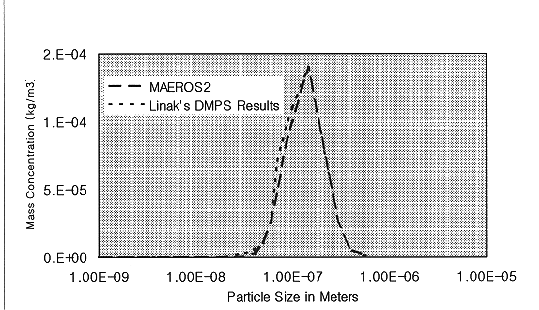
Fig. 3. MAEROS2 result comparison
with Linak et al.'s (13) experimental DMPS result. The numerical solution
incorporates nucleation, condensation, coagulation, and the Kelvin effect.
CONCLUSION
KEPRIs ultimate goal, the establishing of an industrial scale vitrification plant, follows many initial steps including preliminary tests, orientation tests, concurrent bench scale and pilot plant studies. To have a useful, functional vitrification plant, the final waste characteristics should be optimized, specifically for the consideration of the waste glass form. In addition, considerations during the optimization procedure include that of the off-gas volume among others. For the optimization of these characteristics, there is a need to understand them. The final treated waste will be comprised basically of two parts: the final vitrified product and the off-gases resulting from the vitrification process. An overview of the examination to be undertaken by KEPRI and its partners of the waste characteristics of the waste glass and off-gas was given. This included general discussions of the overall technical scope of the project and available testing/analysis procedures and equipment. A brief overview of the orientation tests and pilot plant tests to be performed was also included. In addition, various future analysis tests for waste glass characteristics and off-gas characteristics examination were discussed. KEPRIs investigation and understanding of the waste by-products characteristics will hopefully lead to the optimization of the resulting waste products to minimize any negative impact on the environment.
REFERENCES