Table I Curie Balance Closure from Radioactive Ion Exchange Resin
Processing (Bench-scale data)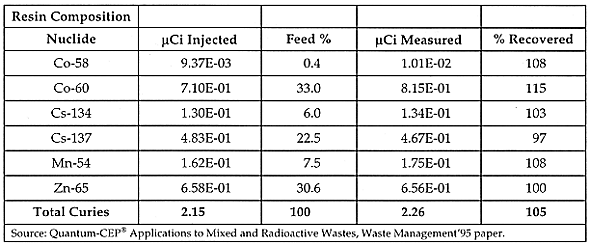
Ron Sills and Myron Kaczmarsky
Molten Metal Technology
Al Castagnacci
Duquesne Light Company
ABSTRACT
Quantum-CEP® is an innovative and proprietary technology developed by Molten Metal Technology, Inc. which can process radioactive and mixed waste streams to decontaminate and recover resources of commercial value while achieving significant volume reduction and radionuclide stabilization. The technology has been commercialized in the government and commercial radioactive markets. A Q-CEP® facility, wholly owned by Molten Metal Technology, located in Oak Ridge, Tennessee, processes low-level radioactive spent ion exchange resins (IER) from commercial nuclear power plants.
In the Q-CEP®-IER commercial facility, radioactively contaminated IER is ground, dried and fed to Catalytic Processing Units (CPU) which contain a molten metal (iron) bath, operating at 1320-1650°C (2400-3000°F) and 2-11 bar (10-150 psig). The dried resin together with gaseous co-feeds (oxygen, natural gas and nitrogen) are injected into the CPU. The spent IER dissociate and dissolve into their elemental intermediates. The process provides high efficiency destruction and conversion of organics with simultaneous capture of radioisotopes in a stable form for long-term storage. Organic constituents of the IER are converted to decontaminated gases (primarily hydrogen and carbon monoxide) which have sufficient energy value as fuel to be reused on-site. Non-volatile radioisotopes (55Fe, 60Co, 54Mn) remain in the metal bath as the final stable form. Radioisotopes such as 134Cs/137Cs, which are volatile, evolve in the process gas and are captured in concentrated form for long term storage using a trap in the gas handling train. The solidified bath, with the volatile radioisotope trap, is shielded and shipped to a disposal site.
This paper presents campaign results from processing spent IER, from Duquesne Light Company's Beaver Valley Power Station. These results demonstrated the commercial viability of the facility by processing 7700 kg (17,000 lb) dry resin, and achieving key performance objectives including injection rates of greater than 0.04 kg/s (5 lb/min) and a campaign length of 7 days.
The Q-CEP® facility provides a commercially available, cost effective alternative to the nuclear power industry for disposing of low level radioactive spent IER. Key highlights of the process include high destructive efficiency of resin, recovery of organic material as decontaminated product gas, the safe and stable capture of radionuclides in a self-shielding final form, and significant volume reduction.
INTRODUCTION
Catalytic Extraction Processing (CEP) is an innovative and proprietary technology that allows waste material of a wide range of composition (organic, organometallic, and inorganic) to be recycled as products of commercial value, such as industrial gases, metal alloys, and specialty ceramics. At the core of CEP is a liquid metal bath which acts as a catalyst and solvent in the dissociation and dissolution of the feed and the synthesis of products. Upon introduction to the bath, feeds dissociate and dissolve into their constituent elements. Addition of co-reactants enables reformation and partitioning of desired products. The catalytic and solvation effects of CEP, together with the thermodynamically controlled reaction pathways, allow the technology to achieve superior environmental and waste minimization performance. Quantum-CEP® is the application of the CEP technology to process radioactive and mixed waste (waste which is both hazardous and radioactive) streams. Targeted radionuclide partitioning leads to decontamination and reuse of a large portion of the waste components as commercial products (e.g., synthesis gas) with high resultant volume reduction through radionuclide concentration into a stable final form.
This paper presents campaign results from processing spent IER, from Duquesne Light Company's Beaver Valley Power Station. Duquesne Light Company operates Beaver Valley Power Station Units 1 and 2 located in Shippingport, Pennsylvania, which is approximately 25 miles northwest of Pittsburgh. Each unit has generating capacity of 833,000 kilowatts. Unit 1 began operating in 1976 and Unit 2 in 1987.
The Beaver Valley steam generator blowdown systems are used to process and recover blowdown liquids through demineralizers that are loaded with cation and mixed bed resin. Resin replacement is based primarily on sodium break through on the demineralizer effluent. The resin is mildly radioactive and requires disposal as radwaste. The Beaver Valley resin processed in the campaign presented in this paper had sufficiently low levels of radionuclides to be considered releasable from regulatory control.
Q-CEP® FACILITIES
Molten Metal Technology has engaged in the technical development of Quantum-CEP® and has commercialized the technology to the government and the commercial radioactive waste markets. Molten Metal Technology operates a variety of experimental and demonstration-scale CEP systems and has demonstrated long-term operability and reliability to commercial and government customers.
Q-CEP®-IER Commercial Facility in Oak Ridge, Tennessee
The Q-CEP®-IER commercial facility has a design capacity of over 2830 m3 (100,000 ft3) per year of spent IER with contact readings of up to 10 R/hr. Located in Oak Ridge, Tennessee., this first-of-a-kind Q-CEP® facility processes low-level radioactive spent IER used by commercial nuclear power plants for water purification. The facility was initially jointly operated and owned by Molten Metal Technology and Scientific Ecology Group (SEG), a subsidiary of Westinghouse Electric Corp. In December 1996, Molten Metal Technology completed the acquisition for full ownership. The facility was designed to reduce radiation exposure to levels that are As Low As Reasonably Achievable (referred to as the ALARA program), including operations remotely controlled. In April 1996, the commercial viability of the facility was demonstrated using spent IER from a commercial nuclear power plant. This spent IER had sufficiently low levels of radionuclides to be considered releasable from regulatory control. In December 1996, the first campaign processing low level radioactive IER was successfully completed.
M4 Environmental L.P. ® (M4) Technology Center in Oak Ridge, Tennessee
M4, a limited partnership between Lockheed Martin Corp. and Molten Metal Technology is licensed to provide Quantum-CEP® technology to certain U.S. government, commercial, and international markets. M4 currently operates a commercial Q-CEP® system for processing mixed wastes at its Technology Center also in Oak Ridge, Tennessee. A second commercial system is scheduled to begin operations in the first quarter of 1997.
Molten Metal Technology Recycling-R&D Facility in Fall River, Massachusetts (MA)
Molten Metal Technology Recycling-R&D Facility in Fall River, MA, has been the primary site for technology development and customer demonstrations. A variety of experimental and demonstration-scale CEP and Q-CEP® units have been operated for both research and customer needs. Fall River houses bench-scale units, pilot-scale units, physical models and a commercial demonstration prototype unit. The facility is fully permitted by the Commonwealth of Massachusetts for recycling demonstrations using hazardous and non-hazardous materials as feeds. At Fall River, Molten Metal Technology has carried out a range of demonstrations processing U.S. Resource Conservation and Recovery Act (RCRA)-listed and characteristic hazardous materials and has received recycling certifications from the Massachusetts Department of Environmental Protection for the processing of RCRA feeds. Molten Metal Technology has also carried out radioactive surrogate and common isotope testing at the facility. The U.S. Environmental Protection Agency (EPA) has recognized CEP technology as achieving the Best Demonstrated Available Technology (BDAT) requirements for processing all wastes for which incineration was previously the only approved processing method.
QUANTUM-CEP® APPLICATION TO SPENT ION EXCHANGE RESINS
Surrogate Testing
Prior to "hot" testing, Molten Metal Technology performed demonstration runs on non-radioactive resin at the Fall River demonstration unit to study CEP efficiency for organic (polystyrene-divinylbenzene polymer) resin conversion. The calculated Destruction Removal Efficiencies (DRE) were >99.9999% (below the Lower Detection Limit (LDL) of 1.2 ppb).
Bench-Scale Testing
A range of hot tests using commercial spent IER have been performed, beginning in 1994, at Oak Ridge using a bench-scale Q-CEP® system. A representative total Curie balance is shown in Table I for the gamma-emitting radionuclides in the resin.
Table I Curie Balance Closure from Radioactive Ion Exchange Resin
Processing (Bench-scale data)
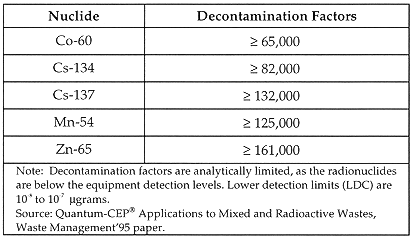
The bench-scale testing has also demonstrated decontamination factors leaving the reactor system >=104 (limited by analytical). The commercial facility is designed for decontamination factors >107. Table II shows representative decontamination factors achieved in the bench-scale tests exiting the reactor system but excluding the gas handling train (i.e., HEAP filter). Decontamination factor is defined as DF = Activity In / Activity Out.
Table II System Decontamination Factors
Q-CEP®-IER Commercial Facility in Oak Ridge, Tennessee
Process Description: In this Q-CEP® facility, radioactively contaminated IER with up to 5.3 Ci/m3 (0.15 Ci/ft3) activity is ground, dried and fed to the CPU which contain a molten metalbath, operating at 1320-1650°C (2400-3000°F) and 2-11 bar (10-150 psig). After the metal bath reaches the maximum allowable volume or maximum concentration of radioactivity, the CPU is shut down and the metal bath cooled and solidified. Organic constituents of the IER dissociate into their elemental intermediates, and through the addition of co-reactants, form CO, H2, and N2. Non-volatile radioisotopes, such as 60Co, 54Mn, 51Cr, 55Fe, 60Ni and 51Cr remain in the metal bath. Volatile radioisotopes such as 134Cs,137Cs and 65Zn are captured in the Gas Handling Train. The solidified bath, with the volatile radioisotope trap, is shielded and shipped to a disposal site. The facility is also designed to produce steam to dry the resins from the synthesis gas product.
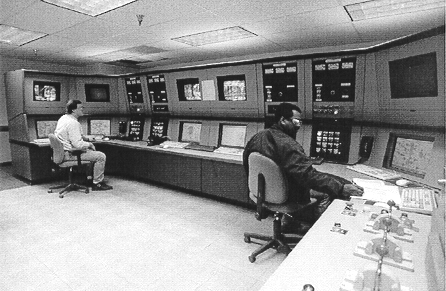
Fig. 1. Q-CEP®
control room.
Q-CEP®-IER Facility: The facility can be divided into three sections: feed preparation/injection, the Catalytic Processing Unit (CPU), and the gas handling train.
Feed Preparation / Feed Injection - Spent IER is received from the customer in High Integrity Containers (HIC's) or other containers which are transferred into separate holding tanks prior to batch processing. The resin is ground, dried and collected to allow injection of dried resin into the CPU. The system is fully enclosed allowing containment and recycle of any dust escaping from the feed.
The IER is conveyed through an injector, called a tuyere (triple concentric pipes), which is installed in the bottom of the CPU. Oxygen and natural gas are fed through separate pipes in the tuyere. Oxygen is fed in an approximately stoichiometric ratio to the carbon in the feed to generate synthesis gas.
Catalytic Processing Unit (CPU) - The CPU is a reactor which converts spent IER to synthesis gas and provides capture of non-volatile radionuclides in the metal bath. The CPU consists of an inductively heated, refractory crucible holding a molten metal bath inside of an outer containment carbon steel pressure vessel. The inner refractory crucible, which is in direct contact with the molten metal bath, is designed to be removable after each batch.
Prior to batch processing, the refractory crucible is loaded with a metal charge in the crucible preparation area. A motorized cart and hydraulic lift system remotely places the crucible in the pressure vessel. The electric induction coil provides the main source of energy to melt the initial charge of metal and supplies additional energy required to maintain the operating temperature of the liquid bath during feed processing. Containment and continuous monitoring system provide a mechanism to ensure safe containment of the molten metal bath.
Gas Handling Train (GHT) - The GHT captures radionuclides in a volatile radionuclide trap and removes impurities from the process gas before final emission or reuse as product.
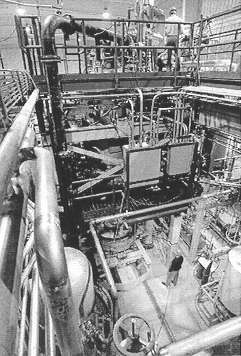
Fig. 2. Q-CEP®
Facility.
Post-Operation - Once a batch is completed, the CPU is depressurized and the crucible is allowed to cool. After cooling, the crucible and the attached bottom head assembly are lowered and placed onto a motorized cart (shown in Fig. 3). The crucible assembly is then transferred to the capping area where it is prepared for shielding and shipping. The volatile radionuclide trap is removed from the GHT and placed into the crucible assembly. A separate shielded container is lowered over the crucible assembly, mechanically secured, seal welded and prepared for shipment. The CPU bottom crucible assembly and motorized cart are returned to the crucible preparation area.
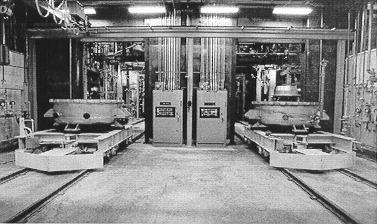
Fig. 3. CPU bottom crucible assembly
and motorized carts; dual trains are shown
Q-CEP® Campaign
A wide variety of resins can be processed. The Waste Acceptance Criteria (WAC) for Ion Exchange Resins is broad:
Campaign results from processing IER, from Duquesne Light Company's Beaver Valley Power Station, which had sufficiently low levels of radionuclides to be considered releasable from regulatory control, are presented.
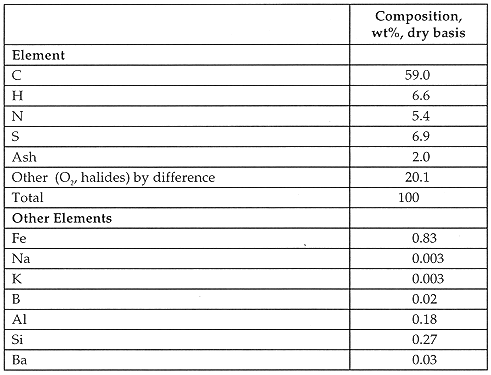
The IER composition is a key input to the facility's operating strategy to provide an integrated, cost effective, environmentally sound solution for spent IER. Analyses are performed on incoming resin to determine the composition. Ultimate and Inductively Coupled Plasma Emission Spectroscopy (ICP) analyses of the resin are shown in Table III.
Table III Analyses of Beaver Valley Resin
Campaign Results
The commercial viability of the facility was demonstrated with the successful completion of this campaign in April 1996. The campaign was conducted at the operating conditions of 6 bar (75 psig) CPU pressure and bath temperatures of 1320-1370 oC (2400-2500°F). As shown in Table IV, this campaign processed 7700 kg (17,000 lb) dry resin, achieving the key technical performance targets:
Table IV. Campaign Operating Conditions and Results
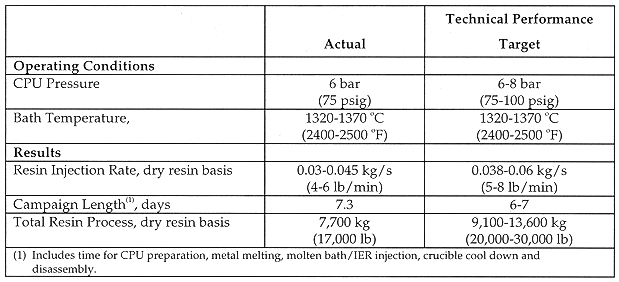
At design rates of 0.06 kg/s (8 lb/min), two trains could process essentially all of the 3260 m3 (115,000 ft3) annual generation of IER with dose rates <10 R/hr.
The organic constituents (C, H and O) in the IER feed are partitioned into the gas phase primarily as synthesis gas, which is a mixture of carbon monoxide and hydrogen. Nitrogen partitions to the gas phase as N2. Sulfur partitions primarily to the gas phase as H2S, with the balance remaining in the metal bath as metal sulfides. The facility is designed to use the synthesis gas as fuel, after purification by removing H2S in the GHT. About 98 wt% (dry basis) of the IER feed was C, H, N, S and O. Trace elements, such as Fe, Si, Al, Ba and B which represented 1.3 wt%, were captured in the metal bath as sulfides and oxides.
In December 1996, the first campaign processing low level radioactive spent IER was successfully completed. Results from campaigns with low level radioactive IER will be presented in a future publication.
CONCLUSIONS
Quantum-CEP® technology can be applied to a wide range of low level radioactive and mixed waste feeds, effectively partitioning and stabilizing radionuclides while destroying hazardous constituents. Current programs, including extensive laboratory, bench-scale and demonstration-scale testing, have led to commercializing the technology to both the commercial and government nuclear markets. A Q-CEP®-IER facility processing radioactive IER from nuclear power plants is in commercial operation. The commercial viability of the facility was demonstrated, in April 1996, using spent IER which had sufficiently low levels of radionuclides to be considered releasable from regulatory control. The first campaign processing low level radioactive IER was successfully completed in December 1996.
The key benefit of the Q-CEP®-IER facility is that it provides a commercially available, cost effective alternative to the nuclear power industry for disposing of low level radioactive waste IER. The facility is designed to process essentially all of the 3260 m3 (115,000 ft3) U.S. annual generation of IER with dose rates <10 R/hr. The process achieves significant volume and weight reduction due to the recovery of organic material as decontaminated product gas. The process produces an environmentally improved final form that is safe and self-shielding, which reduces liability to the customers, reduces environmental risks to the public and is consistent with U.S. regulations.