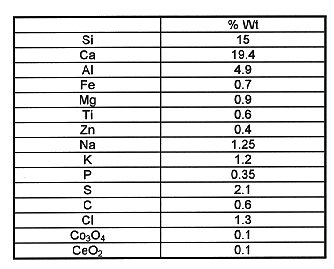
Table I Ash Composition
Rosemarie Atabek
CEA (Commissariat à l'Energie
Atomique)
BP 6 - 92265 Fontenay-aux-Roses Cédex (FRANCE)
Hubert Massit and Jean-Pierre Turchet
CEA (Commissariat à
l'Energie Atomique)
BP 1- 13108 St Paul Les Durance Cédex (FRANCE)
ABSTRACT
The Commissariat à l'Energie Atomique (CEA) is actively interested in high-temperature processes for treating a variety of solid radioactive wastes. The Plasma Arc Centrifugal Furnace (PCF) developed by RETECH Inc., USA, forms the basis of the PLASMARC®-2 melting facility installed in FRANCE at CADARACHE for treatment of radioactive wastes. The results obtained with the PLASMARC®-2 (designated CEA-1) on incinerator ash vitrification are presented with emphasis on the behavior of Co and Ce tracers and on the off-gas treatment optimization
INTRODUCTION
The principal objectives of the waste management policy implemented by the Commissariat à l'Energie Atomique (CEA) are to minimize waste volume and to improve waste conditioning matrices for final disposal.
Incineration of combustible waste provides the best performance of all available volume reduction processes. Small incineration facilities with capacities of 10 to 20 kg h-1 have been operated many years in France, mainly according to the priorities and constraints of the Research Development program. The volume reduction strategy is implemented in existing facilities some of which are being renovated to upgrade the technology or to ensure compliance with new safety requirements, and new facilities are being built, including one specialized in defense transuranic waste. In this context, research on conditioning of incinerator ashes has focused on «vitrification» and new high temperature processes based on plasma torch technology are currently being assessed by the CEA.
Treatment of wastes and residuals with plasma technology has been tested for several years with a variety of materials including organic materials, sludges, metals, concrete, soils and obsolete military munitions (1, 2, 3). A PLASMARC® plant will be built bu MOSER-GLASER & Co Ltd for ZWILAG to treat low level wastes from medecin industry, research and nuclear power stations in Switzerland (4). The CEA has undertaken feasability tests with PLASMARC®-2 mobile system including a Plasma Arc Centrifugal Furnace (PCF) developed by RETECH Inc, USA, with a capacity of about 20 kg h-1 (5, 6). These 1993-1994 tests have clearly demonstrated that plasma are process treatment is a promising solution (7) and a new installation of the same type, designated CEA-1, was delivered to the CEA's Cadarache Research Center in 1994. About 80 tests were conducted since the beginning of these studies on surrogates for low-level solid wastes.
TEST PROGRAM AND PROCEDURE
The main objectives of ash treatment are the following :
Tests were also performed to determine the experimental conditions for dust spreading minimization in the furnace and to optimize the off-gas treatment.
The CEA-1 facility mainly comprises a 2 ft diameter centrifugal furnace (PCF2), a 150 kW Retech RP-75T transferred arc plasma torch and a gas-fired secondary combustible chamber (SCC)(7).
Each waste heat treatment test is carried out according to the following sequence :
Sampling points are provided after the SCC to monitor on line gaseous release, e.g. Cl2, O2, NOx, COand SO2.
The matrix, waste and slag composition is determined by X-ray fluorescence or by inductively coupled plasma atomic emission spectrometry (ICP-AES). The concentrations, expressed as centesimal fractions of the sample mass, are extrapolated to the total mass.
The following elements are determined in the scrubber water : Cl-, NO3-, NO2-, SO42-, inorganic C and insoluble elements such as the nonradioactive Co and Ce tracers added to the waste to study radionuclide behavior. Where possible, the tracer distribution is determined in the PLASMARC®-2 components (slag, furnace refractory material, off-gas duct and scrubber, exhaust stack). The furnace is rinsed for the final balance, and tracer retention is calculated with allowance for the fraction recovered in the rinse. The tracers are analyzed by inductively coupled plasma mass spectrometry (ICP-MS).
TREATMENT PROCESS
Ashes are very fine and dispersable wastes which need special attention to be handled, transferred and stored. Meanwhile their composition presented in Table I includes chemical elements useful for glassy matrix formation.
Table I Ash Composition
Ashes are pre-prepared to improve transfer capability and adjust chemical composition before thermal treatment. They are melted together with a silico-aluminate glass by means of the 150 kW torch. The off-gas are purified passing successively through the secondary combustion chamber, high temperature filters and a scrubber unit. At the end of the experiment, the melted slag is homogenized before pouring into the recovery system. The melted slag viscosity is optimized by sodium or calcium oxide addition to guarantee furnace draining and vitrified matrix homogeneity after cooling. As reported on Fig. 1, silico-aluminate glass viscosity decreases when calcium oxide content increases.
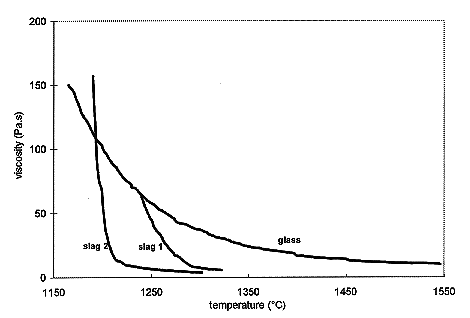
Fig. 1. Viscosity of glass and slag.
PLASMA PROCESS PERFORMANCES FOR ASH TREATMENT
Plasma arc centrifugal process performances were evaluated with regard to the waste volume reduction factor, the radionuclide tracer incorporation fraction in the glassy matrix and the off-gas treatment results.
It was found that PLASMARC® treatment of incinerator ashes allows :
 emittor
surrogate) initially introduced ; Fig. 2 shows the tracer distribution in the
process (slag, furnace, SCC, gas filtration system and scrubber) and enhances
the fact that no tracer is detected after the filtration system,
emittor
surrogate) initially introduced ; Fig. 2 shows the tracer distribution in the
process (slag, furnace, SCC, gas filtration system and scrubber) and enhances
the fact that no tracer is detected after the filtration system,
 2.6) which appears to be stable under
disposal environmental conditions.
2.6) which appears to be stable under
disposal environmental conditions.
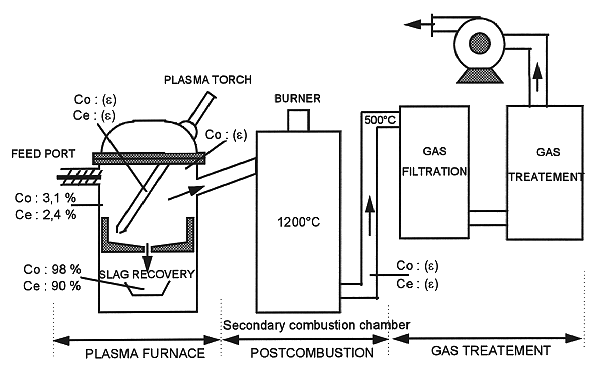
Fig. 2. Ash treatment: Co and Ce
partitioning (wt%).
Off-gas treatment was also optimized using a high temperature filtration system after the SCC. Preliminary tests were conducted and a ceramic (Al2O3-SiO2) candle device was selected ; the optimum filtration conditions were the following for a dust concentration of 1.2 g.Nm-3 (Fig. 3) :
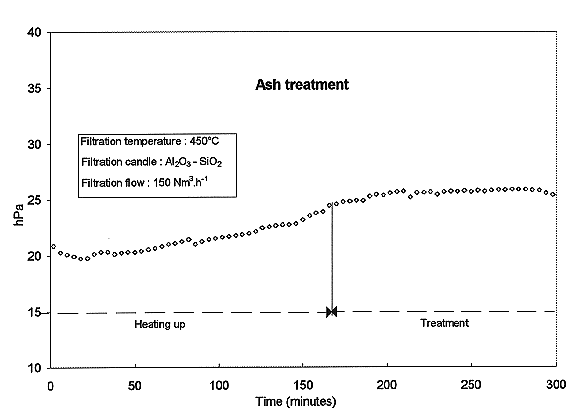
Fig. 3. Off gas filtration.
The filtration rate obtained during ash treatment was 99,96% for the dust and 99,99% for cobalt. The European guideline limits CO and NOx concentrations in the off-gas respectively to 50 mg. Nm-3 and 500 mg.Nm-3. Carefull measurements of the gaseous release were performed on line during ash treatment. The main characteristics of the off-gas are reported in Table II for the mean values and for Fig. 4 for the instantaneous measurements. CO and NOx concentrations in the off-gas were found to be lower than the above permissible release limit. Meanwhile it was noticed that the SO2 concentration of about 650 mg.Nm-3 exceeded the European limit of 50 mg.Nm-3 and will be specifically investigated and reduced in the future by means of an appropriate neutralization scrubber system.
TABLE II Off Gas Characterization After Secondary Combustion Chamber
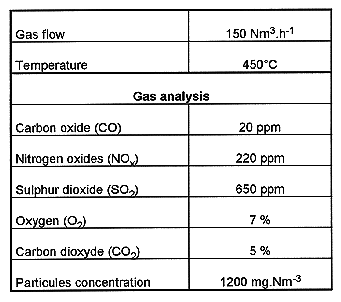
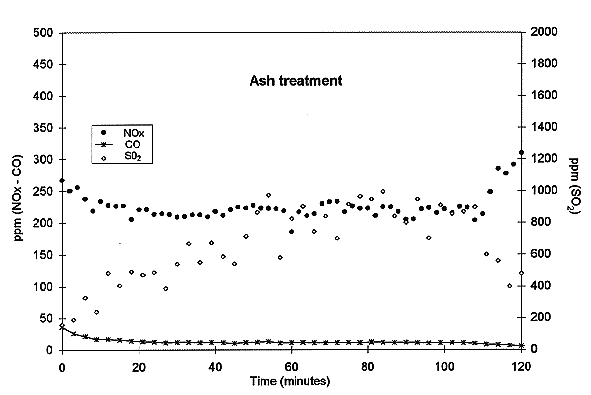
Fig. 4. Gaseous release after
filtration.
CONCLUSION
The whole tests performed by CEA demonstrated that Plasma Arc Centrifugal process PLASMARC® is capable to vitrify incinerator ashes under satisfactory conditions :
The CADARACHE unit has been partially nuclearized for use in processing actual CEA wastes beginning in 1998.
REFERENCES