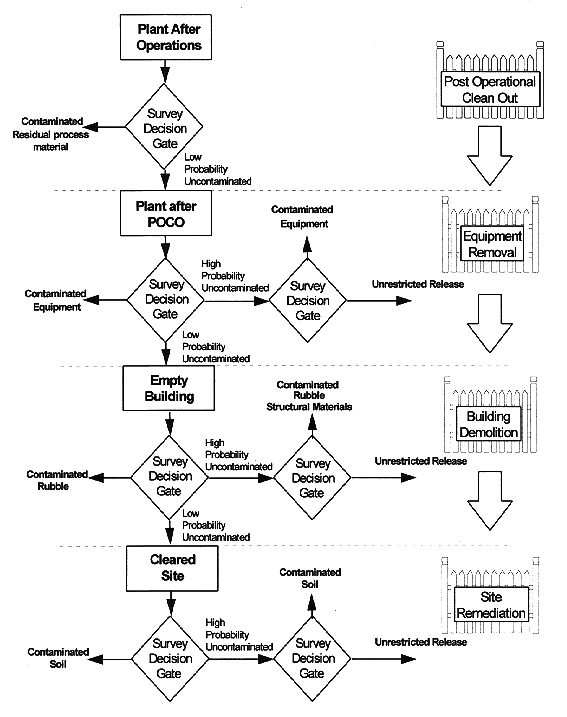
Fig. 1. Decision gate structure for
the unrestricted release of waste arisings.
R.D. Gunn, C.H. Orr and D.J. Thornley
BNFL Instruments
Limited
Sellafield, England
ABSTRACT
With current waste monitoring technology it is reasonable to assume that much of the material designated as Low Level Waste (LLW), generated within nuclear facilities, is in fact uncontaminated. This may include operational wastes, soil and rubble, office wastes and discrete items from decommissioning or decontamination operations.
The generation of a significant component of uncontaminated waste within the LLW stream represents a double penalty for the operator. Not only is disposal to a LLW repository considerably more expensive than to a municipal waste facility, but also the LLW repositories in all countries are limited in both volume and permissible radioactive inventory. By linking the skills of its operations, R&D and instrumentation teams, the British Nuclear Fuels Group is vigorously pursuing the elimination of much of this uncontaminated material from its LLW.
Strategies for the identification and segregation of material suitable for unrestricted release are proposed in this paper. The strategies are based on a multi stage monitoring process. Each set of circumstances is analyzed to establish the relevant mix of radionuclides and hence the appropriate monitoring technologies; this allows decision points to be identified with regard to the routing of material, and also the criteria to be applied at those points. At each stage confidence is increased regarding the acceptability of the material for unrestricted release into the environment. Unrestricted release monitoring will be carried out at the final stage of the process and will be a confirmatory measurement on material which through earlier stages has shown a high probability of being uncontaminated.
By applying this approach, it has already been possible to identify specific measurement technologies which would be necessary at the decision points within the process. The development program is now well advanced and gives every confidence that it will be possible to sentence future material arisings in the most cost effective manner.
INTRODUCTION
With knowledge of the history of nuclear facilities it is reasonable to assume that much of the material designated as Low Level Waste (LLW), generated within the facilities, is in fact uncontaminated. This may include operational wastes, office wastes, discrete items or soil and rubble from decommissioning and demolition.
The incorporation of a significant component of uncontaminated waste within the LLW stream represents a double penalty for the operator. Not only is disposal to a LLW repository more expensive than to a municipal waste facility, but also the disposal of uncontaminated material as LLW will shorten the operating life of the repository.
A practical approach for the identification and segregation of material suitable for "free" release is proposed in this paper.
UNRESTRICTED RELEASE REGULATIONS
Unrestricted release regulations vary considerably between different countries and are authorized by the approved radiation protection agencies, the Ministries of Health, or the appropriate ministries of federal states.
Release criteria include surface contamination limits and specific activity limits. In France, Germany, Sweden, Great Britain and the USA additional nuclide specific limits have been applied. In Belgium, Germany and Sweden total activity, mass and volume limits have been applied to some projects/plants. Additional limits have in some cases been applied based on toxicity (Belgium, Germany, Great Britain and Sweden) type of material (Canada, France) and destination of disposal (France) (1).
In Britain surface contamination Derived Working Limits were set up in the 1950s and included as a condition of nuclear site licences up to the end of 1985. These were defined as:
| Alpha 10-5 | µCicm-2 | 0.4 Bqcm-2 |
| Beta 10-4 | µCicm-2 | 4 Bqcm-2 |
| Low toxicity beta (3H,14C,35S) | 40 Bqcm-2 |
In 1986 the Ionising Radiation Regulations (2) were issued and gave generally more relaxed limits although sites chose to remain with previous practices as this was shown to be reasonably practicable. For several nuclides these were more restrictive, however it is not anticipated that this will be a significant factor at most nuclear sites.
The clearance activity levels of 0.4Bqcm-2 alpha and 4 Bqcm-2 beta represent the majority of practicable situations. Activity is averaged over 300cm2 (inanimate objects) and 1000cm2 for walls and floors.
For transport purposes, material with specific activities exceeding 70 kBq/kg is deemed to be radioactive. This limit is applicable to a single radionuclide contamination and for a mixture of radionuclides (3).
Mass activity limits are given in the Radioactive Substances Exemption order issued in 1986 (4) which defines the limit as 0.4 Bqg-1. This limit applies to all types of radioactive decay i.e. alpha and beta.
FREE RELEASE APPROACH
QUALITY PLAN
The quality plan is a definition of the means by which waste management tasks will be carried out to ensure that the requirements for quality are met. The quality plan defines each stage in the decommissioning/ remediation or plant operational process, the required verification at appropriate stages, review hold points where decisions will be made and proof/evidence documentation. The plan clearly defines the standards of acceptability for all features of the process including confidence levels in measurement results at the verification stages and definition of the control of measurement procedures. The quality plan ensures and provides evidence that the task has been carried out in a controlled and approved manner to satisfy the requirement of both the customer and regulator. In the following sections three main stages of the quality plan have been identified and the detail of what is to be achieved during these stages defined.
A flow chart showing the main stages of the quality plan and the decision/hold points is given in Fig. 1.
Fig. 1. Decision gate structure for
the unrestricted release of waste arisings.
Initial Survey
The purpose of this stage is to provide a "map" of activity levels which will identify the following:-
The first activity to achieve these objectives is the compilation of all relevant information on the area. This information should include; historical data defining past uses of the area and operational practices employed; knowledge of process activities; potential radionuclides present along with their chemical form; mechanical integrity of the facility, structures and process vessels.
This information will allow an assessment to be carried out to identify the most appropriate methods and techniques for the initial survey. This survey is likely to employ a combination of the following techniques.
Health Physics Survey: This is appropriate where all potentially contaminated surfaces are readily accessible. The survey would involve the use of hand held probes and discrete sampling by swab, in the case of loose contamination. A manual survey is most appropriate where there are no time constraints regarding the surveying of large areas of large numbers of items. As a Health Physics survey is carried out manually operator effectiveness should be taken into consideration in the approach. Typical Output: Health Physics survey certificate indicating areas, levels and types of contamination.
Discrete Sampling: This is appropriate where there is a high level of confidence that the material is homogeneous and the samples are likely to be truly representative. This method could include swabbing or removal of samples for destructive analysis. This method may also provide a radionuclide fingerprint which could subsequently be used as inferential information to support a more comprehensive in-situ surveying technique. Generally many samples are produced which often have to be transported to a suitable facility to undergo lengthy preparation processes and analysis. Discrete sampling can have the capability of identifying and measuring radionuclides which are difficult to measure in-situ due to the nature of their radiations, e.g. soft beta emissions. The quality plan should ensure that documented procedures are maintained for the control of verification and traceability within any analysis laboratory used. Typical Output : Laboratory analysis report detailing each sample result.
Automated In-Situ Measurements: These are appropriate where the area to be measured can be easily defined, such as walls, floors and areas of land. The techniques involve systems where the measurement devices are automatically moved over (or scan) a pre-defined area. These techniques can include vehicular systems traversing the required region and incorporating detector types suitable for the potential radiations present. Where appropriate a static measurement system remotely scanning areas of floor, wall or objects for specific radiation emissions may be employed when radiation levels permit. Typical Output : Contamination map of the defined area/object.
Materials Removal - Sorting and Segregation
This stage of the approach requires the output data from the previous stage to enable the order of removal of material and objects to be defined. The main purpose of this stage is to remove sort and segregate materials in a manner which will minimize cross contamination and maximize the amount of material which has the potential for unrestricted release.
The effectiveness of the unrestricted release approach is dependant on the order of removal of materials and items. The removal approach is dependant upon the individual situation and should be driven by the type of plant or materials present. Removal order should be established with reference to the situations detailed below. The key issue at this stage is removal and segregation without cross contamination.
Readily Removable Clean Items: Items of equipment outside potentially contaminated areas such as office equipment, electrical cabinets, cabling, inactive ducting, files, inactive pipes etc.
Removal of Containable Potentially Contaminated Items
Removal of Readily Defined Contaminated Areas: Areas of floor, wall or ground where contamination has been identified to be removed in a controlled and contained manner.
Demolition of Building or Removal of Area of Land: Building structures, walls, floors, construction girders, concrete and soil.
Following removal operations it may be necessary to re-survey to ensure that the contamination has been effectively removed and that no cross contamination has occurred. The decision to repeat surveys will be dependant upon the type of operation and the perceived risk of contamination remaining.
Typically segregation of materials would be into the following areas:-
Free Release Monitoring
The purpose of this stage is to provide a confirmatory measurement on material which has been identified, at earlier stages in the process, as having a high probability of meeting the regulatory requirements for unrestricted release. These measurements are the last stage in the process immediately prior to the material being dispatched to a municipal waste facility, recycling plant or for re-use.
In order to measure down to the low activity limits specified for unrestricted release it is essential to use high sensitivity measurement systems which have very low limits of detection for the radionuclides to be measured. Limits of detection can be improved by reducing the measurement background, increasing the detection efficiency or sensitivity of the measurement systems and by increasing the measurement times. The measured background due to the surrounding radiation levels can be reduced by the use of appropriate quantities of low background steel and lead. Detection efficiency can be improved firstly by selecting detector technologies with high intrinsic detection efficiencies and secondly by the use of large area or multiple detectors. Although longer count times may be desirable to reduce the limits of detection they are likely to be undesirable for operational reasons as longer count times result in lower waste throughputs.
Another major issue concerns the natural background radiation levels of the material being measured. The unrestricted release limits usually refer to activity levels above natural background levels of the material and as such techniques must be developed to take this component into account. Clearly some radionuclides are more easily measured down at unrestricted release levels than others. For example radionuclides such as Co-60 and Cs-137 have properties which are advantageous for free release monitoring i.e. they emit relatively penetrating gamma radiation and have high intensities in terms of gammas emitted per Bq. Other radionuclides are more problematic and may for example emit soft, easily absorbed radiations such as alpha particles or soft betas or have low intensities. Thus radionuclides such as tritium and plutonium are difficult to measure at unrestricted release activity levels. Some radionuclides may not be measured directly and may have to be accounted for by inference techniques using radionuclide fingerprints.
A development program is underway at BNFL Instruments to develop highly sensitive radiometric instrumentation capable of identifying materials which are suitable for free or unrestricted release. The approach has identified the most appropriate detectors types which have been evaluated with regards to their suitability to carry out free release measurements. Detector types and analysis methods have been selected to cover the range of radiation types emitted by all potential contaminants.
CONCLUSIONS
This paper identifies an approach which could potentially be applied to any decommissioning/remediation situation. The approach has been developed to maximize the amount of material which could be admissible for unrestricted release outside the nuclear arena, optimizing the use of waste repositories and material resources.
The approach is based on a multi stage monitoring process. Each set of circumstances is analyzed to establish the relevant mix of radionuclides and hence the appropriate initial monitoring technologies; this allows decision points to be identified with regard to the routing of material, and also the criteria to be applied at those points. At each stage confidence is increased regarding the acceptability of the material for unrestricted release into the environment. Unrestricted release monitoring will be carried out at the final stage of the process and will be a confirmatory measurement on material which through earlier stages has shown a high probability of being uncontaminated.
By applying this approach it has already been possible to identify specific measurement technologies which would be necessary at the decision points within the process. The development program is now well advanced and gives every confidence that it will be possible to sentence future material arisings in the most cost effective manner.
REFERENCES