
DEVELOPMENT OF NEUTRON POSITION SENSITIVE DETECTOR AND APPLICATION TO THE MINIMIZATION OF UNCERTAINTIES IN LOW LEVEL WASTE MEASUREMENTS
J-P Coulon, L. Solvery, J. Loridon, J. Romeyer-Dherbey
CEA-DRN-DER-SSAE, Centre d'Etudes de Cadarache
13108 SAINT PAUL LEZ DURANCE
FRANCE
A. Gabriel
EMBL / ILL, 20 avenue des martyrs BP 156
38 042 GRENOBLE CEDEX
FRANCE
ABSTRACT
A comprehensive program is in progress for the development of non destructive techniques for the characterization of low level transuranic wastes. It is performed at CEA-CADARACHE, with the realization of several experiments to optimize performances of each measurement cell components (interrogating fluxes, counting blocks and electronics, backgrounds reduction). Simultaneously, developments are made on complementary measurement systems and soft-wares allowing a characterization of the package matrix and an inner localization of the nuclear material.
This paper reports the development of a multiwire proportional helium 3 detector used to characterize the spatial distribution of the heavy nuclide masses and activities in radioactive wastes drums. The detector was designed to be placed in an existing device (PROMETHEE). It was fabricated at the European Molecular Biology Laboratory in Grenoble. The active detection area of the position sensitive prototype was 100 mm x 960 mm which is quite large. Exhaustive Monte Carlo code MCNP 4A calculations show that the total neutron counting efficiency of the position sensitive detector is similar to the former experimental setup made of seven 3He one meter active length tubes. Moreover, a study of counting efficiency and spatial resolution (FWHM) on the large size detector will be presented in this paper
Preliminary tests on a small size prototype (one wire, active detection area : 200 mm x 10 mm) have shown a spatial resolution (FWHM) of 25 mm which is excellent for our applications.
INTRODUCTION
Research programs are in progress for the development of non destructive techniques for the characterization of low level wastes. They are being performed at CEA-CADARACHE, with the realization of several experiments to optimize performance of each measurement cell component (neutron fluxes, counting blocks and electronics, backgrounds reduction). Simultaneously, development is underway on complementary measurement systems and soft-ware allowing a characterization of the package matrix and an inner localization of the nuclear material. Our work focused on the reduction of spatial uncertainties which can be very high. Some examples show these uncertainties to be an order of magnitude.
This paper reports the development of a position sensitive multi-wire proportional helium 3 detector used to characterize the spatial distribution of the nuclear material in radioactive waste drums. The first part presents the specifications of the prototype detector designed to be used an existing low level waste measurement cell (PROMETHEE). Detection process, position encoding and electronics will be presented . After that we present the results of an exhaustive work on Monte Carlo transport code. Finally, first experimental results are shown.
DESCRIPTION OF THE DETECTOR
Our neutron position sensitive multiwire proportional counter under development, was fabricated at the European Molecular Biology Laboratory, at Institut Laue Langevin in Grenoble (1),(2). This kind of detector is a gaseous detector. The position encoding of the particles is based on a delay line readout system. This localization technology is well known in X-ray detection (medical applications, plasma physics, solid state physics, astrophysics,...) (3) and neutron diffraction experiments (4). Our detector was designed to be placed in an existing low level waste measurement cell (PROMETHEE) (5).
The cell was built to measure 120 liter drums. The active volume of the cell is 500 x 500 x 900 mm3. Three walls are equipped with three banks of 3He neutron detectors. Each bank comprises seven 3He cylindrical tubes (1 meter useful length) enclosed in high density polyethylene and surrounded by cadmium shielding. The detectors are 2.54 cm diameter tubes. All tubes are simply connected together and linked to a special electronic NIM module. The outlet dimension of a bank is 150 mm x 85 mm x 1100 mm.
The active detection area of the position sensitive prototype was 100 mm x 960 mm. The detector consists of a 120 mm x 55 mm x 1000 mm aluminium pressure cell containing the detecting gas. Then, with a 15 mm thick polyethylene shell all around the detector, we are able to use it instead of a bank of seven conventional helium tubes in the PROMETHEE cell measurement. Comparisons between both systems will be possible with great accuracy. The pressure cell is made of a special aluminium alloy chosen for its low level of impurities (Cu, Mn) which could be activated by neutrons. This material was also chosen for its low absorption cross section for thermal neutrons. Calculations have shown that less than 5 % of the incident particles are lost with a five mm thickness.
Detection
The detector consists of a pressure cell filled with detecting gas with a plane of wires (anodes) between two cathodes. The first one is the entrance window, the second is used for position encoding. A high electric field is applied between the anodes and the body of the detector.
The detection of thermal neutrons is based on neutron capture reactions (4). In our case, the detecting gas is helium 3 which has a high absorption cross section for the thermal neutrons (~5300 barn for an 0.025 eV energy). The reaction involved in neutron detection is the following :
Gas filled detectors rely on the phenomenon of gas multiplication to amplify the charge represented by the original ion pairs created within the gas by the passage of a charge particle. As the electrons and charged ions drift under the influence of the applied electric field, they collide with neutral molecules. If the applied field exceeds a critical value, electrons will be accelerated sufficiently between collisions for them to acquire the kinetic energy needed to ionize the next neutral atoms they encounter. An electron liberated by this secondary ionization process can, in its turn, be accelerated sufficiently to create further ionization. The phenomenon of gas multiplication therefore takes the form of a cascade of ionizing collisions. The electric field rises steeply in the immediate vicinity of the wire and the electrons enter the high field region as they are drawn to the anode. A Townsend avalanche occurs and provides a large amplification.
The use of pure helium 3 gives poor spatial resolution and a stopping gas has to be employed to reduce the centroid image. The stopping gas is generally a heavy gas which does not detract from the ionization effect in the helium 3. Typically, xenon or argon are used as a stopping gas. Polyatomic gas additives also have the effect of quenching the ultraviolet or visible light emitted from collisions between drifting electrons and gas molecules and hence prevent breakdown in the counter when it is operating with a high gas multiplication. Our detectors will work with a 3He + CF4 mixtures (6). The active thickness of the detector is about 30 mm.
Position encoding
As described on Fig. 1 , the cathode used for the position encoding system
is a plane consisting of linear copper strips orthogonal to the wires of the
anode . In our applications, each strip is 5 mm wide and the gap between them,
is 1 mm wide. We use lumped delay lines of 50
 impedance with separate sections of inductances and capacitors, with a total
delay of 200 ns.
impedance with separate sections of inductances and capacitors, with a total
delay of 200 ns.
When a signal reaches the anode wire, the capacitance coupling between anode and cathode plane results in a charge buildup on the cathode. The charge distribution in the strips of the cathode will be influenced by the arrival of an electric pulse anywhere on the wire. The effect on a given cathode strip will depend on the solid angle subtended by the element at the position where the neutron arrives. Since each element of the cathode is connected to an element of a delay line, the charge flows in opposite directions on the line giving two electric signals. Comparison of the time dependence of both signals at the end of each line allows us to determine the position of the incident particle. We should note that with delay lines, position data are digital which is very effective to avoid noise. Moreover, intrinsic spatial resolution of the detector is much smaller than the gap between each cathode strip (5 mm in our case). As a matter of fact, electric charges on the cathode are distributed on several strips. Then, position electronics will determine the position of the center of gravity of induced charge.

Fig. 1. Schematic diagram of position encoding electronics.
Electronics and data acquisition
Electronic signals from each end of the delay line are pre-amplified (PA). This first stage of the signal processing electronics consists of low noise and high bandwidth preamplifiers which are located close to the detector. Further amplification of the signal is achieved by a timing filter amplifier (A). Then, a constant fraction discriminator (CFD) follows the amplifier to obtain accurate timing information independently of the pulse height. A gate and delay generator must be used on the Stop line to make a difference between the right and the left of the detector. In our preliminary experiments, Start and Stop lines are connected to a Time to Amplitude Converter (TAC) which generates an analog output pulse proportional to the measured time between Start and Stop. Analog output of the time converter module is connected to an Analog-Digital Converter (ADC) which is combined via a bus with a personal computer. Count rate capability in this data acquisition configuration is limited to some thousands of counts per second, because we used an ADC without buffer memory.
In a future configuration, we plan to use a Time Digital Converter (TDC). Then, the count rate capability of the acquisition will be close to a million of event per second.
MONTE CARLO CALCULATIONS
This study was performed to examine the detection efficiency and the spatial resolution capability of the prototype detector. Other objectives included comparing our calculation results to those observed with an existing system and optimizing the experimental set-up used for the measurements.
Monte Carlo N-Particle 4A transport code (7) was used to model each of the different configurations. In all calculations, neutron source was californium 252 isotropic point fission spectrum.
Efficiency
First calculations show that the attenuation of 5 mm thick aluminium of the pressure vessel is negligible. A study of the total efficiency of the detector has been carried out versus the thickness of polyethylene in front or behind the detector and versus the helium 3 pressure in the detector. Results confirm that our detector works as the other helium 3 detector. Efficiency rises with helium pressure and polyethylene thickness until a maximum is reached.
Comparisons with a bank of seven conventional helium tubes of the PROMETHEE cell measurement show that our detector with 15 mm thick polyethylene in front and 15 mm thick polyethylene behind has nearly the same detection efficiency. In our calculations, we consider in both cases a 4 atm pressure. Calculation results show that the prototype detector has nearly the same efficiency of the bank of seven detectors. This point confirms that it will be possible to get spatial data without losing total counting.
Spatial resolution
The MCNP geometry used to calculate the spatial resolution (FWHM) is described on Fig. 2. To study spatial resolution, we used a collimator made of cadmium. The cadmium energy cut off is approximately 0.42 eV. Therefore, neutrons should be thermalized by polyethylene moderator. As shown on Fig. 2, we placed polyethylene in different positions in order to improve cadmium filtering and detection efficiency.
We defined eleven individual cells. In front of the central cell, we install the neutron collimator. The absorption rate of each cell was studied as function of the different CH2 thickness (neutron moderation), gas pressure, width of the collimator slit and width of cells.

Fig. 2. Plan view of the cells defined for the study of the spatial resolution.
Spatial resolution calculations were performed for the following configuration. We used a 1 cm wide neutron collimator slit in front of the detector. In this case detector cells were 1 cm broad. The thickness of polyethylene before the cadmium was 2 cm. As shown on Fig. 3 , the calculated spatial resolution (FWHM) is found to be 2.5 cm.
In a configuration with a 2 mm collimator slit, the spatial resolution is 1.5 cm.

Fig. 3. Calculated detectin efficiencies of the 11 cells defined with
transport code. FWHM
 25 mm.
In a waste drum measurement cell, helium 3 detectors work without neutron collimators. Therefore, we studied with MCNP 4A the influence of the neutron scattering in the moderator material (CH2), used to increase the detection efficiency, on the spatial resolution of the detector. In this case, a code bias technique was used in order to send the neutrons from the 252 Cf source in the direction perpendicular to the surface of cell 6 (Fig. 2). Consequently, the effect of neutron scattering can be shown. Table I presents the calculation results.
Table I Calculated spatial resolution versus the thickness of the neutron moderator (CH2) in front of the detector.
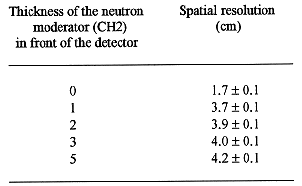
We observed that the degradation of the spatial resolution due to CH2 is about 4 cm which is quite important in comparison to the spatial resolution found with the neutron collimator. Consequently, the intrinsic spatial resolution of the detector should be on the order of magnitude of a centimeter.
PRELIMINARY RESULTS
Spatial resolution measurement
Spatial resolution measurements were performed with a small size prototype detector prototype (one wire, active detection area : 200 mm x 10 mm). We used 252Cf neutron source with an intensity of 105 n/s. Experiments are as presented in Fig. 2. After preliminary tests on detection electronics, we measured the background of the detector. Position encoding tests were carried out to check any problem. Electronic spatial resolution was excellent.
Figure 4 shows the spatial resolution measurement with a 1 cm wide slit for a 2 atmosphere helium 3 pressure.

Fig. 4. Measured spatial resolution. FWHM26mm.
First results are very encouraging. We showed that neutron position sensitive detection based on delay line technology is easy to perform.
Finally, We plan to test the large size detector very soon.
Application to waste drum measurements
One of the most important uncertainties of waste drum measurement is due to the inner localization of the nuclear material. A first step towards the reduction of uncertainty was to rotate the drum. Then, with detectors on cell measurement walls, the radial uncertainty can be reduced. This improvement is used on the more recent device (5). However, the axial uncertainty is still very high. Some examples of cell efficiency show order of magnitude between the upper and the lower part of the drum. Cells were designed with a lot of individual helium 3 tubes to reduce the error. But, in this case, it is necessary to link each detector with a complete electronic set.
With a position sensitive detector installed following the axis of the drum, it will be possible to determine the location of nuclear material inside the waste drum.
Shortly, this first measurement will be performed in our cell measurement (5].
CONCLUSION AND FUTURE PROSPECTS
Our research programs show the feasibility of the large size neutron position sensitive detector. Numerous technical problems have to be resolved. We showed that neutron position sensitive detection based on delay line technology is easy to realize.
Calculation results and preliminary tests demonstrate the possibility to determine the location of a neutron source.
It has been proven that the detection efficiency of the prototype is nearly the same as those of the bank (seven helium 3 tubes) of the former experimental setup. Consequently, the new detector is position sensitive without losing detection efficiency which is very important in the case of low level measurement.
In the future, we will study the large size detector. After background and position encoding tests, we will determine the experimental spatial resolution versus the helium 3 pressure and the polyethylene thickness. After that, we will concentrate first on measurements of the location of the fissile mass inside the drum. Later, the behavior of the detector with active neutron measurement (bursts of 14 MeV neutrons from D-T neutron generator) will be studied.
REFERENCES