TABLE I Korean Nuclear Power Plants under Operation,
Construction and Planning
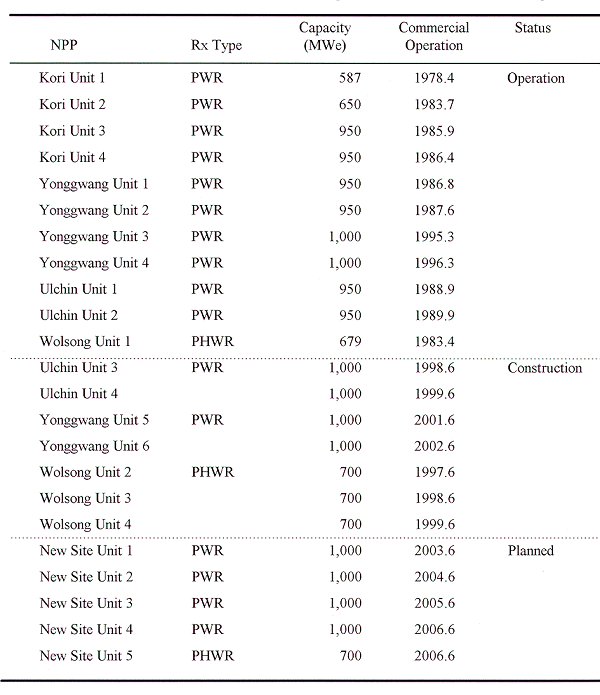

Fig. 1. Nuclear power installed
capacity beyond 2006.
Young - Eal Lee and Myung - Jae Song
Korea Electric
Power Research Institute
103-16, Munji-dong, Yusung-gu, Taejeon, Korea
ABSTRACT
Due to the insufficient energy resources in Korea, the Korean government has selected nuclear energy as the major source of electricity supply in Korea. In compliance with the government policy, Korea Electric Power Corporation (KEPCO) established an ambitious nuclear power plant construction program. Currently, KEPCO is operating eleven nuclear power plants and constructing seven others.
All of the Korean nuclear power plants were designed and constructed to have a wet pool for the spent fuel storage. The capacity of the pool is different from plant to plant. The interim At Reactor (AR) storage pools have very limited capacities. Therefore, the storage capacity has to be expanded before the middle of the lifetime of a power plant. Accordingly, KEPCO established a reracking program for PWRs and a dry storage construction program for CANDUs. However, this will relieve the additional storage burden only temporarily. There was a plan to construct a centralized spent fuel storage facility but the plan was postponed officially by the government. Hence, a somewhat more permanent solution for the storage of spent fuels AR capacities would be desirable.
One alternative for the AR storage of spent nuclear fuels is to reduce its volume via reprocessing. Since there is no reprocessing facility in Korea, the spent nuclear fuels could be shipped to European facilities. The fuels could be reprocessed and the recovered nuclear fuels could be reused. After reprocessing, the high level radioactive waste would be returned to Korea. But by then, the volume of the returned waste would be greatly reduced and hence, the storage would be much easier. Since there is a long time lag between the spent fuel shipping date and the high level waste receiving date, the necessity for the additional AR storage capacity would be diminished.
Currently, the Korean back-end fuel cycle policy is not yet fixed. In essence, there are many considerations such as those discussed that need to be examined before the Korean back-end fuel cycle policy is established.
NUCLEAR POWER PROGRAM
Due to the insufficient energy resources in Korea, the government has selected nuclear energy as the major source of electricity generation. Accordingly, The government established an ambitious nuclear development program. The long-term electricity development program shows the nuclear power plant construction schedule up to the year 2006 in Table I. For the nuclear power in Korea beyond the year 2006, there are many different predictions. One of the most plausible forecasts up to the year 2030 is shown in Fig. 1. KEPCO is the owner of all nuclear power plants in Korea. Currently, It is operating eleven nuclear power plants and constructing seven others. In the year 2030, Korean nuclear power plants will consist of 23 PWRs and 7 PHWRs. The total installed nuclear capacity is to be increased from 8,616 MWe in 1995 to 31,800 MWe in 2030 (1)(3).
TABLE I Korean Nuclear Power Plants under Operation,
Construction and Planning
Fig. 1. Nuclear power installed
capacity beyond 2006.
AR SPENT FUEL STORAGE CAPACITIES
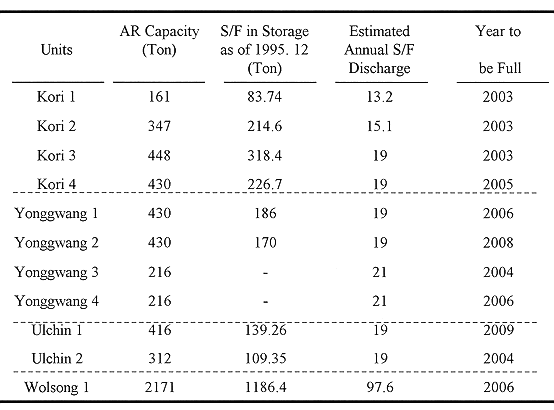
Korean nuclear power plants were built to have wet spent fuel storage pools. The capacities of AR storage pool are different from plant to plant. Table II shows the AR storage capacities for the nuclear power plants which are currently in operation (2).
TABLE II AR Storage Capacities of Korean Nuclear
Power Plant
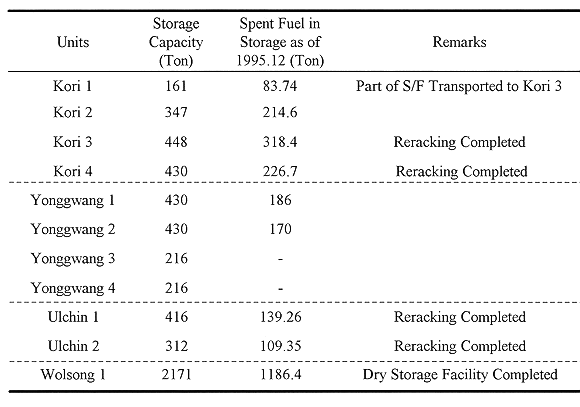
The above table also shows the amount of spent fuel stored in each pool. As shown in the above table, the actual generation of spent fuels had already reached its maximum AR storage capacity for Wolsong nuclear power plant. Therefore, the AR storage capacity of Wolsong unit 1 had been expanded using concrete casks. Other units like Kori unit 1 are also approaching their maximum AR storage capacities. Therefore, the AR spent fuel storage capacities have been expanded or are being expanded through reracking work for the same nuclear units. In the case of Kori unit 3, there is a plan to construct an high density rack facility. For Ulchin unit 1&2 reracking work has already been completed. Therefore, the AR storage capacities are expected to reach their limitations in the year 2003 for Kori site and 2004 for Ulchin unit 2. This will ease the on site spent fuel storage problem for the time being via transhipping of spent fuels from one unit to another in the same nuclear site.
SPENT FUEL ARISING
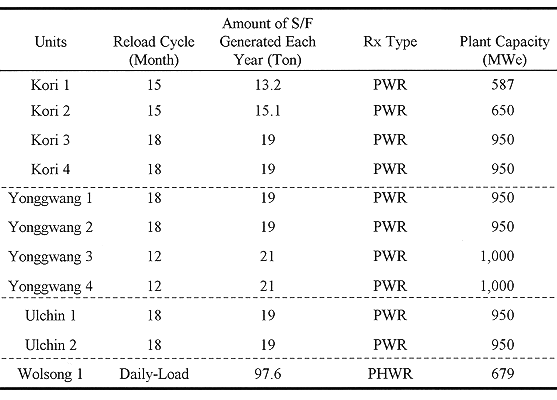
There are two types of power reactors in operation in Korea. The amount of nuclear spent fuels generated in a year is different from reactor to reactor according to the reactor capacity, nuclear type, and fuel loading cycle. Table III shows the fuel load cycle and the amount of spent fuels generated each year for all operating nuclear units in Korea (1).
TABLE III Fuel Loak Cycle and Annual Amount of Spent
Fuel Arising
There is an attempt to increase the burn-up of the fuels to be loaded in the reactors and the longer reload cycle is being implemented for some reactors. Table IV shows the current status of nuclear fuel burn-up and loading cycle for the operating nuclear reactors in Korea. The table also shows the future fuel burn-up and loading cycle to be implemented.
TABLE IV Future Reload Pattern and Fuel Burn-up
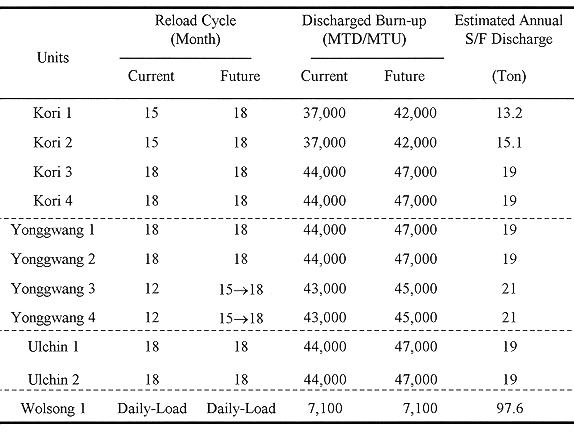
Table V shows the expected years when the AR storage pools will be full for all the operating nuclear power plants. Kori site spent fuel AR storage capacity will reach its maximum in 2003. The spent fuel AR storage capacities for Ulchin and Yonggwang will reach the storage limits in early 2000. But new nuclear units to be installed at the sites would give more room for AR storage for these two sites. Therefore, immediate actions have to be taken for the additional spent fuel storage for Kori site.
TABLE V Expected Year to be Full for AR Storage Pool
EXPANSION OF SPENT FUEL STORAGE CAPACITY
As for the spent fuel interim storage, the Korean government, in the past, had a plan to build a centralized wet pool to accommodate the spent fuels generated from the nuclear power plants. The centralized wet pool was to have initial storage capacity for spent fuel that would later be expanded if necessary. However, the plan was canceled indefinitely due to the public objection two years ago. Currently, there is, yet, no official alternative from the government.
Therefore, KEPCO, the generator of all nuclear spent fuels in Korea, in order to accommodate its needs, must take the initiative to solve its problem for the management of its spent fuel. One solution that is in KEPCO's consideration is the expansion of its spent fuel AR storage capacity by the inclusion of an on-site dry storage facility. For Wolsong unit 1, the expected year when the existing AR storage pool will reach its capacity is 1997. The dry storage facility was constructed so that the capacity could be increased. But if the 8 PHWRs are eventually constructed and then operated at the Wolsong site, how to select the interim storage site will be a serious issue.
One alternative to ease the spent fuel storage problem is to reprocess the spent fuels using foreign facilities. Fig. 2 shows the implementation strategy for reprocessing. It will be possible to transport the spent fuel to a foreign reprocessor in 2001. In this case, after temporary storage, the first reprocessing of our spent fuel would be possible in 2003, and the first loading in Korea of MOX (Mixed Oxide Fuel) fuel obtained through reprocessing would be feasible in 2005. After the reprocessing, the volume of the waste returned in 2008 would be greatly reduced to one sixth or one seventh of the original volume of the spent fuels. Since there is a long time lag between the spent fuel shipping date to foreign countries and the high level waste receiving date, approximately 8 to 10 years, the requirement for additional AR storage capacity would be greatly reduced for Kori site.

Fig. 2. Schedule for reprocessing
and utilization of MOX.
CONCLUSIONS
Currently KEPCO is operating eleven nuclear power plants and constructing seven others. All of these nuclear power plants were designed and constructed to have a wet pool for the spent fuel storage. Nevertheless, the amount of the actual generation of spent fuels will eventually reach the maximum AR storage capacities. Accordingly, KEPCO established a reracking program for PWRs and a dry storage construction for CANDUs. However, this will relieve the additional storage burden only temporarily.
One alternative for AR storage of spent fuel is to reduce its volume via reprocessing. It is possible to transport the spent fuel to a foreign reprocessor in 2001. In this case, the first reprocessing of our spent fuel is possible in 2003, and the first loading of MOX fuel, after fabrication and temporary storage, will be feasible in 2005. After the reprocessing of the generated radioactive waste, the volume of the waste returned in 2008 would be greatly reduced to one sixth or one seventh of the original volume of the spent fuels. Since there is a long time lag between the spent fuel shipping date and the high level waste receiving date, the requirement for additional AR storage capacity would be reduced. It is generally about 8 to 10 years between the spent fuel shipping date and the high level waste receiving date. Through this way, the necessity for the additional AR storage capacity would be diminished. Currently, the Korean back-end fuel cycle policy is not yet fixed. In essence, there are many considerations, such as those discussed in this paper, that need to be examined or further examined before the Korean back-end fuel cycle policy is established.
REFERENCES