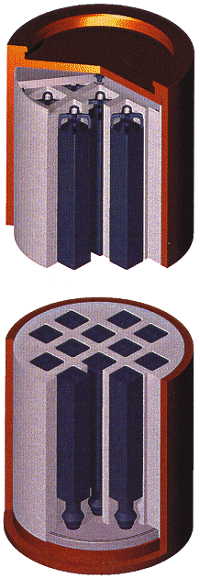
Fig. 1. Current design of a copper
canister with a cast insert for BWR fuel.
Kristina Gillin and Tommy Hedman
Swedish Nuclear Fuel
and Waste Management Co, SKB
Box 5864
S-102 40 Stockholm
Sweden
ABSTRACT
The Swedish Nuclear Fuel and Waste Management Co, SKB, presently owns and manages a final repository for radioactive operational waste (SFR), a central interim storage facility for spent fuel (CLAB) and a transport system. The remaining parts of the Swedish system for handling nuclear waste, i.e. an Encapsulation Plant and a Deep Repository for spent fuel and other long-lived wastes, are now being planned.
The disposal canisters, which the spent fuel will be encapsulated in, have an inner cast insert for mechanical strength and an outer copper canister for corrosion resistance. At present, SKB is conducting research and testing of manufacturing methods for both the cast insert and the copper canister. So far, two complete full-size canisters have been manufactured using two different methods: extrusion and forming from rolled plate.
Encapsulation of spent fuel in disposal canisters will take place in an Encapsulation Plant, which is planned to be built as an extension to the existing CLAB facility. The plant is designed for an annual output of approximately 210 canisters. Construction is intended to begin in the year 2000 so that the first fuel can be encapsulated in 2007. At a first stage the plant will only encapsulate spent fuel but preparations are made for the later addition of equipment for treating core components.
In the Encapsulation Plant the fuel is first identified and measured in pools. The fuel assemblies are then brought up, out of the water, to a handling cell where they are dried and placed in a disposal canister. Next, the canister is transferred to another station where the air in the cast insert is exchanged with argon and the steel lid is bolted to the insert. At a welding station, a copper lid is welded to the copper canister with electron beam welding. In the next station the weld is inspected using ultra sonic and X-ray techniques and the weld area is machined. When a canister has passed the non-destructive testing it is transferred to a station for monitoring and, if necessary, decontamination. Finally, the canister is brought to a buffer store for filled canisters where it awaits shipment to the Deep Repository.
In order to test the very crucial sealing operations, SKB is presently building a Canister Laboratory in the town of Oskarshamn, where part of an old shipyard has been purchased for that purpose. The main parts of the laboratory are the welding and non-destructive testing operations, although there are plans to also test and demonstrate other parts of the encapsulation process. Welding trials in the Canister Laboratory will commence in 1998.
INTRODUCTION
In Sweden approximately 50 % of the electricity is produced by nuclear power from 12 reactors located at 4 sites. Within the Swedish nuclear program, these reactors will generate about 8,000 tons of spent fuel and 200,000 m3 of radioactive waste. A comprehensive system for radioactive waste management has been developed during the last two decades. The system is owned and managed by the Swedish Nuclear Fuel and Waste Management Co, SKB, which in turn is owned by the Swedish nuclear power utilities.
At present, the system consists of a final repository for radioactive operational waste (SFR), a central interim storage facility for spent fuel (CLAB) and a transport system. The remaining parts, an Encapsulation Plant and a Deep Repository for spent fuel and other long-lived wastes, are now being planned. The Swedish Encapsulation Plant Project started in 1993. In this paper, the current status of the project is presented.
EXISTING FACILITIES
Final Repository for Radioactive Operational Waste, SFR
The final repository for radioactive operational waste, SFR, is the central disposal facility for most of the short-lived low and intermediate level waste from the operation of the nuclear power plants. SFR, which is located near the Forsmark Nuclear Power Plant, is built in bedrock at a depth of about 50 meters underneath the bottom of the Baltic Sea. Currently, there are four rock caverns and one silo with a total capacity of 60,000 m3. Since the start of operation in 1988, approximately 20,000 m3 of waste has been disposed of in SFR. For future waste from decommissioning of the nuclear reactors, there is a planned expansion of SFR for an additional 100,000 m3 of waste.
Central Interim Storage Facility for Spent Fuel, CLAB
The central interim storage facility for spent fuel, CLAB, is located close to the Oskarshamn Nuclear Power Plant and consists of a receiving building at ground level and a storage building in a rock cavern, approximately 25 meters below ground. The fuel assemblies are stored in waterpools in the storage building, in special storage canisters. Core components are also stored in CLAB in a similar manner. After 30-40 years of interim storage, the spent fuel and core components will be encapsulated before transfer to the Deep Repository.
Today, there is storage capacity for 5,000 tons of spent fuel in CLAB. Since the start of operation in 1985, approximately 2,500 tons of spent fuel has been received. In the future, CLAB will be expanded with another storage building, parallel with the existing one, with storage space for an additional 3,000 tons of spent fuel. Construction of the second storage building is planned to start in 1998 and be finished in 2004.
Transport System
Since all the nuclear power plants in Sweden are situated on the coast, all transports from the nuclear power plants to CLAB and SFR are made using the purpose-built ship M/S Sigyn. The spent fuel is transported in casks and the operational waste in shielded containers. Special terminal vehicles are used for transferring the casks and containers to and from the ship.
DISPOSAL CANISTER FOR SPENT FUEL
In the Swedish system for handling radioactive waste, the spent fuel will be encapsulated in corrosion resistant canisters which will be placed in a Deep Repository, approximately 500 meters down in the Swedish bedrock. In order to prevent ground water flow around the canisters, they will be surrounded by bentonite clay. Throughout the more than 10 years of research and development of the disposal canister, several different canister alternatives have been studied.
The environment which is prevailing 500 meters down in the Swedish bedrock is oxygen-free. Under these reducing conditions copper is the most suitable canister material for corrosion resistance. To improve the mechanical strength, the copper canister contains a stronger component of another material.
In the Swedish deep repository concept, the canister is an important barrier which will prevent radioactive isotopes from being released to the biosphere. It is crucial that the canister remains intact for a very long time but there are no regulatory leakage requirements specified on the canister welds. However, in the safety analyzes made by SKB it is conservatively assumed that 0.1% of the canisters have welds with defects which will lead to early leakage.
Instead of having specified requirements on the different subsystems, the regulatory body puts guidelines on the complete system. The guidelines state that the releases from a nuclear site shall give an annual dose of no more than 0.1 mSv to individuals in a critical group.
Fig. 1. Current design of a copper
canister with a cast insert for BWR fuel.
Current Canister Design
In the current design, the disposal canister consists of an outer copper canister for corrosion resistance and an inner cast insert for mechanical strength, as shown in Fig. 1. The cast insert, which has channels for the fuel assemblies, has a minimum wall-thickness of 50 mm and is manufactured from cast steel or cast iron. The material which will be used in the final design depends mainly on the results from the manufacturing trials. The cast insert is sealed by bolting a steel lid to the insert.
The outer copper canister has a wall-thickness of 50 mm. Electron beam welding is used for welding a copper lid to the canister. All welds have, so far, been welded horizontally but recently trials have started with electron beam welding the lid at an angle. Development of the welding techniques is made in co-operation with TWI in Cambridge, England.
A disposal canister can hold either 12 BWR or 4 PWR fuel assemblies. The diameter of the canister is 1050 mm and the length 4850 mm. With spent fuel, a canister weighs 25-30 tons, depending on the cast insert material and if it is a BWR or PWR type canister. For identification, each disposal canister is marked with a unique indication.
Manufacturing Trials
SKB has been conducting research and development of manufacturing methods for the disposal canister for more than 10 years. At first, manufacturing trials were made in a smaller scale but in February 1996, the first complete full-size copper canister with a steel container ever manufactured was delivered to CLAB, see Fig. 2.
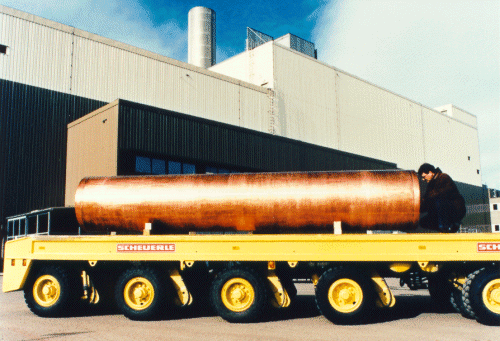
Fig. 2. The first trial full-size
disposal canister was delivered to CLAB in February 1996.
The first canister was manufactured using extrusion. The copper cylinder which resulted from that was then machined internally and externally. A copper bottom was welded on before a steel container was fitted into the copper shell. In order to seal the disposal canister, a copper lid was finally welded to the copper canister. Later in 1996 a second full-size canister was delivered. This copper canister was manufactured by forming from rolled plate and then welding the two halves together. Electron beam welding was used for all copper welds on both canisters.
When manufacturing of these first two canisters started, the design of the disposal canister was a copper canister containing a cylindrical steel container with a void in the center. Since then, the reference canister has changed to the current design with a cast insert. As soon as the new design was developed, SKB started manufacturing trials of cast inserts. So far, full length inserts have been manufactured from both cast steel and cast iron. Several other cast steel and iron inserts have been ordered and will be cast in the near future. In parallel with the manufacturing trials, methods for non-destructive testing of the welds are being developed. The current plan is to use both ultra sonic and X-ray testing of all welds but other non-destructive testing methods are also being studied at the moment.
The manufacturing trials so far have shown that it is feasible to produce full-scale disposal canisters according to specifications. However, the development work on manufacturing methods continues throughout the coming years.
ENCAPSULATION PLANT
Since the spent fuel is stored in the CLAB interim storage facility and the location of the future Deep Repository is not yet decided, the Encapsulation Plant is planned to be built as an extension to CLAB, see Fig. 3. This location provides possibilities to extend several existing functions into the Encapsulation Plant. These functions include the fuel elevator, cooling systems, water purification systems and electrical power supply. At a first stage only spent fuel will be encapsulated but preparations are made for the later addition of equipment for treating core components.
In 1994 design work of the Encapsulation Plant was started and in 1996 the work had resulted in a Basic Design, which will form the basis for the application for construction of the plant. BNFL Engineering Ltd did all work involving the encapsulation process and ABB Atom AB designed the auxiliary systems. The layout of the plant and co-ordination of the design work was performed by SKB.
The plant is designed for an annual output of approximately 210 disposal canisters per year, i.e. on the average one canister per workday. The operating staff shall be able to work both in the Encapsulation Plant and in CLAB. During normal operation, approximately 30 people will be working daytime with encapsulation and maintenance.
The Encapsulation Plant will be approximately 65 x 80 meters in size and about 25 meters high, which is equivalent to the height of the existing receiving building in CLAB. Construction of the new plant is intended to begin in the year 2000 with cold testing starting in 2005. The first fuel could then be encapsulated in 2007. The cost of the Encapsulation Plant is close to SEK 2 000 million (USD 290 million).
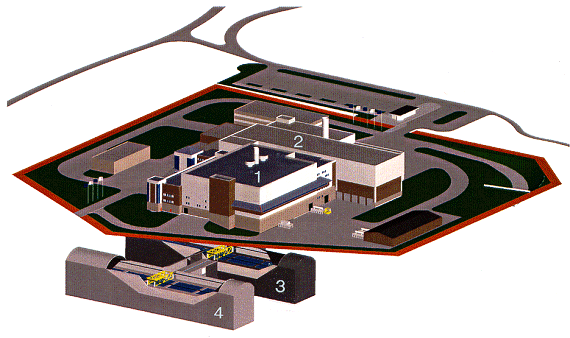 | |
| Fig. 3. The Encapsulation Plant built as an extension to the existing CLAB facility: | |
| 1. Encapsulation Plant | 2. Receiving building (CLAB) |
| 3. Storage building (CLAB) | 4. Future storage building (CLAB) |
ENCAPSULATION PROCESS
Disposal Canister
The cast insert is assembled into the copper cylinder before transportation of the disposal canister to the Encapsulation Plant. A canister is transported horizontally and is, after arrival, raised to a vertical position with a special tilting equipment. All parts are inspected thoroughly in an inspection frame before the canister is placed in a shielded frame which is used for transfer of the canister within the plant. The frame is lifted and transferred using a remote controlled air film transporter.
Fuel Elevator
The fuel assemblies which are stored in CLAB have very different values of burn-up and residual power. These properties give the heat output of the canisters, which is a restricting factor in the Deep Repository. To minimize the total number of disposal canisters, the combination of fuel assemblies in a canister is optimized. Based on the fuel data in CLAB, storage canisters with suitable fuel for encapsulation are chosen.
For the transfer of fuel from the storage pools in CLAB to the Encapsulation Plant, the existing fuel elevator is used. A storage canister is moved, using the handling machine in the storage building, to a water filled elevator cage. The elevator is then raised, turned by a turntable and lowered down into a transfer channel in the Encapsulation Plant. Today, there is similar handling when transferring storage canisters between the receiving pools and the storage pools in CLAB.
Handling Pool
The storage canister is moved from the transfer channel to the handling pool with a handling machine. In the handling pool it is placed in a rack which has 16 canister positions. In order to simplify visual inspection of operations, the handling machine is operated from a platform which is situated directly above the pool. Before any fuel is lifted out, the canister and the fuel assemblies are identified. The handling machine is similar to the existing fuel handling machines in CLAB.
After identification, one fuel assembly at a time is lifted out and transferred to a fuel monitoring station where gamma measurements are made in order to calculate, for example, burn-up and residual power. The results of these measurements are compared with the historical fuel data. In the next step, the assembly is transferred to a transfer canister which is positioned in the canister rack. A transfer canister is similar to a storage canister but can only hold 12 BWR or 4 PWR fuel assemblies, which is the same as the number of fuel channels in a disposal canister.
Ramp Elevator
When a transfer canister is filled, it is brought to a transfer bogie in a connection pool. The bogie with the canister is lifted up an inclined elevator, out of the water. The design with a ramp elevator ensures that high lifts are avoided. When the canister is over the water surface, it is allowed to drain before it is lifted to a handling cell.
The water in the pools acts as radiation shielding and gives the necessary cooling for the fuel. The air in the elevator and the handling hall is separated by the transfer channel acting as a water seal. In the same way, the air in the handling hall and the handling cell is separated by the connection pool. All pools can, independently of each other, be emptied of water for maintenance.
Handling Cell
The transfer canister is lifted, by a handling cell crane, to the handling cell where it is placed in one of two drying stations. There, the fuel is dried with recirculating air with a temperature of about 120°C. A shielded frame with an empty disposal canister is docked from below to another part of the cell. The connection between the disposal canister and the handling cell is tight so that the outside of the canister is not contaminated and the air in the cell does not escape and cause airborne activity in other parts of the plant.
When the fuel assemblies are dry they are transferred, one by one, to the insert of the disposal canister. The top of the disposal canister is protected so that the surface will not be damaged during handling. When the canister is filled, the shielded frame with the disposal canister is moved away from the handling cell and is transferred to the next station. The empty transfer canister is brought back, via the ramp elevator, to the handling pool.
Inerting and Lidding Station
In the inerting and lidding station, the air in the cast insert is removed and exchanged with argon. In order to achieve this, the insert is vacuumed down and then filled with argon a number of times. The connection between the canister and the inerting and lidding station is similar to the connection at the handling cell. When the atmosphere in the insert is of the required quality, a steel lid is bolted to the cast insert. The lid is tested for tightness before the canister is transferred to a welding station.
Welding Station
At the welding station the disposal canister is docked to a welding chamber within the station. Also here the connection is made in a similar manner as previous stations. When the canister is connected, the chamber is vacuumed down and a copper lid is placed on the copper canister. The lid is then sealed to the canister using electron beam welding. During welding the canister is rotated and the welding equipment is fixed. When the weld is completed, the disposal canister is transferred to the next station for testing.
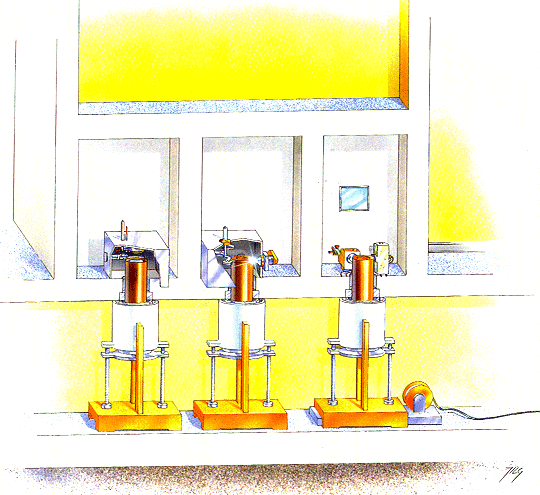
Fig. 4. Stations for sealing a
disposal canister: Inerting and lidding station, Welding station and NDT and
machining station.
NDT and Machining Station
When the canister is docked to this station, a visual control of the weld is made before the weld area is machined. Non-destructive testing is then performed using both ultra sonic and X-ray techniques. If the weld contains defects which are repairable, the canister is brought back to the welding station for re-welding. In case a weld has failed in a way that it can not be repaired, the copper lid is removed, the steel lid unbolted in the inerting and lidding station and the fuel, finally, unloaded in the handling cell. The 3 stations for sealing a disposal canister are shown in Fig. 4.
Monitoring and Decontamination Station
When a canister has passed the non-destructive testing it is lifted out of the shielded frame, using a remote controlled shielded handling machine, and is transferred to a monitoring and decontamination station. The canister is lowered down into the station where smear tests are taken on the entire outer surface to monitor that it is clean. The station is equipped with high pressure water which can be used if there is need for decontamination, after which new smear tests are taken. The surface dose rate is also measured before the canister is transferred to the buffer store.
Buffer Store for Filled Canisters
The buffer store for filled canisters is situated under a radiation shielded floor with openings over the storage positions. Each opening is covered with a shield plug. A canister is transferred to an available position with the shielded handling machine. The plug is lifted and the canister is lowered down and is released from the machine. Before the handling machine leaves the position, the shield plug is replaced over the opening. The buffer store is cooled with air and has approximately 50 storage positions.
Transport Cask for Transfer to the Deep Repository
When a canister is to be delivered to the Deep Repository it is transferred, again using the shielded handling machine, from the buffer store to a loading position. Underneath this position a transport cask for disposal canisters is docked. The canister is lowered into the transport cask and the cask is fitted with a lid. The cask is then lifted, with an overhead crane, to a transport frame which the cask is lowered onto. The same type of handling is already used, routinely, in CLAB. With a transport vehicle, the cask with the disposal canister is moved out of the Encapsulation Plant for further transportation to the Deep Repository.
CANISTER LABORATORY
In order to test the very crucial sealing operations, SKB is building a Canister Laboratory in the town of Oskarshamn, where part of an old shipyard has been purchased for that purpose. The main parts of the laboratory are the electron beam welding and non-destructive testing operations. There are, however, plans to also test and demonstrate other parts of the encapsulation process at a later stage, e.g. fuel drying, transfer of fuel to the disposal canister and sealing of the cast insert.
At the moment, the building is being refurbished and the welding and non-destructive testing equipment is being developed and purchased. The equipment in the Canister Laboratory will be able to perform welds both horizontally and at a variable angle. The welding trials are planned to commence in 1998 and the results from those trials will be submitted to support the application for construction of the Encapsulation Plant.
FUTURE WORK
SKB is planning to submit the application for construction of the Encapsulation Plant in the first part of 1998. The design documents which will form the basis for the application (Basic Design) have already been produced but the actual application, including a Preliminary Safety Report and an Environmental Impact Statement, is yet to be put together. At the same time, i.e. during 1997, there will be an independent review of the layout and the design of the encapsulation process. Results from those reviews may lead to changes in the design, which then will be incorporated into the current Basic Design before submission of the application.
Manufacturing trials of the copper canister and the cast insert will continue in the coming years. Trials involving electron beam welding and non-destructive testing of the canister lid will be performed in the Canister Laboratory, which currently is under construction. Welding trials are planned to start during 1998 and results from those trials will be submitted to support the application for construction of the Encapsulation Plant.
According to the current time schedule, construction of the Encapsulation Plant will begin in the year 2000 with cold testing starting in 2005. The first fuel could then be encapsulated in 2007 in order to meet the time schedule for the Deep Repository which is scheduled to start operation in 2008.
BIBLIOGRAPHY
SKB, RD&D-Program 95. Treatment and final disposal of nuclear waste. Program for encapsulation, deep geological disposal, and research, development and demonstration. Swedish Nuclear Fuel and Waste Management Co, SKB, (September 1995).