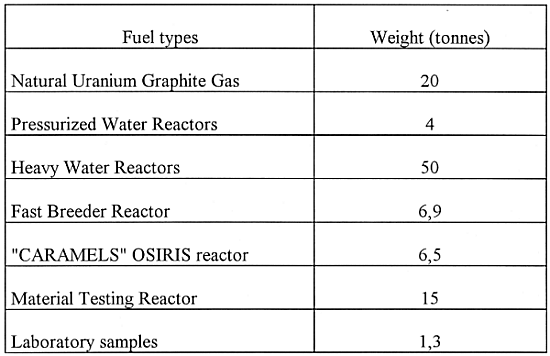
Table I Spent Fuel Composition
Dominique CARAMELLE
CEA (Commissariat à l'Energie
Atomique)
BP 6 - 92265 Fontenay-aux-Roses Cédex (FRANCE)
Bernard BASTIANELLI, François BOUSSARD, Alain MILESI
CEA (Commissariat à l'Energie Atomique)
BP 1- 13108 St Paul Les
Durance Cédex (FRANCE)
Gilles POLYDOR
CEA (Commissariat à l'Energie
Atomique)
BP 171 - 30207 Bagnols sur Cèze (FRANCE)
Guy CHRISTIN
CEA (Commissariat à l'Energie
Atomique)
91191Gif sur Yvette (FRANCE)
ABSTRACT
Since 1995, CEA has implemented a three point cleansing plan. One of the three points is the removal and the reprocessing of a wide range of spent fuels stored in different facilities in Saclay, Grenoble and Cadarache nuclear research centers. This paper presents the solutions worked out and carried out by the Commissariat à l'Energie Atomique (CEA) for each type of fuel and highlights more specifically the removal, conditioning and packaging of the Natural Uranium Graphite GAS (UNGG) spent fuel stored for over 25 years in two pools in Cadarache Nuclear research center.
INTRODUCTION
As a result of its programs, C.E.A has produced irradiated fuels. These fuels come from either abandoned reactor types or laboratory experiments (fuel examinations, critical experiments, special design fuel elements.....) or experimental reactors operated in Cadarache, Saclay & Grenoble. These fuels are now stored in appropriate facilities : water pools in Cadarache and Grenoble or dry wells in Saclay and Cadarache (ie Cascad).
Usually CEA chooses reprocessing because it is safer as far as waste is concerned and fissile materials contained in these fuels follow a closed cycle : manufacturing, irradiation, disassembly, reprocessing, and again manufacturing, etc. ...). Management of this cycle implies the use of storage facilities for a period of a few years in order to achieve accurate disactivation
However, this cycle has been stopped in most of the experimental reactors, which results in a an expanding collection of spent fuels. Saturation of the mentioned facilities could occur as an obvious consequence of this situation.
Moreover these facilities are also used for the storage of spent fuels, sometimes damaged, the processing of which is one of the three points of the cleansing plan developed by C.E.A.
Weight (90 metric tons) and variety of these spent fuels make it necessary for C.E.A to invest heavily for their safe packaging and reprocessing.
There are six main types of such fuels :
Table I Spent Fuel Composition
Management of these spent fuels must take account of two main objectives :
To achieve these goals, C.E.A has developed and is implementing a three-point plan :
At the present , reprocessing is possible at APM and UP1 in Marcoule until October 1997, therefore CEA has decided to send there as much fuel as possible. Only Heavy Water spent fuel coming from the EL4 reactor and irradiated or nonirradiated laboratory samples are stored at the CASCAD and PEGASE facilities in Cadarache.
AGREED SOLUTIONS FOR THE DIFFERENT TYPES OF FUELS
Therefore the problem includes:
The diagram here below shows all the operations for each spent fuel type
Table II Spent Fuel Diagram
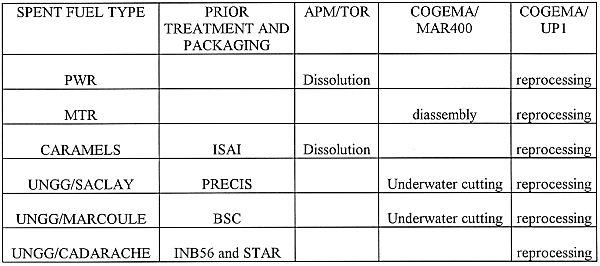
Study of this diagram leads to two families of fuels:
REPROCESSING OF THE PWR, FBR AND MTR SPENT FUELS
PWR
Spent fuels used in the development of P.W.R were initially stored at the Saclay, Grenoble and Cadarache facilities. They were later moved and packaged for reprocessing at the Marcoule TOR-UP1. This plant has been used for separating valuable nuclear materials (uranium and plutonium) from fission products since December 1994. All these fuels were reprocessed in 1996.
RAPSODIE-FBR
Between November 1994 and March 1995 CEA transferred these fuels (Blanket and Core) from the PEGASE facility to the APM pilot work-shop at Marcoule. All these fuels coming from the RAPSODIE reactor core were reprocessed at TOR-UP1 in 1995.
MTR
M.T.R spent fuels, supplied by the US/DOE, are used in research reactors such as Orphée in Saclay and Siloë in Grenoble. They are stored in pools located in Saclay and Cadarache. Since August 1996 most of them have been transferred to a pool at the COGEMA MAR400 facility. These assemblies are cut underwater in order to remove their heads and bases constituted of pure aluminum. Then they are reprocessed at the COGEMA-UP1 plant. This operation will be finished by the end of June 1997.
REPROCESSING OF THE FUELS COMING FROM THE OSIRIS RESEARCH REACTOR AND UNGG REACTOR TYPES
OSIRIS "CARAMELS"
Fuels of the Caramel-type stored in the Saclay and Cadarache pools were transferred to the Marcoule facility for reprocessing at the TOR- UP1 plant before its final closedown by the end of 1997.
Before reprocessing at TOR-UP1 they underwent mechanical processes at the I.S.A.I laboratory (Irradiated Assemblies Monitoring Installation) also located in Marcoule. We will describe ISAI in the following paragraph.
UNGG Marcoule Type and EDF Nuclear Power Plant Type
There are two alternatives for the storage of these fuels. Either they are stored in pools in Cadarache or in dry shafts in concrete blocks in Saclay and Marcoule. Each fuel storage required the designing and building of a specific facility in order to recover, handle and package them before reprocessing. These facilities, described below, are PRECIS at Saclay, BSC at Marcoule, and INB 56 and STAR at Cadarache.
SPECIFIC FACILITIES
ISAI
The ISAI laboratory in Marcoule has two hot-cells. Every "Caramel" type fuel element consists of welded plates which must be separated without breaking the first confinement barrier formed by the fuel cladding. In order to avoid any fire risk, this operation is performed under inert atmosphere
Then, the plates are transferred into the second cell where the operators carry out the punching and cutting of each fuel plate. The pieces, recovered through gravity in aluminum canisters are sent for reprocessing to TOR-UP1.
Packaging of stored fuels at PRECIS in Saclay
In 1995, CEA decided to remove these spent fuels stored until then in two concrete blocks in dry shafts.
Among the 720 containers stored in these blocks, 592 should contain UNGG and heavy water fuel types which could be reprocessed at Marcoule UP1.
These fuels used thirty years ago for some experiments in SACLAY laboratories were transferred in containers, in pieces, cartridges and Uranium rods, most of them cladded. The PRECIS facility was necessary for their recovery in safe conditions involving:
After they have been cut under water at MAR400, they are sent to the UP1 plant for reprocessing.
Operations started in September 1996 and COGEMA is now in a position to prepare a first dissolution.
Packaging of stored fuels at BSC in Marcoule
In 1996 CEA decided to also recover the 814 spent fuels stored in concrete blocks in Marcoule. These fuels had been kept for eventual specific examinations by CEA.
Their removal required building a facility identical to that of PRECIS. These 814 spent elements will be reprocessed at UP1 after transfer to MAR400 for underwater cutting . This operation will be over by June 1997.
Recovery and Packaging of the Fuels Stored at INB 56 in CADARACHE)
About 2,000 spent fuel elements, packaged in steel canisters, were stored in these two pools over 25 years ago.
These containers were placed in baskets and then stacked in levels. Some of them are no longer watertight.
Once the pool water filtered and decontaminated, visibility is good enough to perform the recovery operations with accurate and safe equipment.
The containers are pulled out one by one with a hook and transferred into a rotating device necessary to ensure gas removal (H2) with maximum safety. Then they are transferred to the immersed radioscopy station in order to assess the state of the fuel and eventually detect water within the canister.
After this test, the canisters are placed in a transfer container under inert gas, then they are put into a neoprene bag to prevent external contamination, and finally they are packaged for transport.
All operations are remote-controlled in order to minimize risks, and monitored on video-cameras (some of them immersed). Images are recorded and monitored by the operators in a control room located in the building.
The STAR Facility in CADARACHE
The STAR facility is a high activity laboratory built specifically for the treatment ,cleaning and conditioning of UNGG spent fuel elements. The purpose of the STAR facility and its associated processes is therefore to separate the nuclear fuel from the clad remains, to chemically stabilize the nuclear material and to condition it in sealed canisters meeting road transportation and reprocessing specifications at UP1 in Marcoule.
Know-how of laboratories already in operation was used for the design of the STAR facility in order to comply with the latest design safety rules and to allow further developments and R&D works on various types of fuel.
The main resulting options are described hereafter :
The spent fuel reconditioning process was developed by CEA and validated at the LECA. It includes the following operations performed in hot cells by remote handling :
Separation of nuclear materials from Mg cladding waste. Conditioning of this waste for specific disposal.
Nuclear materials are then placed into a specially designed oven to go through the following steps in order to withstand the effects of a hydrogen explosion.
Hydride destruction with an argon coverage, under atmospheric pressure : (reaction :UH3 -> U + 3/2 H2).
Partial oxidation of highly flammable metallic uranium particles. This operation is carried out by O2 injection, and under varying pressure, until a stable product is obtained.
Conditioning of the stabilized nuclear materials in Aluminum alloy (AG3) canisters. These are fitted with soluble Magnesium windows and leaktight welded.
AG3 canisters, as well as their magnesium windows, are designed to meet the UP1 reprocessing plant requirements.
Transfer of the plugged canisters to cell 2 for weighing, optional decontamination and airtightness control.
Transfer to cell 3 for interim storage and transportation by shielded casks (8 to 12 canisters in baskets) to the UP1 reprocessing plant.
In order to confine contamination as far as possible, all operations from fuel reception to canister sealing are performed in a single large cell (cell 1).
Operation Assessment
By the end of 1996, about 500 UNGG cartridges had been packaged in STAR out of which 300 have already been reprocessed at the COGEMA UP1 plant.
After over a year of operation, the following points can be emphasized :
CONCLUSION
The CEA cleansing plan implemented three years ago has been operational since mid-1995.
Today, CEA has demonstrated and established extensive experience in this area by recovering, conditioning and reprocessing a wide range of spent fuels, whole or in pieces, some of them stored in pools for over 25 years.
We expect, that by the end of 1997, half of the UNGG from Saclay and Cadarache, and «CARAMELS» will have been reprocessed and the others (MTR, PWR, FBR and BSC/UNGG) completely reprocessed.
Since October 1996 we have been studying the problem of remaining spent fuels. One of the solutions could be to send them to the future COGEMA reprocessing plant at LA HAGUE after a few years storage in Cadarache.