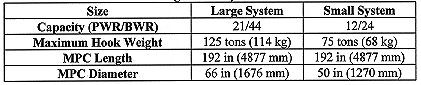
Table I - Commercial MPC Design Summary
C. N. Lindner, K. A. Niemer, C. R. Witt
Chem-Nuclear
Systems, L.L.C..
140 Stoneridge Dr. Columbia, SC 29210
(803)
256-0450
R. T. Haelsig, S. R. Streutker,
G. L. Clark
Packaging Technology, Inc.
4507 Pacific Highway East
Tacoma, WA 98424
(206) 922-1450
ABSTRACT
A multi-purpose canister (MPC) based system has been designed for storage, transport, and potential disposal of DOE-owned spent nuclear fuel (SNF). This DOE MPC system was adapted by team members that developed the MPC system designed for commercial SNF. The DOE MPC system is comprised of four basic system components: an MPC assembly, a storage unit, a transfer cask, and a transportation cask. Each of the system components can be used with the others in a variety of ways to satisfy current and future DOE facility requirements. The benefits of an MPC system for management of commercial spent fuel have been demonstrated by DOE/OCRWM and others. These benefits are directly applicable to DOE-owned spent fuels, and provide a mechanism for integrated management of all types of spent fuel by DOE.
Technical issues addressed in the development of the DOE MPC include the characteristics of candidate fuel and the differences between DOE SNF and commercial fuel. To demonstrate the adaptability of the commercial MPC design for DOE SNF, this paper considers the Advanced Test Reactor (ATR) and Material Test Reactor (MTR) fuel assemblies in storage at the Idaho National Engineering Laboratory (INEL), and the Savannah River Site (SRS). The DOE-owned fuel was adapted to the commercial MPC design by utilizing individual fuel canisters. These canisters each hold one ATR or MTR fuel assembly, and fit within the existing MPC-44B basket assembly. Fuel canisters are stacked three-high within the baskets guide tubes for a total of 132 fuel assemblies per MPC. Engineering analyses have been performed to demonstrate the feasibility of the MPC system adapted for DOE-owned fuel.
While the adaptability of the MPC to DOE-owned fuel has been demonstrated, significant design issues remain to be addressed. These issues are a function of the characteristics of the fuel to be managed, and decisions concerning potential treatment of DOE-owned fuel prior to final disposition. The use of fuel canisters to contain individual fuel assemblies can facilitate the decision-making process by alleviating certain design issues, and providing a means to simplify the fuel treatment process. Further benefits could be obtained through an MPC system optimized for various DOE fuel types. Additional study should be pursued to fully demonstrate the logistical, technical, and economic advantages of an MPC system for DOE-owned spent fuel.
The U.S. Department of Energy (DOE) is responsible for receiving, storing, and disposing of U.S. commercial spent nuclear fuel (SNF) located at commercial reactor facilities. This process is the responsibility of the DOE Office of Civilian Radioactive Waste Management (OCRWM)[1]. Over the years, the DOE has considered several different options for storing, transporting, and disposing of the commercial SNF. A container could be used for one, two, or three modes, storage, transport, or disposal, without the need to repackage the individual fuel assemblies. In 1994, the DOE decided to pursue the development of a multi-purpose canister (MPC) system that could be used for all three modes of the waste management system[2]. Under DOE contract, an MPC system was recently designed to store, transport, and dispose of commercial SNF[3]. This paper discusses an MPC system for DOE-owned SNF based on a modified version of the MPC designed for commercial SNF[3]. The design is based on structural, thermal, shielding, and criticality evaluations, as well as operational considerations unique to DOE-owned SNF.
MPC Program History
DOEs OCRWM awarded the MPC Program contract in April 1995 to a team of companies led by Westinghouse. The Westinghouse team was composed primarily of Westinghouse, Packaging Technologies (PacTec), and Chem-Nuclear Systems, L.L.C. (CNS). PacTec was the design lead for the team, and managed the overall design of the MPCs and baskets, and the transportation casks. CNSI led the design effort for the storage unit, transfer cask, and auxiliary handling equipment for the storage system. Westinghouse provided the program management and some analytical support to the team. The team recently completed a successful Phase I of the program to design the entire system for handling, storage, and transportation of commercial spent fuel assemblies. Due to changes in the OCRWM Waste Acceptance, Storage, and Transportation Program direction, the MPC Program was significantly curtailed at the end of Phase I. This DOE MPC development effort is a commercial-sector funded effort to expand on the advances made on the MPC concept during the Phase I effort.
Principal components
The primary component of the system is the MPC assembly, which is a sealed canister containing the spent fuel assemblies. Once sealed, the MPC assembly is not reopened, eliminating the need to rehandle the individual spent fuel assemblies. The canister is then placed inside a storage unit, transfer cask, transportation cask, or disposal overpack. The storage unit is used for dry storage either on-site at DOE or commercial facilities, or off-site at an interim storage facility. The transfer cask is used to transfer MPCs on-site from the fuel pool to the storage pad, or for transfers between the storage unit and transportation cask. The transportation cask is used for off-site shipments of the MPC, and can be loaded directly in the fuel pool or transferred from the storage unit. The storage unit, transfer cask, and transportation cask are shown in Figure 1. Table 1 presents the primary physical characteristics of the commercial MPC system.
The MPC Assembly consists of a shell assembly and an internal basket assembly. The shell assembly consists of a right circular cylindrical shell with end plates and shield plugs at the top and bottom ends. Basket details are strongly dependent on the particular SNF to be loaded into the MPC. The typical basket assembly consists of a series of circular spacer plates with openings for individual fuel assemblies. The MPC has been designed to accommodate over 90% of commercial SNF.
The Storage Unit is a cylindrical overpack made of standard reinforced concrete which is used to store MPCs in a vertical orientation and is designed to meet NRCs 10CFR72 regulations for long-term dry storage of spent fuel. Removable concrete and steel lids provide access to the top and bottom of the storage unit to accommodate horizontal and vertical transfer. Decay heat emanating from the MPC is dissipated via natural convection air flow through inlet and outlet vents.
The Transfer Cask is a cylindrical vessel composed of inner and outer stainless steel structural shells with lead gamma shielding between them, and is used to transfer MPCs between the fuel pool, storage unit and transportation cask. A neutron shield surrounds the outer structural shell. Lids at each end of the transfer cask provide access to the cask cavity from either end.
The Transportation Cask is a cylindrical vessel constructed of stainless steel inner and outer shells, gamma shielding, and neutron shielding, and is designed meet the NRCs 10CFR71 regulations for rail transportation of MPCs. The primary gamma shielding is provided by an assembly of depleted uranium segments and/or lead. Each end of the transportation cask utilizes an impact limiter during transport to minimize the structural impact and associated consequences of potential accidents.
Table I - Commercial MPC Design Summary
DOE-OWNED SNF
Introduction
The DOE owns over 150 different types of SNF in storage at DOE, private, and university facilities[4], encompassing more than 2600 metric tons of SNF and other reactor irradiated nuclear material[5]. This inventory consists of a variety of high and low enriched U and Pu fuels. The SNF includes both metallic and oxide materials, with various types of cladding. In 1992, the DOE discontinued reprocessing of SNF, -- storing it instead pending geologic disposal or other future action. Thus, a national program was established to manage DOE SNF for safe, long-term interim storage and ultimate disposal[6].
Compatibility of DOE SNF with Commercial MPC
While DOE-owned SNF is significantly different in design and composition than commercial SNF, the flexibility provided by the MPC design allows it to be adapted to most DOE fuels with a minimum of difficulty. The dimensional characteristics of the vast majority of DOE fuel are such that they can be accommodated by existing commercial fuel basket designs as described above.
Design Issues for DOE SNF
A number of design issues differentiate DOE-owned spent fuel from commercial spent fuel assemblies. The dimensions, enrichment, cladding, and composition of DOE-owned fuels vary widely, and is sometimes different from what has been traditionally approved by regulatory agencies for long-term dry storage. The following paragraphs discuss the significant design issues associated with DOE-owned spent fuel.
Unlike commercial spent fuel, which is essentially divided into only two major types of assemblies (PWR & BWR), the DOE-owned spent fuel inventory is broken up into dozens of varieties with significant variation in geometry, composition, enrichment, and weight. These variations make it difficult, if not impossible, to devise a single design which can accommodate the wide range of fuel assembly configurations. However, work has been performed to demonstrate that fuel of differing dimensions can be handled within the existing commercial fuel support structure provided by the MPC. Indeed, some ingenious work has been performed by others[1] to demonstrate that an intermediate fuel canister can be developed to accommodate differing fuel dimensions, while providing an outer envelope that is compatible with the fuel openings in the commercial MPC fuel baskets.
DOE-owned fuel is primarily comprised of highly enriched uranium (HEU), or low-enriched uranium (LEU). Typical uranium loadings are significantly different than commercial spent fuel, which have a considerably larger database of criticality benchmarks[7]. While the relatively high uranium enrichments of DOE-owned fuels pose new challenges for this canister-based system, these challenges are not without a solution. DOE-owned fuel assemblies typically have a much smaller uranium loading per assembly than commercial fuels. The assembly-to-assembly spacing provided by the commercial MPC/fuel assembly canister approach is significantly larger than the operating pitch for which DOE-owned fuel is designed. This reduced spatial uranium loading, increased fuel assembly spacing, along with the ability to position neutron poisons within the fuel basket or fuel canister, provide the criticality control necessary to achieve acceptable subcritical geometries. As an additional safety measure, the individual fuel canisters can be filled with a material such as depleted uranium to fill void space and prevent the potential for hydrogeneous moderation of the fuel.
A significant portion of the DOE-owned spent fuel inventory is comprised of aluminum clad fuel assemblies. The long-term dry storage and disposal criteria for aluminum clad fuels have not yet been developed, or applied in an actual installation. However, it is known that aluminum cladding will have a lower allowable temperature than the typical values for commercial zircaloy or stainless steel fuels. The canisterization of individual fuel assemblies can be used to resolve these uncertainties by assuming that the fuel canisters provide the containment for the radionuclides contained within the fuel assemblies. This canisterization approach has been used to ship failed fuel assemblies in the past. Instead of definitive aluminum cladding temperature acceptance criteria, the fuel canister is relied upon for maintenance of acceptable temperatures. The fuel canister maintains the structural support of the fuel assembly, and the containment of radionuclides within them.
DOE continues a tremendous effort to characterize the Yucca Mountain repository, and to develop the acceptance criteria for the waste to be disposed at the facility. However, DOE has only recently devoted the same efforts to developing equivalent criteria for the myriad of DOE-owned spent fuel. A potential problem with DOE-owned spent fuel is that much of it has been in wet storage for extended periods of time, in water with less than ideal chemistry characteristics. This water chemistry has resulted in accelerated corrosion of the fuel, and may lead to its failure in a shorter period of time. Again, canisterization of individual fuel assemblies provides a solution, and a means to work around the lack of definitive fuel acceptance criteria. By canning the individual assemblies, the canister serves as the containment boundary, rather than the fuel cladding. Additionally, the canister can provide supplemental structural support to the fuel assembly to assist in maintaining its geometry. As planned for vitrified waste canisters, the fuel canister can be qualified as an acceptable repository waste form somewhat independently of the fuel inside.
While many important issues have been identified or resolved, many issues remain that are beyond the scope of this paper. Some facilities are not currently capable of handling the 125-ton MPC design. Such facilities could employ custom designs, or upgrade facility equipment as necessary to handle the MPC equipment. Proliferation and security classification issues further complicate the design requirements for the MPC system. Finally, potential co-disposal of aluminum-clad, DOE-owned spent fuel with vitrified high level waste logs in a MPC-type system has also been proposed [8]. These issues remain open, and as such, are beyond the scope of this paper.
Selection of ATR/MTR Fuel Assemblies
Based on the discussion of critical design issues above, aluminum-clad fuel assemblies such as the Advanced Test Reactor (ATR) and Materials Test Reactor (MTR) fuel have been selected for further consideration in this study. These fuel types embody most of the important design issues for DOE fuels, such as high uranium enrichment and aluminum cladding.
The adaptation of the commercial MPC to DOE-owned fuels is intended to demonstrate that the specific needs of DOE-owned fuels can often be accommodated without changes to the existing design of the MPC system. This would provide significant benefits to DOEs desire for integrated management of both commercial and non-commercial spent fuel.
ATR/MTR Fuel Design Parameters
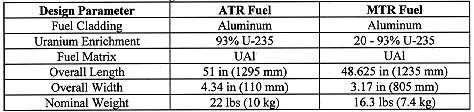
ATR and MTR fuel assemblies are each aluminum-clad, highly enriched uranium assemblies with roughly equivalent dimensional measurements. The basic design criteria for these fuel assemblies is provided in Table 2.
Table II - ATR/ MTR Fuel Design Criteria
ATR/MTR Fuel Canister / Basket Design
The adaptation of the MPC system to DOE-owned fuel is demonstrated with the MPC-44B design, which accommodates 44 BWR fuel assemblies and can easily accommodate 132 ATR or MT fuel assemblies. Additionally, a custom basket design could also be used within the existing MPC shell, accommodating a significantly higher number of fuel assemblies. While greater capacities would be facilitated by using a customized design, the existing commercial fuel design also provides benefits because of the detailed designs efforts already expended, and the incremental costs associated with obtaining a license amendment to the design. In a production environment, use of the commercial fuel basket would eliminate the need to establish fabrication facilities for a number of custom designs.
The fuel canister for ATR/MTR fuel assemblies, as shown in Figure 2, is a right circular cylinder constructed of stainless steel. The overall length of the canister is 55 inches, and the outside diameter is 5.5 inches. The top coverplate contains penetrations to support draining, vacuum drying, and backfilling with helium after fuel loading. A second seal plate is installed over the penetrations after completing the loading operations. The fuel canister contains internal structures that support the fuel assembly within the canister. Separate support structures can be used to contain ATR or MTR fuel within the same canister shell. This fuel canister design is similar to that proposed in earlier published material concerning the use of multi-purpose systems for DOE-owned spent fuel [9,1].
As shown in Figure 3, the MPC with the 44 BWR element basket can accommodate 132 ATR/MTR fuel canisters within its openings by stacking three fuel canisters within each guide tube. The MPC assembly consists of five major subassemblies: the spent fuel internal basket; the canister shell, which consists of a stainless steel cylindrical shell and bottom end closure; a top end shield plug; an inner top end closure plate; and an outer top end closure plate. The spent fuel basket consists of traverse support plates, axial support rods and guide tube assemblies
Analysis of the ATR/MTR Fuel Canister System in the MPC-44B
Structural. The ATR fuel assemblies are to be contained in the fuel canisters as shown in Figure 2. The design weight of a loaded fuel canister is 72 lbs, making the total payload weight 9504 lbs. This is significantly less than the maximum commercial SNF payload of nearly 31,000 lbs. Although the payload weight is much less than the commercial application, the impact loads can be higher than previously calculated. Because the impact limiters are designed for the heavier commercial SNF payload, this lighter load produces a smaller crush distance, resulting in a more rapid deceleration and higher impact loads. Calculations have been performed to evaluate the effects of the lighter payload. While the impact acceleration is approximately 10% higher due to the lighter payload, the commercial MPC system has sufficient design margin to handle the minimal impact acceleration increase. The fuel canister wall thickness of 0.19 inches is very robust when compared to the fuel assembly weight of approximately 22 lbs. The horizontal spacer plates of the MPC-44B are a maximum of 6 inches apart, giving 8 or 9 support locations for each fuel canister during a side impact. The end impact produces the maximum axial load where a fuel canister must support two canisters above it. The maximum analyzed wall stresses are well below material allowables and buckling limits. Internal pressures due to the decay heat are also well within canister limits.
Thermal. The thermal evaluation of the selected ATR fuel was based on analysis methods previously used on the commercial MPC project. The ATR fuel and fuel canister with inert helium atmosphere have been analyzed for a variety of decay heat conditions within the MPC-44B canister for storage and transportation conditions. The ATR fuel was assumed to have a typical decay heat with time curve which resulted in a 5 year cooled heat generation rate of 160 watts/assembly and a 10 year cooled heat generation rate of 86 watts/assembly.
The storage mode consists of the MPC contained by a concrete overpack which is cooled by convective air flow between the MPC and the inner surface of the overpack. Using a maximum fuel canister wall temperature of 380oC as the limiting factor, the maximum fuel assembly decay heat has been determined to be 200 watts/assembly. This corresponds to a maximum fuel assembly cooling time of approximately 4 years. The transportation cask is sealed and therefore all decay heat must be conducted to the outside surface of the cask through the cask stainless steel walls and shielding. Using a maximum fuel cladding temperature of 340oC as the limiting temperature for this case, the maximum fuel assembly heat has been determined to be 140 watts/assembly. This corresponds to a minimum fuel assembly cooling time of approximately of 5.8 years prior to transporting the fuel in the MPC.
Criticality. Representative ATR and MTR fuel assemblies have been analyzed within the fuel canisters and MPC. Because the fuel assemblies are significantly smaller in cross-section than commercial spent fuel assemblies, the resulting pitch between fuel assemblies within the MPC-44B basket is much larger than they fuel was designed for. As such, the fuel with the MPC produces keff values that are significantly below critical. Even with a reduced pitch between assemblies, the fuel remains subcritical by a substantial margin. The fuel canister design was evaluated within the MPC-44B assuming an infinite array of assemblies, and assuming infinite length. The pitch between assemblies was varied to envelop all possible variations in distance that could occur under normal and design basis accident conditions.
Shielding
The shielding evaluation was performed in two steps. First, the gamma and neutron source terms were determined using the SAS2/ORIGEN-S module of the SCALE package for a conservative representation of the ATR fuel assemblies at five and ten years after discharge. Second, one-dimensional radiation transport calculations were performed using the SAS1/XSDRNPM computational sequence of the SCALE package to determine dose rates exterior to each of the casks. The gamma and neutron source terms were based on an ATR fuel assembly irradiated for 60 days at 6.25 MW/assembly (250 MW total), with a decay time of five and ten years. The preliminary radiation source terms showed the gamma source term to be about 1014 ph/sec/assy and the neutron source term to be about 103 n/sec/assy, well below those for the design basis commercial PWR and BWR fuel assemblies.
Shielding calculations were performed for the storage unit, transportation cask, and transfer cask, assuming the MPC-44B basket was loaded with 132 ATR fuel assemblies. The storage unit and transfer cask were analyzed with the five-year cooled fuel and the transportation cask was analyzed with the ten-year cooled fuel. Preliminary results show that the dose exterior to these casks to be well below the dose from the commercial PWR and BWR fuel analyzed in the commercial MPC project.
Presently, DOE is considering several options for disposition of DOE-owned fuel, which involve "direct disposal" or some "treatment" of the fuel prior to disposal. [8] With direct disposal options, the MPC is overpacked, then placed in the repository. Thus the MPC becomes a functional component of the final repository fuel disposal system. Direct disposal options potentially impose serious constraints upon an MPC system design. With treatment disposal options, the treatment process is designed to transform the fuel material into a long-term stable form. The impact of treatment options on an MPC design is much less severe, because the treatment process can be used to address particular design issues before final disposition.
In addition to the current uncertainty over direct disposal or treatment of fuel prior to final disposition, there are three basic MPC system design requirements that presently remain undefined. They are (1) appropriate fuel temperature limit criteria; (2) maximum total heat deposition limits per MPC; and, (3) appropriate long-term performance criteria for criticality control features. Each of these design requirements will be dictated by final fuel disposition decisions.
From a critical path planning standpoint, treatment options allow the implementation of an interim storage in parallel with the development of repository standards. With direct disposal options, interim storage must lag the final determination of repository requirements. Considerations for each of the above "open" design requirements follows:
Fuel Temperature Limits. For interim storage purposes, commercial spent fuel cladding is limited to a temperature of approximately 350ºC. Equivalent temperature limits for DOE fuels are presently being developed, but some estimates forecast equivalent limits as low 150ºC[10]. Because these temperature limits translate nearly directly into fuel loading capacity limits for an MPC, they represent one of the primary challenges to MPC overall system cost effectiveness. The setting of these limits must be based upon the subsequent roles assigned to the cladding -- during interim storage, during transportation to the repository, during treatment (if applicable) and finally, for the duration of repository service life. Must integrity be maintained in order to provide containment/confinement? Must geometric stability be preserved for criticality control purposes? Must structural integrity be maintained to allow treatment prior to disposal? Are there other means to provide these functions?
In this paper, the ATR/MTR fuel is contained within a metallic canister, thereby transferring containment responsibility from the aluminum cladding to a more conventional stainless steel vessel. This allows the restrictive limits on aluminum fuel cladding temperatures to be replaced by more generous temperature limits applicable to the stainless steel canister. Importantly, this design solution approach also allows one to immediately proceed with MPC design despite the absence of definitive clad temperature limits.
Maximum Total Heat. This repository limit may or may not constrain the maximum capacity of an MPC system. In general, this limit is applicable only to direct disposal options. Additionally, interim dry storage can be used to provide the decay time necessary to reach repository heat load requirements.
Criticality Control Features. With direct disposal options, the preservation of essential criticality control features (geometry, poisons, etc.) of the fuel canisters, and/or MPC, is of paramount importance. In such a case, if criticality control features cannot be maintained, then fissile content must be reduced. For highly enriched fuels, such fissile content reductions, translates into fuel capacity limits, which could compromise the economic viability of MPC solution approaches.
With treatment disposal options, the treatment process is designed to transform the fuel material into a long-term stable critically safe geometry. Thus, the MPC criticality control requirement is reduced to only the maintenance of critically safe geometry for the relatively short period of fuel storage within the MPC; i.e., approximately a 100 year storage service life vs. 10,000 or more years for a repository service life.
As demonstrated in this report, the MPC system can be adapted to DOE-owned spent fuel. Additionally, the MPC system concept has been proven by DOE/OCRWM to have technical and economical benefits for management of commercial spent fuel. We believe these same benefits are directly applicable for DOE-owned spent fuel, and therefore further studies should concentrate on ways to integrate the MPC concept into a system-wide solution for DOE to manage its spent fuel. A flow diagram for such an integrated management system is shown in Figure 4. Three layers of development work are needed to implement this integrated system concept: (1) acceptance criteria and treatment technology, (2) optimized MPC designs, and (3) an integrated MPC system.
Acceptance Criteria and Treatment Technology
The acceptance criteria for storage, transport, and disposal of DOE-owned spent fuel, especially the aluminum-based fuels, needs to be determined. Once this is done, the proper treatment technology that meets these criteria can be assessed and selected.
Optimized MPC Design
This paper demonstrates the feasibility of accommodating DOE spent fuel by adapting the MPC system designed for commercial spent fuel. Once acceptance criteria and a treatment technology have been selected for DOE spent fuel, a new MPC system design that is optimized for the final DOE spent fuel waste forms can be developed. Presumably the treatment technology will involve canning of the spent fuel. As shown in this paper, the MPC system can accommodate the canned spent fuel within the same dimensions and configuration as that for commercial spent fuel. By doing so, DOE can utilize the storage, transfer, and transport overpacks developed for the OCRWM program.
Integrated MPC System
The inherent advantage of the MPC for DOE-owned spent fuel is that once the spent fuel is placed in the MPC, it need not be handled bare again. However, this requires that the system be developed in a way integrates all aspects of treatment and handling of the spent fuel around the MPC, including storage, transport, and final disposal. A flow diagram for such an integrated system is illustrated in Figure 4. After fuel is treated and placed in an MPC, the MPC is placed in modular concrete overpacks for interim storage. The interim dry storage of the fuel has three advantages; (1) it makes space available in the wet storage basins, (2) it places the fuel in the environmentally safer dry storage condition, and (3) the MPCs are immediately available for transport when the repository is ready. When ready for transportation to the repository, the MPCs are transferred from the storage overpack to the transportation cask.
This integrated system provides technical and economic advantages. Furthermore it can be adapted for all types of DOE-owned spent fuel. Further work should emphasize adapting the MPC and this integrated system for managing DOE spent fuel.
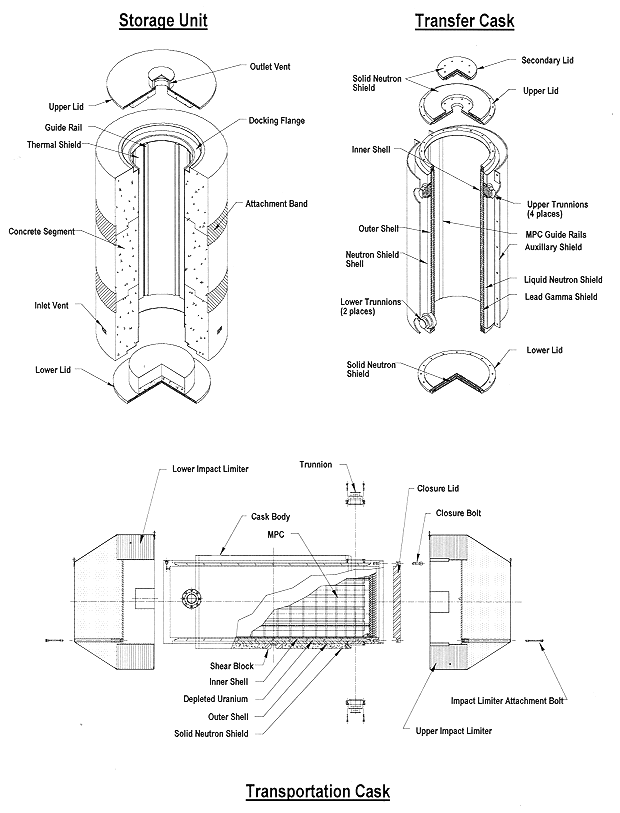
Fig. 1. Storage Unit, Transfer Cask, and Transportation Cask for Handling, Storage, and Transportation of Spent Fuel in MPC Assemblies
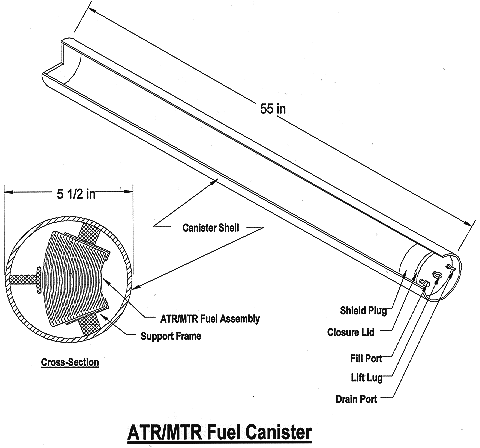
Fig. 2. ATR/MTR Fuel Canister Design for Use in Cmmercial MPC BWR Basket Design
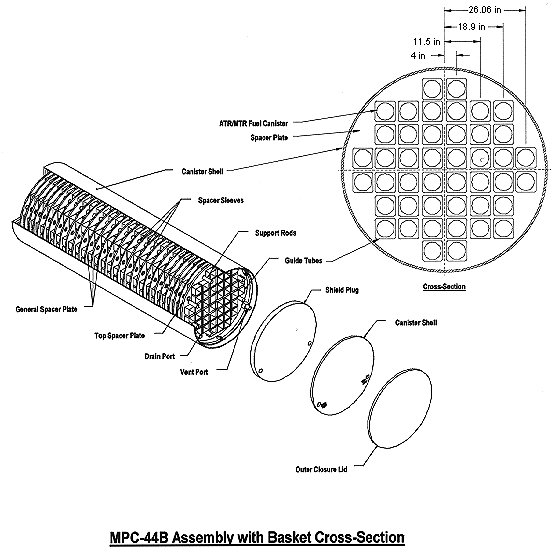
Fig. 3. Commercial MPC-44B Canister/ Basket Design
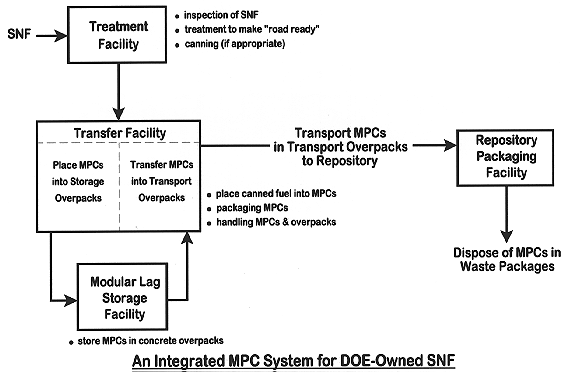
Fig. 4. Intergrated System Flowchart